Which Users Are Willing to Pay?
Many startup projects do not fail because they have no users. They fail because they mistake the wrong people for real users. Someone likes…
Which Users Are Willing to Pay?

Many startup projects do not fail because they have no users. They fail because they mistake the wrong people for real users. Someone likes the post, bookmarks the page, comments “this is useful,” joins the group, tries the demo, and even suggests ten features. You think you have found demand. But when payment appears, the room suddenly becomes quiet.
This is especially dangerous for indie builders. When you build alone, your time, energy, and cash flow are limited. If you choose the wrong paying audience at the beginning, everything after that becomes distorted. You may keep polishing features, rewriting landing pages, publishing content, and running launches, while the real problem is not conversion rate. The real problem may be that you are serving people who never intended to pay.
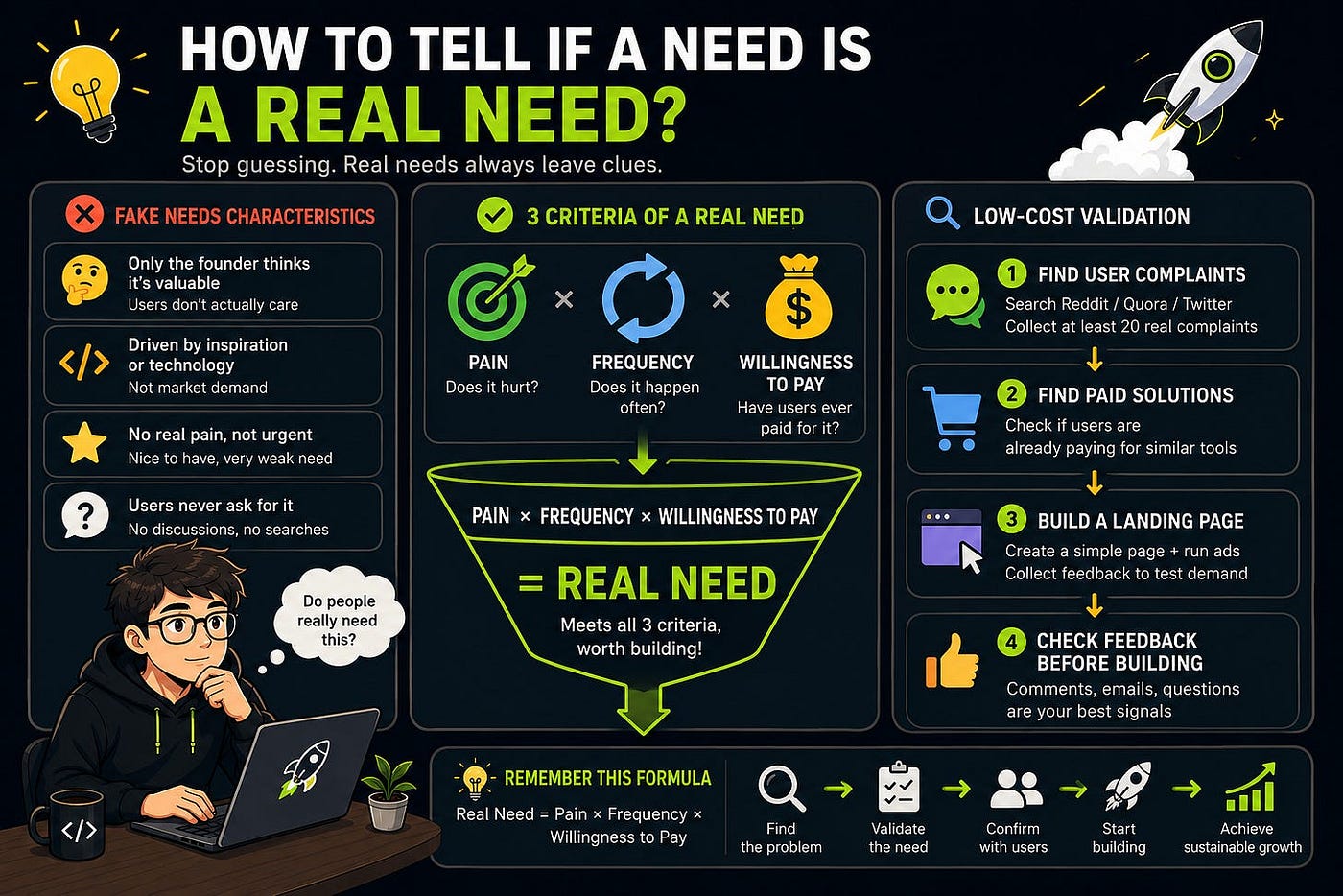
So when you look for a project, do not only ask, “Does anyone like this?” Do not only ask, “Will anyone try it?” The better question is: who is already paying a cost because this problem exists? That cost may be money, time, lost customers, missed opportunities, operational risk, or repeated manual work. Users usually pay not because a product excites them, but because it reduces loss, increases return, or lowers risk.
Do Not Confuse “I Would Use It” With “I Would Pay”
There is a wide gap between “I would use this” and “I would pay for this.” Many users are happy to try a free tool because free tools require almost no decision. But once you ask them to pay $9, $19, or $49 per month, they immediately start comparing, delaying, and rethinking whether the problem is worth solving at all.
Early research often produces weak signals. Users say “nice feature,” “tell me when it launches,” “I have this problem too,” or “I would use it if it were free.” These signals are not worthless. They show that the direction may have attention. But they do not prove willingness to pay. Stronger signals look different: users already spend money on the problem, spend a lot of time working around it, lose orders because of it, or are willing to leave an email, book a demo, or join a waitlist for a better solution.
Many founders assume that more users means more opportunity. In the early stage, that is often wrong. You do not need the largest possible audience first. You need the audience with the clearest cost. A broad consumer tool may attract many visitors but give each person a weak reason to pay. A small B2B tool may have only a few thousand potential buyers, but if it helps them make money, save money, or reduce risk, the business case can be much stronger.
Paying Users Can Connect the Problem to a Result
The first type of user worth studying is someone whose problem is directly tied to revenue, cost, efficiency, or risk. Ecommerce sellers pay for product image tools not because they love AI images, but because images affect click-through rate and conversion. Salespeople pay for lead tools not because they love databases, but because one qualified lead can become revenue. Indie developers pay for monitoring, SEO, payment, and email tools not because the tools are fancy, but because traffic, uptime, and checkout determine whether the business works.
These users share one trait: they calculate. If a tool costs $19 per month but saves five hours, replaces a manual task, improves conversion, or prevents a costly mistake, they do not see it only as an expense. They see it as an investment. When the result is clear enough, the payment decision becomes much easier.
On the other hand, if users cannot explain what result your product helps them achieve, and only say that it is “interesting,” “cool,” or “maybe useful later,” their willingness to pay is usually weak. Products that rely mainly on novelty often get high traffic, low retention, and low conversion. Attention is useful, but attention is not the same as a business signal.
The same feature can have completely different payment potential in different scenarios. AI writing for personal journaling may feel like a toy. AI writing for Shopify product descriptions becomes an operations tool. AI writing for ad buyers generating creative variants can directly affect campaign efficiency. The feature did not change. The user’s result value changed, and payment willingness changed with it.
The Strongest Signal Is Existing Spending on Alternatives
The most reliable way to judge whether users will pay is not to ask, “Would you pay?” It is to look at where their money already goes. If users already pay for a substitute, they have admitted that the problem is worth solving and that it belongs inside some kind of budget.
An alternative does not have to be similar software. It may be manual labor, outsourcing, spreadsheets, Notion templates, courses, consulting, plugins, data services, or a clumsy internal workflow that runs every day. Many good products do not begin with a completely new idea. They begin with noticing that users are solving an old problem in an expensive, slow, or awkward way.
Beginners often love markets with no competitors because “no competition” feels like a blue ocean. But a market with no competitors is often a warning sign. Maybe users do not have the problem. Maybe the problem is not worth paying for. Maybe the education cost is too high. The better opportunity for an indie builder is often a market where people already pay, but the current solutions are too expensive, too complex, too heavy, too enterprise-oriented, or poorly suited to a specific niche.
You are not looking for “nobody has done this.” You are looking for “people already pay, but they are still unsatisfied.” If large tools serve enterprises, you can serve individuals and small teams. If existing products are overloaded, you can solve one frequent action. If global products miss a local context, you can localize. If platforms are too heavy, you can carve out one lightweight workflow. This is much more realistic than inventing demand from nothing.
Frequency and Switching Cost Decide Whether Payment Can Continue
A problem can be painful, but if it happens only once a year, it is hard to build a recurring product around it. A user may pay once because the cost is high, but continuous payment usually depends on frequency. Daily email processing, weekly content creation, monthly reporting, rank monitoring, repeated image editing, and ongoing customer management all create recurring value.
But frequency is not enough. You also need to understand switching cost. If your product asks users to abandon their current system, migrate historical data, retrain a team, and change the whole workflow, adoption becomes difficult. Many products do not fail because they lack value. They fail because the cost of entering the product is too high.
Indie builders often have a better chance with embedded products. Instead of replacing a CRM, help users extract leads from webpages and send them into the CRM. Instead of replacing Shopify, improve product photos, listings, or review analysis. Instead of replacing Notion, generate structured templates for it. Instead of replacing the whole writing system, improve one step such as ideation, rewriting, summarizing, or publishing.
The advantage is simple: the user does not need to move house. They do not need to learn a large new system. They do not need to convince a whole team. If one step becomes faster, more accurate, or easier, they can try it immediately. Many small SaaS products, Chrome extensions, templates, and AI workflow tools grow from these narrow gaps.
Users Who Look Active but Are Poor First Customers
The first group is novelty seekers. They enjoy trying tools, sharing launches, and commenting that something is “interesting.” But they often have no stable scenario and no clear loss. Today they try your product, tomorrow they try another product, and the next day they move to a new trend. They may help with distribution, but they are not always good commercial validation.
The second group is users without a clear budget source. Hobby users, students, and entertainment users can still pay, but their payment decisions are often more random, more price-sensitive, and more vulnerable to free alternatives. Unless your product becomes part of their daily life, they should not be your main early revenue assumption.
The third group is users with a large pain you cannot actually solve. Some users are truly frustrated, but the problem comes from organizational structure, resources, sales ability, supply chain, policy limits, or internal process. A small tool may not be enough. You can observe these users, but do not assume they are your best first customers.
The fourth group is users who only search for free alternatives. If their search behavior is full of words like free, open source, cracked, no signup, and unlimited, they may have demand, but their first priority is not a better result. Their first priority is not paying. This traffic can be useful for ads or distribution, but if your core business model is subscription revenue, they should not decide your product direction.
A Simple Screening Formula
You can use a simple formula to decide whether a user group deserves priority:
Payment likelihood = Problem cost x Frequency x Existing payment behavior x Manageable switching costThe higher the problem cost, the more seriously users treat it. The higher the frequency, the easier it is to form a habit. The clearer the existing payment behavior, the more real the demand. The lower the switching cost, the easier it is for users to move from interest to trial, and from trial to payment.
In practice, score each dimension from 1 to 5. If a user group is large but has a low problem cost, low frequency, no payment history, and high switching cost, it may look attractive but still be a poor first project. If a user group is smaller but faces the problem every day, has bought alternatives, remains unsatisfied, and can be served through a lightweight product, it deserves serious research.
Startup building is not about finding the most people. It is about finding the people most willing to pay for a result. The best early users are not the ones who praise you the most. They are the ones who understand exactly what the problem is costing them.
Summary
Which users are willing to pay? Not necessarily the users who like you most, suggest the most features, or praise you in the comments. The best users are the ones who clearly understand the link between the problem and the result. They know the problem wastes time, affects revenue, increases risk, lowers efficiency, or makes them miss opportunities.
They may already use alternatives. They may already have paid for similar tools. They may face the problem every day, but the current solution is too expensive, too complex, too heavy, or not built for their specific scenario. Your job is not to educate someone with no payment awareness. Your job is to serve someone who already recognizes the value of solving the problem.
When looking for projects, do not begin with “What product can I build?” Begin with “Who is already paying a cost because of this problem?” The clearer the cost, the clearer the willingness to pay. The more specific the answer, the closer the project is to a real business.
Homework
- List 3 user groups you are considering and judge whether their problem is related to making money, saving money, saving time, or reducing risk.
- Find 5 alternatives for each group, including software, manual work, templates, courses, outsourcing, consulting, plugins, or spreadsheet workflows.
- Score each group from 1 to 5 on problem cost, frequency, existing payment behavior, and manageable switching cost.
- Choose the strongest user group and write one sentence explaining why they would pay instead of only trying the product.
Next Lesson
How to Do Competitor Analysis: not just what features competitors have, but why users are still unsatisfied.
메타데이터
- post_id
- 5f76ddc4996e
- slug
- which-users-are-willing-to-pay-5f76ddc4996e
- url
- https://medium.com/indie-hack-lab/which-users-are-willing-to-pay-5f76ddc4996e
- canonical_url
- https://medium.com/indie-hack-lab/which-users-are-willing-to-pay-5f76ddc4996e
- author_url
- https://medium.com/@jxausea
- status
- ok
- fetched_at
- 2026-06-12 18:14:10