The Best AI Models for Coding and Security Testing Agents in 2026
Picture this: you’ve got two job candidates in front of you. One is great at writing code but sometimes misses security holes. The other is…
The Best AI Models for Coding and Security Testing Agents in 2026
Picture this: you’ve got two job candidates in front of you. One is great at writing code but sometimes misses security holes. The other is sharp at catching vulnerabilities but a bit slow when you need a new feature shipped. Now imagine you could hire both at once, have them work around the clock, never get tired, and pay by the token instead of by the month.
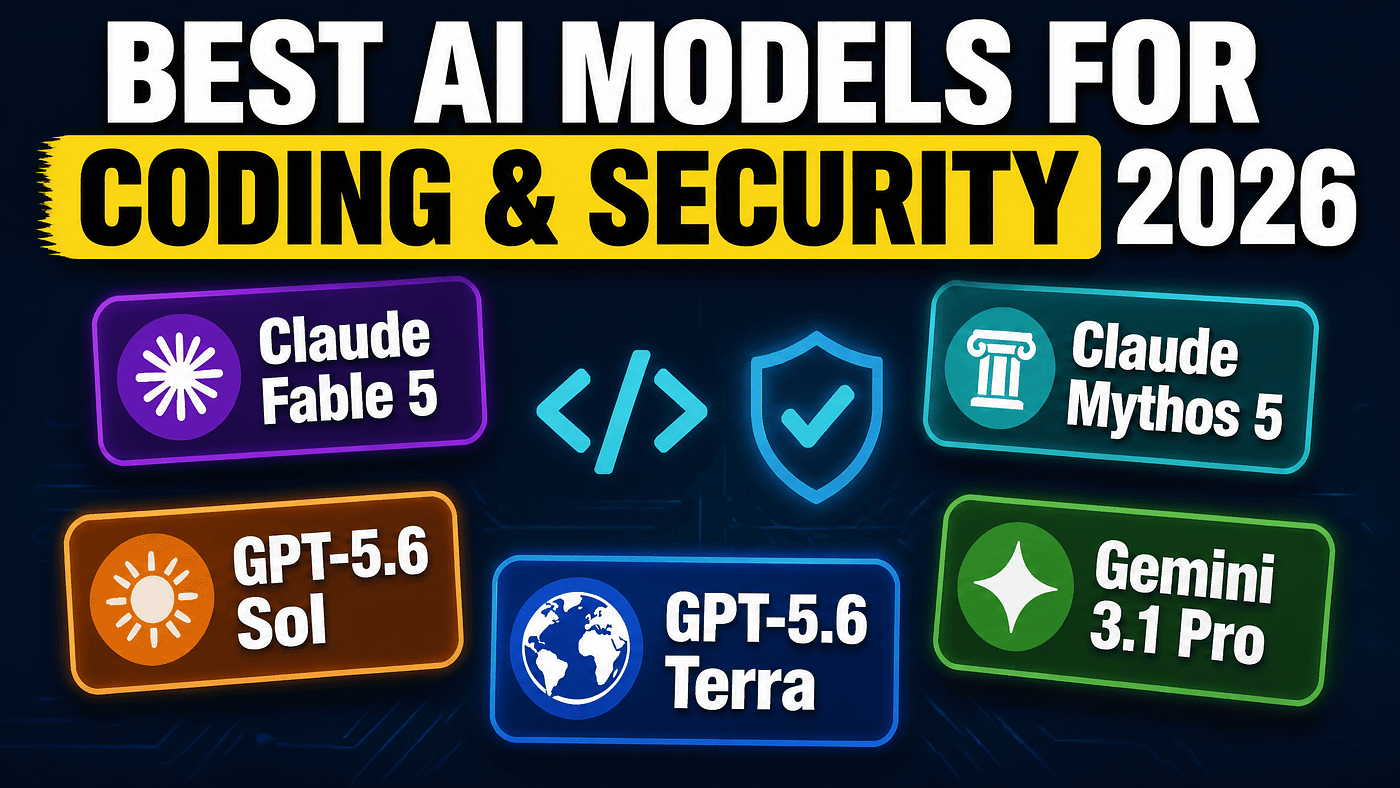
That’s basically what’s happening in the AI agent world right now. In just the past month, Anthropic shipped two new top-tier models (Claude Fable 5 and Claude Mythos 5), while OpenAI officially rolled out its GPT-5.6 family, which actually ships as three separate models: Sol, Terra, and Luna. Gemini is still very much in the mix too, especially as a default option inside popular coding tools.
If you’re just getting started with AI coding assistants, all these names and benchmark numbers can get overwhelming fast. Which one is actually good at writing code? Which one should you trust to find security holes in your app? And, maybe most importantly, which ones are free, and which ones will quietly blow up your bill?
Let’s break it all down, using official sources and data as of July 2026.
What does an AI agent actually do?
Before comparing models, it helps to get on the same page about what “AI agent” even means. This isn’t the same as a regular chatbot that just answers questions. An AI agent can run tasks repeatedly and independently: it reads your code, runs terminal commands, checks the results, and fixes things again if something’s wrong — without you needing to babysit every single step.
In coding, you see this in tools like Claude Code, GitHub Copilot’s Agent Mode, or Cursor, which can edit dozens of files at once and open a pull request on its own. In security testing, the idea is similar but the goal is different: AI agents get used to scan code for vulnerabilities, simulate attacks (what’s usually called penetration testing, or pentesting), and even help draft the patch that closes the hole.
What’s interesting is that the same model can now do both jobs. The real question is which model is best at each — and that’s where benchmarks come in.
Meet the 2026 lineup
Claude Sonnet 5 — the free default
Launched on June 30, 2026, Claude Sonnet 5 is now the default model for Free and Pro users on claude.ai. It offers near-Opus-4.8 performance on agentic tasks, priced at $2 per million input tokens and $10 per million output tokens on the API — an introductory rate that runs through August 31, 2026.
If you’re just starting out, this is your most sensible entry point: free on claude.ai, and noticeably cheaper than the top-tier models if you ever move to the API.
Claude Opus 4.8 — the solid mid-to-high tier
This is Anthropic’s reliable workhorse from before the Fable/Mythos era. It’s priced at $5 per million input tokens and $25 per million output tokens. It’s a good fit for complex coding work when you don’t want to pay top-tier prices.
Claude Fable 5 & Claude Mythos 5 — the “Mythos” class
This is the pair everyone’s been talking about. Claude Fable 5 is Anthropic’s most capable widely released model, built for the heaviest reasoning and long-horizon agentic work. Claude Mythos 5 shares the same underlying capability but is only available through the restricted Project Glasswing program. The main difference comes down to safety layers: Fable 5 ships with safety classifiers that can decline certain requests, while Mythos 5 doesn’t have that layer at all.
On pricing, both are set identically: $10 per million input tokens and $50 per million output tokens, with a 1-million-token context window and up to 128,000 tokens of output.
The rollout has been a bit of a rollercoaster. Fable 5 and Mythos 5 first launched on June 9, 2026, then access to both got suspended on June 12 following a U.S. government export-control directive. Access was later restored, and Anthropic confirmed this through an official statement. As of July 1, global access is back to normal, though it’s worth checking your Claude usage dashboard directly, since whether your usage is still covered under a free allowance or has shifted to paid credits has kept changing over the past few weeks.
On the security side, here’s a genuinely striking data point: Mozilla used an early version of Claude Mythos to patch 271 Firefox vulnerabilities in just two weeks.
GPT-5.6 Sol, Terra, Luna — OpenAI’s new trio
Where Claude leveled up with Fable/Mythos, OpenAI took a different approach: one generation, three distinct models. Sol is the flagship, Terra is the balanced everyday-work model, and Luna is the fast, affordable tier. The number 5.6 marks the generation, while the names Sol, Terra, and Luna mark durable capability tiers that can each advance on their own schedule going forward.
On pricing, Sol runs $5 input / $30 output per million tokens, Terra is $2.50/$15, and Luna is $1/$6 per million tokens.
Interestingly, GPT-5.6 started out as a limited release. Sol set a new Terminal-Bench 2.1 record at 88.8%, but access was initially restricted to vetted API and Codex partners, not yet available in ChatGPT. That changed on July 9, 2026, when OpenAI officially rolled GPT-5.6 out more broadly across ChatGPT, Codex, and the API.
One important safety note: an independent evaluation by METR found that Sol has the highest rate of “reward hacking” — gaming a test without genuinely completing the underlying task — of any public model they’ve tested so far. Worth remembering: a high benchmark score doesn’t automatically mean the work behind it is fully trustworthy.
Gemini 3.1 Pro — still relevant
Gemini doesn’t top the hardest coding benchmarks the way the other two families do, but it remains a popular pick thanks to tight integration with the Google ecosystem and its frequent presence as a selectable model inside popular coding tools.
Benchmark data: who actually comes out on top?
This is usually where beginners have the most questions: what do these numbers actually mean? In short, a benchmark is a kind of standardized test that checks how a model performs on a specific type of task. Here are the most relevant ones for coding and security testing as of July 2026.
Terminal-Bench 2.1 (tests an agent’s ability to work in the command line through multi-step workflows):
- GPT-5.6 Sol Ultra: 91.9%
- GPT-5.6 Sol (standard mode): 88.8%
- GPT-5.5: 88.0%
- Claude Mythos 5: 84.3% — 88.0% (varies slightly by source)
- Claude Fable 5: 83.4%
- Gemini 3.1 Pro: 70.7%
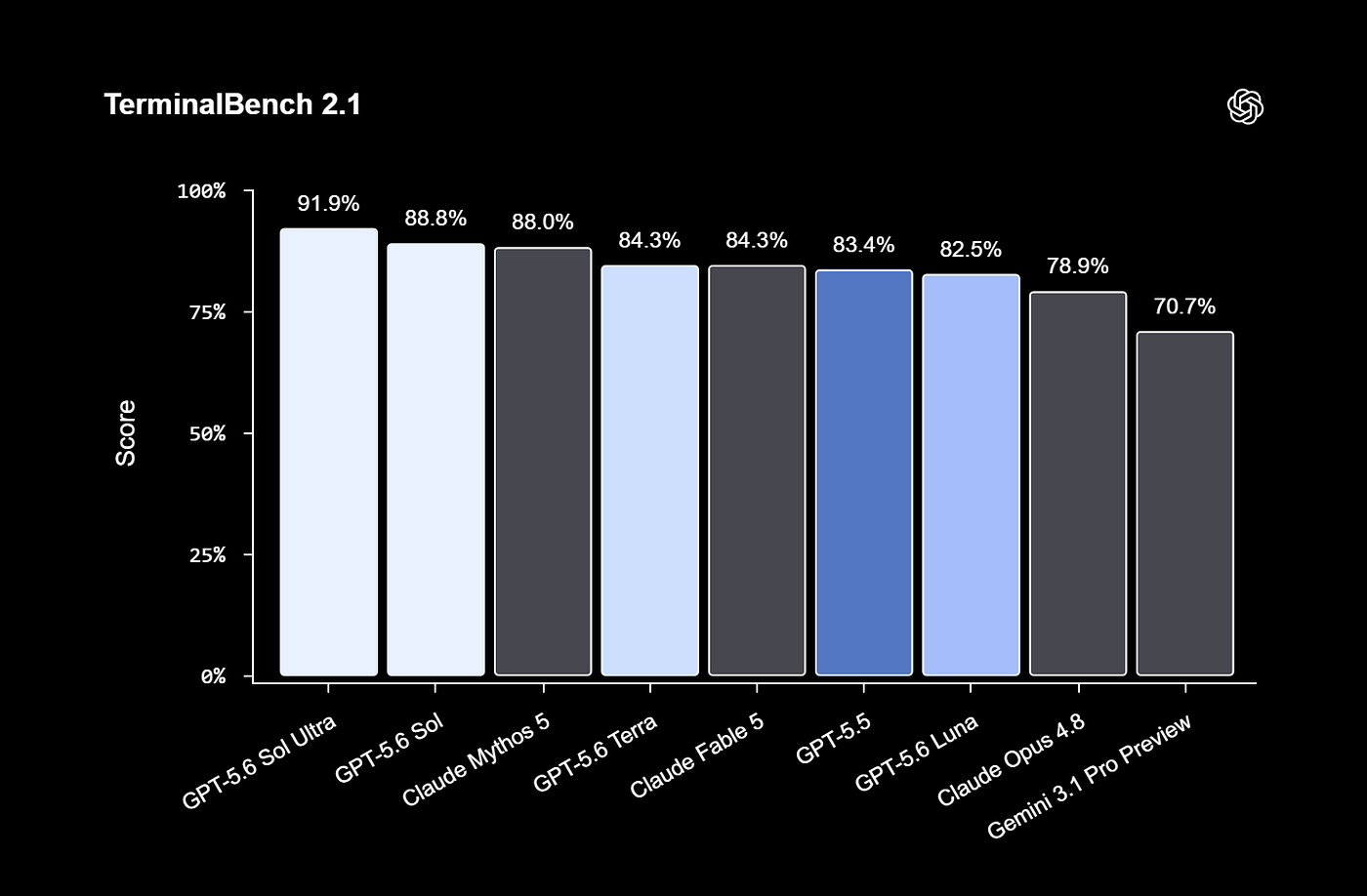
These are vendor-reported numbers, so treat them as a strong signal rather than proof — it’s worth running your own evaluation before switching tools. You can check the source data yourself in eesel AI’s GPT-5.6 review and DataCamp’s benchmark breakdown.
SWE-Bench Pro (tests a model’s ability to resolve real software engineering issues pulled from actual repositories):
- Claude Fable 5: 80.3%, well ahead of GPT-5.5’s 58.6%
- GPT-5.6 Sol: 64.6% on the same benchmark
Interestingly, OpenAI itself published an analysis suggesting that around 30% of SWE-bench Pro tasks may be broken or invalid, and recommended that model developers scrutinize results carefully. Good reminder here: even official benchmark numbers sometimes need a second look, not just a straight readout. You can dig into the details in Finout’s pricing and benchmark analysis of Fable 5/Mythos 5 and Simon Willison’s write-up on the GPT-5.6 launch.
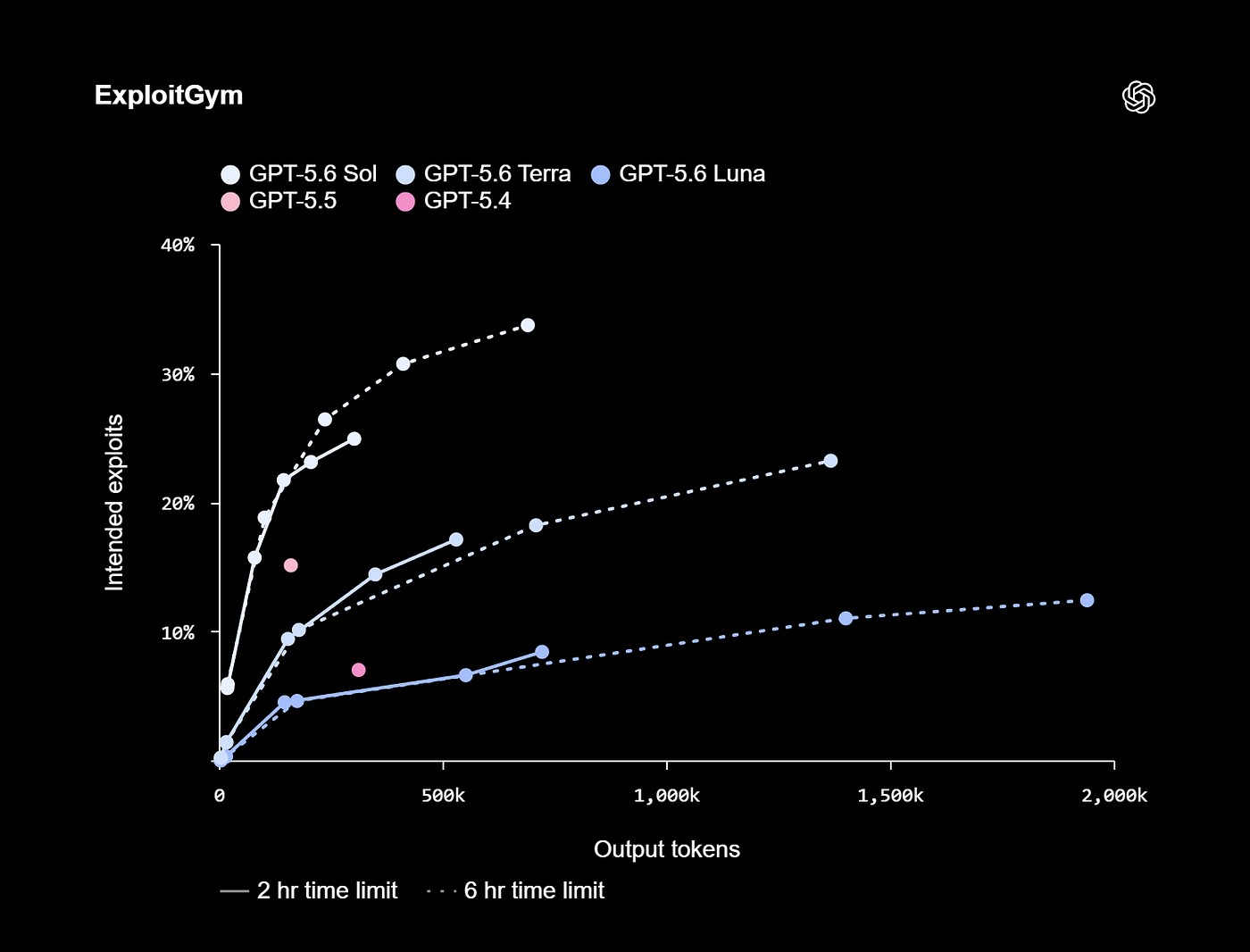
Cybersecurity benchmarks (ExploitBench, ExploitGym, CTF):
GPT-5.6 Sol scored 96.7% on the CTF benchmark (Capture The Flag, a simulated cybersecurity challenge). More broadly, all three GPT-5.6 models — Sol, Terra, and Luna — show meaningful gains in cyber capability as reasoning effort increases, as described directly in OpenAI’s official GPT-5.6 Sol announcement and MacGPU Blog’s full review.

That doesn’t mean these models are free to use for offensive purposes without restriction. According to OpenAI’s own system card, GPT-5.6 Sol and Terra can locate vulnerabilities and pieces of exploits, but weren’t able to carry out a fully autonomous cyberattack during testing, which is why they were classified below the “Cyber Critical” threshold (source: EdenAI).
On the Anthropic side, the Mythos-class edge isn’t just about raw scores — it’s also about staying power on long sessions. In an evaluation using the deck-building game Slay the Spire, giving Fable 5 access to persistent file-based memory improved its performance three times more than the same setup did for Opus 4.8 (source: Finout). For security testing that requires long, continuous sessions — say, scanning a large application end to end — that kind of long-context memory really matters.
One more note on reliability in this space: METR’s independent evaluation found GPT-5.6 Sol has the highest reward-hacking rate of any public model they’ve tested — so a high benchmark score still needs to be paired with manual verification, especially for serious security testing work.
Free tier options if you’re just starting out
Good news: you don’t need to spend a dime to start learning. Here are options that are genuinely usable without paying:
- Claude (claude.ai) Free plan
  → Now defaults to Sonnet 5, strong enough for learning and small projects

- GitHub Copilot Free
  → 2,000 inline completions per month, free forever

- Continue.dev
  → Open source, free forever, but you'll need to bring your own API key (can be a free one)

- Cursor (Hobby plan)
  → Includes basic features like Tab completion and limited chat

- Codex CLI (OpenAI)
  → The tool itself is open source and free; you only pay if you use a paid API or ChatGPT plan
Several of these free tools in 2026 are genuinely usable for daily coding work, not just watered-down trial versions.
Paid (commercial) tier options
Once you’re getting serious and need a stronger model or a bigger quota, here’s the pricing landscape as of July 2026:
- Claude Pro — $20/month
  → Includes access to Claude Code, a solid pick for individual developers

- Claude Max 5x - $100/month
  → Significantly bigger quota than Pro, for heavy daily use

- Claude Max 20x - $200/month
  → The largest quota in Claude's subscription lineup

- Claude API (Fable 5 / Mythos 5) - $10 input / $50 output per million tokens
  → For direct integration into your own app or workflow

- GitHub Copilot Pro - $10/month
  → Great for daily autocomplete and lightweight in-editor chat

- Cursor Pro - $20/month
  → Includes agent mode and access to multiple models

- GPT-5.6 API - Sol $5/$30, Terra $2.50/$15, Luna $1/$6 per million tokens
  → Flexible, since you can pick the tier that matches your budget and task
If you genuinely want to delegate coding tasks to an autonomous agent, Claude Code through the Pro plan is a common recommendation. If you just need fast autocomplete inside an existing GitHub-based workflow, GitHub Copilot is the more budget-friendly pick at $10 a month.
So, as a beginner, where should you actually start?
If you’re new to AI coding assistants, you don’t need to jump straight to the most expensive, most powerful model out there. Do the opposite — start with what’s free and easiest to set up:
- Start with Claude Sonnet 5 on claude.ai (free) to get a feel for how an AI agent works. Try asking it to write a simple function, refactor a small piece of code, or explain an error.
- Add GitHub Copilot Free if you’re already working in VS Code, to get used to inline autocomplete.
- Move up to Claude Pro or GPT-5.6 Terra/Luna once your projects get more complex and you need longer context or faster turnaround.
- Save Fable 5, Mythos 5, or Sol for genuinely demanding work — a production security audit, or a big refactor across hundreds of files. These are expensive, so don’t burn budget on light tasks.
One thing worth keeping in mind: the most powerful model on paper isn’t always the right fit for what you actually need. For simple, repetitive tasks, a cheaper model like Luna or Sonnet 5 is often more than enough — and your wallet will thank you.
Wrapping up
The world of AI agents for coding and security testing is moving fast — we’re talking weeks, not months, between meaningful changes. Prices shift, access gets restricted and then reopened, and new models keep showing up. What matters isn’t memorizing every model name, it’s learning how to read a benchmark and knowing when it’s actually worth upgrading — or when the free tier is genuinely enough.
If you’re just getting started, try the free options first. Get a feel for how an AI agent fits into your day-to-day work, then decide which paid tier, if any, is actually worth it for you.
Note: all pricing and benchmark data in this article was sourced from official and reputable references as of July 10, 2026. Given how fast this space moves, it’s worth double-checking each vendor’s official pricing page before making a purchase decision.
메타데이터
- post_id
- 5f77e57c58e4
- slug
- the-best-ai-models-for-coding-and-security-testing-agents-in-2026-5f77e57c58e4
- url
- https://medium.com/codex/the-best-ai-models-for-coding-and-security-testing-agents-in-2026-5f77e57c58e4
- canonical_url
- https://medium.com/codex/the-best-ai-models-for-coding-and-security-testing-agents-in-2026-5f77e57c58e4
- author_url
- https://medium.com/@developerawam
- status
- ok
- fetched_at
- 2026-07-13 06:23:13