Resolution Methods for Ambiguous Parse Trees in Compiler Design
Introduction
Resolution Methods for Ambiguous Parse Trees in Compiler Design
Introduction
In compiler design, ambiguity occurs when a single input string can generate multiple parse trees. This creates confusion in determining the correct structure and meaning of a program. Resolving such ambiguity is essential to ensure accurate compilation and execution.
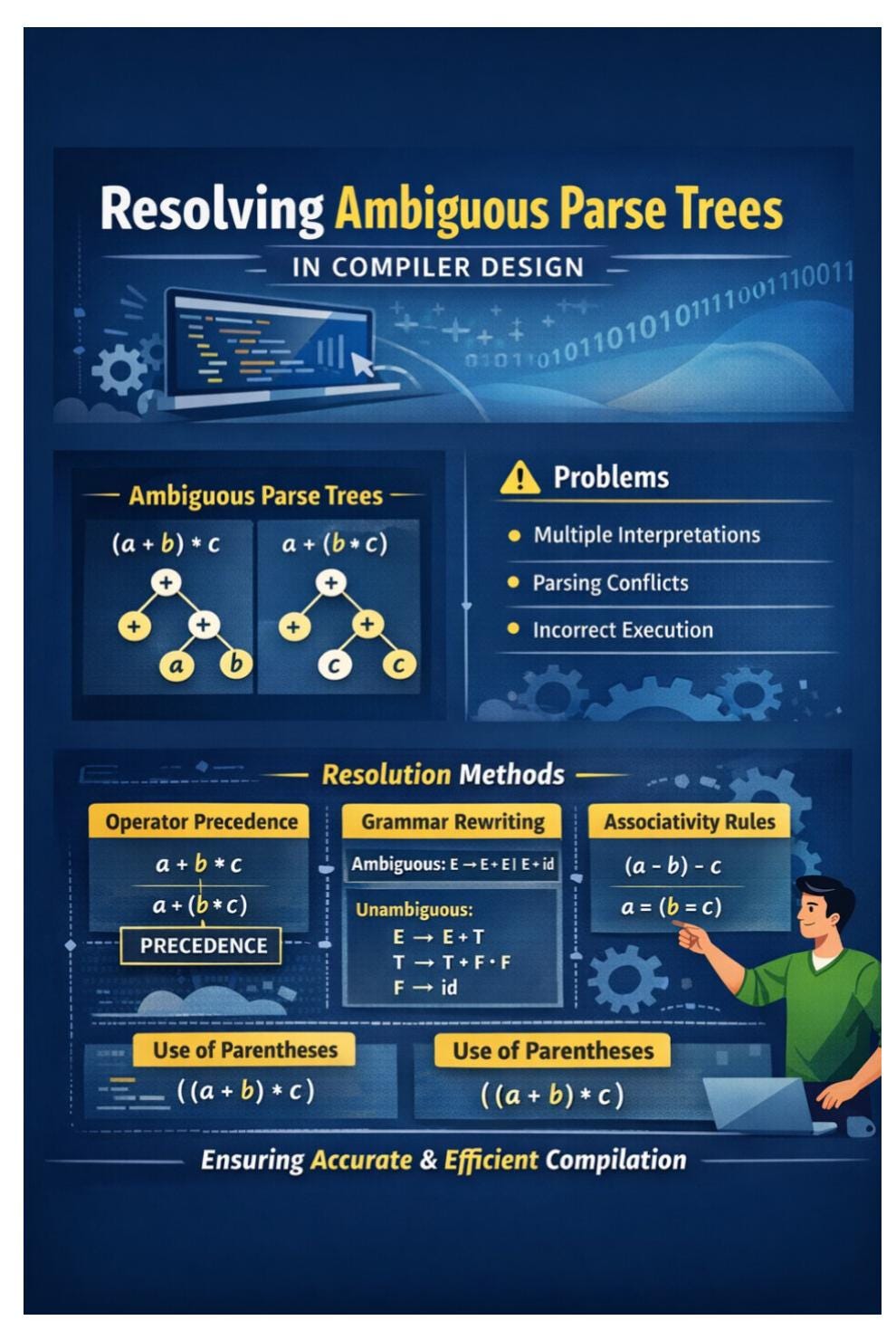
What is an Ambiguous Parse Tree?
An ambiguous parse tree arises when a grammar allows more than one derivation for the same input.
For example: a + b * c
This expression can be interpreted as:
- (a + b) * c
- a + (b * c)
Without proper rules, the compiler cannot decide the correct interpretation.
Problems Caused by Ambiguity
- Multiple interpretations of the same statement
- Parsing conflicts in compilers
- Incorrect program execution
- Increased complexity in compiler design
Resolution Methods
1. Operator Precedence
Defines priority among operators.
Example: * has higher precedence than +, so:
a + (b * c)
2. Operator Associativity
Defines the direction of evaluation.
- Left associative: (a — b) — c
- Right associative: a = (b = c)
3. Grammar Rewriting
Convert ambiguous grammar into unambiguous grammar.
Example: Ambiguous: E → E + E | E * E | id
Unambiguous: E → E + T | T T → T * F | F F → id
4. Use of Parentheses
Explicitly defines evaluation order. Example: (a + b) * c
5. Disambiguation Rules
Special rules defined by compilers.
Example (Dangling else problem): Else is matched with the nearest if.
6. Using Proper Parsing Techniques
Techniques like LL(1) and LR parsing require unambiguous grammar, ensuring correct parsing.
Importance of Resolving Ambiguity
- Ensures correct program interpretation
- Simplifies compiler design
- Improves reliability and efficiency
Conclusion
Ambiguity in parse trees is a critical issue in compiler design. By applying techniques like operator precedence, associativity, and grammar rewriting, compilers can ensure a single, correct interpretation of programs.
메타데이터
- post_id
- 5f7c7dda7e4f
- slug
- resolution-methods-for-ambiguous-parse-trees-in-compiler-design-5f7c7dda7e4f
- url
- https://medium.com/@grecypatel16/resolution-methods-for-ambiguous-parse-trees-in-compiler-design-5f7c7dda7e4f
- canonical_url
- https://medium.com/@grecypatel16/resolution-methods-for-ambiguous-parse-trees-in-compiler-design-5f7c7dda7e4f
- author_url
- https://medium.com/@grecypatel16
- status
- ok
- fetched_at
- 2026-06-28 04:42:08