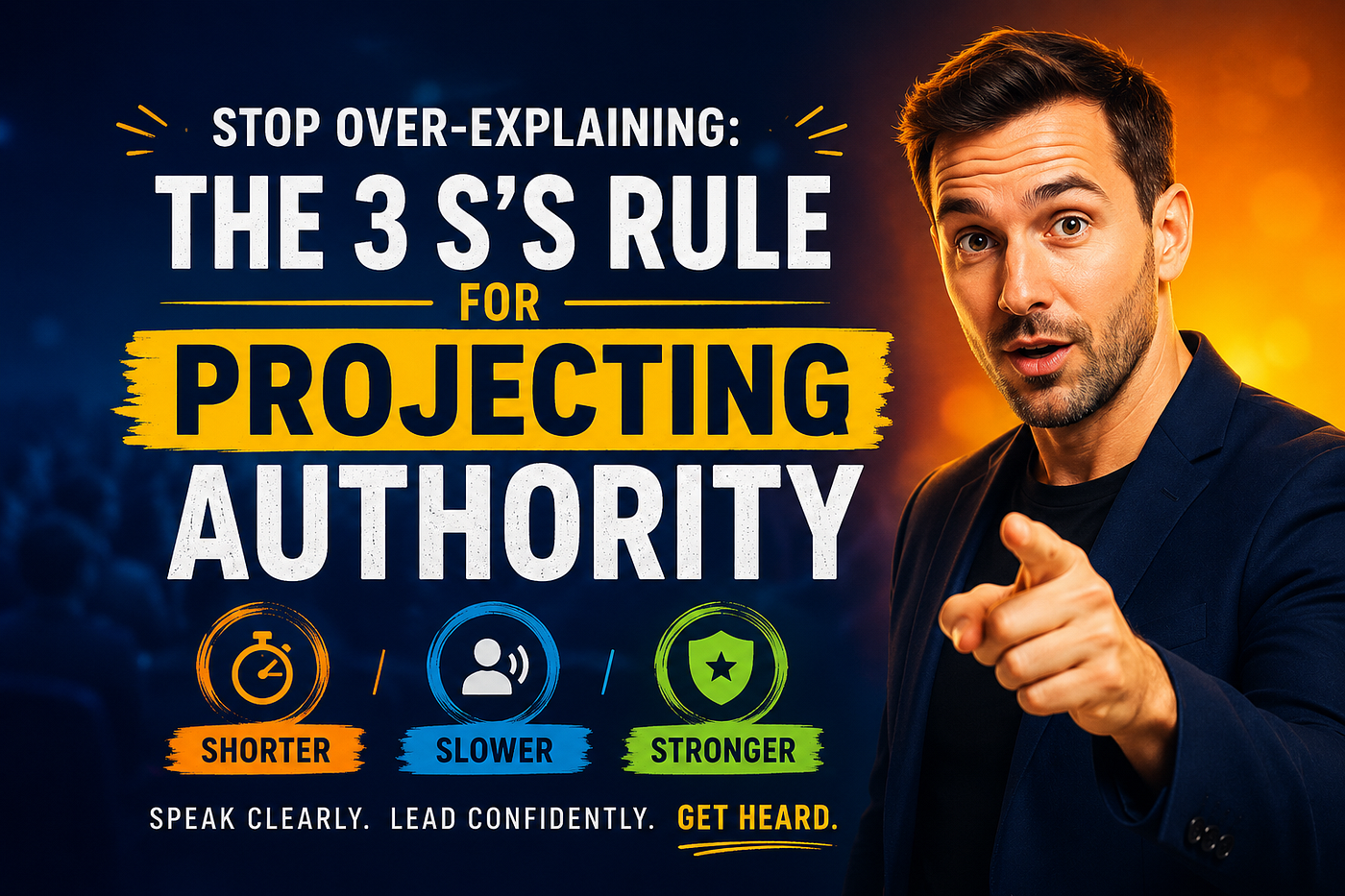
Warning: These 7 Speaking Habits Are Destroying Your Credibility Daily.
The Day I Lost the Room
Warning: These 7 Speaking Habits Are Destroying Your Credibility Daily.
The Day I Lost the Room
The smartest person in the room was losing the room.
Every word was right. Every fact was solid. Every argument was airtight.
And nobody was listening.
Here’s the brutal truth most high achievers never figure out — your ideas aren’t the problem. Your delivery is.
In the next few minutes, you’re going to discover the seven invisible speaking traps that quietly drain your authority every time you open your mouth — and the shockingly simple fixes that change everything.
No voice coaching. No personality transplant. Just a few small shifts that make the difference between being ignored — and being unforgettable.
***Not a yet a member? View the entire article for free Click here.***
I remember the exact moment I realized I’d been doing it wrong for years.
There I was, standing in front of a room full of people who should have been hanging on my every word. I had the data. I had the research. I had the answers.
And I was losing them. Fast.
Eyes glazing over. Phones appearing. That polite-but-checked-out nod that every speaker dreads.
The worst part? I was the smartest person in that room. And that was exactly the problem.
The Trap Smart People Fall Into
Here’s something nobody tells you when you’re busy getting good at things.
The better you get, the more you know. The more you know, the more you feel the need to explain that knowing. And the more you explain — the faster you lose people.
It’s a cruel joke, really.
The person who knows the least in the room often commands it most confidently. While the expert — the one with actual answers — ties themselves in knots trying to sound credible.
Sound familiar?
What Confidence Actually Sounds Like
There’s a study that should make every smart person deeply uncomfortable.
Researchers took two groups of speakers. Same argument. Same facts. Same conclusion. One group delivered it confidently. The other hedged and qualified.
The confident group won — even when they were wrong.
Let that sink in.
Confident and wrong beat hesitant and right.
Every time you say “I could be off here, but…” or “I’m not totally sure, maybe…” — you’re not being intellectually honest. You’re bleeding credibility before you’ve even made your point.
There’s a name for it. Linguistic hedging. And it’s quietly killing your authority in every meeting, every pitch, every conversation that matters.
The fix isn’t to become arrogant. It’s to sound like you trust yourself.
Instead of: “I might be wrong, but I think we should cut this feature.” Try: “Based on the data, cutting this feature is the right move — and here’s why.”
Same thought. Completely different person delivering it.
The Genius of Saying Less
Steve Jobs once walked onto a stage and said seven words.
“Today, Apple is going to reinvent the phone.”
That was it. Everything that followed was just proof of that one line.
No hedging. No over-explaining. No “what I mean by that is…”
Just one clean, confident idea — and then the evidence to back it up.
Most of us do the opposite. We explain, then clarify, then give an example, then restate the example, then summarize the summary.
And somewhere in that avalanche of words, the audience quietly decides you either think they’re slow — or you don’t trust your own idea.
Neither is a good look.
Cognitive psychology calls it processing fluency. When something is easy to understand, people automatically judge it as more intelligent and more trustworthy.
Which means the more you simplify, the smarter you sound.
“We buy boring businesses that make money.”
That’s it. That’s the pitch. Not a single piece of jargon. Not one unnecessary syllable. And you remember it — don’t you?
Slow Down at the Finish Line
Picture a horse race.
The jockey doesn’t sprint the whole track. They pace. They conserve. They wait. And then, at exactly the right moment — they let it go.
Your most important sentence deserves the same treatment.
When we’re nervous, we speed up. The words tumble out faster, the pitch rises, the breath shortens. And the audience reads every single signal — even if they don’t know they’re reading it.
Studies on vocal perception are clear: slower, lower-paced speech signals higher status and greater credibility.
When you rush your key point, you’re unconsciously saying: “I need to get through this before you reject it.”
The fix is almost embarrassingly simple.
When you reach the moment that matters — slow down by 20%. Breathe. Pause. Let the silence do the heavy lifting.
Three words to tattoo somewhere useful: Shorter. Slower. Stronger.
The Rehearsal Nobody Sees
Here’s the thing about people who look effortlessly brilliant on stage.
They’re not effortless.
Psychologist Anders Ericsson spent decades studying elite performers — musicians, surgeons, chess grandmasters. His conclusion demolished the myth of natural talent.
The best violinists in his study had logged over 10,000 hours of deliberate practice by age 20. The good ones? About 4,000. Same instrument. Same age. Wildly different outcomes.
Jobs rehearsed his keynotes for weeks. Down to the fonts. Down to the demo beats. Down to the exact pause after the key line.
That’s why he could look relaxed. That’s why he could improvise. Because the spine of the talk was so deeply internalized, he had room to breathe.
The speakers who don’t rehearse are the ones who ramble, panic, and run out of time. The ones who do? Calm. Clear. In control.
Run your talk out loud. Fix one thing each time. Do it obsessively.
People will start calling you a natural. That’s the whole game.
Stop Shrinking
One last thing — and this one’s personal.
Someone pays you a compliment. “That was a great presentation.”
And what do you say?
“Oh, honestly, I totally winged it. It was kind of a mess.”
You just rewrote their perception of you. In the wrong direction. In real time.
Research on impression management shows that chronic self-deprecation lowers your perceived ability — especially with people who don’t know you well yet.
A study on job interviews found that candidates who self-promoted were rated as more competent, more intelligent, and more likely to be hired. The modest ones? More likeable — but less capable in the eyes of the evaluators.
Modesty doesn’t help you. It helps your competitors.
So when someone tells you that you did well — try this radical move.
“Thank you.”
That’s it. No disclaimers. No self-deprecation. No shrinking.
Confidence with warmth is magnetic. Insecurity dressed up as humility is just… transparent.
The Only Checklist You Need
Before your next important conversation, run through this:
Am I hedging out of fear — or for genuine clarity? Am I over-explaining because I don’t trust my audience? Am I rushing through the parts that matter most? Am I accepting credit when it’s given?
Pick one thing to work on this week. Just one.
Because here’s the truth that ties all of this together:
Most smart people aren’t held back by their intelligence. They’re held back by the way that intelligence gets delivered.
Fix the delivery — and the room changes. Not because you got smarter. Because you finally started sounding like it.
5 Questions People Always Ask
“Is it ever okay to hedge?” Yes — when you’re adding genuine nuance with specific data. “There’s a 30% failure rate we need to account for” is strategic. “I mean, I could be wrong…” is just fear talking.
“How do I know when I’m over-explaining?” You’ve already said it once and you’re about to say it again. Stop. Pause. Wait. If they need more, they’ll ask.
“Won’t speaking slowly make me seem boring?” Only if you do it uniformly. Run fast through the setup — then hit the brakes on the moment that matters. That contrast is what creates impact.
“Isn’t self-promotion just bragging?” There’s a world of difference between arrogance and simply not undercutting yourself. Accepting a compliment gracefully isn’t showing off. It’s just honest.
“How long before I actually notice a difference?” Pick one trap. Focus on it for a week. Most people feel a shift within 30 days. The key is one thing at a time — not trying to fix everything at once.

You might also find this helpful: The 10-Second Mental Shift That Makes Bad Habits Literally Disappear!
메타데이터
- post_id
- 5f9116d5df33
- slug
- warning-these-7-speaking-habits-are-destroying-your-credibility-daily-5f9116d5df33
- url
- https://medium.com/@ameritor/warning-these-7-speaking-habits-are-destroying-your-credibility-daily-5f9116d5df33
- canonical_url
- https://medium.com/@ameritor/warning-these-7-speaking-habits-are-destroying-your-credibility-daily-5f9116d5df33
- author_url
- https://medium.com/@ameritor
- status
- ok
- fetched_at
- 2026-06-17 08:20:12