Healthcare Is Still Fighting Disease. AI Gives Us a Chance to Build Health.
A person has diabetes. A person has hypertension. A person has heart disease. A person has early kidney disease. A person has fatty liver…
Healthcare Is Still Fighting Disease. AI Gives Us a Chance to Build Health.
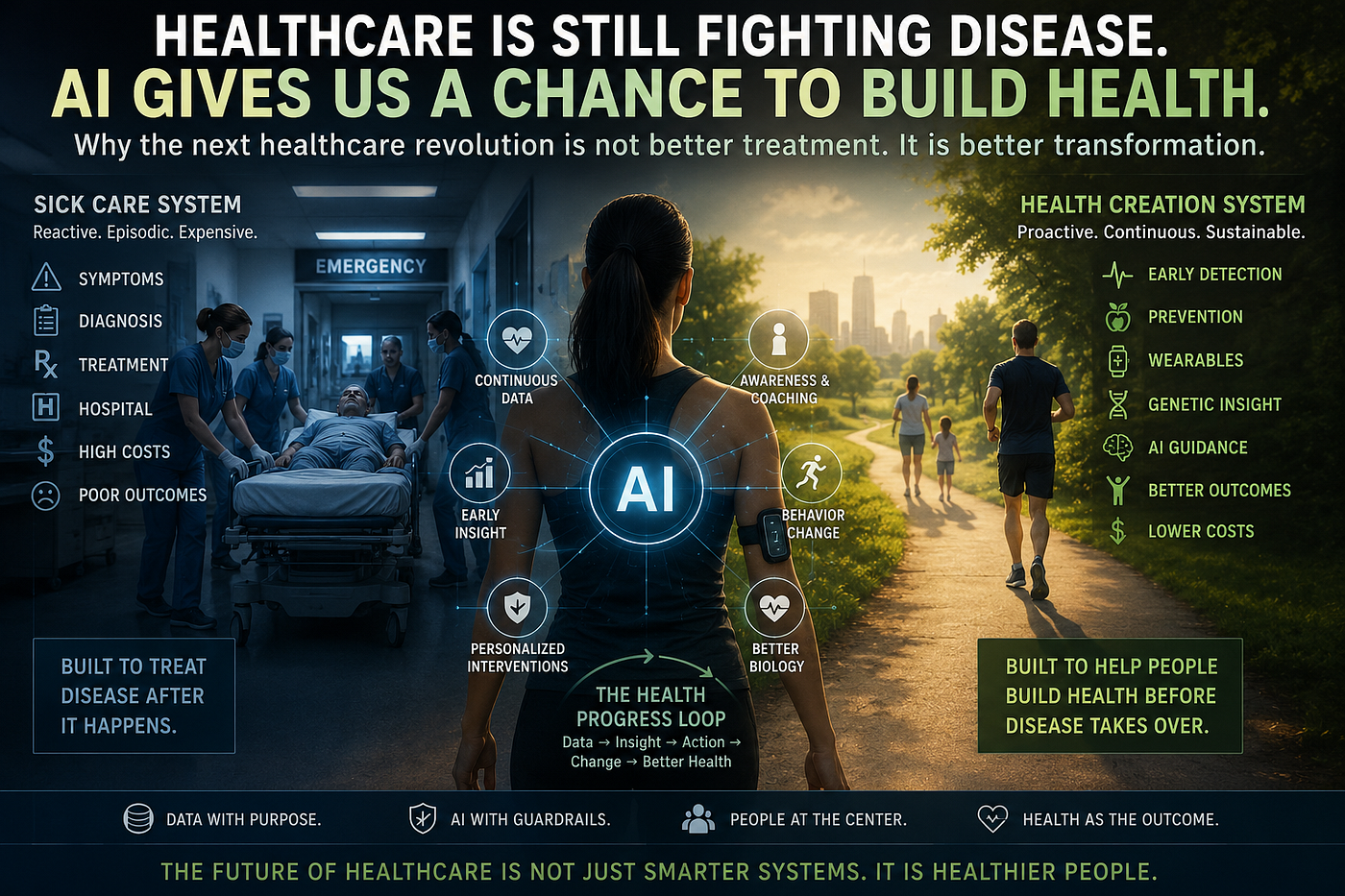
A person has diabetes. A person has hypertension. A person has heart disease. A person has early kidney disease. A person has fatty liver disease. Once the label exists, the healthcare system knows what to do. There are codes, protocols, medications, specialists, claims, quality measures, and follow-up schedules.
The problem is that biology does not wait for the diagnosis code to be officially recognized. Long before many chronic diseases are diagnosed, the body has been whispering. Weight has been changing. Sleep has been degrading. Blood pressure has been creeping upward. Glucose has been behaving differently. Resting heart rate has been drifting. Exercise tolerance has been declining. Stress has been accumulating. Inflammation may have been building quietly in the background.
AI’s greatest healthcare opportunity may be to hear the whisper before it becomes a siren.
That is the real shift from reactive illness fighting to proactive health ownership. Instead of waiting for a disease to announce itself, AI can help identify risk trajectories earlier and support safer, personalized action. The FDA has already recognized that AI and machine learning can help derive new insights from the enormous volume of data generated in healthcare, and it maintains a public list of AI-enabled medical devices authorized for marketing in the United States.⁸ That does not mean every AI health tool is trustworthy. It means the category is moving from speculative promise toward regulated clinical reality.
The safest future is not a world where AI diagnoses people in isolation. That would be reckless. The safer and more powerful model is AI as an early-warning layer, operating within clinical protocols, with human clinicians setting boundaries, reviewing escalations, and applying judgment. A recent Wall Street Journal report on UpDoc, for example, described an FDA-cleared AI system designed to communicate with patients between visits and adjust medication doses within physician-set limits for Type 2 diabetes management.⁹ Whether any particular company succeeds is less important than the pattern. Healthcare is beginning to move from episodic encounters toward continuous care loops.
That is a very different kind of system.
The Edge Is Where Health Gets Built
One of the most promising ideas in healthcare AI is that transformation may not depend only on giant centralized models. It may also depend on smaller, safer, more focused AI systems operating closer to the patient, the clinician, and the device. This is what people mean when they talk about AI at the edge.
In health, the edge is not a technical abstraction. The edge is your wrist, your phone, your glucose monitor, your blood pressure cuff, your home scale, your sleep tracker, your smart ring, your pharmacy record, your lab result, your primary-care chart, and the daily choices that determine whether your biology improves or deteriorates. Healthcare is not transformed only inside hospitals. It is transformed in kitchens, bedrooms, grocery stores, workplaces, gyms, pharmacies, and living rooms.
That is why wearables matter. A wearable is not simply a gadget that counts steps. At its best, it is a daily mirror. It helps a person see patterns that were previously invisible: sleep debt, recovery, stress, heart rate trends, activity, resting pulse, and sometimes blood oxygen levels or rhythm irregularities. None of these signals should be treated as a substitute for medical care. But together, they can help people become more aware of the conditions under which their health improves or worsens.
The NIH’s All of Us Research Program shows where this could go at scale. In 2025, the program reported that its research dataset had expanded to more than 633,000 participants, with a nearly 70 percent increase in genomic data and a major expansion of Fitbit wearable data.¹⁰ A 2026 Nature Medicine resource paper described Fitbit data from more than 59,000 All of Us participants, spanning 14 years and including 39 million step observations and 31 million sleep observations.¹¹ That kind of longitudinal data does not merely tell researchers what people look like during a clinic visit. It helps reveal how life is actually lived.
That is where healthcare becomes a transformation economy. The old model asks, “What is wrong with you today? “The new model asks, “What direction is your health moving?”
From Passive Patient to Active Owner
Healthcare often turns people into passive participants in their own biology. This is rarely intentional. Most clinicians want patients to be engaged, informed, and empowered. But the system’s structure teaches passivity. The patient waits until something feels wrong, schedules an appointment, receives a diagnosis, follows instructions, and returns when told.
That model can save lives, but it does not always build ownership.
The transformation economy asks something different of people. It asks them to become active owners of their own progress. In healthcare, that means helping people understand their biology before a crisis arrives. It means turning health data into awareness, awareness into behavior, behavior into measurable change, and measurable change into confidence.
This is not about blaming people for illness. That would be the worst possible version of the argument. Many people are born into constraints they did not choose. They live in food deserts, work multiple jobs, face chronic stress, lack safe places to exercise, cannot afford preventive care, or carry genetic risks they never asked for. A transformation approach does not say, “Your illness is your fault.” It says, “You deserve better tools, earlier insight, and a system designed to help you move before the crisis.”
That distinction matters. The goal is not to make patients feel guilty. The goal is to help people become capable.
AI can support that shift if it is designed correctly. It can translate confusing metrics into understandable patterns. It can help identify when a trend deserves attention. It can personalize health education based on risk, goals, genetics, behavior, and context. It can nudge people toward small changes before large interventions become necessary. It can help clinicians identify who needs outreach now, rather than waiting until the next appointment.
Should Insurance Companies Pay for Wearables and Genetic Testing?
Here is the business question hiding in plain sight: why do insurance companies spend enormous sums after disease develops, but relatively little helping people understand their own biology before the disease takes over?
Health insurers routinely pay for hospitalizations, advanced medications, procedures, dialysis, cardiac interventions, cancer care, and long-term disease management. Much of that spending is necessary and lifesaving. But if chronic conditions drive the overwhelming majority of healthcare costs, then the economic logic of earlier awareness becomes hard to ignore.¹²
Imagine a different bargain. An insurer subsidizes a clinically validated wearable, covers preventive genetic testing where appropriate, supports continuous glucose monitoring for high-risk members, funds lifestyle-change coaching, and provides an AI health companion that operates inside clear medical and privacy guardrails. The individual gets useful metrics and early warnings. The clinician gets a richer context between visits. The insurer gets fewer expensive surprises. Researchers obtain better population-level data when people consent to share it. Society gets a system that tries to prevent deterioration instead of simply billing for it later.
The CDC’s National Diabetes Prevention Program gives a concrete example of what structured lifestyle intervention can accomplish. For people with prediabetes, losing weight through healthier eating and increased physical activity can cut the risk of developing Type 2 diabetes in half.¹³ That is not science fiction. That is prevention working. Now imagine combining that kind of evidence-based lifestyle program with continuous data, AI coaching, clinician escalation, and personalized risk awareness.
This is where wearables, genetics, and AI become more than consumer wellness toys. They become pieces of a progress system.
Genetic testing could help some individuals understand inherited risks earlier. Wearables could help people see behavioral patterns in real time. AI could identify population-level trends across large datasets and individual-level signals inside one person’s daily life. Clinicians could use those insights to intervene with more precision. Employers and insurers could support better prevention programs. Public health leaders could learn from aggregated patterns while protecting individual identity.
But the words “while protecting individual identity” are doing a lot of work.
This future only works if trust is engineered into the foundation. Genetic data and wearable data are not ordinary consumer information. They are intimate, predictive, and potentially exploitable. HHS notes that the Genetic Information Nondiscrimination Act was designed to prohibit discrimination based on genetic information by group health plans, health insurance issuers, and employers. However, privacy and discrimination protections still require careful governance.¹⁴ Axios recently warned that when people move medical-record data from protected healthcare environments into wearable apps, the data may no longer be protected by HIPAA in the same way, leaving consumers dependent on weaker safeguards such as state laws, company policies, and FTC oversight.¹⁵
That is the trust problem. The same data that could help people build health could also be misused to price, exclude, manipulate, or surveil them. So the question is not simply whether insurers should subsidize wearables or genetic testing. The question is whether we can build a trusted health data architecture in which individuals own their data, understand their consent, benefit from the insights, and are protected from discrimination.
Without that, proactive health becomes a surveillance economy wearing sneakers.
Protocols From the Edge
One of the most interesting possibilities in AI healthcare is that it can safely pull learning from the edge of the system. Healthcare innovation often starts in pockets: a diabetes clinic finds a better coaching rhythm, a cardiac team improves remote monitoring, a primary-care group discovers a better way to support patients with hypertension, or a hospital creates a discharge protocol that reduces readmissions.
The problem is that good protocols often remain local. They live in one clinic, one physician’s habit, one care team’s workflow, or one hospital’s improvement project. Healthcare is full of small islands of excellence that never become the ocean.
AI can help change that. With proper governance, privacy protection, and clinical validation, AI can help detect which interventions are working, for whom, under what conditions, and with what risks. It can compare outcomes across populations. It can surface patterns from real-world practice. It can help move safe, effective protocols from the edge of the system into broader adoption.
This is important because healthcare not only needs more innovation. It needs better diffusion of what already works.
A diabetes prevention protocol should not remain trapped in one program if it can help millions. A hypertension outreach method should not remain hidden in one clinic if it reduces strokes. A sleep, stress, and glucose management protocol should not remain a boutique intervention if it improves metabolic health. AI can help healthcare learn from itself faster.
That is what a learning health system should be.
Not a system that collects data for the sake of data. Not a system that buries clinicians under dashboards. Not a system that turns patients into products. A real learning health system uses data to improve outcomes, shorten feedback loops, personalize care, and help people make progress.
The Physician Becomes Less Firefighter and More Coach
If AI works, the physician’s role does not disappear. It gets more important.
The current system forces too many clinicians to operate like firefighters. They respond to crisis after crisis, refill after refill, form after form, message after message. The human being with the deepest judgment in the system often spends too much of the day documenting, coding, chasing information, and reacting to problems that have been building for months or years.
AI should reduce that waste. But the best use of AI is not simply giving doctors more time to see more sick patients. The better use is shifting the physician’s role toward interpretation, coaching, prevention, and high-stakes judgment. AI can monitor patterns. AI can summarize history. AI can flag risk. AI can suggest protocol-based next steps. But the physician helps make meaning, weigh tradeoffs, build trust, and guide behavior in the messy context of real life.
That is especially true in chronic disease. A patient needs more than information. They need interpretation. They need encouragement. They need someone to help them understand why the trend matters and what to do next. They need a system that does not shame them for being imperfect, because behavior change is rarely linear and biology is rarely polite.
The future of healthcare should not be colder because AI exists. It should become more human because AI takes on the mechanical work and frees up space for judgment, relationships, and coaching.
That is the promise, anyway. Whether we achieve it depends on design.
The Transformation Healthcare Test
There is a simple test that every healthcare AI product should pass. Does this help people become healthier, or does it only help the current system process illness faster?
If the answer is documentation, billing, coding, routing, or claims management, the tool may still be useful. But it is not a transformation. It is administrative relief. Relief is good. It is just not enough.
Transformation means the system changes what people can do. It helps a patient understand risk earlier. It helps a clinician intervene sooner. It helps a family make better decisions. It helps an insurer invest before a catastrophe. It helps a community identify patterns before they become epidemics. It helps a person feel less like a victim of biology and more like an active owner of their health.
That is the shift from products to progress. Healthcare has spent decades building remarkable products: hospitals, drugs, devices, records, imaging systems, surgical robots, and now AI tools. The next leap is not adding another product to the stack. The next leap is building a progress system around the human being.
The annual physical may not disappear, but it should no longer carry the full burden of awareness. Episodic care should be surrounded by continuous sensing. Diagnosis should be supported by early warning. Treatment should be paired with coaching. Consent-based data should power population health. Insurance should reward prevention, not only reimburse repair.
The twentieth century saw the development of remarkable systems for treating disease. The twenty-first century may become the century of building health.
AI will not create that future by itself. Better algorithms will not save us. Better institutions might. Healthcare has spent decades asking how to better fight illness. The transformation economy asks a different question.
How do we help millions of people become healthier before they ever become patients?
메타데이터
- post_id
- 5f9149daec38
- slug
- healthcare-is-still-fighting-disease-ai-gives-us-a-chance-to-build-health-5f9149daec38
- url
- https://medium.com/design-bootcamp/healthcare-is-still-fighting-disease-ai-gives-us-a-chance-to-build-health-5f9149daec38
- canonical_url
- https://medium.com/design-bootcamp/healthcare-is-still-fighting-disease-ai-gives-us-a-chance-to-build-health-5f9149daec38
- author_url
- https://medium.com/@mikebruening
- status
- ok
- fetched_at
- 2026-06-27 18:20:27