Promising small molecule may help with sudden cardiac death
SBGrid Member Chuck Sanders reports on a small molecule that may change the trajectory of LQTS intervention research.
Publication Highlight
Promising small molecule may help with sudden cardiac death
This publication highlight is part of the SBGrid Communities Project focused on science education and demonstrating how structural biology and preclinical science connect to medicine, a collaboration between SBGrid PI Piotr Sliz and Jamaine Davis of Belmont University.
Long QT syndrome (LQTS) is a hereditary or acquired cardiac disorder that affects the electrical system of the heart, which causes a delay in the heart’s repolarization or reset time. This delay means the heart takes longer to reset between beats. The heart’s electrical system is measured on electrocardiograms (ECG or EKG) and is represented by waves labeled P, Q, R, S, T. People with LQTS have an increased QT interval. LQTS is a fatal disorder linked to syncope, arrhythmia, and cardiac arrest. It is also one of the most common monogenic disorders, meaning a single gene causes the syndrome. Interventions include avoidance of triggers, administration of beta blockers, and the implantation of a cardiovascular defibrillator. Other possible interventions are being explored because it is the leading cause of sudden cardiac death in young, healthy people. Type 1 Long QT syndrome (LQT1) accounts for close to half of congenital LQTS and is caused by loss-of-function mutations in the voltage-gated potassium channel KCNQ1. In the publication High-throughput screening identifies a trafficking corrector for long-QT syndrome-associated KCNQ1 variants, Charles Sanders from Vanderbilt University and colleagues investigate whether a small molecule could help these channel proteins work better, with a goal that one day it might help treat long QT syndrome.
The IKs channel (Slow Delayed Rectifier Potassium Current) is made up of the KCNQ1 and KCNE1 protein subunits and are called potassium ion channels. These IKs are located in the membrane of heart muscle cells and play a crucial role in the heart’s electrical activity. Multiple pathogenic variants of KCNQ1 have been identified, which result in the destabilization of KCNQ1, protein mistrafficking, and potentially protein degradation. Without enough working IKs channels in heart cells, the heart’s reset time is delayed, causing the dangerous symptoms of Long QT syndrome.
In this publication, Sanders and colleagues identified small molecule VU0494372 as a means to increase KCNQ1’s cell-surface levels, total levels, and surface trafficking efficiency. This finding provides a foundation for LQTS drug discovery. Docking of the VU0494372 and KCNQ1 (8SIK PDB) confirmed that the small molecule interacts with residues of a crucial binding pocket of KCNQ1. Further experiments with this binding pocket showed a direct interaction. Despite the molecule’s success in increasing cell-surface levels and surface trafficking efficiency, the parameters required for drug development were not met. Furthermore, the small molecule blocks an important molecular channel. This issue has been observed with many other “pharmacological chaperones”, and increased surface trafficking still occurred, in spite of the channel block. It is possible to use the small molecule with minor modifications, which remains encouraging for researchers.
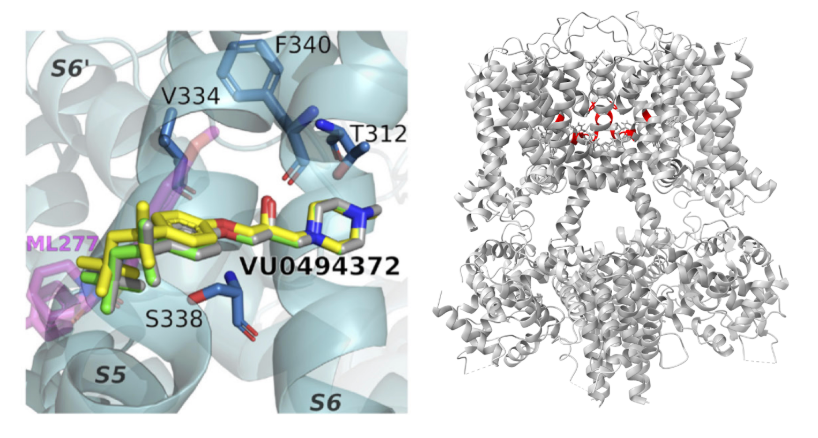
Left: Most frequently observed orientation of VU0494372 docked to KCNQ1 rotated and zoomed, using KCNQ1-CaM in complex with ML277 (PDB 7XNK). Image adapted from Figure 6E. Right: Full view of the KCNQ1–CaM complex with ML277 bound shown in grey (PDB: 7XNK). Four subunits of each protein are present, with one ML277 ligand bound per subunit. Key binding residues for VU0494372, Thr312, Val334, Ser338, and Phe340, are highlighted in red. CC by SBGrid.
Much more investigation and experimentation on the use of VU0494372 is needed; however, its discovery is promising for researchers, physicians, and individuals living with LQTS. Identifying this small molecule as a possible surface trafficking activator and a way to increase KCNQ1 cell surface levels, addresses the initial issues caused by protein destabilization and opens the possibility of pharmacologically enhancing VU0494372 and fueling LQT1 drug discovery efforts.
Read more in ***JCI Insight***.
By Cariuna M. Ellison, Fisk University (Cariuna Ellison)
Cariuna M. Ellison is an undergraduate student at Fisk University, pursuing a bachelor’s degree in Biochemistry and Molecular Biology. She is on track to graduate in May 2028. In her free time, she enjoys reading, exercising, and giving back to her community in any way she can.
메타데이터
- post_id
- 5f9a2baa8223
- slug
- promising-small-molecule-may-help-with-sudden-cardiac-death-5f9a2baa8223
- url
- https://medium.com/sbgrid-community-news/promising-small-molecule-may-help-with-sudden-cardiac-death-5f9a2baa8223
- canonical_url
- https://medium.com/sbgrid-community-news/promising-small-molecule-may-help-with-sudden-cardiac-death-5f9a2baa8223
- author_url
- https://medium.com/@sbgrid
- status
- ok
- fetched_at
- 2026-06-11 21:11:36