The Hidden Cost of Manual Payroll Processing: It’s More Than Just Time
Why growing businesses should rethink how they process payroll
The Hidden Cost of Manual Payroll Processing: It’s More Than Just Time

Why growing businesses should rethink how they process payroll
Payroll is one of the few business processes where there is very little room for error.
Employees expect their salaries to be accurate and paid on time. HR teams rely on payroll to maintain employee trust. Finance departments use payroll information for budgeting, reporting, and statutory compliance. Business leaders depend on payroll data to understand one of their largest operational expenses.
Despite its importance, many organizations continue to process payroll manually.
Some rely on spreadsheets that have been updated for years. Others collect attendance information from one system, leave approvals from another, employee records from a different application, and then manually combine everything before salaries can be processed.
For a small organization, this may appear manageable.
However, as the business grows, payroll gradually becomes one of the most time-consuming administrative activities.
The problem isn’t calculating salaries.
The real challenge is collecting, validating, and synchronizing all the information required before payroll can even begin.
That hidden effort is often overlooked, yet it consumes valuable business time every single month.
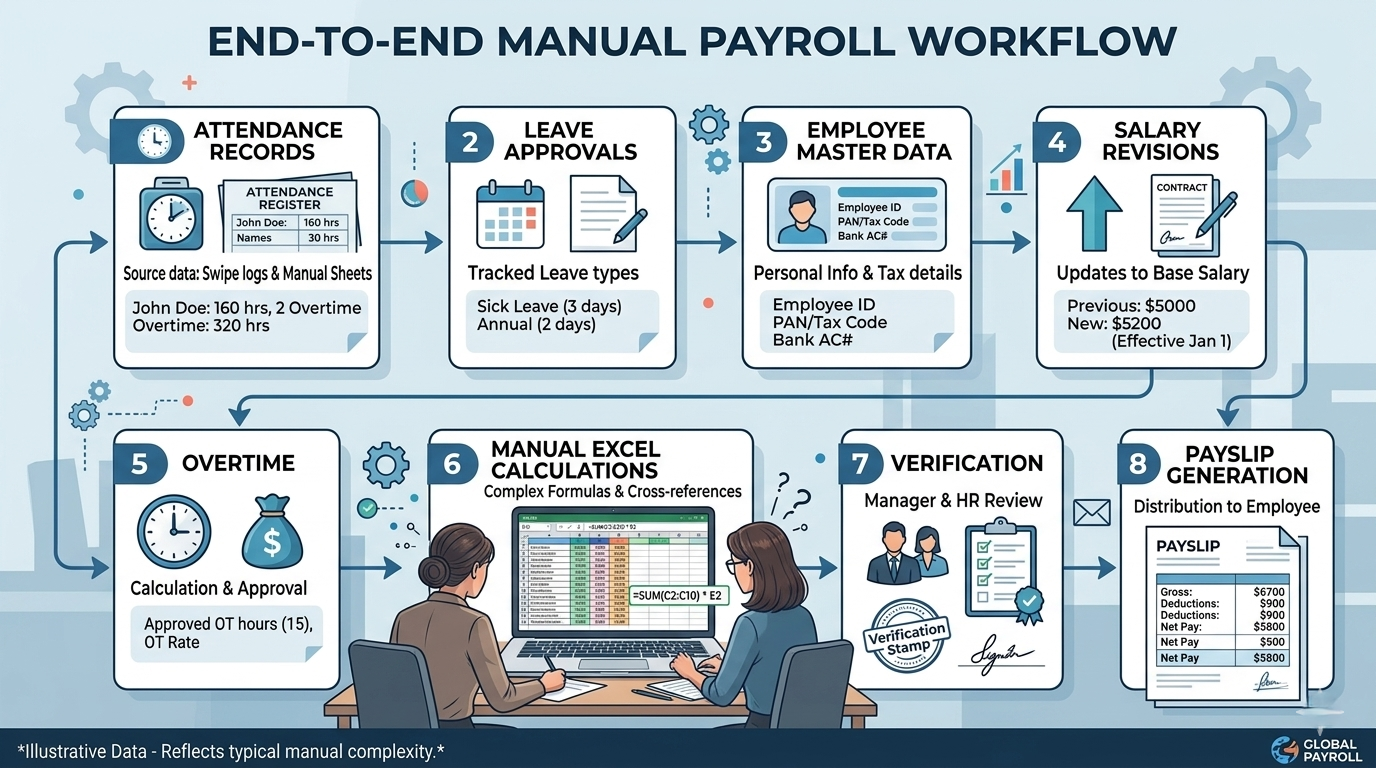
Where Payroll Teams Actually Spend Their Time
Every payroll cycle starts long before salaries are calculated.
Attendance records need verification.
Leave applications must be approved.
New employees have to be added.
Resigned employees need final settlements.
Salary revisions require validation.
Allowances, deductions, reimbursements, overtime, and statutory contributions all need careful review.
Each of these activities may involve different departments, different software applications, or even different spreadsheets.
When information is scattered, payroll professionals spend more time gathering data than actually processing payroll.
The larger the organization becomes, the greater this challenge grows.
Instead of focusing on compliance, reporting, and payroll accuracy, teams often spend days performing repetitive administrative work.
This hidden operational cost rarely appears in financial statements, but it affects productivity throughout the organization.
Why Manual Payroll Creates Challenges Beyond Salary Calculations
One of the biggest misconceptions about payroll is that it is simply about calculating employee salaries.
In reality, payroll is a process that depends on accurate information flowing from multiple business functions.
Employee records maintained by HR.
Attendance captured through biometric systems or mobile applications.
Approved leave requests.
Shift schedules.
Overtime calculations.
Performance incentives.
Government regulations.
Financial policies.
When these sources are disconnected, payroll teams become responsible for bringing everything together manually.
This increases the likelihood of delays, duplicate entries, and avoidable mistakes.
More importantly, it creates dependency on individuals rather than processes.
Businesses that continue relying on manual payroll often discover that their payroll system becomes increasingly difficult to manage as employee numbers grow.
The software isn’t the bottleneck.
Disconnected workflows are.
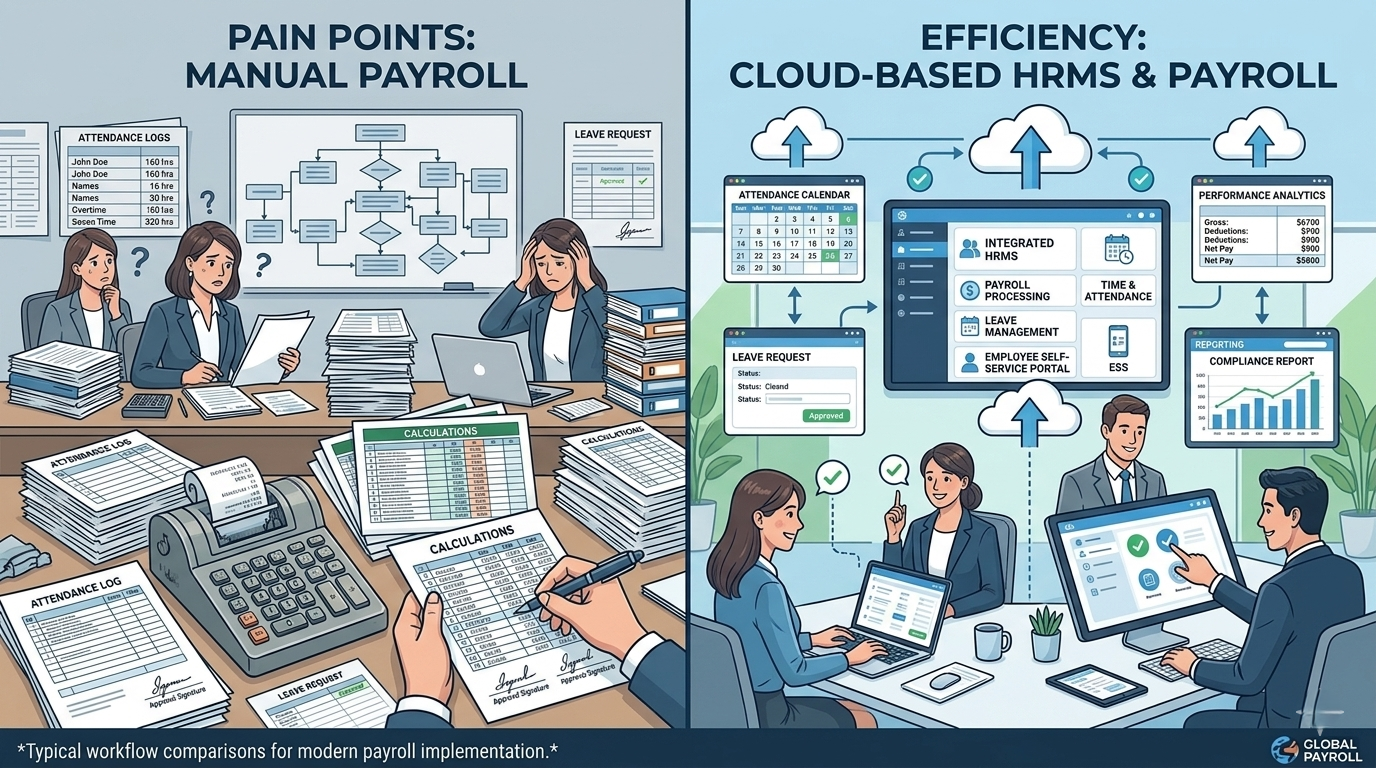
How Payroll Automation Solves These Challenges
Modern payroll systems eliminate fragmentation by connecting all HR and financial data into a single platform.
Instead of manually collecting attendance, leave, and employee updates, the system automatically syncs this information in real time.
This reduces dependency on manual intervention and significantly improves accuracy.
Automation also ensures that compliance rules are consistently applied.
Tax calculations, statutory deductions, and policy-based adjustments are handled automatically, reducing the risk of human error.
More importantly, payroll teams gain time back.
Instead of spending days reconciling data, they can focus on analysis, reporting, and strategic HR planning.
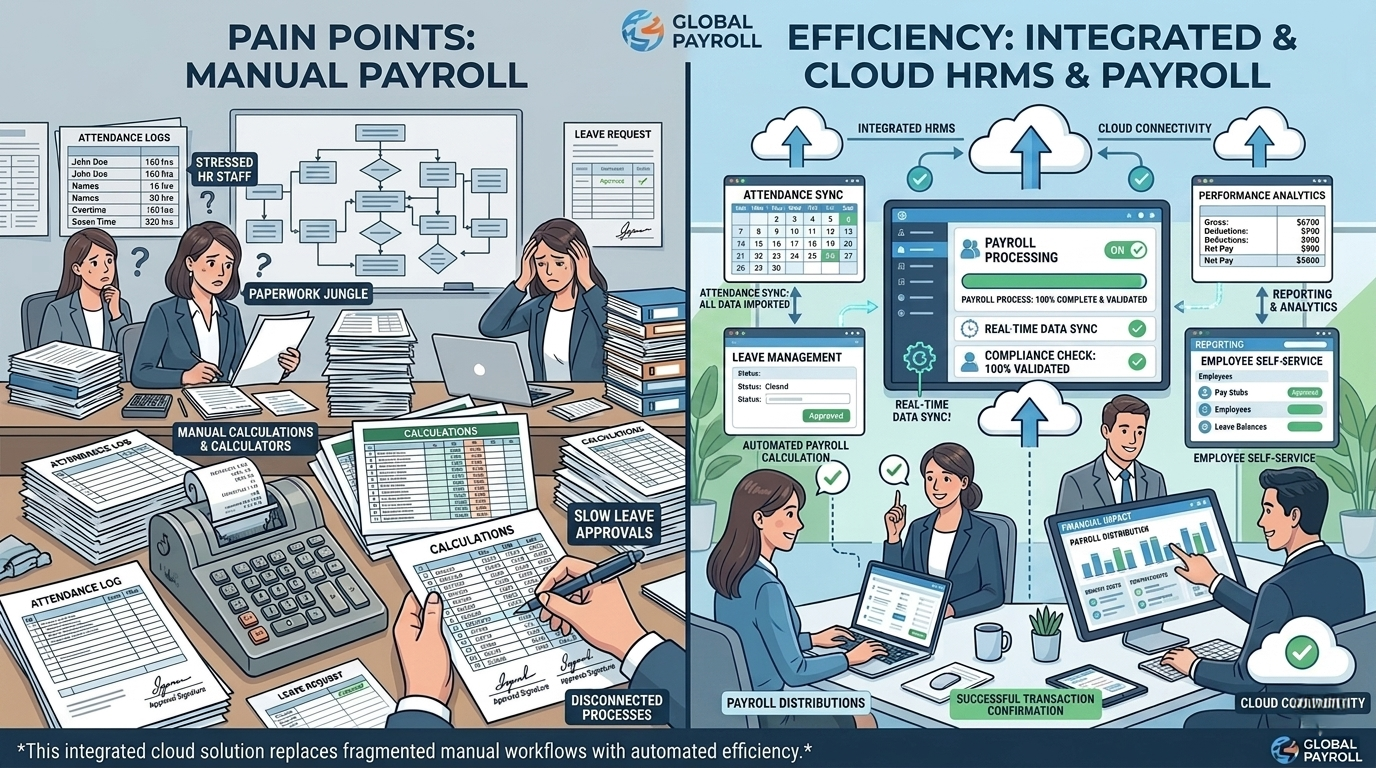
Final Thoughts
Manual payroll processing may seem manageable in the early stages of a business, but it does not scale effectively.
As organizations grow, the hidden costs of manual work — time delays, errors, inefficiencies, and dependency on individuals — become more significant than the cost of software itself.
Automation is not just about speed.
It is about accuracy, consistency, and building a reliable operational foundation for growth.
Businesses that adopt integrated payroll systems early are better positioned to scale without operational friction.
About Intelliob
Intelliob provides integrated business software solutions that connect HR, payroll, attendance, and accounting into a single unified platform.
By eliminating manual processes and enabling real-time data synchronization, Intelliob helps organizations improve efficiency, reduce errors, and streamline business operations.
메타데이터
- post_id
- 5f9cc3493deb
- slug
- the-hidden-cost-of-manual-payroll-processing-its-more-than-just-time-5f9cc3493deb
- url
- https://medium.com/@dev1.intelliob/the-hidden-cost-of-manual-payroll-processing-its-more-than-just-time-5f9cc3493deb
- canonical_url
- https://medium.com/@dev1.intelliob/the-hidden-cost-of-manual-payroll-processing-its-more-than-just-time-5f9cc3493deb
- author_url
- https://medium.com/@dev1.intelliob
- status
- ok
- fetched_at
- 2026-07-31 02:17:44