Korea’s SME Paradox
Why the Missing Middle Is Not Just About Capital
Korea’s SME Paradox
Why the Missing Middle Is Not Just About Capital
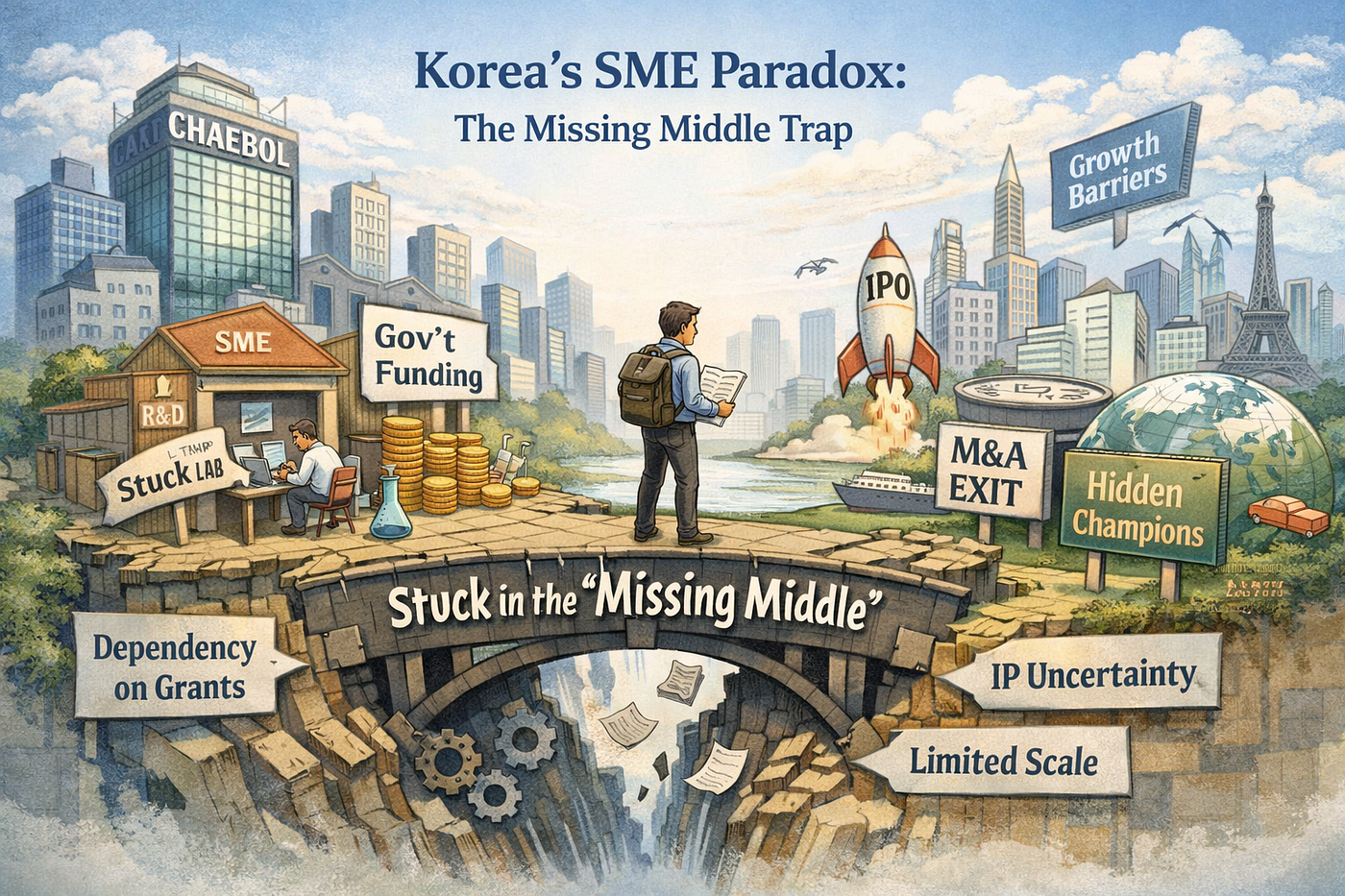
High R&D spending, dominant employment figures — and yet Korean SMEs remain trapped. The problem runs deeper than financing.
Korea’s SMEs employ 83% of the workforce. Their productivity stands at just 29% of large firms — against an OECD average of 65%. Korea spends more on R&D as a share of GDP than almost any country on earth, and yet has produced just 22 hidden champions, all of them in manufacturing. This is not a story about a country that lacks capital or ambition. It is a story about a country that has both — and remains stuck.
To understand why, it helps to start with a number: $5.7 trillion.
That is the estimated financing gap facing micro, small, and medium-sized enterprises worldwide — the chasm between the capital they need to operate and grow, and what the formal financial system is actually prepared to give them. The IFC and World Bank first quantified it at $2.6 trillion around 2017, and have been tracking it ever since. As of March 2025, despite nearly a decade of policy effort, fintech disruption, post-pandemic government intervention, and an entirely new ecosystem of alternative finance, the gap has not narrowed. It has more than doubled.¹
But embedded within that global number is a story that doesn’t get told enough — the story of countries where the problem isn’t simply about access to capital. Where the financing gap is real, but secondary to something more structural. Where SMEs are simultaneously the backbone of the economy and its most underperforming asset.
Korea is that story. And it is one I have spent years observing from the inside.
The Paradox at the Heart of Korean SMEs
Korea does not have an SME quantity problem. It has a scale-up problem.
Korean SMEs account for 99.9% of all enterprises in the country and employ approximately 83% of the workforce, but generate only 65% of GDP.² And yet their productivity level — at just 29% relative to large firms against an OECD average of 65% — ranks among the lowest in the OECD area.³
In my own research on Korean SMEs, one number stands out as particularly telling: AI adoption among Korean SMEs stands at just 27% — less than half the rate among large Korean enterprises⁴ — and their generative AI usage of 25% ranks at the low end among the seven OECD economies surveyed (Austria, Canada, Germany, Ireland, Japan, Korea, and the United Kingdom), marginally ahead only of Japan.⁵ For an economy where SMEs dominate in number and employment yet lag so sharply in productivity, these figures capture a great deal about why so many Korean SMEs remain trapped in low-productivity, low-scalability models — despite the country’s overall technological strength.
The deeper problem is structural. Many Korean technology SMEs are not building around a core, defensible identity of their own. Instead of developing proprietary technology and scaling it — as technology companies in Silicon Valley or Israel typically do — too many Korean SMEs remain structurally dependent on large Korean conglomerates (chaebols) as service providers, or cycle through government-funded projects, reshaping their business models to fit the next grant rather than the next market. In that environment, AI adoption tends to be piecemeal and reactive rather than strategic — the cost of embedding it enterprise-wide is simply too high for most SMEs to justify without a clear sense of what they are building.
The comparison with German hidden champions reinforces this point. By Hermann Simon’s classification, Germany has 1,573 hidden champions — companies that rank among the top three globally in highly specialized niches, despite generating less than €5 billion in revenue and remaining largely unknown to the public. Japan has 283, while Korea has just 22 — all of them in manufacturing.⁶ This is not a matter of industrial capacity.
Korea has consistently ranked as the second-highest R&D spender among OECD nations as a share of GDP, at 5.1% in 2024, trailing only Israel.⁷ Yet the returns from that investment — in licensing revenues, commercialized IP, and global market access — remain well below what the scale of investment would suggest. Without the systems to turn that innovation into licensable, financeable, monetizable assets, the investment stops at the lab door — Korea creates knowledge, but captures little value from it. That gap — between investment and commercialized outcome — is, in my view, one of the defining structural problems of the Korean SME ecosystem.
It is worth noting that this pattern is largely specific to technology SMEs — in sectors like K-beauty and content, a different and more encouraging story has emerged — though that is a story for later in this piece.
The Real Diagnosis: An Institutionalization Gap, Not Just a Financing Gap
Consider a case from my own advisory work. I was advising a US-based buyer seeking a Korean acquisition target. The candidate looked compelling: strong technology, a capable team, enough commercial momentum to generate genuine interest — with a major Korean chaebol as its primary customer. It was only in preliminary due diligence that the picture became more complicated. The IP documentation was ambiguous — written in ways that left open the possibility that the underlying technology could be claimed by the chaebol for which the company had been doing work. The buyer saw clear value in the technology. But without clean IP ownership, there was nothing to acquire — no defensible asset, no protected value that would survive the transaction. They walked away.
What looked like an independent innovative company turned out to be a captive service provider — its most valuable asset effectively belonging to someone else. This is what structural unfundability looks like in practice.
The problem is often framed, in policy circles and the broader development literature, as a shortage of capital. In emerging markets, that diagnosis often holds. But in my experience, Korea is a different case — capital exists, and government support is among the most extensive in the OECD.
The deeper issue is not that funding is unavailable. It is that many Korean SMEs struggle to become financeable at the stage when growth requires more than founder grit, government grants, or relationship lending. What looks like a capital gap is often a broader system failure: weak information, weak governance, weak monetization of innovation, and weak pathways from survival to scale. World Bank and OECD research has also framed this pattern across emerging markets. Drawing on a decade of direct advisory experience in Korea, I can speak to how precisely it plays out here.
A firm enters the missing middle when it is too advanced to rely on founder savings and ad hoc support, but still too opaque, too small, or too operationally fragile to attract growth capital on reasonable terms. The bottleneck is not capital supply — it is legibility. Too many Korean SMEs are not yet readable to growth capital.
The World Bank identifies three supply-side frictions that compound this problem: high cost to serve, information asymmetry, and lack of collateral.⁸ SME lending is expensive not because ticket sizes are large, but because underwriting, monitoring, and diligence remain labor-intensive relative to what lenders can earn from serving them. When firms lack reliable financial data, formal histories, or collateral frameworks, financiers either step back or price the risk prohibitively. In that environment, even viable firms are rationed out of growth capital.
The missing middle lives in the gap between starting a business and professionalizing one — between having technology and owning monetizable IP, between domestic supplier status and global market access, between accounting information that satisfies tax filing and information that satisfies investors.
What I Have Observed Across the Korean SME Ecosystem
Korea illustrates how the missing middle forms — and what keeps companies trapped within it. Korea’s broader SME landscape is diverse, and not every sector tells the same story. The patterns that follow reflect primarily what I have observed among Korean startups navigating the missing middle — where the gap between early-stage promise and institutional fundability is widest, and where government grant reliance shapes business models most consequentially.
The five-year survival rate for Korean startups stands at 29%, against an OECD average of 41.7%.⁹ That number tells only part of the story. The more revealing question is not how many survive, but what kind of survival it is — and what is keeping them alive.
In Korea, a disproportionate share of early-stage companies rely on government funding rather than private capital — not by choice, but because private alternatives are scarce. This creates a distortion that is easy to miss: the valley of death — that brutal period when a startup has exhausted its initial capital but has not yet achieved product-market fit — is often bypassed in Korea. Not through genuine commercial validation, but through the next government grant cycle. Founders who should be spending months or years wrestling with the market, pivoting, failing, and finding a harder and more defensible answer, instead find an easier one. Government funding is available. The struggle that builds companies is quietly avoided.
Part of the reason is structural. Korea’s startup ecosystem lacks the dense layer of angel investors and seed-stage funders that sustains early-stage companies in more mature ecosystems. That layer, in Silicon Valley or Tel Aviv, is built from the proceeds of prior exits — founders who sold companies, returned capital to the market, and are now writing the first checks into the next generation. Korea has relatively few of them. In the absence of private early-stage capital, government grants fill the gap. For many founders, they are not a choice — they are the only option available.
But what begins as necessity quietly becomes dependency. Grants are tied to specific scopes and deliverables — defined not by the market but by program criteria. A founder who needs to pivot often cannot, because the funding does not allow it. The business ends up serving the grant, rather than the grant serving the business. What I have seen is a pattern of founders hopping from one government program to another, adjusting their pitch decks rather than their business models. The funding becomes the product. What gets funded is what fits the form — not necessarily what deserves to grow.
The result is a class of what I would call zombie SMEs that never achieved genuine product-market fit, sustained indefinitely on public support, neither growing nor dying. In a healthy ecosystem, failure is information. In Korea, government funding has muffled that signal — not because there is too much of it, but because too little of it is tied to outcomes that matter: exits, global reach, genuine market traction.
The IP problem described earlier is not an isolated case — it reflects a pattern that runs deeper and wider than most founders realize. But Korea’s exit problem has a second dimension that is distinct: companies that could be acquired, but choose not to be.
In mature startup ecosystems — the US, UK, and Israel — M&A accounts for 85% to 95% of venture-backed exits.¹⁰ In Korea, even at its peak in 2022, the figure stood at just 56% — and has since fallen further to around 38% in early 2025.¹¹ Among companies that reach exit-readiness, Korea’s preference for the long IPO path creates its own trap: companies that are attractive acquisition targets, but that choose to wait for an IPO that may never come — passing up exits that would return capital and talent to the ecosystem. That preference is not accidental. Korean founders and their families tend to view M&A as a failure or a loss of control, rather than as the ecosystem-building mechanism it actually is. Capital and experience that should be flowing back into the next generation remain locked up, and the ecosystem fails to compound.
Israel’s evolution offers the clearest counterpoint. Israeli startups spent decades orienting toward quick M&A exits by global corporates — a strategy criticized at the time as insufficiently ambitious. But the cash liquidity those exits generated funded the next generation of founders, built a dense network of serial entrepreneurs, and created the conditions under which Israeli companies could eventually attempt genuine scale-up and NASDAQ listings. The shortcut turned out to be the long game.
Korea has yet to build that cycle. But not all Korean sectors tell the same story — and the exceptions are instructive.
K-beauty’s global ascent was not driven by government policy or chaebol distribution. It was built on a foundation that had been quietly forming for decades: a sophisticated OEM/ODM manufacturing ecosystem that gave indie brands access to world-class production without the capital requirements of vertical integration. When global distribution channels opened up — first through social media, then through global specialty retailers — those brands were ready. They owned their products, their formulas, their identities. The infrastructure behind them was theirs to leverage, not a chaebol’s to control.
K-pop and K-content followed a similar logic. These are sectors where IP ownership is secured by nature — music, video, and creative content are protected from the outset. Borderless digital distribution did the rest, removing every geographical barrier and allowing what had been built locally to find global audiences without waiting for policy to catch up.
What made the difference was not luck or cultural affinity — it was ownership, ecosystem design, and distribution. In beauty and content, the indie brand owns what it creates, the ecosystem serves the brand, and the route to market is direct — global platforms connect Korean products straight to global consumers, bypassing the B2B dependency that traps Korean technology SMEs behind chaebol supply chains. These are different industries with different structural logics. But the underlying message is the same: you cannot scale what you do not own.
The lesson is not that Korea should replicate K-beauty in tech — every sector has its own infrastructure logic. But the question for Korea’s technology sector is whether the same conditions — clear ownership, ecosystem amplification, borderless distribution — can be deliberately built, and what it would take to get there.
The Structural Constraints That Keep Korean SMEs Stuck
These constraints compound one another in ways that make scale-up systematically difficult — and they apply across the SME lifecycle, not just at the early stage.
Non-scalable business models are pervasive. Korean SMEs are predominantly labor-intensive, with revenue streams built on one-off contracts or project-based work. The more they grow, the more they spend — cost scales with revenue, with no path to the efficiency gains that technology-enabled or recurring-revenue models can deliver. I have seen this pattern repeatedly: firms that are busy, even profitable, but structurally unable to grow without proportionally growing their cost base.
Unsecured intellectual property compounds the problem — and as the advisory case described earlier illustrates, it is more pervasive than most founders realize. Because many Korean SMEs function as customized service providers to chaebols, the IP they develop is frequently transferred — formally or informally — to the chaebol. The SME remains a service company. The chaebol retains the asset. German hidden champions, by contrast, own five times more patents per employee than large German corporations.⁶ Without defensible IP, without recurring revenue, and without independent market positioning, a firm is not just unable to scale — it is perpetually at risk. When your primary customer is a chaebol, your business exists at their discretion. A change in procurement strategy, a shift in supplier preference, or a decision to bring the work in-house can threaten the entire operation overnight.
Structural barriers to global market access constrain both market size and investor valuation. In my experience, these barriers are multiple and mutually reinforcing: corporate structures that were never designed for foreign investment, limited international networks, few Korean VCs with cross-border experience, and years of serving the domestic market that leave companies without the global sales channels, customer references, or investor relationships that cross-border growth requires. By the time founders recognize the need to go global, the window for doing it cheaply has often already closed.
Rigid labor laws and weak incentive structures complete the picture. The inflexibility created by layoff protections — designed to protect workers — carries the unintended effect of making it difficult for SMEs to respond dynamically to market conditions. Without performance-based compensation or equity participation, attracting and retaining talent capable of driving transformation remains a persistent challenge. Employees work for wages rather than participating in the growth of the company. That dynamic limits both ambition and organizational energy.
A dysfunctional exit culture constrains the ecosystem’s ability to compound. Until M&A is treated as a strategic outcome rather than a loss of control, capital and talent will remain locked up rather than flowing back into the next generation of companies.
What Global Research Says — And Where Korea Is Getting It Wrong
Three conclusions from global research apply directly to Korea — and in each case, Korea’s current approach falls short of what the evidence recommends.
Financial infrastructure matters more than financing instruments — and Korea has invested in the wrong one. Global research is clear: credit systems that assess forward-looking cash flow and business performance outperform those relying primarily on collateral and historical credit records. Korea has built the latter. Its lending frameworks do not recognize patents or software as collateral. Its IP regimes cannot convert innovation into something a lender can price. The result is predictable: policy interventions tend to benefit firms that can already access capital — not the ones that cannot.
This is also where technology is changing the equation. AI-driven credit scoring now draws on transaction histories, supply chain data, and platform activity — assessing creditworthiness without collateral or audited financials. A firm’s daily operations can now constitute a credit profile. Previously illegible businesses are becoming readable to capital — not because they changed, but because the tools for reading them did. For Korean SMEs, the question is no longer whether these tools exist. It is whether Korea builds the environment to deploy them. So far, the answer has been slow.
Government should catalyze private capital — but in Korea, it has crowded it out. As I have observed directly in Korea, government funding for SMEs has too often functioned as a substitute for market discipline rather than a catalyst for it. Israel’s Yozma program offers the clearest model of what the alternative looks like: a state-run fund of funds that invested alongside private VCs, with the government providing risk capital and mandate while private fund managers provided expertise and networks. Korea’s TIPS program points in a similar direction — requiring private VC investment before any government funding flows. But TIPS remains the exception. The majority of Korea’s 1,646 SME support programs still flow through direct grants and guarantees, with no prior market validation required.¹² When public money does not demand market discipline, the quality of companies being supported reflects that.
Financing instruments must match firm type — but Korea’s menu is too narrow. The OECD’s framework is clear: different instruments fit different growth paths. Loans may suit traditional capacity expansion; equity fits innovation-led firms; asset-based products support working capital and supplier development; hybrid tools can serve businesses in transition. Korea’s system relies heavily on government grants and bank credit, leaving most of the middle of that spectrum — equity, asset-based finance, and hybrid instruments — significantly underdeveloped.¹³ The consequence is a system where the firms most in need of differentiated capital are the ones least likely to find it.
What Korea Needs to Do Differently
The evidence points to a clear conclusion: Korea’s problem is not a shortage of capital, and it will not be solved by more of it. Capital is only productive when a firm can absorb it — and too many Korean SMEs cannot. Not because they lack ambition, but because the internal foundations are not there. Korea’s startup policy is very good at counting entries. It is much less good at building scalers. Those are not the same thing — and confusing them is expensive.
Build scalable business models, not just more startups. Korea needs to move from a startup-centric mindset to a scale-up architecture. The goal should not simply be to create more firms, but to increase the share of firms that become scalable, productive, and investable. That means restructuring government support away from direct grants toward instruments that demand market validation — and calibrating interventions to where firms actually get stuck: at the point of first institutional financing, at the threshold of export entry, at the moment when AI adoption becomes operationally necessary but financially out of reach. The highest-leverage interventions are firm-specific, stage-specific, and bottleneck-specific.
Secure IP ownership before commercial relationships obscure it. Technology developed under government-funded R&D programs often results in IP that belongs to the program, not the company. And in chaebol service relationships, the same pattern repeats. The fix requires clearer legal frameworks governing IP ownership in subcontracting relationships, lending systems that recognize patents and software as collateral, and early IP registration support — before commercial relationships begin, not after. Korea creates knowledge at scale. The task now is to ensure that the companies doing the creating are the ones who own what they build.
Design for global from the first structural decision. Korean tech SMEs have competitive technology but too often build exclusively for the domestic market — and by the time they consider going global, the structural barriers are significant. The critical shift is not timing of market entry, but the architecture of the company itself. Corporate governance structures need to accommodate foreign investment from the outset — not retrofitted years later when a cross-border deal is already on the table. Financial reporting needs to be investor-legible in English before institutional conversations begin, not after. Business models need to be stress-tested against global peers, not domestic comparables. IP needs to be registered in target markets early, when it is still cheap to do so. And pricing and contract structures need to be designed with cross-border scalability in mind, not localized in ways that become liabilities in international negotiations. These are not ambitions for later — they are architectural decisions that compound in either direction. The longer founders defer them, the more costly and irreversible they become.
Align incentives with growth. Without performance-based compensation or equity participation, attracting and retaining the talent capable of driving transformation remains a persistent challenge across the Korean SME landscape. Without a share in the upside, there is little reason to go beyond what is required. Building scalable companies requires people who have skin in the game. That means stock options, equity schemes, and performance structures that make the upside of growth real for the people responsible for delivering it. Korea’s rigid compensation norms and labor market structures make this harder than it needs to be — but it is not insurmountable, and it is a precondition for building companies that can compete globally.
Reframe M&A as an ecosystem mechanism — and build the exit infrastructure to support it. M&A is the mechanism by which capital, experience, and talent are reinvested into the economy. The Korean government recognizes this: M&A guarantee capacity is set to grow sevenfold by 2030, and a dedicated SME M&A platform is being built. But infrastructure alone will not change behavior. Korean founders overwhelmingly pursue IPO as the only legitimate exit, viewing acquisition as a loss of control rather than a strategic outcome. Until M&A is reframed as a growth mechanism rather than a surrender, the ecosystem will remain structurally illiquid. This applies equally to succession: as founders of mature SMEs age and their children increasingly choose other paths, M&A is the natural transition mechanism — but it requires a market willing to price and absorb those transitions, and a founder culture willing to let go.
The Forward View
The $5.7 trillion global SME financing gap will not close by itself. But the map of how to close it has never been more detailed. What the OECD’s 2025 Scoreboard, the World Bank’s country-level evidence, and a growing body of fintech-enabled credit data collectively point toward is this: infrastructure first, market-catalyzing public intervention second, patient equity capital third.¹³
Korea has all three problems — but the binding constraint is not capital supply. It is the institutional infrastructure that makes capital deployable.
The financing gap is real. But it is not the binding constraint. The deeper problem, as I have argued throughout this piece, sits one level up. Korean SMEs are often not yet organized to absorb and deploy growth capital effectively when it arrives. Government funding has too often substituted for market discipline rather than catalyzing it, producing companies that are dependent rather than competitive. IP developed through years of R&D or chaebol service work has flowed to programs and chaebols rather than remaining with the companies that created it. Business models have been built for the domestic market, for the next grant cycle, for the next chaebol contract — not for the global customer. And the exit ecosystem that should be returning capital and experience to the next generation of founders has barely begun to form.
The result is an ecosystem that is stuck. Not for lack of talent or ambition — Korea has both in abundance. Not for lack of public investment — Korea spends more on SME support than almost any comparable economy. What is missing are the foundations that make capital productive: owned and defensible IP, scalable business models, global market readiness, growth-aligned incentives, and an exit culture that treats M&A as a beginning rather than an end. That is the bridge between capability and capital, between innovation and monetization, between survival and scale.
The real task is not to fund more Korean SMEs. It is to make more Korean SMEs fundable. That is a harder problem than writing a check — but it is the right one to solve.
Sources:
¹ IFC & World Bank, ‘MSME Finance Gap’, 2017 and ‘MSME Finance Gap Report’, March 2025. ² Ministry of SMEs and Startups (Korea), ‘Leap Forward for Small and Medium Enterprises’ Strategy, 2024. ³ IBK Economic Research Institute, ‘Weekly Economy Briefing’, March 2021; OECD, ‘SME Indicators, Benchmarking and Monitoring’, 2024. ⁴ National Intelligence Agency (NIA), Korea, cited in OECD, ‘Artificial Intelligence and the Labour Market in Korea’, 2025. ⁵ OECD, ‘Generative AI and the SME Workforce’, 2025. ⁶ Hermann Simon, ‘Hidden Champions in the Chinese Century’ (Springer, 2022). ⁷ OECD, ‘Reviews of Innovation Policy: Korea’ 2023; Ministry of Science and ICT, 2024. ⁸ World Bank, ‘Fintech and SME Finance: Expanding Responsible Access’, 2022*. ⁹ Gyeonggi Northern Chamber of Commerce and Industry, via Statista, 2021. ¹⁰ JP Morgan, ‘M&A Dominates EMEA Startup Exits’, 2025. ¹¹ Korea Venture Capital Association (KVCA), 2025. ¹² OECD, ‘Economic Surveys: Korea 2024’, July 2024. ¹³ OECD, ‘Financing SMEs and Entrepreneurs Scoreboard: 2025 Highlights’, April 2025; World Bank, ‘Fintech and SME Finance: Expanding Responsible Access’, *2022.
ScaleUp #SMEFinance #KoreanSMEs #MissingMiddle #PrivateCapital #EmergingMarkets #PrivateSectorDevelopment
메타데이터
- post_id
- 5fa01e166f28
- slug
- koreas-sme-paradox-why-the-missing-middle-is-not-just-about-capital-5fa01e166f28
- url
- https://medium.com/@seung-jai.paik/koreas-sme-paradox-why-the-missing-middle-is-not-just-about-capital-5fa01e166f28
- canonical_url
- https://medium.com/@seung-jai.paik/koreas-sme-paradox-why-the-missing-middle-is-not-just-about-capital-5fa01e166f28
- author_url
- https://medium.com/@seung-jai.paik
- status
- ok
- fetched_at
- 2026-06-09 15:37:30



