Demystifying Line-Rate Deep Packet Inspection: Architecting and Tuning Suricata NIDS for Enterprise…
The modern enterprise network perimeter is effectively opaque to traditional stateless security controls. While standard Layer 3 and Layer…
Demystifying Line-Rate Deep Packet Inspection: Architecting and Tuning Suricata NIDS for Enterprise Core Networks
The modern enterprise network perimeter is effectively opaque to traditional stateless security controls. While standard Layer 3 and Layer 4 firewalls execute rapid validation of network traffic based on fixed parameters — such as source IPs, destination IPs, and transport-layer ports — they are fundamentally blind to the underlying application payload. To a traditional firewall, a legitimate HTTPS session and an advanced data exfiltration tunnel look identical: encrypted traffic traveling over TCP port 443.
As adversaries increasingly weaponize obfuscated protocols, application-layer exploits, and lateral movement techniques, network defenders must deploy Network Intrusion Detection and Prevention Systems (IDPS) capable of line-rate Deep Packet Inspection (DPI).
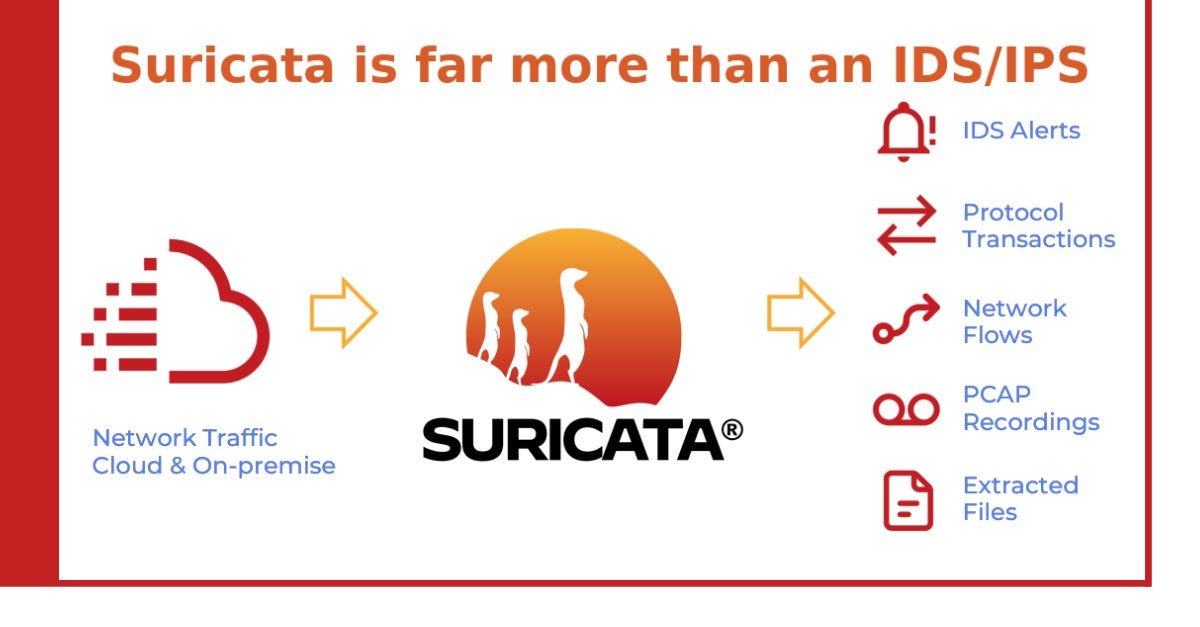
Among open-source engines, Suricata stands out as the industry standard for high-throughput enterprise environments. This technical guide breaks down the engineering mindset required to architect, configure, and fine-tune a production-grade Suricata engine to defend high-scale enterprise core networks.
1. The Multi-Threaded Advantage: Why Suricata Rules Modern Networks
Historically, network security monitoring relied heavily on legacy engines like early versions of Snort. While highly reliable, Snort’s traditional single-threaded architecture became a significant operational bottleneck as network speeds advanced from megabits to gigabits per second. A single-threaded engine can only process packets sequentially on a single CPU core. When traffic volume exceeds that core’s processing threshold, the kernel begins dropping packets — creating massive security blind spots.
Suricata was engineered from the ground up to solve this scalability crisis through a natively multi-threaded architecture.

Suricata splits packet processing tasks into independent execution stages — Packet Acquisition, Decoding, Stream Reassembly, Application-Layer Parsing, and Detection — and maps them across multiple CPU threads concurrently.
By utilizing load-balancing techniques like cluster_flow, packets belonging to the same network flow are consistently routed to the same CPU worker thread. This preserves connection state memory, allows for parallel signature matching, and scales throughput naturally alongside modern multi-core server hardware.
2. Production-Grade Packet Acquisition: Tuning AF_PACKET
An enterprise NIDS sensor is only as good as its packet ingestion layer. For 10Gbps+ core environments, standard packet capture mechanisms (libpcap) introduce unacceptable overhead due to excessive context switching between kernel space and user space.
Production environments typically employ one of two high-performance ingestion paths: AF_PACKET (built into the Linux kernel) or DPDK (Data Plane Development Kit, which bypasses the kernel entirely). For most enterprise Linux distributions, a hardened AF_PACKET configuration delivers line-rate performance when tuned correctly.
Below is an enterprise-grade configuration snippet for the af-packet ingestion block inside suricata.yaml:
af-packet:
  - interface: eth1
    cluster-id: 99
    cluster-type: cluster_flow
    defrag: yes
    use-mmap: yes
    tpacket-v3: yes
    ring-size: 2048
    buffer-size: 33554432
Deconstructing the Tuning Parameters:
use-mmap: yes: Forces the engine to utilize memory-mapped I/O, allocating a shared ring buffer between the Linux kernel and Suricata. This minimizes context switching and keeps memory utilization highly efficient.tpacket-v3: yes: Enables the modern version of the Linux TPACKET socket, allowing the kernel to pass packets to Suricata in dynamic blocks rather than individual packets, reducing system call overhead dramatically.ring-size&buffer-size: Allocates a larger memory footprint for packet queues, providing a buffer to ride out bursty traffic spikes without dropping packets while the detection engine evaluates complex rules.
3. High-Fidelity Rule Engineering vs. CPU Deficiencies
Writing custom rules for an NIDS requires a strict balance between detection accuracy and computational performance. Poorly engineered rules rely heavily on generic Perl-Compatible Regular Expressions (pcre), which force the detection engine to execute intense CPU backtracking operations on every single packet.
The Amateur Approach (High CPU Overhead)
alert tcp any any -> $HOME_NET 80 (msg:"SUSPICIOUS Web Exploit Attempt"; pcre:"/GET.*(\.\.\/|\.\.\\)/i"; sid:1000001; rev:1;)Why this fails in production: This rule uses a raw
pcrestatement against the entire packet stream. Suricata is forced to evaluate the entire payload byte-by-byte, completely killing the engine's performance at high speeds.
The Enterprise Approach (Protocol-Aware, High-Efficiency)
alert http $EXTERNAL_NET any -> $HTTP_SERVERS any (msg:"EXPLOIT Path Traversal Attempt Target WordPress"; flow:to_server,established; http.method; content:"GET"; http.uri; content:"/wp-admin"; startswith; content:".."; sid:9000040; rev:1;)The Engineering Strategy Behind the Enterprise Rule:
- Protocol Limitation (
http): Instead of generictcp, the rule targets the HTTP application-layer parser natively. Suricata only evaluates this rule when the packet has already been successfully parsed as legitimate HTTP traffic. - Flow Control (
flow:to_server,established): The engine skips checking this rule entirely for inbound connection initializations (SYN packets) or traffic originating from internal servers. It only evaluates active payloads after a successful TCP 3-Way Handshake. - Content Modifiers (
http.method,http.uri,startswith): Instead of running a costly regex operation across the whole packet, it instructs Suricata's highly optimized multi-pattern matcher (Hyperscan) to look precisely within the HTTP URI buffer for the string/wp-admin. It drops the packet inspection immediately if those conditions aren't met, saving massive amounts of CPU cycles.
4. Defeating the Alert Fatigue Monster: An SOC Tuning Framework
The greatest operational challenge in any Security Operations Center (SOC) is not deploying security tools — it is managing the sheer volume of noise they generate. An untuned NIDS sensor out-of-the-box will create thousands of low-priority or false-positive alerts every day, clouding real, high-severity threat indicators.
To build a sustainable detection posture, security engineering teams must adopt a systematic tuning lifecycle.

Production Tuning Implementation
Suricata provides a native mechanism to tune rule behaviors externally via /etc/suricata/threshold.config. This allows engineers to manage noise without altering the original open-source or commercial signature files.
Consider a scenario where an internal vulnerability scanner or Network Monitoring System (NMS) asset (10.10.50.250) routinely triggers a high-volume policy rule, such as an ICMP ping check or an SSL expired certificate alert. We can programmatically silence or throttle this traffic:
# Completely suppress policy alerts from the internal vulnerability scanner IP
suppress gen_id 1, sig_id 2017656, track by_src, ip 10.10.50.250
# Throttling noise: Rate-limit a broad rule to maximum 1 alert per 5 minutes per host
threshold gen_id 1, sig_id 9000001, type limit, track by_src, count 1, seconds 3005. Seamless SIEM Integration: Processing EVE JSON
Modern SOCs do not read raw alert files. Suricata’s primary strength in an enterprise pipeline is its EVE JSON output. Every event, alert, protocol metadata dump, and flow log is output as a single, highly structured JSON object, making it natively compatible with modern SIEM and log aggregation platforms like Wazuh, Elastic Stack (ELK), Graylog, or Splunk.
{
  "timestamp": "2026-06-04T13:43:30.643392+0000",
  "flow_id": 793026981491711,
  "in_iface": "eth1",
  "event_type": "alert",
  "src_ip": "185.220.101.5",
  "dest_ip": "10.10.10.15",
  "proto": "TCP",
  "alert": {
    "action": "allowed",
    "gid": 1,
    "signature_id": 9000003,
    "rev": 1,
    "signature": "LAB-03 SSH Brute Force Attempt",
    "severity": 3
  }
}
By streaming this EVE JSON structure into an ingestion pipeline over Logstash, Fluentd, or a dedicated agent, analysts can construct granular dashboards, tie events to automatic security orchestration playbooks (SOAR), and trigger cross-platform threat hunting workflows instantaneously.
Final Thoughts
Implementing an enterprise-grade NIDS sensor is a continuous discipline of balancing visibility, infrastructure performance, and operational clarity. By transitioning from standard Layer 4 tracking to deep, multi-threaded application-layer parsing with Suricata, security architects ensure their detection pipelines can gracefully handle modern multi-gigabit traffic speeds while isolating critical indicators of compromise before lateral movement occurs.
메타데이터
- post_id
- 5faa4923fcc7
- slug
- demystifying-line-rate-deep-packet-inspection-architecting-and-tuning-suricata-nids-for-enterprise-5faa4923fcc7
- url
- https://medium.com/@ammarza77/demystifying-line-rate-deep-packet-inspection-architecting-and-tuning-suricata-nids-for-enterprise-5faa4923fcc7
- canonical_url
- https://medium.com/@ammarza77/demystifying-line-rate-deep-packet-inspection-architecting-and-tuning-suricata-nids-for-enterprise-5faa4923fcc7
- author_url
- https://medium.com/@ammarza77
- status
- ok
- fetched_at
- 2026-06-09 15:37:30






