The Great Sultan Salahuddin Ayyubi: The Leader Who Conquered Hearts Before He Conquered Jerusalem
History remembers plenty of kings who built empires and generals who won battles that changed the map. Far fewer leaders managed to earn…
The Great Sultan Salahuddin Ayyubi: The Leader Who Conquered Hearts Before He Conquered Jerusalem
History remembers plenty of kings who built empires and generals who won battles that changed the map. Far fewer leaders managed to earn the respect of their enemies as well as their friends. Sultan Salahuddin Ayyubi — known in the West as Saladin — was one of them.
More than eight hundred years after his death, his name still carries weight. Muslims remember him as the man who liberated Jerusalem. Western historians, even those writing from the other side of the Crusades, tend to describe him as one of the most honorable commanders the medieval world produced. What earns a man that kind of reputation isn’t just the cities he took or the wars he won — it’s how he treated people once he’d won them. That’s really what this story is about: not conquest, but character.
A Quiet Beginning
Salahuddin was born around 1137 in Tikrit, a city in what is now Iraq, into a Kurdish Muslim family. It was a fractured time for the Muslim world — rival rulers jockeying for power while Crusader forces held Jerusalem and several other key cities across the Holy Land.
He wasn’t the kind of boy anyone expected great things from, at least not in the usual sense. He didn’t chase attention or wealth. Instead, he spent his youth absorbed in the Qur’an, Islamic scholarship, Arabic literature, and the study of warfare. People who knew him as a young man describe someone calm, disciplined, and quietly devout — not the profile of a future conqueror. And yet.
His rise wasn’t handed to him. He started his military career under his uncle Shirkuh, a general serving the ruler Nur ad-Din, and it was during campaigns in Egypt that people first noticed something in him — a steadiness beyond his years. When Shirkuh died, Salahuddin found himself, somewhat abruptly, appointed Vizier of Egypt. Plenty of people doubted whether someone so young could hold that position together.
He didn’t respond by indulging in the perks of power. He got to work — reforming the administration, shoring up governance, preparing the region for what he must have sensed was coming. It was an early glimpse of who he’d become: someone who treated leadership as a burden to carry, not a prize to enjoy.
Uniting a Fractured World
Long before Salahuddin ever set foot in Jerusalem as its conqueror, he’d already achieved something arguably harder: uniting a Muslim world that had spent years fighting itself as much as its outside enemies. Egypt, Syria, Yemen, and other territories were splintered into competing factions, and that infighting was exactly what had let the Crusaders gain and hold ground in the first place.
Salahuddin seemed to understand a truth that’s easy to forget even now — a house divided rarely wins anything, no matter how strong any one room in it might be. Through years of patient diplomacy, careful alliance-building, and military campaigns fought at the right moments rather than the convenient ones, he slowly brought these territories under a single banner.
It’s a lesson that hasn’t aged much. Countries, companies, families — the pattern holds. People get further working alongside each other than working against each other, and Salahuddin’s career is really a long demonstration of that idea before it gets to the famous part.
Hattin and the Road to Jerusalem
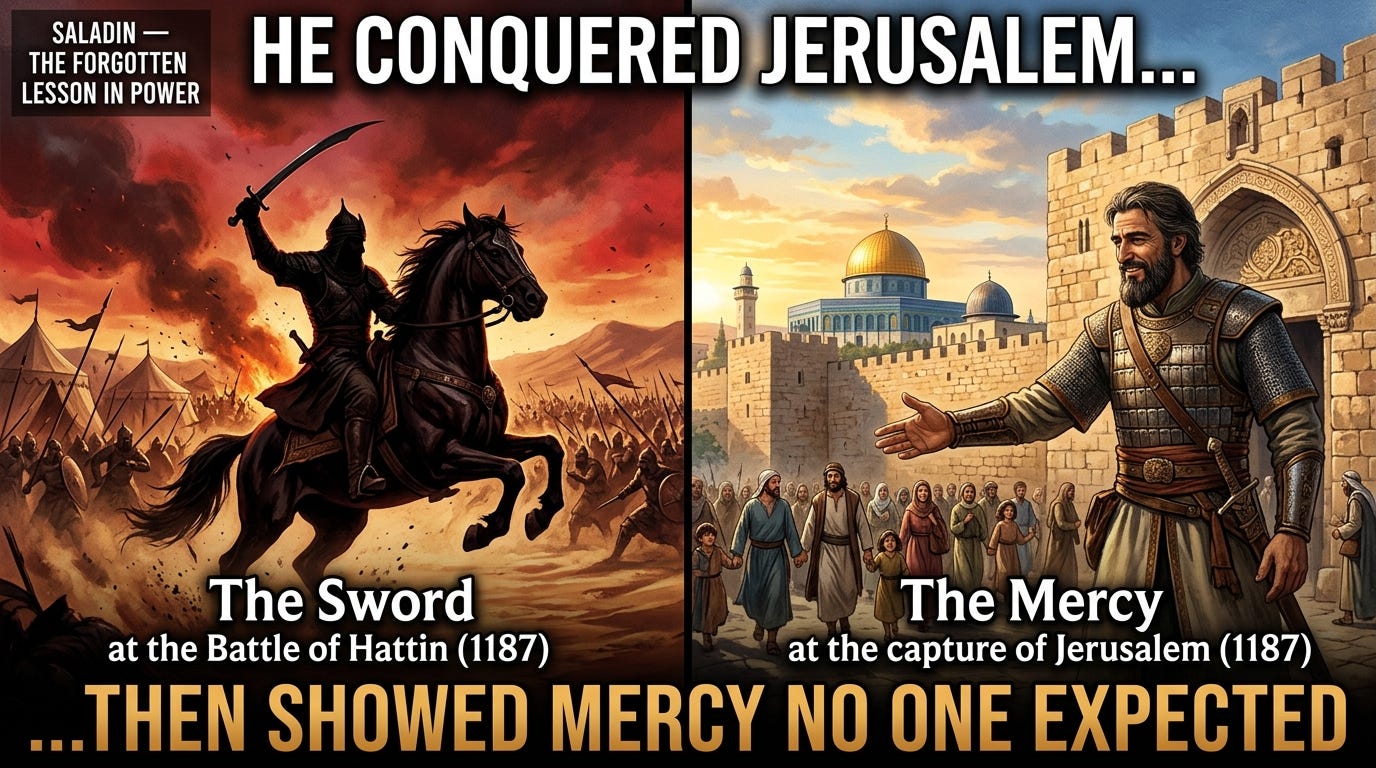
The famous part starts in 1187, at the Battle of Hattin. The Crusader army made the mistake of marching across dry, exposed terrain in brutal summer heat, and Salahuddin — who had clearly planned for exactly this — cut off their access to water while closing in from multiple sides. By the time the fighting was over, the Crusader force had effectively collapsed under exhaustion and thirst as much as combat. It’s still studied as one of the most decisively won battles of the medieval period, and it opened a clear path to Jerusalem.
Jerusalem mattered enormously to Salahuddin and to the Muslim world more broadly — it’s home to Al-Aqsa Mosque, Islam’s third holiest site. When he finally reached the city’s gates, nearly ninety years after the Crusaders had first taken it, a lot of people braced for retaliation.
They had reason to expect it. When the Crusaders seized Jerusalem back in 1099, the conquest had been a bloodbath — thousands of Muslims and Jews killed in the streets. After decades of war and grievance, revenge would hardly have been surprising.
Salahuddin chose something else.
The Mercy That Defined Him
Through negotiation, he allowed most Christian residents to leave the city peacefully in exchange for a ransom, and for those who couldn’t afford to pay, charitable funds — organized in part by Salahuddin himself and his commanders — covered the cost. Churches stayed standing. Christian worship went on. Pilgrims of different faiths were eventually able to visit again.
It stunned people at the time, including writers on the opposing side of the conflict, many of whom still wrote about his fairness and restraint with something close to admiration. Anyone can win a battle and call themselves a conqueror. Far fewer people can win a battle and then choose not to punish the losing side for it. That’s the part of Salahuddin’s story that made him unforgettable rather than just victorious.
An Unlikely Friendship With an Enemy
One of the more striking threads in his life involves King Richard I of England — Richard the Lionheart. The two men fought each other for years during the Third Crusade, and yet something like mutual respect grew between them anyway.
The stories that survive from this period have become almost legendary, even if historians debate how precisely accurate every detail is. When Richard fell ill, accounts describe Salahuddin sending his own physicians and fresh fruit to help him recover. On another occasion, after Richard lost his horse in battle, Salahuddin reportedly sent him a replacement rather than let him fight on foot, exposed.
Scholars argue over how much of this is embellished retelling versus fact, but there’s broad agreement that both men held real respect for each other’s courage. It’s worth sitting with that for a moment — the idea that character shows up most clearly not in how you treat your allies, but in how you treat the person trying to defeat you.
A King Who Died With Almost Nothing
Salahuddin ruled over one of the most powerful states of his time, yet he lived without much personal luxury at all. Rather than filling palaces with treasure, he poured much of his wealth into helping the poor, funding scholars, and building schools, hospitals, and mosques.
When he died in 1193, records show he left behind almost no personal fortune — this from a man who had commanded vast territories for decades. He didn’t leave gold behind. He left a reputation, which turned out to matter a great deal more.
There’s something almost uncomfortably relevant in that today, when success gets measured in cars, square footage, brand names, and follower counts. Salahuddin measured it in service, in justice upheld, in what he’d be accountable for. It’s an old-fashioned yardstick, but it’s stuck around for a reason.
What His Life Still Teaches
His story holds up as a kind of blueprint, even now, for anyone trying to build something that lasts. Discipline tends to outlast raw talent. Preparation beats shortcuts, most of the time. Character carries further than popularity, even if popularity moves faster in the short run.
Think about it in ordinary terms. A student who studies for an hour every day, consistently, usually ends up ahead of someone cramming the night before an exam. A small business built on earned trust tends to outlast one chasing quick profit. None of this is new — Salahuddin was operating on the same logic centuries before either of those examples existed.
In Pakistan and plenty of other places, young people look at successful entrepreneurs and leaders while navigating real limits — economic pressure, narrow opportunities, uncertain paths forward. The obstacles differ from place to place, but the underlying hope doesn’t: people want to build something better for themselves and the people who come after them. Salahuddin’s life is a pretty direct rebuttal to the idea that circumstances decide outcomes. Choices tend to matter more.
Why the Name Survived
His influence hasn’t stayed confined to Muslim communities — historians, military strategists, and students of leadership across very different cultures still study him. What he demonstrated, again and again, is that strength without justice curdles into oppression. Power without humility turns into arrogance. And victory, stripped of mercy, doesn’t really mean much at all.
That’s probably why his name has outlasted rulers who were wealthier and, on paper, more powerful. Reclaiming Jerusalem wasn’t really his greatest achievement. Proving that courage and compassion could coexist in the same person — that faith could inform political leadership without corrupting it — that was the harder, rarer thing.
His empire eventually dissolved, the way empires do. What survived was the example. And that’s really why Sultan Salahuddin Ayyubi is still remembered — not just as the man who took back Jerusalem, but as one of the more genuinely great leaders history has produced.
메타데이터
- post_id
- 5fb0e8349cbf
- slug
- the-great-sultan-salahuddin-ayyubi-the-leader-who-conquered-hearts-before-he-conquered-jerusalem-5fb0e8349cbf
- url
- https://medium.com/@salamkhanali12/the-great-sultan-salahuddin-ayyubi-the-leader-who-conquered-hearts-before-he-conquered-jerusalem-5fb0e8349cbf
- canonical_url
- https://medium.com/@salamkhanali12/the-great-sultan-salahuddin-ayyubi-the-leader-who-conquered-hearts-before-he-conquered-jerusalem-5fb0e8349cbf
- author_url
- https://medium.com/@salamkhanali12
- status
- ok
- fetched_at
- 2026-08-08 02:08:21