Interview with PIPO CEO Igor Lipovetskyi: Pre-IPO Investing Is No Longer a VIP Club
Igor Lipovetskyi began his Wall Street career at BDO Seidman and Deloitte & Touche, where he supported Merrill Lynch on IPO and M&A…
Interview with PIPO CEO Igor Lipovetskyi: Pre-IPO Investing Is No Longer a VIP Club
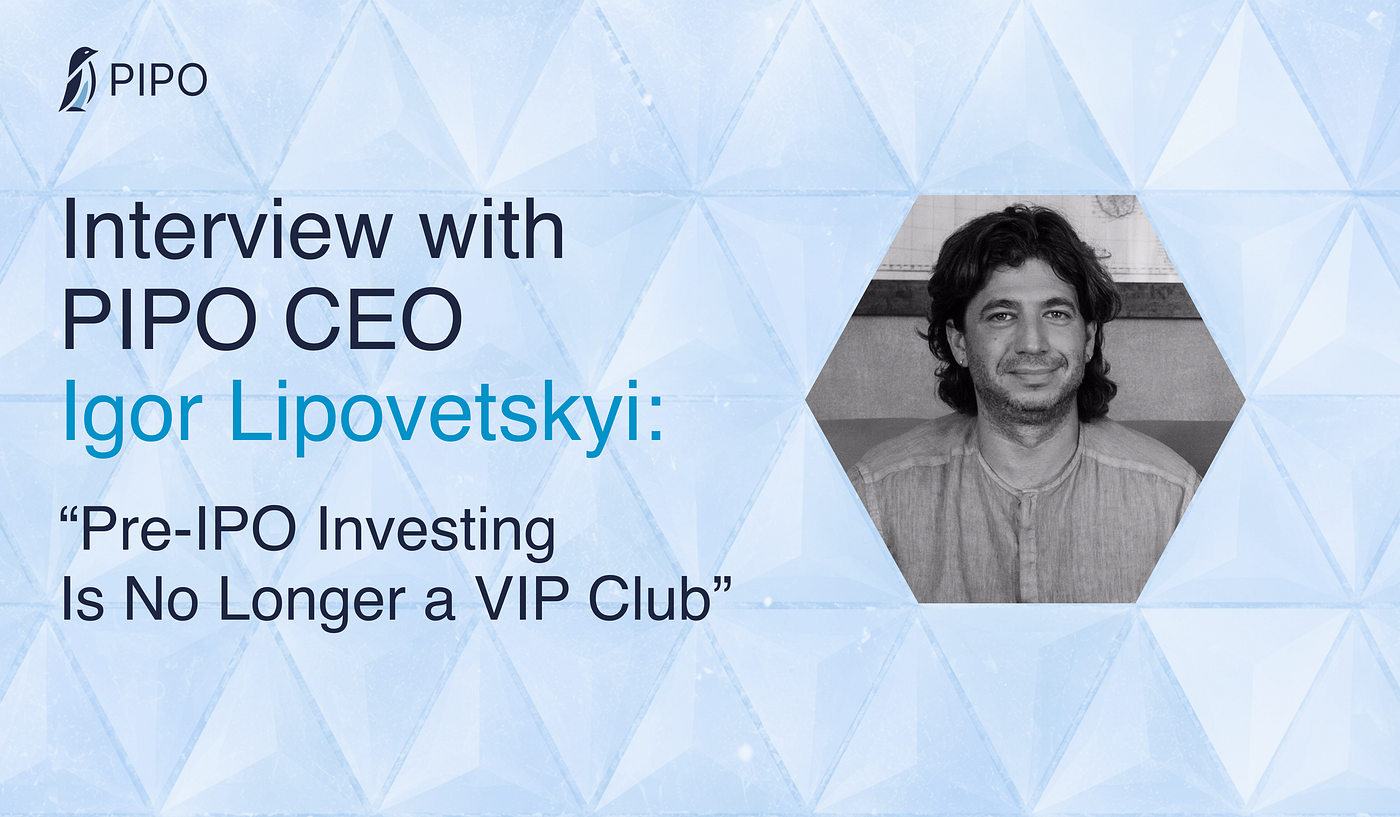
*Igor Lipovetskyi began his Wall Street career at BDO Seidman and Deloitte & Touche, where he supported Merrill Lynch on IPO and M&A transactions, and has built 25+ years of international capital markets experience advising on listings on the NYSE, the Frankfurt Stock Exchange, and the Toronto Stock Exchange. Now he’s the Founder of PIPO, a pre-IPO security token platform that gives global retail investors liquid access to private companies before they go public. We sat down with Igor to talk about what’s broken in private markets, how PIPO fixes it, and why 2026 is the defining moment for this category.*
Igor, you’ve spent decades advising on IPOs, M&A, and cross-border listings. What made you stop advising and start building?
— Frustration, mostly. I kept seeing the same inefficiency erode the value equation on both sides of the table.
On one side, you have privately held companies with good fundamentals: steady revenues, sustainable business models, seasoned teams trapped in illiquidity. Without efficient mechanisms to raise equity before going public, they’re forced into costly dilutions or have to delay their exit. On the other side, you have institutional and retail investors who want exposure to that growth and are effectively shut out by traditional gatekeepers and a regulatory system designed for the previous century.
Pre-IPO rounds can deliver outsized returns: 5x to 20x is a range you often see for those who enter before the listing, though, of course, these are not guaranteed. Historically, that kind of access has been reserved for venture funds, family offices, and wealthy individuals. Ordinary investors have never had a real way to participate in the growth of private companies before they go public.
Advice alone was never going to change that. You can improve deal flow for individual transactions, but the underlying infrastructure is broken. So we built PIPO to remove those barriers entirely.
Walk us through what PIPO actually is. What does an investor do on your platform?
— PIPO is where tokenized pre-IPO opportunities live. The instrument we built is called a Share Subscription Warrant, an SW. Each SW is a digital security token that gives the holder the right to buy one share of a private company at a fixed strike price, with a clear path to a Nasdaq listing.
For the investor, it’s deliberately simple. You sign up, complete KYC, and buy SW tokens directly on PIPO with a card or stablecoin. After listing on a centralized exchange, you can also acquire them on platforms you already use. The token is liquid from day one, it trades on the PIPO order book and on partner CEXs around the clock. Its value moves as the company progresses: new investments, partnerships, an F-1 filing, and the IPO itself.
When the company goes public, you have choices. You can pay the strike price and receive actual Nasdaq-listed shares delivered to your brokerage account. You can do a cashless exercise: net out the strike price and receive fewer shares with no payment. Or you can do nothing at all and just keep trading the token. That’s an important point many people miss: the SW continues to trade post-IPO in parallel with the listed equity for the full warrant term. Nothing automatically converts. The token is a parallel market for the listed share; you exercise at your discretion, or you don’t exercise and treat it as a tradable instrument.
And you don’t even need to wait for the IPO. Once the Transfer Agent is onboarded, the Redemption Gate opens, and you can redeem the token for physical shares at any time. Your timing, your choice.
You’ve structured listings across the US, Frankfurt, and Canadian exchanges. How does that experience shape the legal architecture behind PIPO?
— Enormously. The first and biggest pitfall in tokenized finance is treating legal structure as an afterthought. The structure isn’t an accessory, the structure IS the product.
So let me draw the line clearly, because it matters. The issuer of the SW token is a Cayman Islands SPV, which we’ll call SPV1. SPV1 is the legal entity that issues the warrants under SEC Regulation S, holds the relationship with the underlying company, and controls the FPI pathway to Nasdaq. SPV1 is the security.
PIPO itself is a separate entity in a different jurisdiction with a different role. PIPO is the El Salvador platform, the venue. Token holders bring their SWs to PIPO to trade them. PIPO handles onboarding, KYC, the data room, and, once we have our DASP license, the regulated secondary market with a professional order book and market-making. PIPO is the place where SWs live and trade, but PIPO does not issue the security and is not the warrant’s counterparty.
Why does that separation matter? Because in tokenized finance, mixing those roles is how you blow up your equity classification, your FPI status, and your ability to list on a major exchange. Each SW is structured to satisfy the ASC 815–40 “fixed-for-fixed” test, one token, one share, fixed strike, no anti-dilution gymnastics, no issuer-side cash settlement. That’s what preserves the issuer’s equity classification on the balance sheet, and that’s what survives Nasdaq listing review. You don’t get there by accident.
Institutional due diligence is what we’ve spent 25 years learning to pass. PIPO was designed to withstand it.
One of the core challenges in tokenizing securities is the tension between liquidity and compliance. How does PIPO resolve that?
— This is exactly where most platforms either ignore the problem or solve it badly. The dilemma is real: to give investors meaningful liquidity, you need access to global crypto exchange infrastructure. But an SW is a security under Regulation S, it cannot reach US persons.
Our answer is the Compliance Perimeter. The intuition is simple: separate economic exposure from securities settlement. Issuance happens only on PIPO, with full KYC and a smart-contract whitelist; no wallet receives a token on-chain unless its holder has been verified as a non-US person. Once the token is in circulation, it can also trade on approved CEX venues under formal compliance agreements, those partners are contractually bound to geo-block the US, screen for VPNs, display Reg S disclosures, and report jurisdiction data back to us monthly. So the trading layer is broad and global.
The piece that ties it together is that exercising the warrant, actually converting the token into a real share, can only happen back through PIPO, with a verified KYC profile. If someone buys an SW on a CEX without ever onboarding to PIPO, they hold tradable economic exposure but cannot convert it into equity. That’s the controlled gate that keeps the security inside the regulatory perimeter, even while the token itself trades freely on global venues.
This framework aligns directly with the SEC’s January 2026 Statement on Tokenized Securities. We’re not working around the regulation, we’re building with it.
2026 feels like a critical moment for tokenized assets broadly. Do you see PIPO as part of a larger wave?
— Absolutely, and the timing isn’t an accident. The GENIUS Act in 2025 established the US’s first real federal framework for payment stablecoins, signaling that Washington is finally ready to regulate digital assets rather than just litigate them. The SEC’s 2026 work on tokenized securities opened a regulatory window that hadn’t existed before. And institutional capital is here in a way it wasn’t even two years ago. BlackRock, Bank of America, and Citi are now in the tokenized RWA space.
Look at Circle’s IPO last year, a crypto-native company that went public through a traditional listing and delivered institutional-grade returns. Pre-IPO exposure to a company like that is exactly what PIPO enables. We’re not fighting the tide, the infrastructure is ready, the regulatory clarity is emerging, and the audience is ready. PIPO is launching now, not because we wanted to be fashionable, but because all the necessary pieces have finally come together.
Who is the PIPO investor? Who are you actually building this for?
— This is the part I want to be very clear about, because there’s a lot of noise around it. PIPO is not built for crypto degens. It’s not for memecoin traders or launchpad sharks. We’re building this for ordinary people, for the retail investor who has watched companies like Stripe, SpaceX, Databricks, and OpenAI sit privately for a decade while only the rich got to participate.
The promise of PIPO is that you don’t need to be a venture capitalist or an accredited investor in the US sense to get pre-IPO exposure. You sign up, pass KYC, buy SW tokens directly with your card, and hold a real instrument tied to a real company with a real path to Nasdaq. If you’d rather use a crypto exchange you already trust, such as WhiteBIT or KuCoin, you can buy there too. We meet investors where they already are.
So yes, crypto-savvy users are welcome, and they’ll feel at home with the mechanics. But the core audience is much wider than that. It’s anyone who has ever read about a hot pre-IPO company and thought, “I wish I could get a piece of that before it goes public.” For the first time, the answer is: you can.
What does the next 12 months look like for PIPO?
— The plan is deliberately structured. We start with anchor and strategic placement institutional, strategic, and high-net-worth investors come in under Reg S to seed the initial investor base, and in parallel, we close out the DASP license in El Salvador and finish the dual smart-contract audit. From there, we open up secondary trading: a professional order book with an independent market maker on PIPO itself, and rolling CEX listings under our Compliance Perimeter we move from smaller venues up to the larger ones as volume builds. The endpoint is the Nasdaq IPO, where the exercise window opens, holders choose physical or cashless exercise, and the real Nasdaq-listed shares are delivered to their brokerage accounts via the Transfer Agent and DTC. After IPO, the SW continues to trade for another 24 months, so even after the listing, there’s still a parallel liquid market on the warrant itself.
The 12-month target is the Nasdaq listing. That’s not aspirational language, that’s the product mechanic. The whole point of the SW is to give an investor a liquid instrument with a defined path to real public equity. When we cross that finish line, PIPO will have done something nobody has done before: given a global retail audience institutional-grade pre-IPO access with real liquidity, real legal compliance, and real share delivery at the end.
Private markets used to be invite-only. PIPO changes that.
Igor Lipovetskyi is CEO of PIPO and a 25+ year veteran of international capital markets. He began his career at BDO Seidman and Deloitte & Touche, where he supported Merrill Lynch on IPO and M&A transactions, and has since advised companies on listings on the NYSE, the Frankfurt Stock Exchange (FSE), and the Toronto Stock Exchange (TSX/TSX-V). PIPO is a pre-IPO security token platform accessible at pipo.vc.
Disclaimer: This interview is for informational purposes only and does not constitute an offer to sell or solicitation of an offer to buy any securities. PIPO tokens are offered exclusively under SEC Regulation S to non-US persons in offshore transactions. All return figures and projections are illustrative and subject to change based on actual IPO outcomes. All investments carry the risk of total loss.
메타데이터
- post_id
- 5fc8fe2db457
- slug
- interview-with-pipo-ceo-igor-lipovetskyi-pre-ipo-investing-is-no-longer-a-vip-club-5fc8fe2db457
- url
- https://medium.datadriveninvestor.com/interview-with-pipo-ceo-igor-lipovetskyi-pre-ipo-investing-is-no-longer-a-vip-club-5fc8fe2db457
- canonical_url
- https://medium.datadriveninvestor.com/interview-with-pipo-ceo-igor-lipovetskyi-pre-ipo-investing-is-no-longer-a-vip-club-5fc8fe2db457
- author_url
- https://medium.com/@romanwiligut
- status
- ok
- fetched_at
- 2026-06-20 20:29:01