Local Wallet Payment Acceptance for iGaming Operators: How to Win Emerging Markets in 2026
The story of global iGaming is now moving to new parts of the world, like Southeast Asia, South Asia, Africa, and Latin America. What makes…
Local Wallet Payment Acceptance for iGaming Operators: How to Win Emerging Markets in 2026
Local wallet
The story of global iGaming is now moving to new parts of the world, like Southeast Asia, South Asia, Africa, and Latin America. What makes these places so interesting to iGaming companies? Well, they have a few things that make them really attractive. First, they have a lot of people who are connected to the internet and like to use their phones. Second, more and more people are getting smartphones, which is making it easier for them to play games online. And third, people in these places have always liked to bet on sports and play games, even before the internet existed. This combination of things makes them really exciting for iGaming operators. Another thing that these countries have in common is their payment systems, which are quite different from those in Europe and North America, where credit cards are the primary method of payment. This difference can make it challenging for Western-based online gaming companies to fully capitalize on the opportunity, as they often rely on payment systems that are not as widely used in these regions. In Europe and North America, cards are the dominant form of payment, but in other parts of the world, alternative payment methods are more prevalent, which can create a barrier for companies that are not equipped to handle these differences.
In lots of countries, such as the Philippines, Indonesia, Pakistan, Nigeria, Kenya, and Brazil, you’d be surprised at how little people use cards like Visa. What they use instead is something called a mobile wallet — it’s basically an app on their phone that can do all sorts of things. For example, it can help them pay for their groceries, utility bills, and even send money to their friends. These wallets are really important because they make it easy for people to manage their money and make payments without needing a traditional bank account or credit card. This is especially helpful in places where not everyone has access to banks or credit cards. By using mobile wallets, people can take care of their financial needs in a way that’s convenient and easy to use.
For companies that operate in the online gaming industry and want to establish a strong presence in certain markets, having the ability to accept payments from local wallets is crucial. It’s not just an added bonus, but a fundamental requirement to enter the market. Without this capability, the majority of potential customers are unable to make deposits, which means they can’t place their first bet. This is because, in these markets, local wallets are the primary method people use to make online payments. If a gaming company doesn’t accept local wallets, it’s essentially shutting itself off from a significant number of customers. Therefore, accepting local wallets serves as the foundation upon which everything else is built, enabling companies to genuinely connect with their players and build a successful business. By doing so, they can tap into the local market, understand the needs and preferences of their customers, and provide them with a seamless and convenient gaming experience. This, in turn, can lead to increased customer loyalty, retention, and ultimately, revenue growth. In essence, accepting local wallets is the key to unlocking the full potential of a market and achieving long-term success in the online gaming industry.
This article covers the full landscape of local wallet payment acceptance for iGaming operators targeting emerging markets — from the market-specific wallet ecosystems and compliance requirements to the technical integration architecture and conversion optimisation strategies that turn a local wallet integration from a checkbox into a genuine competitive advantage.
The Emerging Market Wallet Landscape
To do well in different areas, you need to understand how people make digital payments in each place. Each big market has its own favorite way of paying digitally, usually with one or two major platforms handling most payments. So, the first step to creating a good local payment plan is to learn about this and pick the right digital payment methods for each area you want to operate in. This means looking at what’s popular in each market and choosing the payment platforms that are most widely used. By doing this, you can make sure you’re giving your customers the payment options they prefer, which can help you succeed in each market. Southeast Asia.
The digital wallet market in Southeast Asia is really one of a kind and changing fast. What’s fascinating is that each country has its own approach, with different platforms being popular in different areas. For instance, a platform that’s well-known in one country might not be as popular in another. This is making the market really competitive, with lots of players trying to get ahead. In some countries, local platforms are leading the way, while in others, international players are making a big impact. This mix of local and international players is creating a lot of excitement and uncertainty in the market. As the market continues to evolve, it will be interesting to see how the different players adapt and compete with each other. Overall, the digital wallet market in Southeast Asia is a complex and dynamic space, with a lot of opportunities and challenges for players to navigate.
In the Philippines, mobile wallets are extremely popular, and this is largely due to the presence of GCash and Maya. GCash, which is operated by Globe Telecom, boasts an impressive user base of over 90 million people and processes a substantial number of transactions on a monthly basis. For online gaming companies seeking to break into the Filipino market, which is renowned for its enthusiasm for sports betting in Asia, offering GCash as a payment option is essentially a necessity. Meanwhile, Maya provides an alternative that caters to a distinct demographic, particularly those who lack bank accounts but have been introduced to the digital financial system through GCash. This is significant because it provides individuals with more payment options, making it easier for them to access online gaming services. By having these mobile wallets, people in the Philippines have more flexibility and convenience when it comes to online transactions.
In Indonesia, the situation is pretty unique, with GoPay, a part of the Gojek super-app, and OVO, backed by Grab and Tokopedia, vying for the top spot in the market, alongside other major players like Dana and LinkAja. But for Indonesian companies that offer online gaming, things get really complicated. They have to navigate the country’s complex rules and regulations, which can be a challenge. The thing is, online gambling is actually against the law in Indonesia. So, these companies have to find a way to target the large number of Indonesians living abroad, in places where online gaming is allowed. It’s a tricky landscape to navigate, but they have to do it in order to succeed. They need to figure out how to reach their target audience, while also complying with the laws and regulations in Indonesia. It’s a delicate balance, but one that’s necessary for these companies to thrive in the online gaming industry.
In Thailand, the digital wallet market is dominated by two major players: TrueMoney, which is owned by True Corporation, and PromptPay, a national payment system supported by the Bank of Thailand that can be used by various banks. One of the key advantages of TrueMoney for operators is its significant presence in several Southeast Asian countries, making it an ideal choice for those looking to expand into multiple markets in the ASEAN region with just a single integration. This is particularly crucial for businesses seeking to cross borders and requiring a dependable payment system that can operate seamlessly in numerous countries. By having a strong foothold in many countries, TrueMoney provides a convenient and efficient solution for companies aiming to tap into the regional market. As a result, it has become a popular option for businesses looking to establish a presence in the ASEAN region, where a reliable payment system is essential for success.
In Vietnam, MoMo is the top dog when it comes to digital wallets, with a massive following of over 31 million users. It’s pretty much a part of everyday life for Vietnamese consumers when they’re making payments. But MoMo isn’t the only player in town — ZaloPay is another popular choice, and it’s backed by VNG Corporation, the same company that’s behind Zalo, the messaging app that everyone in Vietnam seems to use. ZaloPay is especially popular among younger folks, who love it because it’s a convenient alternative to MoMo.
South Asia
South Asia is a huge and quickly growing market for online money trading and internet gaming, thanks to its young people who are really into technology and the fact that more and more people are getting smartphones.
In Pakistan, the digital wallet market is dominated by two major players, JazzCash and EasyPaisa. JazzCash is owned by Jazz, the country’s largest telecom company, while EasyPaisa is operated by Telenor Pakistan. These platforms have gained immense popularity among Pakistani consumers, who primarily use their mobile phones to access the internet. As a result, people frequently use JazzCash and EasyPaisa to make online payments for various services, including gaming and entertainment. For companies that offer foreign exchange trading or sports betting and wish to operate in Pakistan, integrating their services with JazzCash and EasyPaisa is essential to reach customers who do not have international bank cards. This is because many individuals in Pakistan rely heavily on these digital wallets for online transactions. By partnering with JazzCash and EasyPaisa, these companies can simplify the process of depositing and withdrawing money for their customers, which is crucial for their business operations. The significance of JazzCash and EasyPaisa in Pakistan’s digital payments landscape cannot be overstated, and their integration is vital for companies seeking to tap into the country’s rapidly growing online market. In fact, the popularity of these digital wallets has created new opportunities for businesses to reach a wider audience and expand their customer base. Moreover, the ease of use and convenience offered by JazzCash and EasyPaisa have made them an indispensable part of Pakistan’s online ecosystem. As the country’s digital payments market continues to evolve, the role of JazzCash and EasyPaisa is likely to become even more critical, enabling businesses to navigate the complex landscape of online transactions and providing customers with a seamless and secure payment experience.
In Bangladesh, the digital payment system is mainly controlled by bKash, a mobile financial service run by BRAC Bank. This service has a huge user base, with over 65 million registered users, which is a big part of the adult population in Bangladesh. Many of these users don’t have traditional bank accounts and rely on bKash as their main way to manage their money. Africa
In Africa, they have really good systems for mobile money, which is one of the best in the world. This is because of how well M-Pesa did in Kenya, and then how mobile money spread to other parts of the continent.
In East Africa, M-Pesa plays a significant role in digital payments, particularly in Kenya where it is operated by Safaricom, and in Tanzania where it is run by Vodacom, among other locations. With a substantial user base of over 50 million people, M-Pesa facilitates a considerable volume of transactions for both individuals and small businesses. For online gaming companies seeking to establish a presence in Kenya, Tanzania, or Uganda, where sports betting is extremely popular, integrating with M-Pesa is essential. Given the large number of people in these countries who engage in sports betting, it is crucial for businesses to ensure their systems are compatible with M-Pesa. Essentially, M-Pesa is the primary method through which people in East Africa make online payments, making it vital for businesses to be integrated into this system. By doing so, companies can effectively tap into the thriving sports betting market in these regions.
Furthermore, the importance of M-Pesa in East Africa’s digital payment landscape cannot be overstated, as it has become an indispensable tool for online transactions, underscoring the need for businesses to adapt and work with this platform to succeed in the local market.
Nigeria is home to a wide range of digital payment systems, including Opay, PalmPay, Kuda, and Flutterwave, all of which are competing with one another and with the national instant payment system, operated by NIBSS. The country’s online gaming market is substantial and growing rapidly, driven in large part by the popularity of sports and betting among young people. While establishing local wallet systems in Nigeria can be challenging due to the numerous options available, the potential rewards are significant, given the size and growth potential of the market. In fact, the demand for digital payment solutions is on the rise, and companies that can navigate the complexities of the local market are likely to reap significant benefits. By understanding the unique characteristics of the Nigerian market and adapting their strategies accordingly, businesses can tap into the country’s vast potential and establish a strong presence in the region.
In West Africa, MTN Mobile Money is the go-to service in countries like Ghana and Côte d’Ivoire. It’s widely used for mobile payments, and its popularity spans both Francophone and Anglophone nations. For businesses looking to break into this market, partnering with MTN MoMo is a smart move — it gives them access to multiple countries through a single partnership, making it easier to expand their services across the region. This is especially useful for companies that want to reach a broad audience without having to navigate complex local systems. By teaming up with MTN MoMo, they can tap into the existing network and reach customers in several countries, which can help them grow their business more quickly.
Latin America
The way people in Latin America handle their finances is undergoing a significant transformation. Newly emerging tech companies are introducing innovative payment methods, which is having a profound impact on how individuals manage their money. Just a short time ago, the financial landscape was quite different. However, with the advent of digital payment options, people now have a wide range of choices, making it easier for them to keep track of their finances. This shift is not only changing the way people pay for things, but also providing them with more control over their financial lives. As a result, the traditional methods of payment are being replaced by more modern and convenient alternatives, which is having a lasting impact on the region’s financial sector.
In Brazil, a new payment system called Pix was launched by the Central Bank of Brazil in November 2020. It has been a huge success, with over 140 million people using it and handling a large number of transactions, almost as many as traditional card payments. For online gaming companies looking to operate in Brazil, which is now a major market for sports betting after the government legalized online gambling, being able to use Pix is crucial for taking payments from local customers. This is because Pix has become a very popular payment method in Brazil, and companies that want to do business there need to be able to accept it. By integrating Pix into their systems, these companies can make it easier for Brazilian customers to use their services and pay for things online. This is especially important for companies that want to tap into the Brazilian market, as Pix has become the preferred payment method for many locals.
As a result, companies that offer online gaming and want to succeed in Brazil need to prioritize Pix integration to stay competitive and provide a seamless payment experience for their customers. In Latin America, Mercado Pago, a part of MercadoLibre, provides a wallet that is widely used in several countries, including Argentina, Brazil, Mexico, Colombia, Chile, and Peru. This makes it an ideal choice for businesses looking to expand in this region. With over 45 million active users, Mercado Pago has a deep understanding of the financial habits of people in Latin America. As a result, it is a crucial partner for any company aiming to succeed in this market. By partnering with Mercado Pago, businesses can gain insight into the local financial preferences and habits of Latin American consumers, which is vital for making a significant impact in the region. This understanding can help companies tailor their services to meet the unique needs of Latin American customers, ultimately driving their success in the market.
Compliance Requirements for Local Wallet Integration in iGaming
When you’re dealing with local wallets in the iGaming industry, things can get pretty messy, unlike global wallets which are more straightforward. The main issue here is that local wallet providers, especially those in emerging markets, have their own unique rules and regulations to follow. These rules can be really restrictive, sometimes even completely banning the use of local wallets for making payments related to gambling. And the thing is, this has nothing to do with whether the iGaming operator has the necessary licenses or not — it’s all about the local regulations and how they impact the use of these wallets.
In areas where regulations are in place, operating with local wallets requires a special permit, essentially a license. This is a fundamental necessity for the majority of local wallet integrations in these regions. For instance, if a casino based in Malta aims to enable players from the Philippines to use GCash, the casino must demonstrate to GCash’s team that they possess a local license from PAGCOR, the Philippine Amusement and Gaming Corporation, or are in the process of obtaining one. Alternatively, they need to provide proof that their current license grants them the permission to target players from the Philippines. This process is typical for local wallet integrations in areas with regulatory frameworks.
The license serves as a form of approval, indicating that the casino complies with the local laws and regulations, which is crucial for the integration of local wallets like GCash. By obtaining the necessary license, the casino can ensure a smooth and legal operation, allowing Filipino players to use GCash securely and conveniently. To meet the standards of local wallet providers, iGaming operators must show they are doing a good job of watching transactions and checking customers. This is especially true for wallet providers in South Asia and Africa, where the rules against money laundering are getting stricter. The operators need to give documents that prove they are following these rules, which are based on the standards set by the Financial Action Task Force (FATF). This is to make sure the operators are meeting or even exceeding the wallet providers’ own requirements when it comes to stopping money laundering.
Local payment providers are increasingly requiring gambling operators to demonstrate their commitment to responsible gambling practices. This involves implementing measures such as deposit limits, self-exclusion options, and tools to identify potential problem gamblers. The driving force behind this trend is the pressure from regulators on payment providers to ensure they are not facilitating harmful gambling behaviors. As a result, gambling operators must now prioritize responsible gambling initiatives to maintain relationships with these payment providers. By doing so, they can help prevent gambling-related harm and promote a safer gaming environment. This shift in approach is crucial, as it acknowledges the importance of protecting vulnerable individuals from the potential negative consequences of gambling.
Technical Integration Architecture for Local Wallets
Setting up a local wallet for online gaming can be a real challenge. The technical side of things is way more complicated than it is for a global wallet. One of the main reasons for this is that local wallet providers just don’t have the same level of standards as global ones. Their technical guides are often not as detailed, which can make it hard to figure things out. And to make matters worse, the teams that are supposed to help merchants get set up are not as experienced as they could be. This can lead to a lot of frustration and wasted time. Unlike global wallets, which have widely accepted standards and more comprehensive guides, local wallets can be a bit of a puzzle to set up. As a result, it’s not always easy to get everything up and running smoothly.
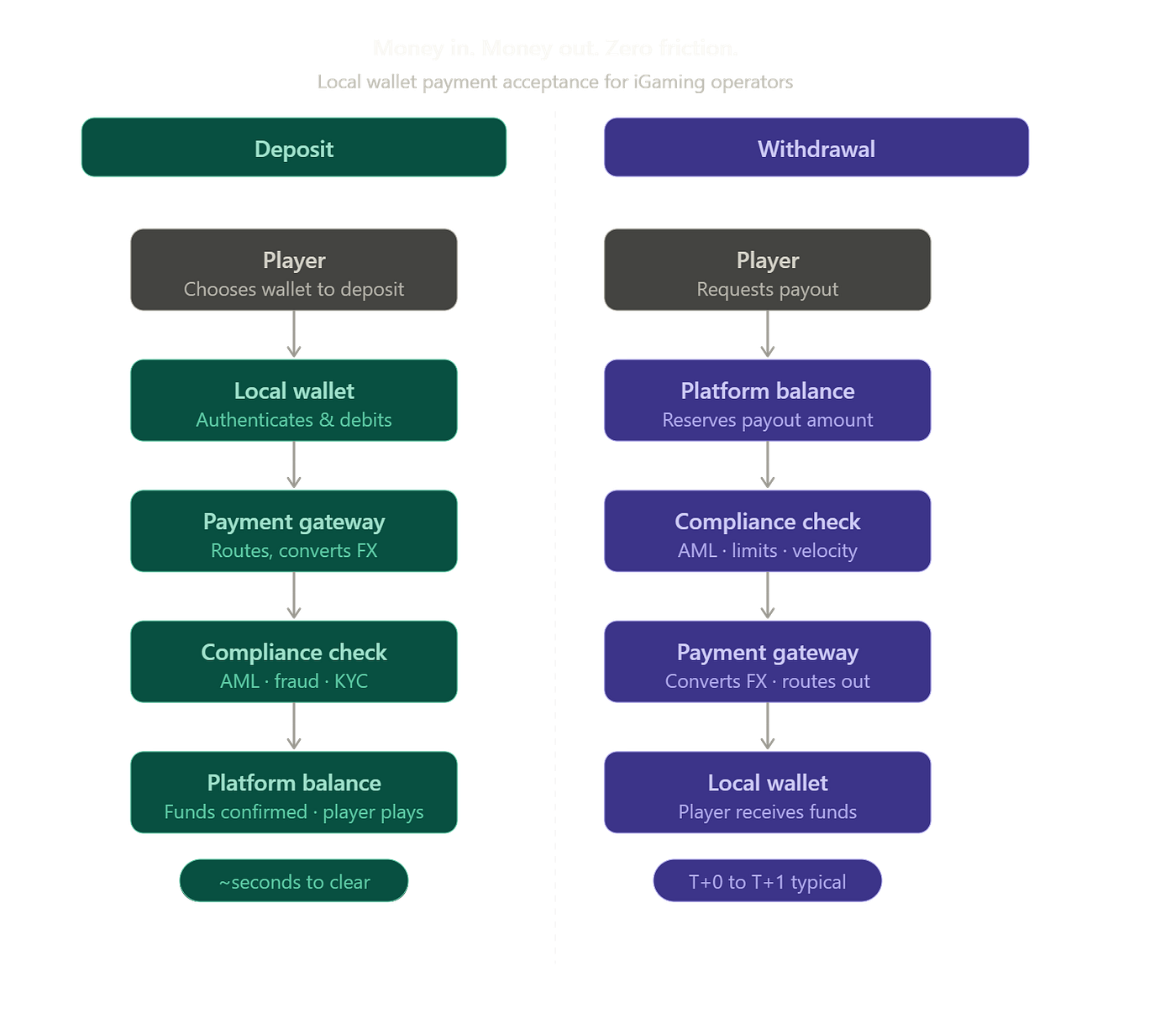
For online gaming companies, using a single system to manage payments is usually the best approach. This system, known as a payment platform, handles all the technical aspects, such as integrating with various local wallet providers and resolving any issues that arise. It also provides the gaming company with a straightforward and standardized way to connect to multiple wallets in different markets. This method is the most efficient because it eliminates the need for the gaming company to perform complex technical tasks and maintain multiple connections. As a result, they can focus on their core business and let the payment platform take care of the payments. By doing so, gaming companies can simplify their payment processes and reduce the hassle of dealing with numerous wallet providers. This, in turn, allows them to concentrate on what matters most — providing a great gaming experience for their users.
Connecting with each local wallet provider is a possibility, but it’s a pretty complex process. From a technical point of view, it’s doable, but it would require a significant amount of resources to make it happen. The thing is, when you integrate directly with a provider, you’re taking on a lot of extra work — you have to keep the integration up to date, which can be time-consuming. And as you add more wallets to the system, this maintenance work will just keep piling up.
Conclusion
Investing in local wallet payment acceptance is a smart move for iGaming operators in 2026, especially in emerging markets. You see, in places like Southeast Asia, South Asia, Africa, and LATAM, local wallets are the main way people pay for things. And it just so happens that these markets are also where the iGaming industry is growing the fastest. By getting in on the local wallet payment scene, operators can tap into this growth and get a big return on their investment. It’s a no-brainer, really — local wallets are the way to go in these markets, and iGaming operators who don’t get on board might be left behind.
Companies that create local wallet coverage in these markets now will have a big advantage over their competitors who only use card processing. This advantage will get bigger over time. Being the first to enter a local wallet ecosystem helps build brand awareness, customer loyalty, and operational expertise that takes years for others to catch up with.
메타데이터
- post_id
- 5fe8d5319a3d
- slug
- local-wallet-payment-acceptance-for-igaming-operators-how-to-win-emerging-markets-in-2026-5fe8d5319a3d
- url
- https://medium.com/@dileep67/local-wallet-payment-acceptance-for-igaming-operators-how-to-win-emerging-markets-in-2026-5fe8d5319a3d
- canonical_url
- https://medium.com/@dileep67/local-wallet-payment-acceptance-for-igaming-operators-how-to-win-emerging-markets-in-2026-5fe8d5319a3d
- author_url
- https://medium.com/@dileep67
- status
- ok
- fetched_at
- 2026-06-20 20:29:01