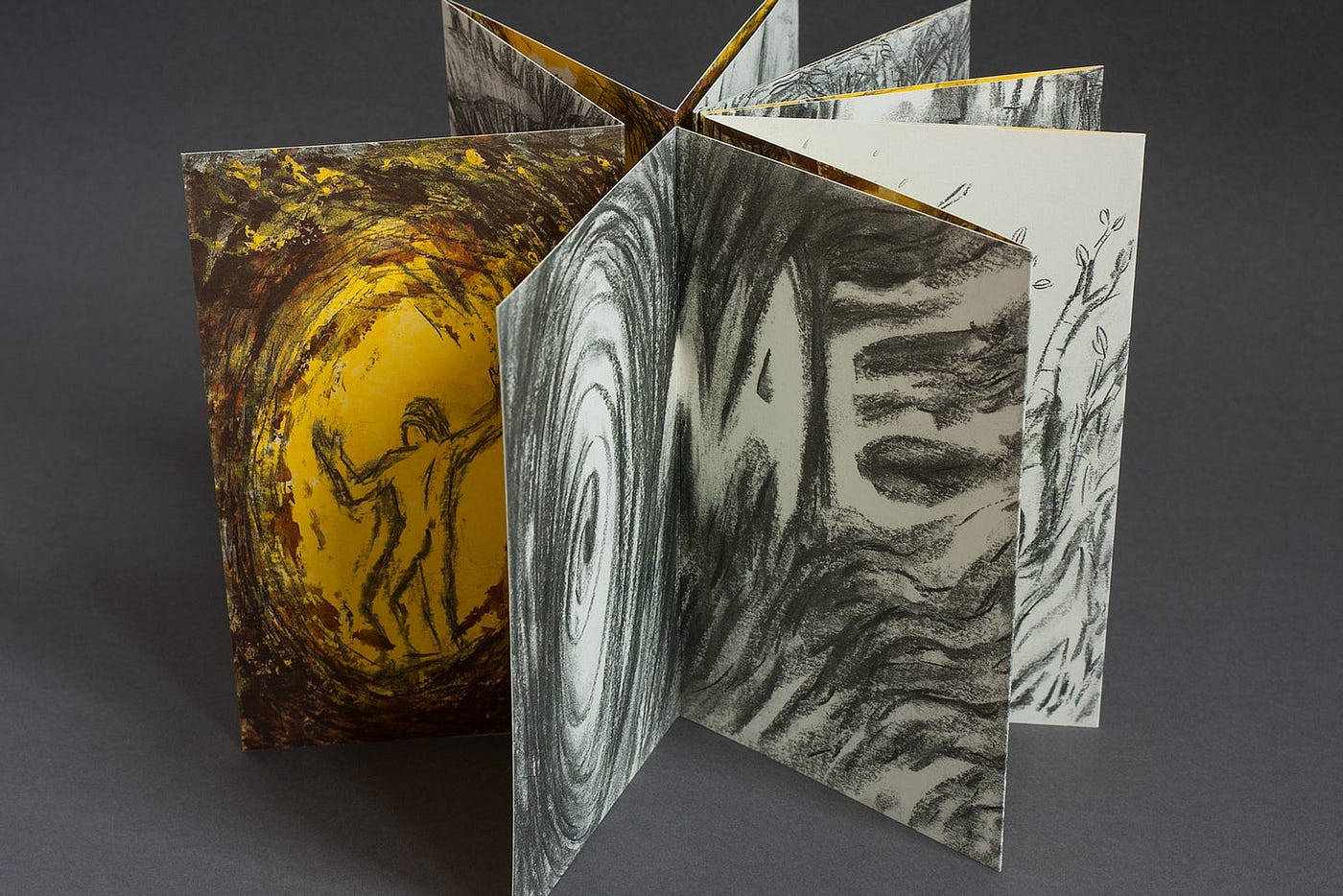
Field Dialogue 3: Talking Salmon
Snapshots from a living field — surfacing stories, practices, and insights in the evolving work of engaging the More-than-Human (For the…
Field Dialogue 3: Talking Salmon
Snapshots from a living field — surfacing stories, practices, and insights in the evolving work of engaging the More-than-Human (For the full version of this Field Dialogue, consisting of an audio track & written synthesis, go to the Substack of the **Co-creation with the More-than-Human sandbox**)
Listen to the conversation:
▶️🎙️Access the audio track on Substack
Read the synthesis:
🌿 Field Dialogue #3 — Talking Salmon
The salmon has been connecting oceans, rivers and forests for millennia. Can we learn to tell that story from inside it rather than from a distance?
What would it mean for a story to genuinely cross the boundary between human and more-than-human — not as a rhetorical move, but as something that actually shifts how we see and relate? And what does it ask of the person trying to tell it?
In this third Field Dialogue, we spoke with Torsten Schäfer — environmental journalist, nature writer, wilderness pedagogist, and professor of journalism at Darmstadt University of Applied Science. For over twenty years, Torsten has worked at the intersection of environmental storytelling and ecological relationship. His current research project, Talking Salmon, funded by the Okeanos Foundation for the Sea and developed with Oslo Metropolitan University, follows the salmon across field sites in Germany, Scandinavia, and the Pacific Northwest — not just as a subject, but as a lens, a connector, and an invitation to tell stories differently.
The conversation moved through questions of language, method, kinship, and the limits of journalism as it currently exists. What does it mean to write as a fish rather than about one? What do Sami languages carry that Western ecological science has no words for? And what actually happens to a journalism student when they try to interview a tree?
The outcome of Talking Salmon will be a massive open online course (MOOC) on ecological storytelling, due in September 2026 — but the questions it is working through feel far larger than any course. Rather than a finished methodology, it provides a glimpse into work that is actively being built — in fieldwork, in classrooms, in the space between a river and the person learning to listen to it.
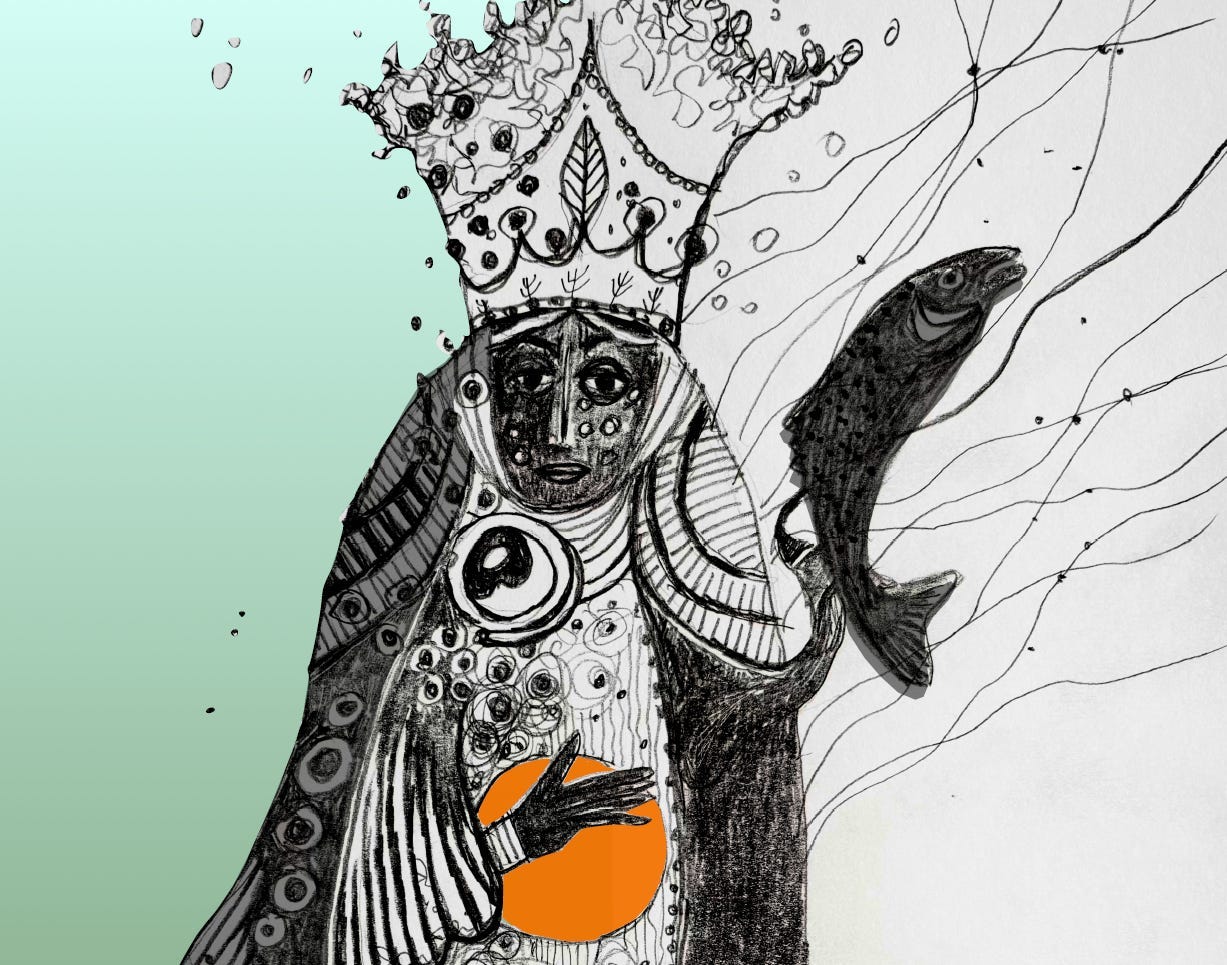
Lurking in the inky shadows of the Modau near Darmstadt, the Black Queen — an ancient and venerable, dark Brown Trout — watches the river’s long history drift toward the Rhine. After ten summers of survival, she rests with quiet majesty, finding hope in the healing waters and the bypass channels that carry her legacy into the future (image by Sara Mark; caption after Torsten Schäfer: “Die Wildnis in uns. Von ungezähmter Natur und inneren”)
Why salmon?
The salmon is one of the few beings that makes visible what Western thinking tends to keep apart — ocean and river, sea and forest, ancient and industrial. Born in freshwater, migrating to the open sea, returning to spawn and die in the very streams of their birth, salmon have been fertilizing forests with their bodies for millennia. Their carcasses, spread by predators into the trees, are a literal bridge between water and land. In certain indigenous legal traditions in North America, that link is not metaphorical but constitutional: you cannot separate water from forest in law, because the salmon is the living link between them. To understand the salmon is to understand that these are not separate worlds.
And then there is the other salmon. Alongside the wild salmon as ecological anchor, sits the farmed salmon — one of the world’s most industrialized food commodities, implicated in habitat destruction, species loss, and pollution across fjords from Norway to Chile to Iceland. Torsten holds both realities deliberately. The lens of the salmon, he says, can show you the whole world. The wild fish and the farmed fish are not opposite stories. They are the same story, seen from different ends.
This holistic view on the salmon is also expressed in the book “Being salmon, being human” by natural philospopher and deep ecologist Martin Lee Mueller who is working with Torsten in the project.
The salmon family — including brown trout and many other species distributed across the globe — also makes the work geographically coherent across very different field sites: a small trout river near Darmstadt, the Sami fishing cultures of northern Scandinavia, a salmon farm in Norway, and planned fieldwork with indigenous salmon communities in the Pacific Northwest. What connects those places is not geography alone, but a shared question: what stories do salmon and trout make possible that other framings foreclose?
There is a well-known criticism of conservation communication — that it reaches for charismatic species that live far away, lighting up ecosystems elsewhere while leaving people estranged from the places they actually live in. Torsten knows that critique and takes it seriously. The salmon is a deliberate counter-move: not a distant symbol, but something findable in the river at the end of the road.
There is also a climate dimension that rarely gets named clearly enough: the answer to adaptation in an overheating Europe lies substantially in water — rivers, wetlands, swamps, coasts. Coming from climate journalism, Torsten sees water as a largely underplayed answer — and the salmon as a door into exactly that conversation. One that he also explored in 2021 with his nature writing book “Wasserpfade”.
Talking salmon — four ways of being in conversation
Talking Salmon is not a single gesture. It holds four orientations at once, drawn from IPBES — the global science-policy platform on biodiversity: we can tell stories about the salmon; we can tell them in the presence of the salmon; we can tell them with it; and — as an experiment — as it.
These are not stages to graduate through in sequence. They coexist, and a practitioner of ecological storytelling might move between all four in a single piece. What matters is that the third and fourth orientations — with and as — ask something different: a willingness, at least provisionally, to let the salmon set the agenda.
Giving voice to a fish is contested terrain. Anthropomorphization attracts criticism, and rightly so. But that tension is held consciously here, rather than resolved. The experiment seems worth making, because the alternative — keeping the salmon permanently at the distance of an object — has its own cost. Objectification has consequences. The question is which discomfort to choose.
A species can go extinct twice
The conversation turned to what restoration actually means — and whether it can stop at habitat and species, or whether something else needs to come back too. With it, the notion surfaced that a species can go extinct twice. Once from the land and water. And once from human memory and imagination. Habitat restoration can address the first. Only stories can prevent the second. And when that second disappearance happens, something is lost that habitat restoration alone cannot bring back: the sense of what it meant to be in relationship with that being. The stories that held it in meaning. The felt knowledge of why it mattered.
The conversation brought up Robin Wall Kimmerer’s Braiding Sweetgrass here — her description of restoration as re-storying: not just returning the plant or the fish, but returning the human imagination that could hold them as kin. It is also what connects Talking Salmon to Torsten’s recently published nature writing book, Die Wildnis in uns (The Wilderness in Us). Rewilding, in this framing, is not about returning to a fixed past. It is dynamic, generative, open to what a good life for all beings — human and otherwise — might look like now.
The language the Sami have that we don’t
After seven or eight years of building trust in Sami communities in northern Scandinavia — years before the work deepened, before the right doors opened — what Torsten keeps returning to is not a practice or a method. It is language.
Sami languages are languages of the land in a way German or English simply are not. There are twelve or more words for different kinds of valley — each capturing a particular quality of moisture, breadth, orientation. There are distinct names for salmon depending on when in the year they enter the fjord: not biological classification, but relational taxonomy, organized around behavior and presence. One entire doctoral thesis was even written at the Sami University of Applied Science just on the richness of Northern Sami expressions specific to salmon net fishing. The world that exists in that language is staggering.
The example that cuts deepest: the Northern Sami word bivdit — to go hunting, to go fishing — simultaneously means to ask for permission. Harvest and consent are a single word. The relationship is already inside the language, not something you add to it afterward.
One of the people Torsten returns to again and again in his fieldwork is an elderly Sami professor — someone he has interviewed before and will visit again — who has retired to his tiny fjord village, a place that does not appear on Google Maps, and is now spending his days recovering place names from oral tradition and old maps, working to have them included in Norwegian official cartography. His argument is precise: when a place loses its name, it loses its individual existence in the conversation between humans and land. A named place is an interlocutor. An unnamed one is background.
Journalism has no language for this. Science, mostly, has no language for this. Nor for the culture of offering and gratitude — the seidi, the offering stones for salmon, still present and still used. Nor for the moments of silence in fieldwork that carry more than the interviews do. Poetry, Torsten reckons, might reach closer. He will be writing poems during his September fieldwork with the coastal Sami — not as a creative indulgence, but as a scientific method. Some things, he says, probably cannot be reached any other way than with “artistic research”: a discipline that Darmstadt’s University op Applied Science is currently establishing at its media campus.
The tension of going
The field raises hard questions about positionality. A European academic arriving at an indigenous community with a research agenda to learn how to tell stories differently can raise legitimate concerns. Torsten does not minimize it.
What has made it ethically navigable — slowly, imperfectly — is time and reciprocity. Years before trying to go deeper. Working only through a trusted colleague who acts as gatekeeper and bridge. Going nowhere alone. Being entirely transparent about his role and what he will do with the material. Fishing alongside, cooking, helping with reindeer corrals. Being present in ways that are not extractive.
And crucially: giving something back. Indigenous communities he has encountered — Maori visitors coming to Darmstadt, women from Peru’s Río Marañón fighting for the rights of their river — are genuinely curious about what comes from the rivers and woods of Germany, about how Torsten relates to his own landscape, his own river, his own rituals. Reciprocity is not a courtesy. It is what makes the exchange real.
A concrete expression of this: an Austrian fisherman who has dedicated his life to protecting the Danube salmon — itself nearly extinct — handmade a fishing lure and gave it to Torsten as what Torsten himself calls a ritual object: a physical token of one man’s dedication to a river. And when he was invited by a Sami salmon elder along the Tana River, he brought it as an offering — passing it from the world of the Danube salmon to the world of the Atlantic salmon, two cousins, two species on the edge of disappearing, held together for a moment by one person acting as bridge.
One of the sharpest insights came from a Sami hunter and fisherman living a modern but land-close life. He did not want to discuss traditional knowledge. He wanted to talk about indigenous values. The specific knowledge might be outdated — changed by climate, by time, by circumstance. The values — sharing, offering, reciprocity, a different relationship to time — these remain alive, and these are what can genuinely travel across cultures without appropriation.
This distinction matters. Not specific practices rooted in specific ecologies, but orientations that can inspire different ways of moving through one’s own landscape. In Germany, this carries its own complexity: homeland and nature rhetoric can shade toward the political right. That risk is named, held consciously, navigated. Caring for one’s own river is not nationalism. Making that distinction legible — again and again — is part of the work.
What happens when you write with a tree
The outdoor writing practice is now nearly ten years old. The laboratory of ecological storytelling — its most recent iteration — started this week (April 2026). It begins, as it always has, with repertoires of strong environmental journalism. Then it moves toward something stranger.
Students arrive with well-established reflexes — environmental journalism means crisis reporting, species profiles, policy analysis. Changing those reflexes asks for invitation, not instruction. Not everyone is ready, and that is accepted. But the invitation is extended.
One exercise: write interview questions for a tree — in the journalistic way, as if preparing for a real interview. Then, as a next step, generate only the tree’s answers. For many students, just arriving at the questions is already a lot. But it is the start of something — the beginning of taking a kinship perspective, of granting an individual existence to a being that journalism normally treats as backdrop.
What happens is consistent and visible. Students go quiet. Attention sharpens. Senses open — to smell, sound, texture — because the assignment requires it. And something shifts in their sense of responsibility: once a particular existence has been granted to a being, once it has been given an individual life in the imagination, it becomes harder to look away.
The exercises also surface how deeply estranged from water German language already is. There are everyday idioms — Ausufern, to leave the shore and dissolve into something uncontrolled, out of normal boundaries in a negative sense — that encode disgust and distance, the need to keep water contained and managed. Language as fossilized estrangement. Noticing it is the beginning of being able to choose differently.
Climate adaptation is not only a technical project. It is a linguistic and narrative one. New relationships with rivers and wetlands require new stories about them. The laboratory is not peripheral to the climate question. It may be working at its root.
A closing seed
Deep ecologist Thomas Berry spoke of the “great work” of our time as recovering the capacity for conversation among species — a conversation that modernity interrupted. Torsten is drawn to the same idea but comes at it through practice: through the river near his house, through fieldwork in Lapland, through students learning to be quiet in the presence of a tree.
The salmon has been doing this work for millennia — connecting oceans, rivers, and forests, fertilizing what seems separate. The question Talking Salmon keeps circling is whether we can learn, again, to follow its lead. Not metaphorically. Actually.
Torsten Schäfer’s most recent book is ***Die Wildnis in uns. Von ungezähmter Natur und inneren Landschaften* (2026). An English translation will come out by 2027.
The epilogue of the book has been written from a trout’s perspective and has subsequently been translated into English. She, a dark Brown Trout — a trout species native to Germany — , is the “Black Queen” (refer to main image) and becomes a river narrative herself.
The **Co-creation with the More-than-Human sandbox** is a collaboration between The Repatterning Collective and Kincentric Leadership.
If you’d like to receive announcements of our popular monthly online learning sessions, which use live dialogue & discussion to explore different approaches and praxes for meaningful co-creation with the more-than-human (natural) world, then register here for the sandbox’s mailing list.
To receive syntheses of Learning Sessions and Field Dialogues in your inbox, find us on Substack.
메타데이터
- post_id
- 5fea716f33b9
- slug
- field-dialogue-3-talking-salmon-5fea716f33b9
- url
- https://medium.com/@rbecque/field-dialogue-3-talking-salmon-5fea716f33b9
- canonical_url
- https://medium.com/@rbecque/field-dialogue-3-talking-salmon-5fea716f33b9
- author_url
- https://medium.com/@rbecque
- status
- ok
- fetched_at
- 2026-06-15 20:49:13