Activation Functions: Comparative Analysis
There are many kinds of activation functions, but three of the most important are ReLU, Leaky ReLU, and sigmoid.
Activation Functions: Comparative Analysis
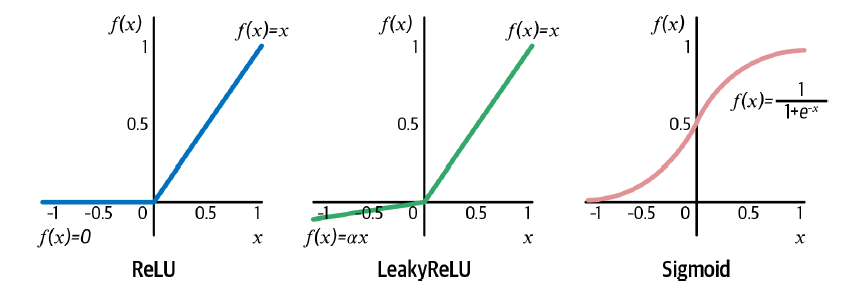
There are many kinds of activation functions, but three of the most important are ReLU, Leaky ReLU, and sigmoid.
ReLU (Rectified Linear Unit)

Description: Outputs zero for negative inputs and the input itself for positive values.
Advantages: It helps mitigate the vanishing gradient problem, is computationally efficient, and works well in deep neural networks.
Disadvantages: Can suffer from the dying ReLU problem, where neurons output zero for all inputs and stop learning.
Leaky ReLU

Description: A modified version of ReLU that allows small negative values instead of zero.
Advantages: It addresses the dying ReLU problem by allowing small gradients for negative inputs and works well in deep networks.
Disadvantages: The small negative slope is manually set and may not be optimal for all tasks.
Sigmoid

Description: A smooth, S-shaped function that squashes input values between 0 and 1.
Advantages: Useful for binary classification problems and provides smooth gradients.
Disadvantages: Prone to the vanishing gradient problem, making training slow in deep networks. Outputs are not zero-centered, which can slow down optimization.
We are going to evaluate a multilayer perceptron built with 3 versions of the model with the between activation functions (described above) to compare the output accuracy:
Model and Training Implementation
a) Data Preprocessing:
- The dataset is preprocessed to ensure it is in the correct format for training a neural network.
- Input images are flattened and normalized to values between 0 and 1 to improve convergence during training.
# Load and preprocess the MNIST dataset
(x_train, y_train), (x_test, y_test) = mnist.load_data()
x_train = x_train.reshape(-1, 28*28).astype("float32") / 255.0
x_test = x_test.reshape(-1, 28*28).astype("float32") / 255.0
y_train = to_categorical(y_train, num_classes=10)
y_test = to_categorical(y_test, num_classes=10)
b) Model Creation:
Layers include:
- Dense Layer with 512 neurons.
- Dropout Layer to reduce overfitting.
- Output Dense Layer with 10 neurons (one for each class) and softmax activation for probability outputs.
# Function to build the MLP model
def build_mlp_model(activation_function):
    model = Sequential()
    model.add(Dense(512, input_shape=(28*28,)))
    if activation_function == 'LeakyReLU':
        model.add(LeakyReLU(alpha=0.1))  # Adding LeakyReLU activation
    else:
        model.add(Dense(512, activation=activation_function))
    model.add(Dropout(0.2))
    model.add(Dense(10, activation='softmax'))  # Output layer
    return model
c) Training and Evaluation:
- Compiling the model with an optimizer, loss function, and evaluation metrics.
- Training the model using the training data and validating on a holdout set.
- Evaluating the trained model on the test dataset.
- This separation of training logic from model creation ensures clarity and reusability.
# Function to compile, train, and evaluate the model
def train_and_evaluate_model(activation_function):
    model = build_mlp_model(activation_function)
    model.compile(optimizer='adam',
                  loss='categorical_crossentropy',
                  metrics=['accuracy'])
    history = model.fit(x_train, y_train,
                        validation_split=0.2,
                        epochs=10,
                        batch_size=128,
                        verbose=2)
    test_loss, test_accuracy = model.evaluate(x_test, y_test, verbose=0)
    return history, test_loss, test_accuracy
# Training and evaluation of the models with 3 different activation functions
activation_functions = ['relu', 'LeakyReLU', 'sigmoid']
results = {}
for activation in activation_functions:
print(f"\n ----------Training model with {activation} activation function --------------")
history, test_loss, test_accuracy = train_and_evaluate_model(activation)
results[activation] = {
'history': history,
'test_loss': test_loss,
'test_accuracy': test_accuracy
}
print(f"Test Accuracy with {activation}: {test_accuracy:.4f}")


The experiment compares three activation functions (ReLU, LeakyReLU, and Sigmoid) based on training, validation, and test performance on the MNIST dataset.

1. ReLU (Rectified Linear Unit)
Training Performance:
- It started with an accuracy of 91.95% in the first epoch and steadily improved to 98.73% by the 10th epoch.
- Loss reduced consistently, indicating effective learning without significant overfitting.
Validation Performance:
- Validation accuracy peaked at 97.54% after 10 epochs, which is close to training accuracy.
- Validation loss showed a decreasing trend, stabilizing toward the end, with slight fluctuations (e.g., Epoch 6 and 7).
Test Accuracy:
- Test accuracy was 97.53%, demonstrating good generalization capability.
Interpretation:
- ReLU is highly effective for this task due to its simplicity and ability to avoid the vanishing gradient problem in deeper layers.
- Slight overfitting may have occurred in later epochs, as validation accuracy plateaued while training accuracy continued to improve.
2. LeakyReLU
Training Performance:
- Started slightly lower than ReLU at 90.69% accuracy in the first epoch but reached 99.06% by the 10th epoch, the highest among all activations.
- Loss decreased more rapidly than with ReLU.
Validation Performance:
- Validation accuracy was 97.79% after 10 epochs, slightly higher than ReLU.
- Validation loss stabilized earlier than ReLU, indicating better robustness.
Test Accuracy:
- Test accuracy was 97.86%, the highest among all three activation functions.
Interpretation:
- LeakyReLU performed slightly better than ReLU due to its ability to handle small gradients for negative inputs, reducing neuron “death.”
- The model was less prone to overfitting compared to ReLU, as validation and test accuracies closely matched training performance.
3. Sigmoid
Training Performance:
- Started at 88.76% accuracy in the first epoch, slower than both ReLU and LeakyReLU, but improved to 98.41% after 10 epochs.
- Training loss decreased steadily but at a slower rate than ReLU and LeakyReLU.
Validation Performance:
- Validation accuracy reached 97.43%, slightly lower than both ReLU and LeakyReLU.
- Validation loss decreased consistently but remained higher than the other two functions.
Test Accuracy:
- Test accuracy was 97.44%, slightly lower than ReLU and LeakyReLU.
Interpretation:
- Sigmoid is less efficient for deep networks because of the vanishing gradient problem, which slows convergence.
- While it reached high accuracy, it required more epochs and showed slightly lower generalization performance than ReLU and LeakyReLU.
Overall Observations
- LeakyReLU: Best overall performance in terms of test accuracy and robustness.
- ReLU: Close second, with slightly higher overfitting potential.
- Sigmoid: Performed well but lagged slightly behind due to slower convergence and less effective gradient propagation.
References or Further reading…
Goodfellow, I., Bengio, Y., & Courville, A. (2016). Deep learning. MIT Press.
TensorFlow. (n.d.). ReLU activation function. TensorFlow Documentation. https://www.tensorflow.org/api_docs/python/tf/nn/relu
He, K., Zhang, X., Ren, S., & Sun, J. (2015). Delving Deep into Rectifiers: Surpassing Human-Level Performance on ImageNet Classification. Proceedings of the IEEE International Conference on Computer Vision (ICCV), 1026–1034
*Russell, S. J., & Norvig, P. (2020). Artificial intelligence*: A modern approach (4th ed.). Pearson Education.
메타데이터
- post_id
- 5ffd8e5dedcf
- slug
- activation-functions-comparative-analysis-5ffd8e5dedcf
- url
- https://medium.com/@nishantparmar/activation-functions-comparative-analysis-5ffd8e5dedcf
- canonical_url
- https://medium.com/@nishantparmar/activation-functions-comparative-analysis-5ffd8e5dedcf
- author_url
- https://medium.com/@nishantparmar
- status
- ok
- fetched_at
- 2026-07-26 12:48:17




