Is 2025 Dead Yet?
Are we courageous enough to begin anew?
Is 2025 Dead Yet?
Are we courageous enough to begin anew?

druidry.org
Rebirth, resurrection, gilgul, reincarnation, renaissance, samsara, transmigration, Dene Tha, Wankan Tanka, the Great Mystery. The soul’s journey from life to afterlife.
Rebirth, resurrection, and gilgul are anchored primarily in the Judeo Christian tradition. We have one soul that eschatologically walks with the holy spirit. James Finley speaks in the metaphor of a carousel. Children riding a carousel orbit along side where their parents stand. As the child comes into view, the child waves and smiles; the parents recognize their child, waving and smiling back. Eventually, the children leave the parental view. Just because the children are now unseen does not mean that they ‘unexist’. Finley shares that God exhales us into ‘being’ and ‘physical presence’, and then God inhales and we return to that place where the holy spirit resides.
We tend to think of time as linear. Collins: English Dictionary definition lists its first definition as so:
1. The continuous passage of existence in which events pass from a state of potentiality in the future, through the present, to a state of finality in the past.
However, it then progresses to include time as seen through the lens of physics.
2. physics a quantity measuring duration, usually with reference to a periodic process such as the rotation of the earth or the frequency of electromagnetic radiation emitted from certain atoms. In classical mechanics, time is absolute in the sense that the time of an event is independent of the observer. According to the theory of relativity it depends on the observer’s frame of reference. Time is considered as a fourth coordinate required, along with three spatial coordinates, to specify an event.

There are multiple other definitions of time, but they will not be listed here.
I see time as circular. One day ends, but another begins. One month ends, and another begins. One year ends and another begins. Time does not stop and restart again at the end of a day, a week, a month or a year. Many humans have grave difficulty in thinking circularly; we prefer lines.
In my mind, I see those children on the carousel aging, but I also see the carousel on which the parents sit slowly circling. They do not meet up exactly, but their rotations overlap for a moment. The iterations of carousels extends backward — grandparents, great-grandparents, great-great-grandparents, and back, and back. We all are out of sight eventually, and out of time, but we are not out of existence. It is, indeed, relative.
Renaissance, objectively, is the French word for rebirth. Historically, it is a time period that followed the Dark Ages. The “Dark Ages” is an outdated term for Europe’s Early Middle Ages (roughly 5th-10th centuries) assuming a period of cultural, economic, and intellectual decline. But as in all generalizations, it is not entirely accurate. Even within these Ages, there were advancements in thinking, after all, it led to the Renaissance. The Renaissance was a progressive European period (14th-17th centuries) marking a rebirth of classical Greek and Roman culture, art, and learning after the Middle Ages, marked by humanism, individualism, and significant advancements in arts. The focus changed from the divine to the human.

Reincarnation, samsara and transmigration are also forms of rebirth, but incorporate a sense of moving from one being, whose immediate presence has ended, and passed on to a new being just born. Many religious traditions which view rebirth in this way, also incorporate their own sense of karma: our actions create ripples (karma) that influence future lives. Reincarnation, samsara and transmigration are the ability for a soul to re-enter physical existence and improve on what they did in the last. Native American beliefs reflect these ideas in Dene Tha, Wankan Tanka, the Great Mystery.
Modern evangelical Christianity has emphasized purity over grace. There is a litmus test of purity which we must pass in order to gain entrance to the divine ever-after. These purity codes are rigid forms of performative behavior, dress, socio-cultural prescriptions and socio-political beliefs. Little of it has to do with Jesus or his teachings.
John 14:1–6
1 “Let not your hearts be troubled. Believe in God; believe also in me. 2 In my Father’s house are many rooms. If it were not so, would I have told you that I go to prepare a place for you? 3 And if I go and prepare a place for you, I will come again and will take you to myself, that where I am you may be also. 4 And you know the way to where I am going.” 5 Thomas said to him, “Lord, we do not know where you are going. How can we know the way?” 6 Jesus said to him, “I am the way, and the truth, and the life. No one comes to the Father except through me.”
Strict adherence to the literal definition implies that only Christians who have perfected the purity code gain access to the divine. But many theologians interpret this verse differently.
In their interpretation, Jesus is self-reflecting on humanity. When he says, “I am the way, the truth, the life,” he is saying he as a human can access divinity. He does not need an intercessor. And by believing in what he is saying, we are shifting our belief to our own grace and ability to experience the divine without any type of purity code or intercessor. We all are eligible for rebirth and salvation by our own seeking for truth and light and grace.
No matter which tradition (or lack there of) resonates with you, all of these themes have one commonality — death must happen before rebirth. Many of us keep trying to convince ourselves that if we look ever-younger, behave ever-younger, pretend that there is no death, and pass a purity code — we get to party like Barbie in a perfect existence of timeless youth and happiness.
Regardless, death must happen in order to reincarnate.
Bardo, in some sects of Buddhism, is a 49-day transitional grieving period where the bereaved and the dead perform ritual in order to send them on their way to their next incarnation. The transition is important, and many in Western European Christian culture are never given this transitive grace. Stopping the transition locks many into complicated grief because mourning never really happens. Even in bardo, it is possible to get stuck in a confused, attachment-bound state, manifesting as hungry ghosts. The ritual of grieving helps to move both the dead and the living on.

Peaceful and Wrathful Deities of the Bardo
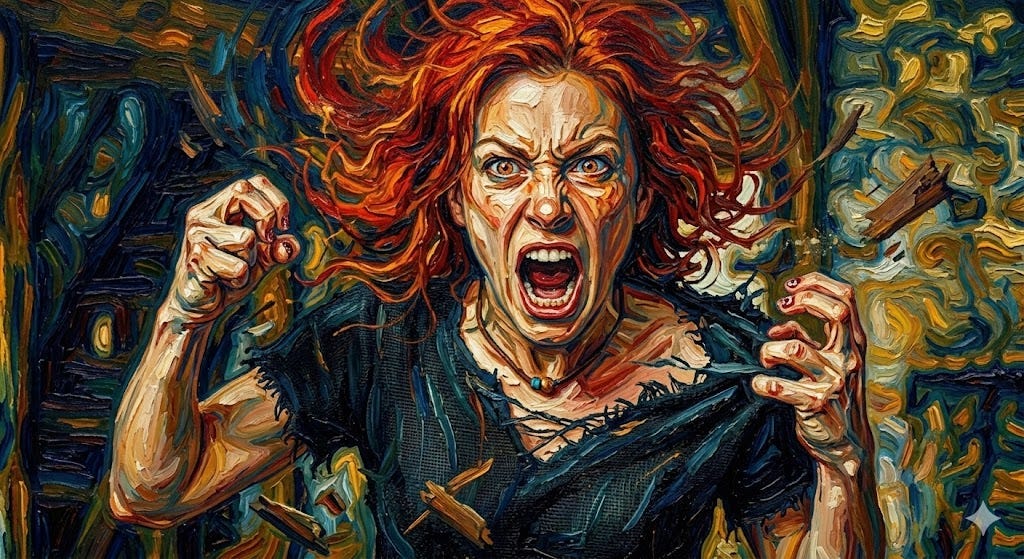
Here we are, on the last day of 2025. For me and for many, 2025 has demonstrated the death of so much — the death of our country as we thought it was, the death of democracy as we understood it to be, the death of civil rights, the death of equality, the death of bodily autonomy, the death of socio-economic equity, the death of Christianity, the death of faith, hope, light and truth. Iterations of carousels reaching back and back. We are in our own Dark Age.
I believe in rebirth, resurrection, renaissance, and reincarnation. But we must accept this death first. We must enter bardo, reflect, ruminate, and own. We must grieve. We must, like in the late Middle Ages, begin to transition toward the renaissance. We must also obliterate purity codes. No one person, class, race, culture, gender, educational level or religion is more deserving.
We must delve into our mistakes, our sins, our transgressions. We must own them because renaissance is not wash, rinse, repeat. Renaissance is rebirth — tearing through a canal far too small for life and yet pushing anyway. It is covered in blood and slime, and must be slapped into breath. We must be able to invoke karma, but we can only do better when we know what we did wrong.
Right now, I am writing from bardo. I can see what came before, I can see where I am, but I am blind to the future. I will bless the death of 2025, and with grace, wisdom and strength, I hope to transition to the renaissance. I cannot predict when this will happen, but I will happily depart 2025 knowing it isn’t here.
I will take steps to meditate on what it means to forgive, love and move on. I will take responsibility for my part in this failure. I will try to not persecute others for not having my relative perspective. I will try to realize that in order to lighten our darkness we need all manner of things: art for beauty and savagery, songs for peace and protest, silences and raised voices, rationality and passion. We need the peace-makers and the warriors. We need us all. We need truth and light. And, according to John 14, we are the truth and the light — we don’t need an intercessor.
May this new year hold blessings we cannot see yet, but believe are there. I hope that a year from now, I won’t still be writing from bardo.
메타데이터
- post_id
- 600e8adcebd2
- slug
- is-2025-dead-yet-600e8adcebd2
- url
- https://medium.com/@cailleachanam/is-2025-dead-yet-600e8adcebd2
- canonical_url
- https://medium.com/@cailleachanam/is-2025-dead-yet-600e8adcebd2
- author_url
- https://medium.com/@cailleachanam
- status
- ok
- fetched_at
- 2026-06-23 17:05:31