Three Half-Truths About Getting Your Data AI-Ready
Consolidate, clean, lock down. Three real projects that each leave the thing blocking production exactly where it was.
Three Things Everyone Believes About Getting AI-Ready. All Three Are Half True.
Consolidate the data. Clean the data. Lock the data down. Each one is real work that leaves the actual problem untouched.
Each belief funds a real project. None of them changes what happens at run time.
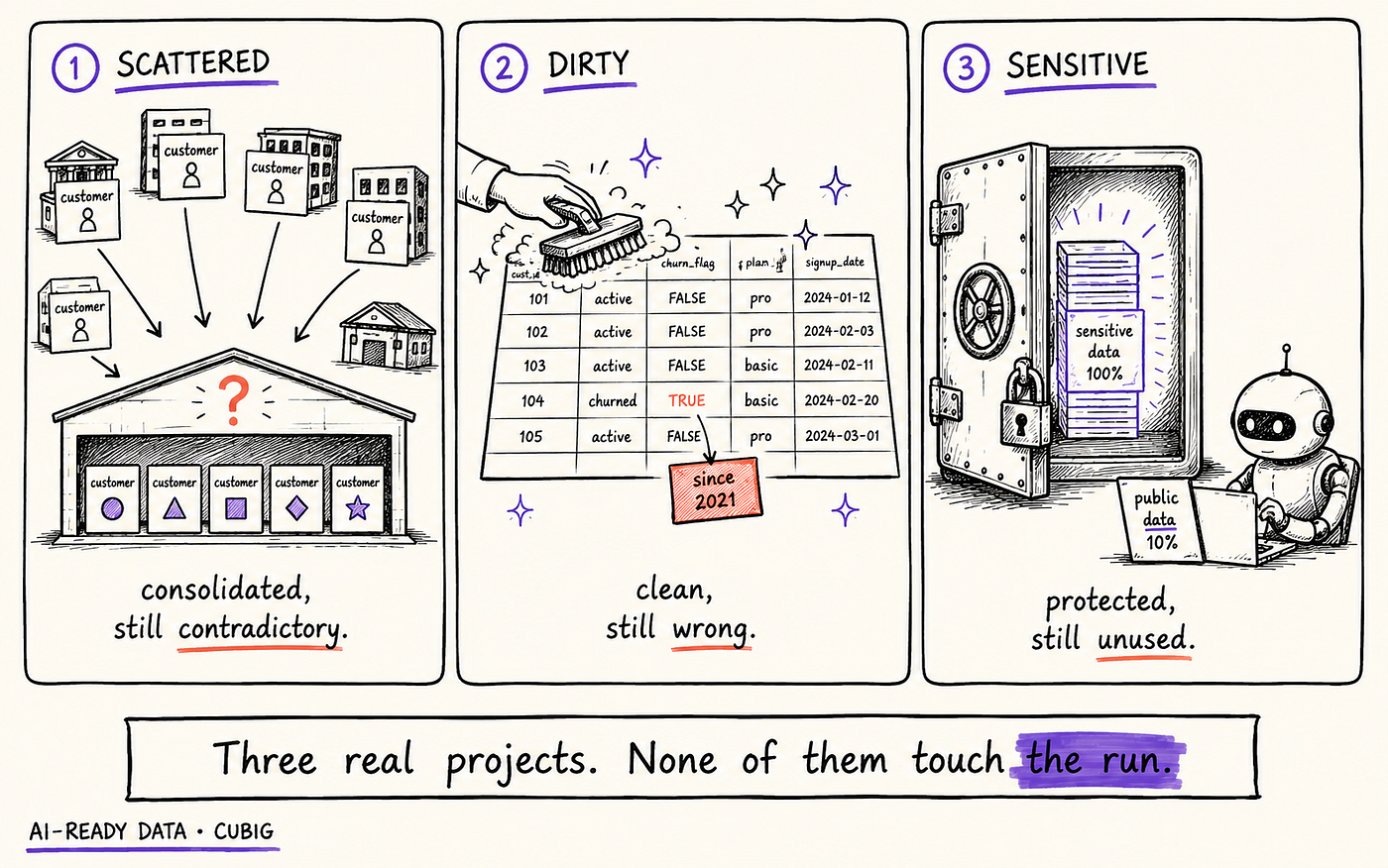
Ask five enterprises why their AI isn’t in production and you’ll get three answers. The data is scattered. The data is dirty. The data is too sensitive to touch.
All three are true. That’s what makes them dangerous. Each one describes a real problem, funds a real project, and leaves the thing that actually blocks production exactly where it was.
Here’s the other half of each.
”Our data is scattered across systems.”
So the company buys consolidation. A warehouse, a lakehouse, a lake on top of the warehouse. Two years later everything is in one place, and the agent still can’t act on it.
Because scattered was never the hard part. Reconciled was. When five systems each held their own definition of “customer,” the scatter kept the contradiction invisible, every team was locally correct in its own database. Consolidation moves all five definitions into the same table and calls the job done. The contradiction didn’t get resolved. It got centralized.
An agent doesn’t experience your lakehouse as organized. It experiences it as five definitions of customer with no ruling on which one applies to the action it’s about to take.
”Our data is dirty, we need to clean it.”
So the company runs a quality program. Nulls filled, duplicates merged, formats standardized, dashboards green.
Then the agent runs, and breaks on things no quality tool flagged. Because cleaning was built for a human reader. It optimizes for the things that make a person mistrust a number: missing values, obvious outliers, inconsistent formats. A human sees a clean report and asks the right follow-up questions from experience.
The agent has no follow-up questions. It needs to know that churn_flag has been TRUE for one region since a migration nobody finished, that “daily_sales” refreshes when someone remembers, that the 2019 validation rule checks something nobody can name anymore. None of that is dirt. Every one of those fields is perfectly clean and completely wrong to act on.
Clean is a property of the values. Ready is a property of the state: current, consistent, traceable, reproducible. A quality program gets you the first and leaves the second untouched.
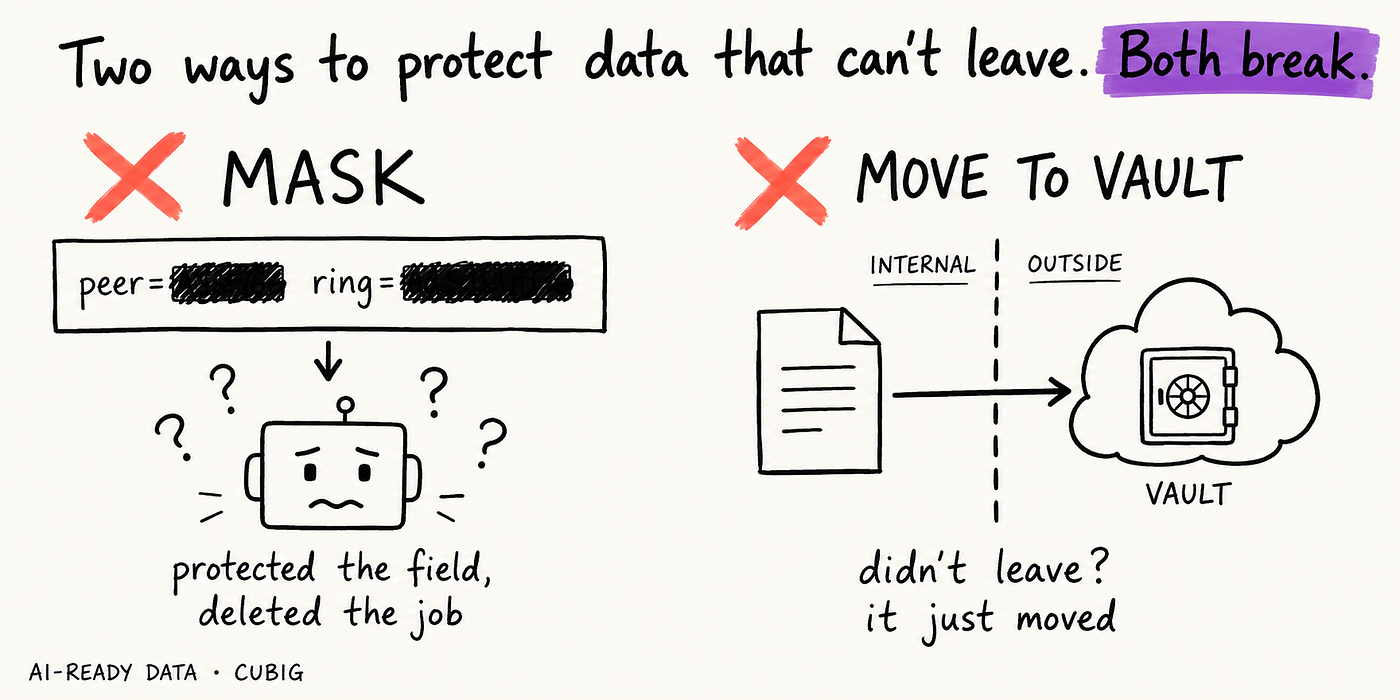
”Our data is too sensitive, that’s the blocker.”
This one is the most reasonable and the most limiting. It’s true that regulated data can’t be shipped to a frontier model. The half that’s missing: teams treat that as the end of the sentence, so the AI runs on the safe, thin, non-sensitive data instead, and the valuable 90% sits untouched while everyone waits for a compliance answer that isn’t coming.
Sensitivity is a constraint on the path the data takes, not on whether AI can work on it. The model needs the structure and the relationships. The raw values are what carry the risk, and the two are separable: the work can leave while the originals and the mapping that restores them stay inside. Different problem, different fix, and it isn’t “wait.”
Static properties are checked once. The state has to hold every time.
What the three have in common
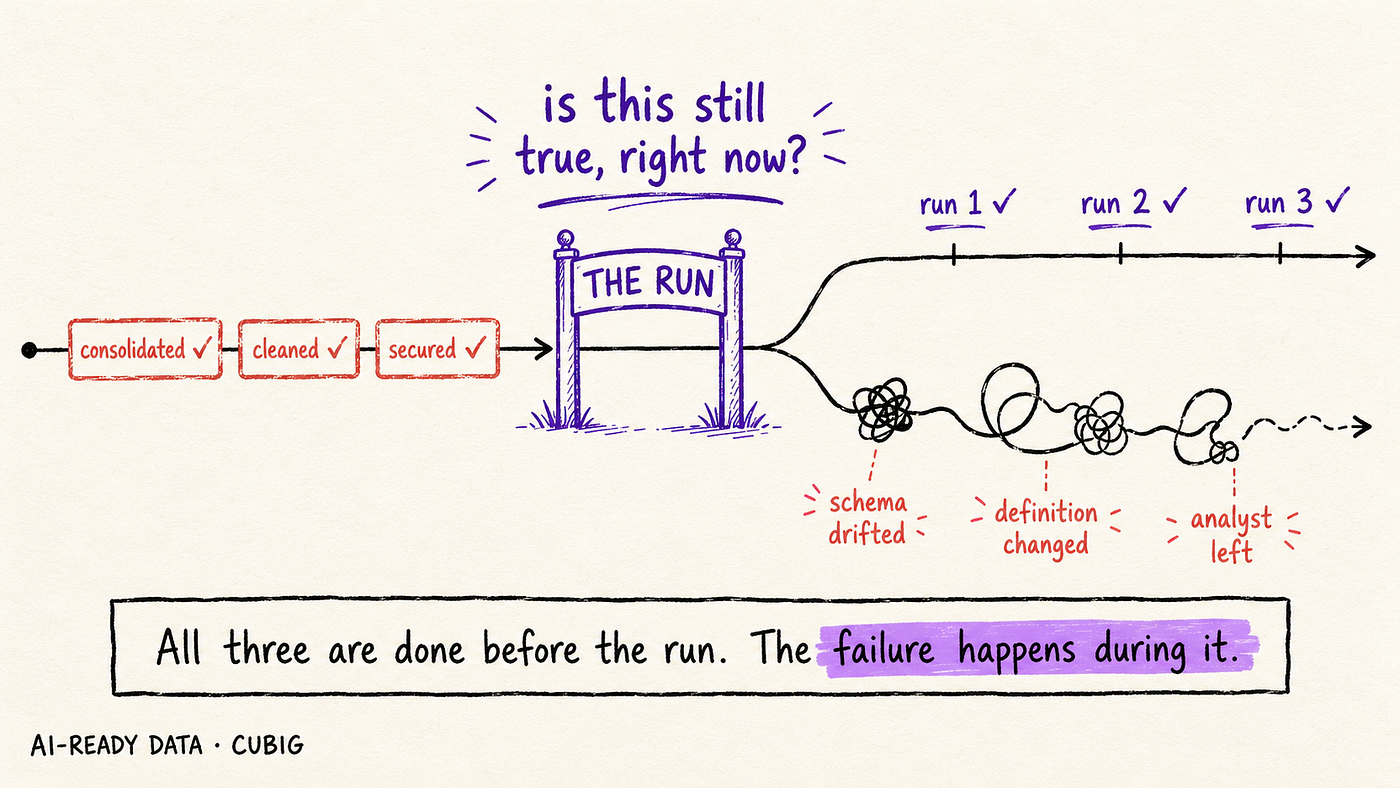
Each belief points at a property of the data, where it sits, how clean it is, how sensitive it is. All three are static properties. You can fix all three and still fail in production, because the thing that breaks isn’t a property of the data. It’s a property of the data at the moment of the run.
Is this current, right now? Do the definitions agree, right now? Can the same run be reproduced next quarter, when the schema has drifted and the analyst who understood it has left?
That question doesn’t get answered by consolidating, cleaning, or locking down. It gets answered by holding the state and checking it before each run.
So the three beliefs aren’t wrong. They’re each half of a job that nobody finishes. Consolidation without reconciliation gives you contradictions in one place. Cleaning for a human reader gives you fields that pass inspection and fail execution. Locking data down without a path for it gives you compliance and no capability.
If your team is about to fund one of these three, worth asking one question first: when this project is finished, what will tell us the data is still ready six months later?
If nobody can answer that, you’re not buying readiness. You’re buying a snapshot of it.
메타데이터
- post_id
- 6021dc840c68
- slug
- three-half-truths-about-getting-your-data-ai-ready-6021dc840c68
- url
- https://medium.com/cubig-tech-blog/three-half-truths-about-getting-your-data-ai-ready-6021dc840c68
- canonical_url
- https://medium.com/cubig-tech-blog/three-half-truths-about-getting-your-data-ai-ready-6021dc840c68
- author_url
- https://medium.com/@alscks
- status
- ok
- fetched_at
- 2026-07-29 23:48:37