Dengue: A Growing Global Health Threat
Disclosure: I wrote this article and used AI as a “professional editor” to refine and shorten overly long or complicated sentences. .
Dengue: A Growing Global Health Threat
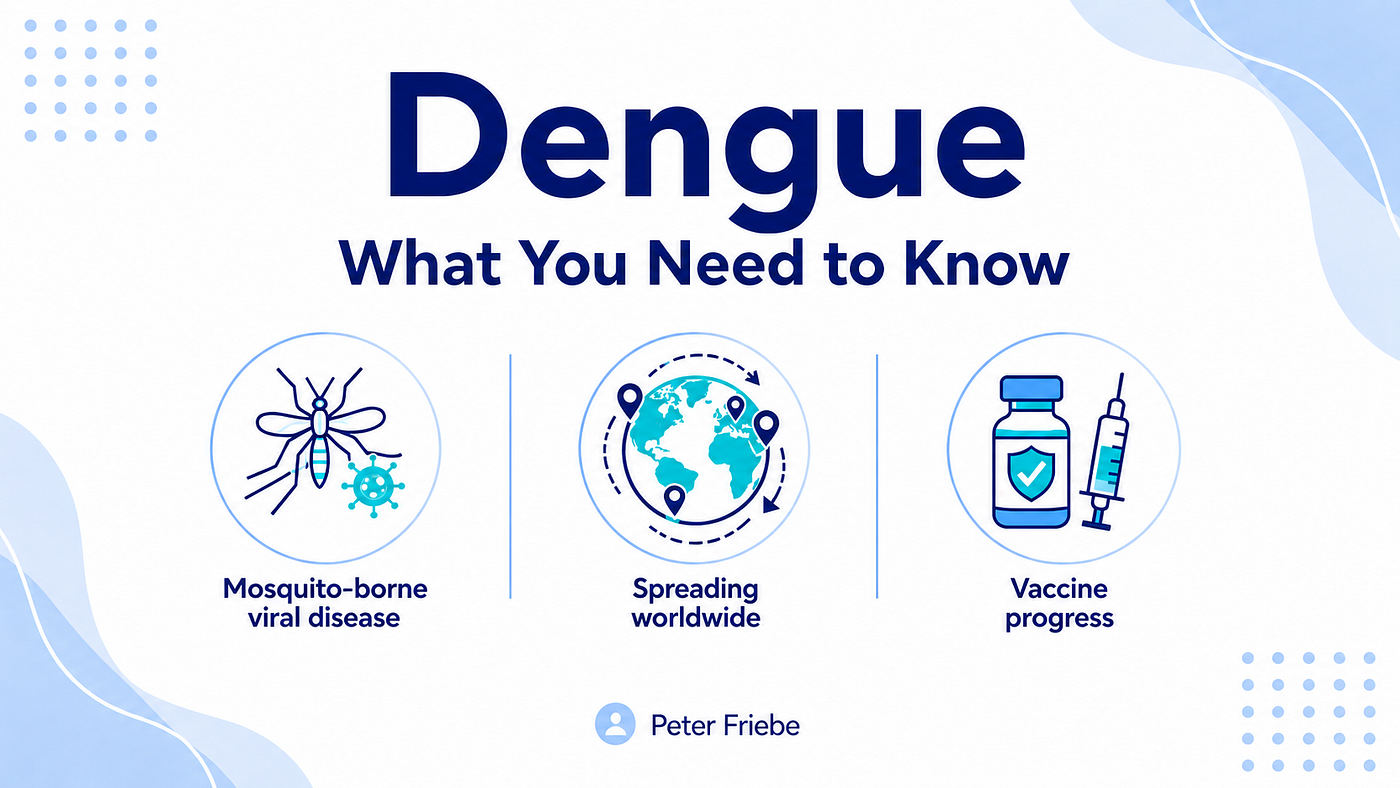
Image generated with the assistance of AI
Disclosure: I wrote this article and used AI as a “professional editor” to refine and shorten overly long or complicated sentences. .
This one is overdue. After all, I have worked with the dengue virus. Though all my work fell into what is commonly called the “basic research” bucket. Contrary to the name, it is anything but basic, and the discoveries it produces are often absolutely fundamental to finding a cure. But in my case, my research did not answer questions like how the virus spreads, who is at risk, what the symptoms are, how bad it can get, and what we can do to protect ourselves.
These are the questions I will answer in this article. To all my former colleagues and everyone still working in this field (keep up the important work!): this article is intentionally simplified. Not everything is explained in the same depth as in a scientific publication. However, if you find a Project Hail Mary centrifuge-error-like issue, please comment or PM me.
For all non-scientists: in the movie Project Hail Mary, there is a scene where Ryan G. loads two reaction tubes into a small centrifuge, both tubes right next to each other. Every scientist knows that is a rookie mistake. Tubes always go opposite each other, and with matching weights. Once a centrifuge spins up, it generates enormous forces, so two tubes sitting side by side is a bit like putting a single heavy blanket in the washing machine on its own: the moment it starts to spin, things get loud and shaky.
OK, back to dengue. Dengue is not only the fastest-growing mosquito-borne disease in the world; it is also expanding into new regions, including parts of the United States and Europe. The trend is expected to continue. A warming climate lets the Aedes mosquitoes that carry the virus survive in places that were once too cool for them, and global travel and dense urban living add to the push.
The scale is already enormous. Modeling studies estimate that there may be around 390 million dengue infections worldwide every year, though most cause mild or no symptoms and are never counted. About half the world’s population now lives in areas where dengue can spread.
At the same time, dengue can cause severe illness and even death. The symptoms can be so severe that the disease earned the nickname “breakbone fever.” So, let’s look at dengue a little closer.
.
What Is Dengue?
Dengue is caused by the dengue virus, or DENV. The virus belongs to a group of viruses called flaviviruses, alongside Zika, yellow fever, and West Nile. All of these viruses are mosquito-borne, meaning they are spread through the bite of an infected mosquito.
And only very specific mosquitoes can spread the dengue virus. These are mainly Aedes aegypti and, to a lesser extent, its relative Aedes albopictus, often called the tiger mosquito. A mosquito bites a person who already has the virus in their blood, becomes infected itself, and then passes the virus on when it bites the next person. This is very different from the flu, which spreads directly from person to person through the air and needs no in-between carrier, or “vector,” the role the mosquito plays for dengue.
Both of these mosquitoes are daytime biters, most active in the early morning and late afternoon. They also thrive in cities, as they only need small amounts of standing water to breed. This is unlike the mosquitoes that transmit malaria, which generally bite from dusk to dawn.
There is one more important fact about the dengue virus. Dengue is not a single virus. There are four closely related types, called serotypes: DENV-1, DENV-2, DENV-3, and DENV-4. As we will see, the fact that there are four different serotypes matters a great deal.
.
What Does Dengue Feel Like?
Many dengue infections cause no symptoms at all, or symptoms so mild they’re mistaken for another mild viral illness. However, when symptoms develop, the onset is usually sudden, about four to ten days after the mosquito bite.
The classic symptoms of dengue are a high fever along with severe headache, pain behind the eyes, and intense muscle and joint pain. That last symptom can be extremely intense, hence the nickname “breakbone fever.” A rash, nausea, and vomiting are also common. The good news is that most people recover within a week or two.
Unfortunately, dengue is one of those infections where we do not have a specific treatment. As with measles and several other viral infections, care is supportive: rest, fluids, and controlling the fever. For dengue, it is important not to take any medication that can increase the risk of bleeding, so the recommended pain reliever is acetaminophen (paracetamol), not aspirin or ibuprofen.
So, why is dengue so dangerous if most people recover on their own?
In a small percentage of cases, usually around the time the fever starts to drop, between day three and day seven, the illness suddenly gets worse. This is known as severe dengue, and it can be dangerous precisely because it often begins just as a person seems to be improving. Warning signs include severe belly pain, persistent vomiting, bleeding from the gums or nose, blood in vomit or stool, rapid breathing, and extreme fatigue or restlessness. Severe dengue can involve leaking blood vessels, internal bleeding, and organ damage, and it can be fatal.
With good supportive care, the death rate from severe dengue can be kept under 1 percent. That sounds reassuring, but two things make it less so. First, dengue is so widespread that even a small percentage adds up. In 2024, the worst year on record, more than 11,000 dengue deaths were reported worldwide, according to WHO’s year-end report. Second, dengue often hits hardest in places where that level of care is hard to reach, and where the true toll is almost certainly undercounted.
Whether you live in a region where dengue is common or are only visiting, if you develop a high fever, take it seriously and see a doctor. If you have traveled recently, mention where you have been. Early medical care is one of the biggest factors in keeping dengue from becoming dangerous.
.
What Are the Risk Factors for Severe Dengue?
Here is where I have to come back to the four serotypes, the four different types of dengue.
As with most infections, if you get infected with DENV-1, and you recover, your immune system builds immunity that will protect you from DENV-1. However, DENV-2, -3, and -4 are different enough that your immunity against DENV-1 does not necessarily protect you from the other types.
The level of protection against a different serotype depends on many factors. One of them involves antibodies. If you know what an antibody is, skip this paragraph. For everyone else, here’s a simplified explanation: antibodies are part of your immune response, and they are proteins that bind very specifically to their target. An antibody against DENV-1 binds DENV-1; it does not normally bind influenza, SARS-CoV-2, or unrelated viruses or bacteria. The binding of the antibody has multiple functions, but in simple terms, some antibodies neutralize viruses to protect us. Usually, once we recover from an infection (or after a vaccination), these protective antibodies stay with us for a long time, sometimes for life.
Now, back to dengue. As I mentioned above, being protected against one of the serotypes doesn’t mean protection against any of the other three serotypes. In some cases, if someone with protective antibodies against one dengue serotype, let’s say DENV-1, gets an infection with another serotype (let’s say DENV-2), the antibodies are able to somewhat bind to DENV-2, but it’s not a perfect match, and the antibodies aren’t able to neutralize the virus. Instead, those antibodies can end up helping the virus to infect cells more efficiently. The immune response that should protect you can, in this specific situation, make things worse. This mechanism is called antibody-dependent enhancement (ADE).
This sounds counterintuitive. And the underlying biology is extremely complex. But infections with a second, different serotype of dengue are one of the risk factors for severe dengue, and one reason is believed to be ADE. Importantly, this does not happen to everyone infected a second time; whether it occurs depends a lot on a person’s own immune response.
.
What About a Vaccine?
A disease in which antibodies can increase disease severity, and vaccination, the very thing that creates antibodies, do not seem to go together. And in fact, this has been the biggest challenge for developing a vaccine: if a vaccine provides uneven protection against the four serotypes, a later dengue infection could increase the risk of severe disease.
A vaccine needs to protect against all four serotypes, and that is extremely difficult for dengue to achieve. In the early 2020s, a vaccine that could be used more broadly became available. However, the vaccine shows stronger protection for some serotypes than for others. It is complicated, but it is also the best we have and the World Health Organization now recommends it for children aged 6 to 16 in areas where dengue is very common. For a disease that spent decades resisting every vaccine attempt, that is big and impactful progress.
When it comes to dengue and vaccines, there is a lot to untangle, including an earlier vaccine that caused more problems than a vaccine should. But the latest vaccine developments are incredibly promising.
Besides vaccination, mosquito control is a major way to limit dengue outbreaks. This is known as vector control and includes reducing mosquito numbers, removing breeding sites, and using newer approaches that make mosquitoes less able to spread the virus. But this is a topic on its own: Vector Control: Fighting Dengue Through Mosquito Control.
.
In Summary
Dengue is not a new disease, but it is a growing one and it is spreading into new regions. For most people who develop symptoms, dengue means a miserable week or two followed by recovery. But once you have had dengue, a later infection with a different serotype actually raises your risk of severe dengue. Just to be clear, not everyone who gets infected with a second serotype will develop severe dengue; it’s all about increased risk.
Prevention is crucial. On a personal level, protecting yourself from mosquito bites is the single most important thing you can do. In practical terms, that means using mosquito repellent, wearing long sleeves when practical, using screens, and removing standing water around your home. On a larger level, community mosquito-control programs are an important tool.
And scientists have made real progress towards creating a protective vaccine. After decades of failed attempts, there is now one that the World Health Organization recommends in areas with high dengue transmission. It is not perfect, but for a disease that long resisted every vaccine, that is a real step forward.
.
If you’d like to keep reading:
Subscribe to my newsletter on **Substack** (free, email delivery)
If you’d like to follow my work professionally (and read articles there as well):
Connect with me on **LinkedIn**
If you find this writing useful and want to support independent science communication:
You can support my work on **Patreon** (optional)
메타데이터
- post_id
- 604ac2cbfcb8
- slug
- dengue-a-growing-global-health-threat-604ac2cbfcb8
- url
- https://medium.com/@scienceworthknowing/dengue-a-growing-global-health-threat-604ac2cbfcb8
- canonical_url
- https://medium.com/@scienceworthknowing/dengue-a-growing-global-health-threat-604ac2cbfcb8
- author_url
- https://medium.com/@scienceworthknowing
- status
- ok
- fetched_at
- 2026-08-17 00:33:41