Calligraphy and Shorthand: A Tradition That Should Return
By Martín E. Córdoba (former parliamentary stenographer, former Pitman Shorthand teacher, and shorthand calligrapher)
Calligraphy and Shorthand: A Tradition That Should Return
By Martín E. Córdoba (former parliamentary stenographer, former Pitman Shorthand teacher, and shorthand calligrapher)
Below, I transcribe the complete letter I wrote, entitled *“Calligraphy and Shorthand: A Tradition That Should Return”, published by La Gaceta *de Tucumán on May 8, 2026:
“In the 1990s it was decided to remove subjects such as Calligraphy and Stenography from school curricula, replacing them with Informatics. That measure, instead of seeking balance, eliminated disciplines that had shaped generations in patience, memory, and the beauty of writing.
Today, several recent studies conducted by prestigious institutions confirm what the old masters already intuited: handwriting activates the brain, strengthens memory, and stimulates creativity. Handwriting is not a mere trace on paper: it is an act that unites mind and hand, turning words into living thought.

Shorthand and calligraphy are not relics of the past. They are arts that teach discipline, concentration, and aesthetic sensitivity. Reintroducing them in schools, alongside new technologies, would allow tradition and modernity to coexist, offering students a more complete, balanced, and human education.
Therefore, I request that the inclusion of handwriting in educational programs be reconsidered, as an indispensable complement to informatics.”
Background
In July 2004, while teaching shorthand at the Círculo del Magisterio de Tucumán, I submitted a proposal to the Tucumán State Secretariat of Education, registered in file № 12925/230-C-04, requesting that the subject Shorthand be reinstated in the curriculum.
In June 2005, my initiative to promote the teaching of shorthand was formally submitted to the Legislature of Tucumán by legislator Dr. Marta E. Zurita under file № 670-PR-05, as a draft resolution requesting the effective implementation of a shorthand training course in the province.
Subsequently, two legislators submitted draft resolutions to the Legislature of Tucumán (files № 1144-PR-06 and 303-PR-09) to declare my Manual de gramálogos parlamentarios of legislative interest, citing in their grounds the proposal I had submitted in 2004 to the State Secretariat of Education.
Later, on December 16, 2010, when I was honored by the Legislature of Tucumán during a legislative session for having ranked as the Ibero-American runner-up in shorthand/stenotyping, I reaffirmed in my speech the need to reincorporate manual shorthand and questioned its exclusion from official curricula. These precedents show that, over the years, I have consistently upheld the importance of preserving shorthand and handwriting as a fundamental part of education.
Handwriting, in its forms of calligraphy and shorthand, remains an essential complement to education. Preserving it alongside informatics is a commitment to a more complete and balanced education. This art of writing by hand is, moreover, a cultural legacy that unites generations, and keeping it alive is to preserve the living memory of our identity.
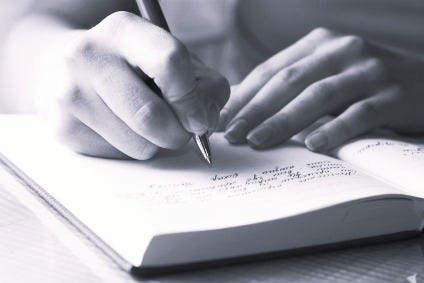
The model in English script of the expression “La caligrafía es un arte” (Exercise № 19), shown in the photograph, was made with a flexible fine‑point pen (New Pitman Calligraphy Method. English Script. Notebook № 2 [Academias Pitman, 21st edition, 1966]).
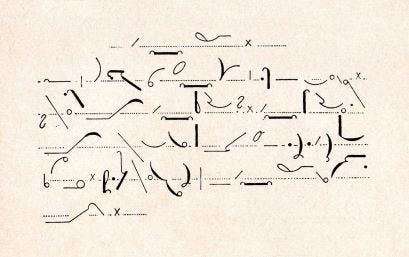
The shorthand sheet shown in the image was taken from the book Taquigrafía Pitman Comercial y Parlamentaria (Academias Pitman, 35th edition, 1956, p. 122). Copy from the author’s private collection. The translation is as follows: “Stagnant water. Everything here is pleasant, only this water gives off a stench that cannot be endured. Why has the water of this swamp become corrupted? The swamp water has become corrupted because instead of flowing it is still and idle, and idleness harms all things. Study and work, because if you live idly, you, like stagnant water, may end up corrupted.”
As a cultural and aesthetic complement to this reflection, we invite the reader to discover the poem “Calligraphy and Shorthand”, written in collaboration with Natalia G. Martínez, where handwriting is celebrated as both art and memory.
We also invite you to visit our blogs *Caligrafía Pitman and [La Taquigrafía](https://lataquigrafia.blogspot.com/)*.
This article is available in Spanish.
© 2026 Martín E. Córdoba. All rights reserved.
메타데이터
- post_id
- 605507fd2bc8
- slug
- calligraphy-and-shorthand-a-tradition-that-should-return-605507fd2bc8
- url
- https://medium.com/@maresteban.cordoba/calligraphy-and-shorthand-a-tradition-that-should-return-605507fd2bc8
- canonical_url
- https://medium.com/@maresteban.cordoba/calligraphy-and-shorthand-a-tradition-that-should-return-605507fd2bc8
- author_url
- https://medium.com/@maresteban.cordoba
- status
- ok
- fetched_at
- 2026-08-19 07:38:38