Databricks Lakebase: Rethinking OLTP for the AI Era
The Evolution of OLTP Databases
Databricks Lakebase: Rethinking OLTP for the AI Era
The Evolution of OLTP Databases
The OLTP databases have changed very little since the 1980s. Operational databases (OLTP) are based on decades-old architecture.
For decades, we’ve treated operational databases and analytics systems as separate worlds. One handles transactions. The other handles insights. That separation made sense when applications were simpler and data moved slower.
AI is introducing a new set of requirements. Now, every data application, agent, recommendation, and automated workflow needs fast, reliable data at the speed and scale of AI agents. In the age of AI, that old boundary between OLTP and analytics is starting to break.
It’s time for databases to evolve. Lakebase represents the next evolution of databases: transactional systems rebuilt for the cloud, for developers, and for the AI era. It’s not just about storing data anymore — it’s about making data instantly usable across applications, analytics, and AI workflows.
Why Another Take on Lakebase Matters
A crazy stat and you can take this several different ways, but there are ~1,010 biographies of Winston Churchill, published biographies of the same person talking about the same life.
[embed]
It’s about your perspective, voice, and framing. Because each explanation adds something new. The value isn’t just in the idea — it’s in how you explain it.
Similarly, even though there are already numerous blogs and videos about Lakebase, this article reflects my own learning and perspective. It’s my way of making sense of how Lakebase fits into the evolving landscape of operational databases, AI workflows, and cloud-native applications.
What is Lakebase?
A Lakebase is a new, open architecture that combines the best elements of transactional databases with the flexibility and economics of the data lake.
Databricks Lakebase is a fully managed database-as-a-service offering that provides the power and flexibility of PostgreSQL without the operational burden of self-management.
Traditionally, operational databases are deployed in a separate stack from the analytics platform, creating silos between transactional and analytical data. Lakebase changes that — it represents a new architecture for OLTP databases. What makes Lakebase so special is its deep integration with the Lakehouse architecture.
In other words: Lakebase = One Unified System. It integrates seamlessly with the Lakehouse, sharing the same storage layer across OLTP and OLAP workloads. This means operational and analytical data can coexist, eliminating the friction of separate systems.
Why does this matter?
For developers, it means faster iteration cycles — you don’t have to wait for data to move between transactional and analytical systems. For AI workflows, it means real-time data availability — agents, recommendations, and automated pipelines can access both fresh and historical data without complex ETL pipelines. For organizations, it means simplified infrastructure and lower costs, since you’re no longer managing two separate stacks for transactional and analytical workloads.
Lakebase isn’t just about storing data — it’s about making data immediately useful, wherever it’s needed, while reducing operational complexity. That’s the promise of this new architecture: the next evolution of OLTP for the cloud and the AI era.
Built on PostgreSQL — Reimagined for the Cloud
Lakebase is built on PostgreSQL, one of the most popular open-source databases. But Lakebase isn’t just PostgreSQL in the cloud — it’s serverless PostgreSQL, designed for modern applications and AI workloads.
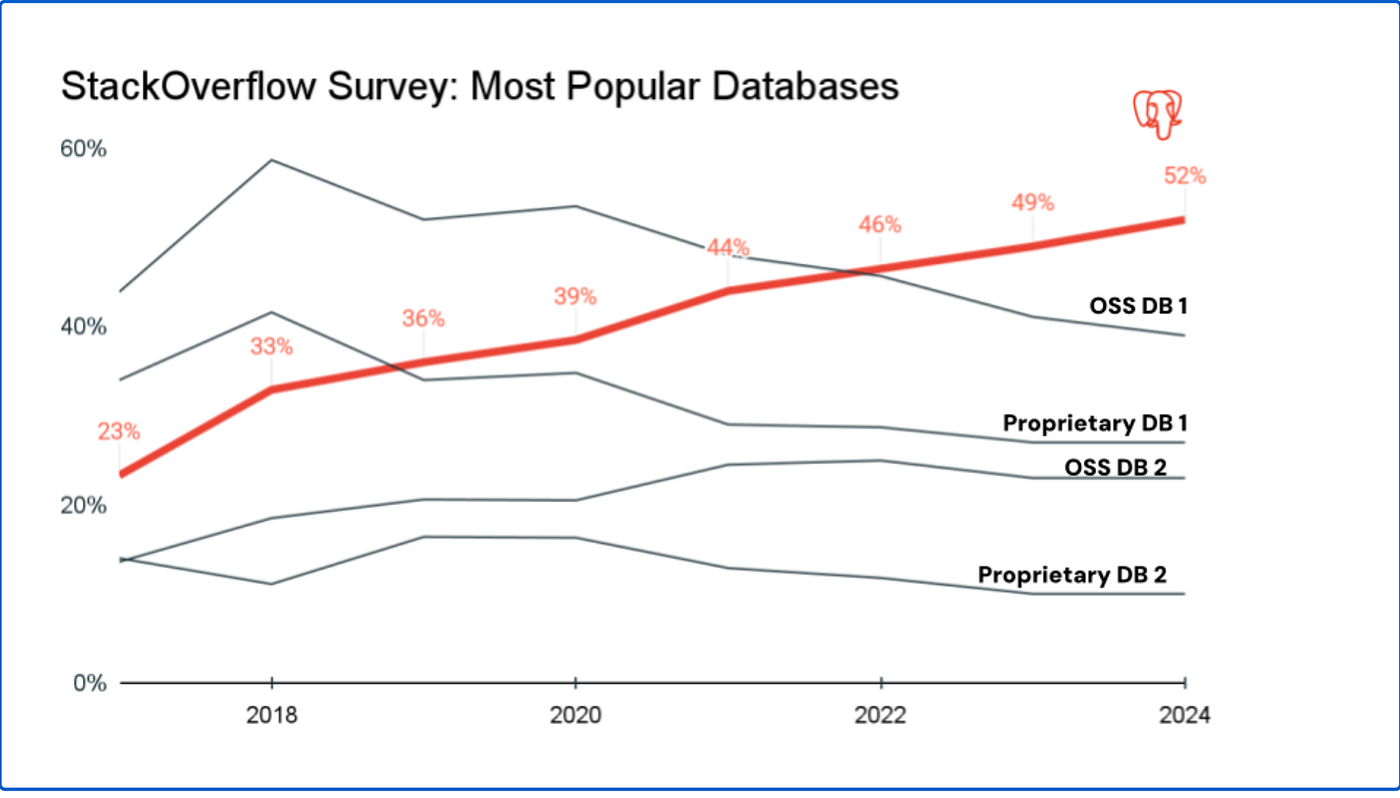
Serverless means the database scales automatically with demand and scales down when idle, removing the operational burden of managing infrastructure. For developers, this translates into faster experiments, instant provisioning, and more focus on building features instead of managing servers.
Another key innovation is the separation of compute and storage. Traditional databases tie these two together, forcing you to over-provision for peak loads or compromise on performance. Lakebase separates them, which allows independent scaling, supports low-latency transactions (<10ms), and handles high concurrency (>10k queries per second).
This separation isn’t just technical — it directly improves the developer experience. You can run complex workloads without worrying about infrastructure limits, and resources are used more efficiently, lowering costs.
Combined, serverless architecture and independent scaling mean Lakebase behaves like a flexible, on-demand service, perfectly suited for AI agents, modern applications, and dynamic workloads that require speed and reliability at scale.
Databases That Move at the Speed of Code
One of the most exciting features of Lakebase is database branching. Traditional databases are rigid and shared — changing them is risky, and testing often slows developers down. Lakebase flips that model.
With copy-on-write branching, you can instantly create a full clone of a database without duplicating the underlying data or affecting the original. This means every developer branch — or even AI agent workflow — can have its own isolated database environment.
Think of it like branching code in Git, but for your database. Each branch comes with dedicated compute resources, so experiments, tests, and new features can run in isolation while staying connected to the same underlying data. It’s a huge leap in flexibility and speed.
Lakebase also supports point-in-time restore and time travel queries, allowing you to access historical snapshots of your database whenever needed. This is particularly useful for debugging, audits, or recreating experiments exactly as they happened.
In short, Lakebase doesn’t just store data — it moves with your code and workflows, giving developers and AI agents the freedom to iterate quickly and safely.
Seamless Syncs and Unified Governance
Lakebase doesn’t just rethink how databases operate — it also bridges the gap between operational and analytical data.
It syncs directly with Unity Catalog (UC) managed tables, making it easy to combine operational, analytical, and AI workloads without building custom ETL pipelines. Customers can synchronize data between their UC tables and Lakebase tables. When you enable data synchronization, Databricks deploys a serverless Lakeflow Spark Declarative Pipeline in the background. You will be charged for the DBUs used by the pipeline.
You can configure synchronization in multiple ways: one-off snapshots, triggered updates, or continuous streaming, depending on your workflow. This flexibility ensures your data is always where it needs to be, without added operational overhead.
On top of that, governance is unified. Applications inherit consistent access control, auditing, and compliance across the Databricks platform. By integrating natively with Unity Catalog and Databricks identity, Lakebase ensures that operational and analytical users share a single source of truth for permissions and identity. You can even register a Postgres database in Unity Catalog to provide unified governance for analytics users, simplifying security while maintaining control.
In other words, Lakebase isn’t just a database — it’s a platform that connects data, AI, and applications while keeping security, compliance, and governance simple.
Why Lakebase Matters
Lakebase isn’t just another database — it represents a shift in how we think about operational systems.
Applications are becoming data-native, AI agents need real-time access to both fresh and historical data, and developers demand flexible, low-friction environments to experiment and build. Traditional OLTP architectures simply aren’t designed for this new reality.
By combining serverless PostgreSQL, separation of compute and storage, database branching, and deep integration with the Lakehouse, Lakebase addresses these challenges head-on. It enables faster development cycles, reduces operational complexity, and allows AI workflows and applications to move at the speed of data.
Ultimately, Lakebase shows us what the next generation of operational databases can look like: unified, flexible, and purpose-built for the AI era. It’s not just about storing data — it’s about making data actionable, reliable, and immediately useful, wherever it’s needed.
For anyone building modern data applications, this isn’t a nice-to-have — it’s the foundation for how the cloud, AI, and analytics converge in the future.
References
- Introducing Lakebase — Databricks Co-founder & Chief Architect Reynold Xin https://www.youtube.com/watch?v=waGy8eYJvMg
- Introduction to Lakebase: OLTP for Data Apps and AI Agents https://www.youtube.com/watch?v=UQynsu6qklw
- https://www.databricks.com/blog/what-is-a-lakebase
- https://www.databricks.com/blog/databricks-lakebase-generally-available
- https://www.databricks.com/company/newsroom/press-releases/databricks-launches-lakebase-new-class-operational-database-ai-apps
- https://www.databricks.com/blog/announcing-lakebase-public-preview
- https://www.databricks.com/blog/databricks-neon
메타데이터
- post_id
- 606bbb1e0ab1
- slug
- databricks-lakebase-606bbb1e0ab1
- url
- https://medium.com/@praveen.pc.choudhary/databricks-lakebase-606bbb1e0ab1
- canonical_url
- https://medium.com/@praveen.pc.choudhary/databricks-lakebase-606bbb1e0ab1
- author_url
- https://medium.com/@praveen.pc.choudhary
- status
- ok
- fetched_at
- 2026-06-20 20:29:01