A Silhouette That Learned to Turn
Dior, YSL, and the Geometry of Transformation
A Silhouette That Learned to Turn
Dior, YSL, and the Geometry of Transformation
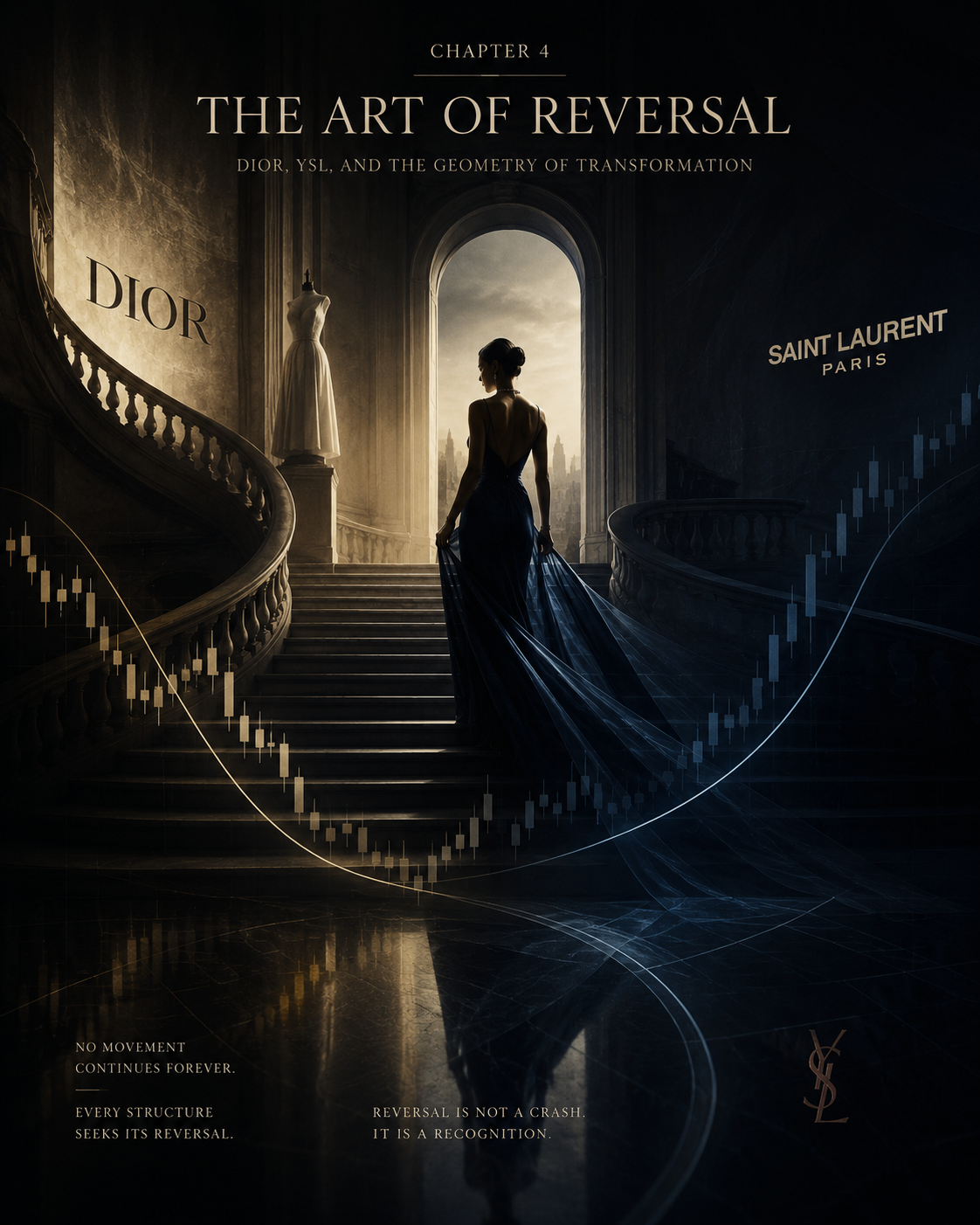
“The structure still appeared unchanged. The reversal had already begun beneath the surface.”
Chapter 4 — The Art of Reversal
No movement continues forever. Fashion knows this. Markets know this. The people who refuse to know this are the ones still holding a position that peaked three seasons ago, convinced that conviction alone is enough to keep a direction alive.
It isn’t.
Every structure eventually reaches a point where momentum begins exhausting its original logic. Not dramatically, at first. The silhouette still holds. The chart still trends. From the outside, nothing appears to have changed. But internally — in the tension of the fabric, in the narrowing of the candles, in the way the room responds a half-second slower than it did last month — something has already begun reorganizing itself.
This is how reversals begin. Not with a crash. With a feeling.

“At Dior, transformation was never abrupt. It was architecture disguised as inevitability.”
Dior and the Engineered Rounded Bottom
Dior has always treated the body as a problem to be solved architecturally.
From the radical geometry of the New Look — which arrived in 1947 like a correction after years of wartime austerity, nipping the waist and expanding the skirt with the force of a chart reversing off a major low — to the modern sculptural tailoring that Christian Dior’s successors have continued refining across decades, the house has never been interested in clothing that simply drapes. It builds. Waist containment, fabric expansion, controlled curvature, engineered proportion. Every element guides the eye through a transformation that feels, by the time it resolves, completely inevitable.
Nothing appears accidental at Dior. That is precisely how you know how much was calculated.
To understand the patient accumulation of a Rounded Bottom formation in the flesh, look at Princess Diana at the 1996 Met Gala — her one and only appearance at the event, and perhaps the most symbolically loaded fashion moment in the gala’s history.
The theme that year celebrated the house of Christian Dior itself. And Diana arrived in a midnight blue silk slip dress designed by John Galliano for his very first couture collection at Dior — lingerie-inspired, cut on the bias, trimmed with delicate black lace at the neckline and shoulder straps. She carried a Lady Dior bag and wore her famous seven-strand pearl and sapphire choker. The dress was, by every royal convention she had lived under, the wrong choice. It was also completely, unmistakably correct.
Because this was not a fashion moment. It was a reversal signal.
Diana had finalized her divorce from Prince Charles just months earlier. The woman who arrived at that staircase was not the same woman who had spent years performing restraint in buttoned-up coats and conservative hemlines. The rounded bottom had been forming quietly for years — the gradual accumulation of pressure, the slow softening of the previous direction, the almost imperceptible reorganization of identity beneath the surface. By the time she cleared the top of those steps in Galliano’s slip dress, the reversal was already complete. The new direction had been forming long before anyone saw it move.

“Princess Diana at the 1996 Met Gala”
In technical analysis, a rounded bottom does not announce its intentions. It accumulates them. Momentum slowly loses its aggression. Volatility softens. The candles shrink. And then, gradually, from beneath the stillness, a new direction begins forming — not a sharp pivot, but a magnificent curve. The transformation is so engineered it feels organic. Which is, in both fashion and finance, the highest possible technical achievement.

“Saint Laurent never drifted. Its strongest movements came from conviction.”
YSL and Directional Identity
Yves Saint Laurent did not redesign fashion. He redecided it.
The house’s legacy rests on a single, radical act of conviction: taking the vocabulary of masculine tailoring — the sharp shoulder, the clean lapel, the line that communicates authority before the wearer has said a word — and placing it, without apology or irony, on the female body. Le Smoking arrived in 1966 and the fashion industry spent the next several decades processing the implications. Some still are.
Consider Zoë Kravitz at the 2021 Met Gala: a see-through Saint Laurent dress made entirely from crystal chain links formed into the YSL logo, repeated across the entire surface of the garment, with almost nothing underneath. The dress was not subtle about what it was doing. It was a strong directional candle in a trend continuation pattern — no hesitation in the body, no significant wick suggesting doubt, just clean committed movement in a direction the structure had already decided on. The house’s monogram as the fabric itself, authority woven into the weave.

“Zoë Kravitz at the 2021 Met Gala”
YSL garments do not drift. They commit.
And yet — this is the part the house understood better than most — even the strongest directional movement eventually encounters its own exhaustion. Le Smoking was revolutionary in 1966. By the 1980s, power dressing had become its own kind of uniform, its own compression zone, and fashion was already beginning the long slow reversal toward something softer. Conviction, held too long without adjustment, becomes rigidity. And rigidity, in markets as in fashion, is what makes a reversal not just possible but mathematically necessary.
Adam, Eve, and Emotional Recovery
Among reversal formations, the Adam and Eve pattern is the one that most honestly describes how transformation actually feels from the inside.
Adam forms sharply. Hard edges, fast movement, high emotional intensity — the kind of drop or spike that feels, while it’s happening, like the only possible reality. There is no ambiguity in Adam. There is only the speed of a structure losing confidence in itself all at once.
Eve forms slowly. Rounded edges, gradual stabilization, the long quiet work of a market that has been through something and is now, carefully, finding its way back. Eve is not dramatic. Eve is what comes after dramatic — the soft recovery, the controlled transition, the emotional geometry of a system that has decided to survive.
Together, they reverse through contrast rather than symmetry. A rigid structure softens into draping. Sharp tailoring gives way to fluid textile movement. The transformation is emotional before it is directional — which is why, by the time the rest of the industry catches up to what has changed, the houses that understood it first are already three collections into somewhere new.
The Shape of Becoming Something Else
People tend to imagine reversal as failure. A trend that couldn’t hold. A look that didn’t survive the season. A position that gave back everything it made.
This is the wrong way to see it.
A reversal is not a structure collapsing. It is a structure completing. The original direction was not wrong — it was finite. Every momentum eventually reaches the boundary of what it can sustain, and what happens at that boundary is transformation: pressure redistributing, emotion reorganizing, a new direction forming quietly beneath the old one.
The fashion industry has always known this. Every era eventually reaches saturation — too much structure, too much minimalism, too much excess — and the silhouettes begin changing shape in response. What looks groundbreaking in one season becomes, within a few cycles, the very thing the next wave of designers are reversing away from. Florals for spring. Sharp shoulders for power. Logomania for visibility. Each one revolutionary in its moment, each one eventually the floor that the next reversal pushes off from.
The candle narrows. The waist is nipped. The shoulder softens.
And the chart, like the silhouette, becomes something it was always going to become. It just needed long enough to get there.

“Structure gave it form. Direction gave it purpose. Reversal gave it meaning.”
No line goes on forever, no hem stays the same, what opens with structure must close with a name. The chart that reversed was not broken — but done, a silhouette learning to face a new sun.
Dior curved the body. YSL cut it clean. The reversal, like fashion, rewrites what things mean.
메타데이터
- post_id
- 607ca8780c0a
- slug
- a-silhouette-that-learned-to-turn-607ca8780c0a
- url
- https://medium.com/@veyrain.paperrain/a-silhouette-that-learned-to-turn-607ca8780c0a
- canonical_url
- https://medium.com/@veyrain.paperrain/a-silhouette-that-learned-to-turn-607ca8780c0a
- author_url
- https://medium.com/@veyrain.paperrain
- status
- ok
- fetched_at
- 2026-06-22 05:41:33





