United States v. Cruikshank: When the Supreme Court Protected the KKK
How the Supreme Court Turned a Massacre Into a Blueprint for Jim Crow
United States v. Cruikshank: When the Supreme Court Protected the KKK
How the Supreme Court Turned a Massacre Into a Blueprint for Jim Crow

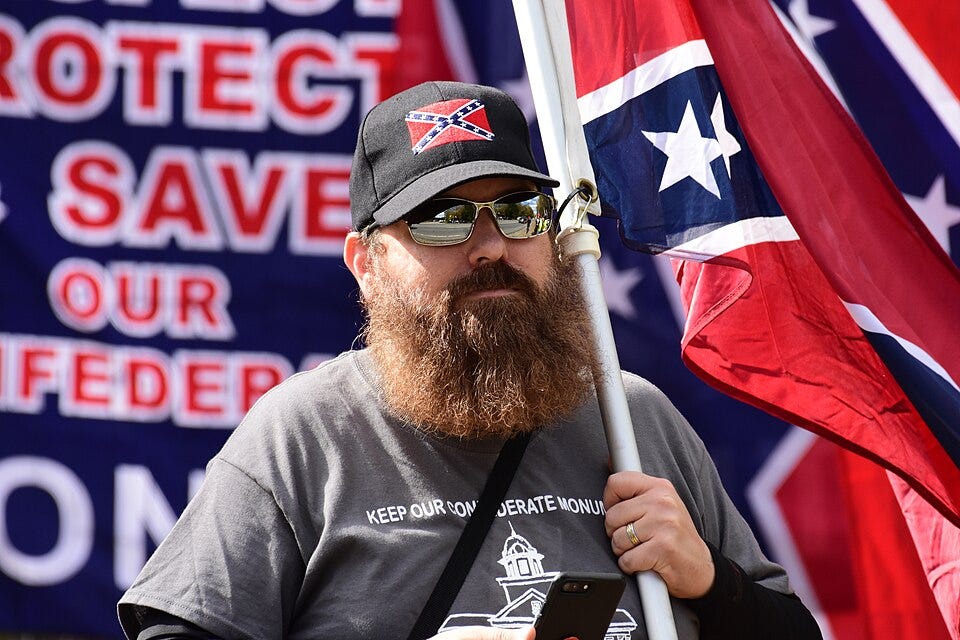
This sign was posted by white supremacists who labeled the massacre as a riot and who were pleased with the result. It still stands in Colfax, LA as an official state marker.. https://commons.wikimedia.org/wiki/File:Colfax_Riot_sign_IMG_2401.JPG
After the Civil War, Louisiana was one of the most violently contested states in the South. Three forces collided:
-
Newly enfranchised Black voters, who overwhelmingly supported the Republican Party
-
White Democrats, determined to restore pre‑war racial hierarchy
-
A fragile Reconstruction government, backed by federal troops but constantly undermined by paramilitary groups
The 1872 Louisiana gubernatorial election pushed this tension to the breaking point. Both parties claimed victory. Both inaugurated their own governors. Both appointed their own local officials. Grant Parish became one of the flashpoints.
In early 1873, Black Republicans in Grant Parish attempted to defend the legitimacy of the Republican sheriff and judge who had been certified by the Republican state government.
White Democrats, refusing to accept that outcome, organized armed militias — including members of the White League and Klan‑aligned groups to seize the courthouse by force.
Black residents, many of them Civil War veterans, took control of the Colfax courthouse to protect the elected officials and prevent a coup.
On Easter Sunday, April 13, 1873, a white paramilitary force of 300+ armed men, including former Confederate officers, surrounded the courthouse. What followed was not a “battle.” It was a mass execution.
The white mob brought a cannon to break the defenders’ position. Though Black defenders surrendered, many were shot on the spot. Others were captured, lined up, and executed hours later. Some were burned alive when the courthouse was set on fire. The mob hunted down fleeing survivors across fields and swamps. As many as 150 Black men were killed, along with 3 of the white attackers.
Louisiana’s white‑controlled local courts refused to prosecute the killers. So federal officials used the Enforcement Acts of 1870–71, laws designed to suppress the Ku Klux Klan, to charge several members of the mob with:
- Conspiracy to deprive Black citizens of their constitutional rights
- Interference with voting rights
- Violations of the First and Second Amendments (assembly and bearing arms)
A federal jury convicted several defendants. They promptly appealed. The defendants argued that the federal government had no authority to prosecute them. The Supreme Court agreed.
The Court’s ruling can be distilled into three core holdings:
1. The Bill of Rights does not apply to the states.
The Court said the First and Second Amendments restrict only the federal government, not state governments or private individuals. This meant the federal government could not prosecute private actors for violating those rights.
2. The 14th Amendment protects against state action, not private violence.
The Court held that the 14th Amendment only prohibits actions by states — not by individuals. So, unless a state government itself violated someone’s rights, the federal government had no role.
3. The federal government cannot prosecute private conspiracies to deprive Black citizens of their rights.
Even when the conspiracy was explicitly racial and violent — as in Colfax — the Court said federal charges were invalid unless the state was directly involved.
This decision effectively legalized racial terror carried out by private groups, including the Klan, so long as state officials looked the other way, which they routinely did. Its consequences were immediate and far‑reaching:
1. It nullified federal protection for Black life and political participation.
Federal prosecutors could no longer bring cases against white mobs who murdered, assaulted, or intimidated Black citizens.
2. It signaled to Southern states that the Court would not enforce Reconstruction.
White supremacist paramilitary groups — the White League, Red Shirts, and others- escalated violence with impunity.
3. It helped end Reconstruction.
By removing federal enforcement power, the Court cleared the path for the Compromise of 1877 and the rise of Jim Crow. It remained the law for decades.
The “state action doctrine” created here still shapes constitutional law today, though later cases partially incorporated the Bill of Rights against the states.
The Supreme Court legitimized private racial violence as long as the states refused to act. Now, the Supreme Court invites states to engage in racism, as long as they call it something different. SCOTUS disallows evidence of racism and insists that intent is the only measure. That’s the basis for the Louisiana v. Callais decision, now seeing state after state targeting minority districts while ignoring the racial effect.
The Supreme Court has never formally overturned United States v. Cruikshank (1876). What happened instead is that its core doctrines were eroded, limited, or bypassed over the next century — but never explicitly reversed. The Civil Rights Act of 1964 and the Voting Rights Act of 1965 gave Congress new statutory authority to enforce federal power against states that commit or endorse racism. Recent decisions like Shelby v. Holder and Louisiana v. Callais have returned power to the states to discriminate at will, as long as it's worded correctly.
Is the Supreme Court of the present any different than when they decided Cruikshank in 1876? You can’t prove it by their actions. Watch what they do, not what they say.
메타데이터
- post_id
- 60a4c3597eeb
- slug
- united-states-v-cruikshank-when-the-supreme-court-protected-the-kkk-60a4c3597eeb
- url
- https://medium.com/@williamspivey/united-states-v-cruikshank-when-the-supreme-court-protected-the-kkk-60a4c3597eeb
- canonical_url
- https://medium.com/@williamspivey/united-states-v-cruikshank-when-the-supreme-court-protected-the-kkk-60a4c3597eeb
- author_url
- https://medium.com/@williamspivey
- status
- ok
- fetched_at
- 2026-06-09 15:37:30