The Reputation Gap: Why Great Businesses Still Lose Customers Online
Imagine two companies offering nearly identical products, prices, and customer service.
The Reputation Gap: Why Great Businesses Still Lose Customers Online
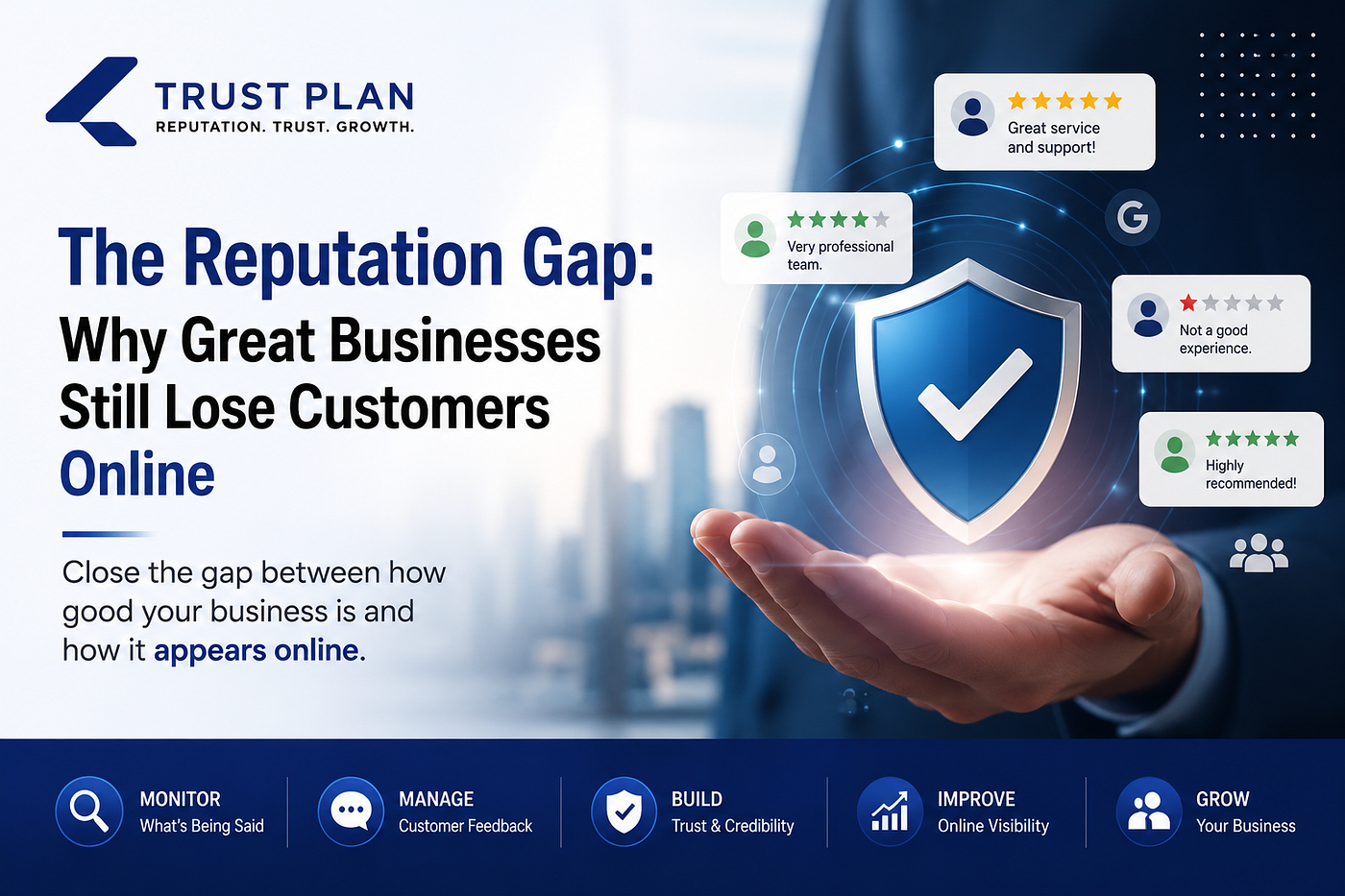
Imagine two companies offering nearly identical products, prices, and customer service.
One consistently attracts new customers, receives inquiries, and earns trust almost immediately.
The other struggles to convert leads despite investing heavily in marketing and sales.
What’s the difference?
Often, it’s not the quality of the business.
It’s the quality of its online reputation.
The Trust Gap Most Businesses Don’t See
Many business owners assume that delivering excellent service is enough to build a strong reputation.
Unfortunately, that’s not always true.
In today’s digital environment, customers make decisions based on what they can find online — not just on the actual quality of a company.
A business may have hundreds of satisfied customers, but if its online presence is weak, outdated, or overshadowed by a few negative comments, potential clients may never discover its true value.
This creates what we call the Reputation Gap:
The difference between how good a business actually is and how trustworthy it appears online.
Why Customers Trust Search Results
When people need a product or service, they want reassurance.
Before making a decision, they typically look for:
- Reviews
- Testimonials
- Google ratings
- Social media activity
- News articles
- Industry recognition
These signals help answer a simple question:
“Can I trust this business?”
In many cases, customers place more trust in these external signals than in the company’s own marketing materials.
That’s why reputation has become one of the most valuable assets a business can build.
The Hidden Cost of a Weak Online Presence
Most companies only think about reputation when they encounter a problem:
- A negative review goes viral
- An unhappy customer posts online
- A misleading article appears in search results
- Competitors leave unfair criticism
However, reputation issues can be costly even when there is no obvious crisis.
A weak online presence can lead to:
Lost Sales
Potential customers choose competitors with stronger reviews and more visible credibility.
Lower Conversion Rates
People visit your website but hesitate to contact you because they cannot find enough evidence to trust your business.
Reduced Brand Authority
Without positive content supporting your expertise, it becomes harder to stand out in a crowded market.
Missed Opportunities
Investors, partners, and potential employees often research companies online before making decisions.
Reputation Management Is About Building, Not Just Fixing
One common misconception is that reputation management only involves removing negative content.
In reality, the most successful businesses focus on building a strong reputation long before problems arise.
Effective reputation management includes:
Monitoring Online Mentions
Knowing what customers and stakeholders are saying about your brand.
Encouraging Authentic Reviews
Happy customers are often willing to share positive experiences when asked.
Publishing Valuable Content
Articles, case studies, and thought leadership content help establish expertise and credibility.
Engaging With Feedback
Responding professionally to reviews demonstrates transparency and accountability.
Maintaining Consistency
Customers trust brands that communicate consistently across websites, social media, and business directories.
The Businesses That Win Online
The companies that perform best online share several characteristics:
✔ They actively manage their reputation.
✔ They invest in customer trust.
✔ They respond to feedback.
✔ They publish useful content.
✔ They monitor their digital presence regularly.
They understand that reputation is not a marketing tactic.
It’s a business strategy.
The Future Belongs to Trusted Brands
As search engines, reviews, and social platforms continue to influence buying decisions, reputation will play an even larger role in business success.
Customers have more information than ever before.
They can compare businesses instantly.
They can research your company in seconds.
And they often decide whether to trust you before they ever speak with you.
The question for every business is no longer:
“Do we have a reputation?”
The real question is:
“Are we actively managing it?”
Final Thoughts
Building a strong reputation takes time, consistency, and effort.
But the businesses that invest in trust today will be better positioned to attract customers, grow their brand, and withstand future challenges.
At Trust Plan, we believe reputation isn’t just something to protect during a crisis — it’s something worth building every day.
Because in a world where customers search before they buy, trust is often the most powerful competitive advantage of all.
메타데이터
- post_id
- 60e4a8328e3b
- slug
- the-reputation-gap-why-great-businesses-still-lose-customers-online-60e4a8328e3b
- url
- https://medium.com/@trustplan/the-reputation-gap-why-great-businesses-still-lose-customers-online-60e4a8328e3b
- canonical_url
- https://medium.com/@trustplan/the-reputation-gap-why-great-businesses-still-lose-customers-online-60e4a8328e3b
- author_url
- https://medium.com/@trustplan
- status
- ok
- fetched_at
- 2026-06-12 18:14:10