‘Likes’ over Licenses: Why We Trust Influencers More Than Experts
Deconstructing the UI/UX Mechanics That Turn Influencers into Instant “Experts”
‘Likes’ over Licenses: Why We Trust Influencers More Than Experts
Deconstructing the UI/UX Mechanics That Turn Influencers into Instant “Experts”
“Everyone on my feed is saying this, so it must be true.” When an interface assigns authority based on engagement and the blue check mark, can we truly trust the advice we consume on social media?
By: Gabriela Z
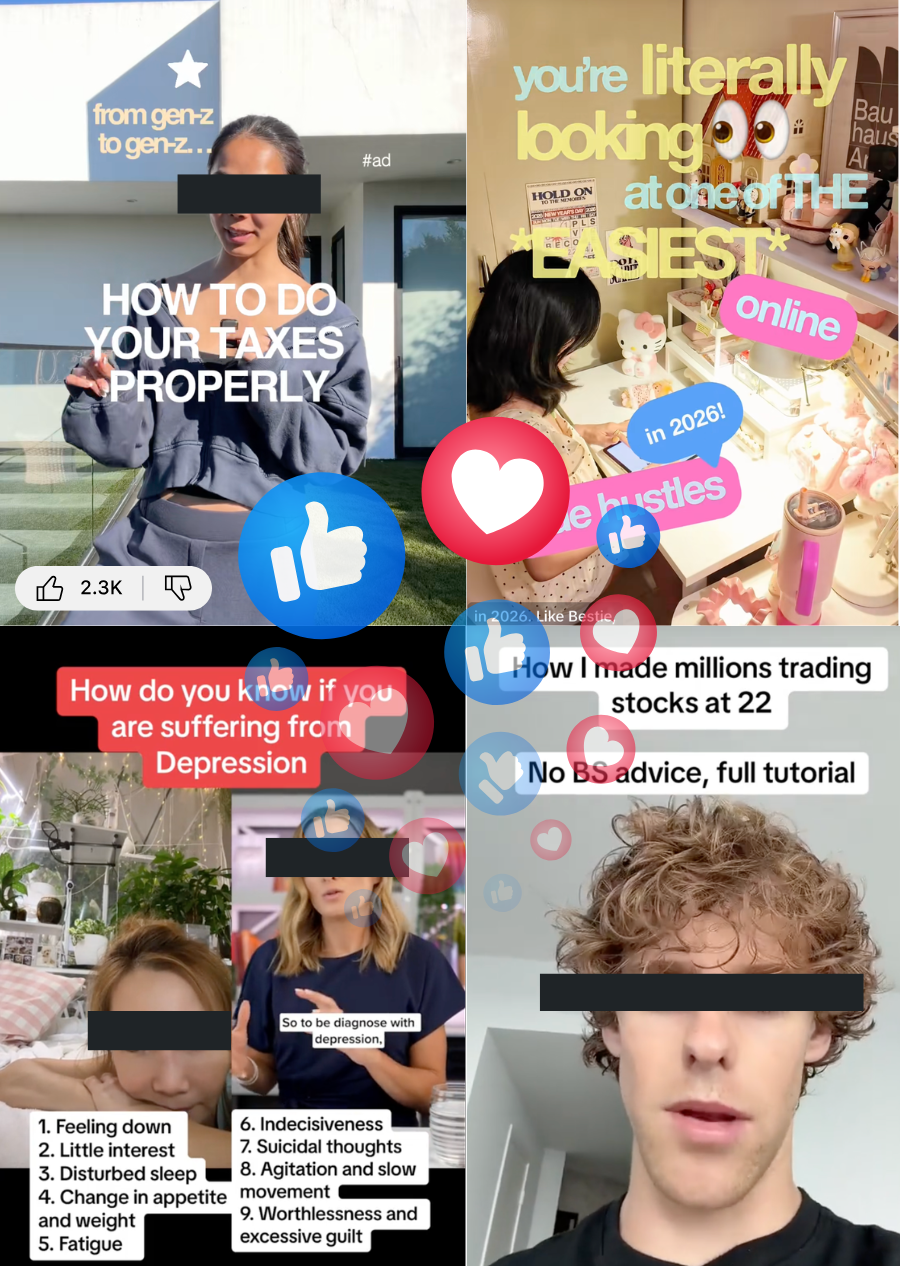
source: https://www.tiktok.com/@eileenxyang, https://www.tiktok.com/@everyrinidays, https://www.tiktok.com/@tradingwithmorgan | edited by the writer
Abstract
In the contemporary digital ecosystem, social media platforms have transitioned from mere networking utilities into primary vehicles for knowledge acquisition. Increasingly, users bypass traditional institutional channels in favor of digital content creators or what we know these days as “influencers”, for critical life guidance across highly regulated domains such as personal finance, law hack, and mental health care. While these platforms democratize access to information, their underlying structural architecture is fundamentally optimized for user engagement rather than factual veracity.
To understand how digital interfaces manufacture unearned trust, this article utilizes Marshall McLuhan’s Medium Theory alongside modern frameworks of the Attention Economy. By analyzing the interface as an active agent rather than a neutral conduit, we can observe how the structural features of the UI (such as real-time metric counters) dictate consumer behavior. This structural manipulation interfaces directly with the audience’s psychological drives, as outlined by Uses and Gratifications Theory, explaining the user's tendency to algorithmically select and validate content that functions as an emotional or cognitive confirmation mechanism.
Keywords: UI/UX Design, Confirmation Bias, Social Proof, Influencer Credibility, Media Studies
Introduction
In the contemporary era, “influencer” has become a ubiquitous term within society, particularly among youth and individuals who consume social media on a daily basis. According to the Cambridge Dictionary, an influencer is defined as “a person active on social media who is able to influence people’s opinions or to persuade them to follow a particular lifestyle or buy a particular product.”
An individual is typically classified as a “social media influencer” once they successfully accumulate a substantial following, generally ranging from over 10,000 to millions of followers across social platforms. Beyond mere follower counts, their status is evaluated by the volume of user engagement generated by each piece of content, manifest in metrics such as likes, comments, and shares. The greater these quantitative metrics, the more the creator is deemed a “successful” influencer — regardless of the empirical accuracy of their content.
Consequently, the validity of digital content is increasingly evaluated based on engagement volume rather than the actual substance or context of the information presented. Alarmingly, a significant number of influencers disseminate advice or “tips” concerning personal finance, mental health, and general medical wellness without possessing professional licensure. This content is subsequently consumed by followers who readily apply it to their personal lives, despite the fact that the advice may be fundamentally flawed. Furthermore, such tips frequently double as covert promotional material, serving as a vehicle for brand sponsorships and commercial collaborations rather than objective expertise.
Methodology
This article aims to analyze the intersection of Medium Theory and the economics of the Attention Economy to evaluate how social media interfaces manufacture unearned credibility for unregulated advice. This dual-framework conceptualizes the user interface (UI) as an active, ideologically driven architecture that shapes human cognition and behavioral habits.
Discussion and Findings
Metrics Over Merit
Under the lens of McLuhan’s Medium Theory, which is “the medium is the message”, the interface is never neutral. Social media UIs are engineered with a specific visual hierarchy that elevates algorithmic engagement while burying institutional credentials.
When a user/audience opens a post, the social media interface forces the eye to scan high-contrast, large-font metric counters, such as “4.2M views,” “250k likes,” or a verified blue checkmark. These elements are placed at the primary focal points of the screen. Conversely, actual credentials (degrees, professional licensures, or institutional affiliations) are either non-existent, relegated to a character-limited bio, or buried behind a “see more” truncation link.
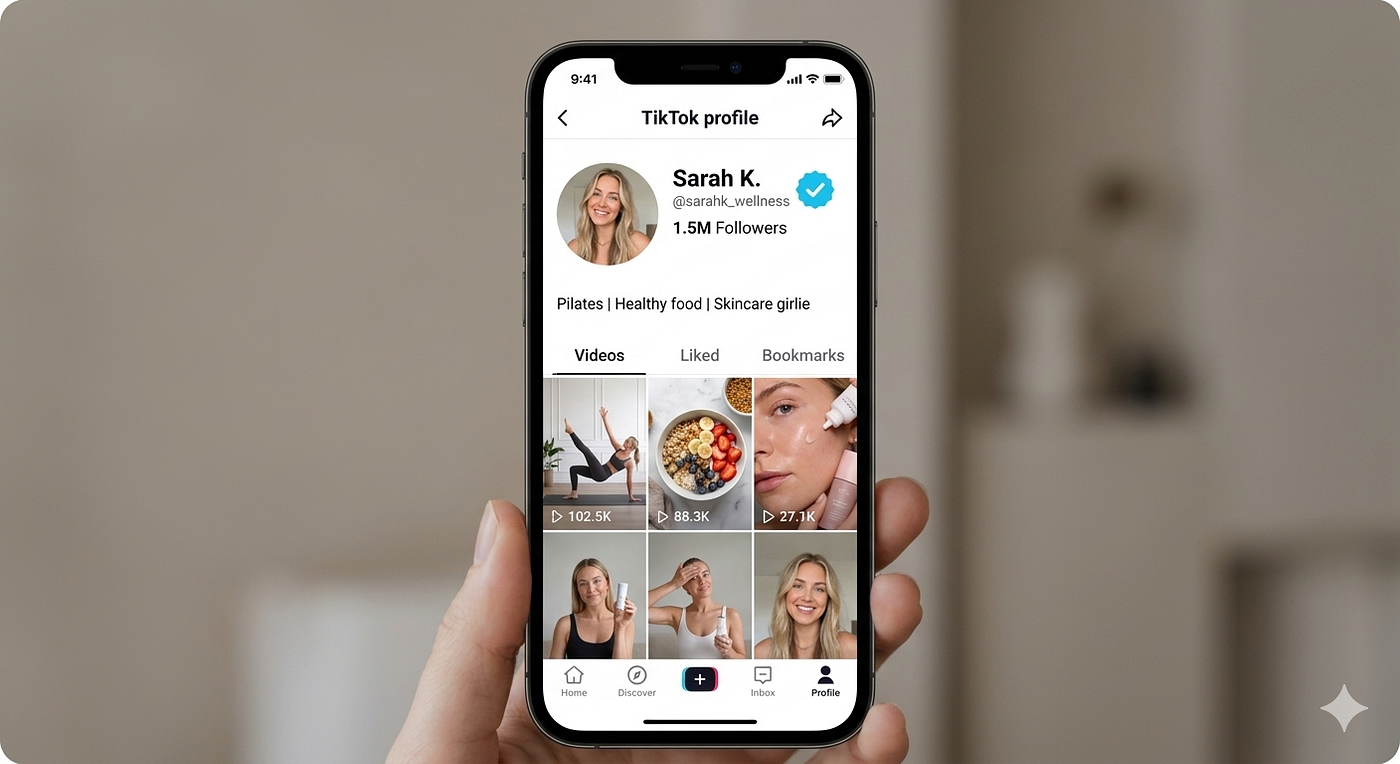
Image is generated by AI Gemini
By making popularity hyper-visible and credentials invisible, the interface structurally redefines what “authority” looks like. The interface tells the user’s brain that if a million peers have validated this content via a tap, it is safe, trustworthy, and authoritative, even more trustworthy than individuals possessing actual professional licensure outside the social media ecosystem.
In reality, these influencers may completely lack the credentials required to address highly specific domains such as healthcare, legal counsel, or other fields demanding specialized expertise. Conversely, in the physical world, licensed professionals, including lawyers, doctors, psychologists, nutritionists, and practitioners of other regulated vocations, tend to go unheard or face a lack of clients primarily due to the prohibitive cost of their services. Meanwhile, influencers offer their advice completely free of monetary charge; instead, consumers pay for this information by contributing their digital engagement through views, likes, and comments.
The Gamification of “Trust”
Herbert Simon’s theory, called “The Attention Economy” (1977), states that a wealth of information inherently creates a poverty of attention. In the digital era, algorithms, social media, and advertisers compete fiercely to capture and monetize users’ time and engagement. It relies on keeping users scrolling, which requires reducing “cognitive friction” (the mental effort needed to process information). User interface elements like the double-tap to like, endless vertical scrolling, and auto-playing video loops are designed to induce a state of cognitive ease.
This frictionless architecture becomes predatory when intersecting with socio-demographic vulnerabilities, such as the sandwich generation or individuals facing systemic debt. When a user experiences acute financial stress, their cognitive load is already heavily taxed. By serving highly complex financial advice wrapped in a ‘zero-friction’ UI, where validation is proven by a bolded ‘245K likes’ icon rather than a regulatory license, the interface exploits the user’s desperation for an immediate solution. The UI successfully decouples the feeling of systematic safety from the reality of financial risk, leading users to execute volatile ‘hacks’ that could worsen their economic precarity.

Source: www.tiktok.com/@grace_lemire
But why do people trust a random person on the internet more than a real licensed person?
When an influencer speaks directly into a vertical camera, filling the user’s mobile screen, the UX creates a parasocial interaction (a one-sided illusion of intimacy). Because the interface makes the influencer feel like a trusted friend standing in the same room, the user lowers their skeptical defenses.

www.tiktok.com/@grace_lemire
The Semiotics of the “Blue Check” on Social Media interface
To understand why users blindly trust the blue checkmark, you must look at its UX history. Originally introduced by Twitter in 2009 and later adopted by Meta and TikTok, the blue checkmark was an exclusive, platform-vetted badge. To receive it, a user had to prove they were a notable public figure, celebrity, or journalist through rigorous documentation (e.g., press coverage, government IDs).
source: https://edition.cnn.com/
Because platforms spent over a decade training the human brain to associate that specific blue icon with identity verification and high status, users developed a cognitive shorthand: Blue Checkmark =Vetted, Authentic, and Safe.
However, since 2022, that blue check can be bought by everyone without waiting for months to get approved. For a nominal monthly fee, almost anyone can acquire the exact same visual badge that was once reserved for institutional authority figures, yet the UI design did not change. The badge looks exactly the same. This creates a phenomenon known in media studies as semiotic decay, where a signifier (the blue check) remains structurally identical, but its underlying meaning has completely degraded. Because the interface does not differentiate between an influencer who bought status and a medical professional who earned status, it actively tricks the user’s subconscious.
The presence of the blue checkmark casts a positive light over the creator’s entire profile. If the account is “verified,” the user automatically assumes the creator’s advice is also verified. The interface encourages the user to transfer the platform’s baseline identity confirmation onto the empirical accuracy of complex financial or medical claims.
Humans have a natural tendency to trust automated, systemic indicators over their own critical judgment. The blue check functions as an official “stamp of approval” from the platform’s system architecture, overriding the user’s skepticism regarding the influencer’s lack of professional licensure. While in the physical world, a financial advisor or mental health therapist must display physical licenses, certifications, and legal disclaimers. These regulatory frameworks create institutional friction to protect consumers.
Algorithmic Confirmation Mechanics
Finally, the discussion must address how the backend UX (the algorithm) feeds the frontend UI to weaponize confirmation bias. When a vulnerable user searches for terms like “Bipolar symptoms” or “how to invest and be a millionaire in just 1 year,” the platform’s recommendation engine doesn’t serve the most legally or medically accurate content, it serves the content most likely to prolong session time.
Once a user interacts with an unverified piece of advice, the UI dynamically alters their future feed to display identical perspectives. This creates a hyper-isolated echo chamber. Under Uses and Gratifications, the user feels emotionally validated because the interface continuously mirrors their internal anxieties or desires. They mistake this hyper-relevance and algorithmic repetition for objective truth, concluding: “Everyone on my feed is saying this, so it must be true.”
Conclusion
This article has deconstructed how social media UI/UX acts as an active, ideologically driven agent that manufactures unearned credibility. Through the lenses of Medium Theory and the Attention Economy, it is evident that the digital ecosystem has successfully decoupled the psychological feeling of trust from the objective presence of truth. By eliminating cognitive friction, gamifying metrics, and utilizing immersive vertical framing, platforms intentionally lower users’ critical defenses to maximize screen time and revenue.
This structural manipulation becomes dangerous when intersecting with socio-demographic vulnerabilities. When a user is under acute economic or emotional strain, such as individuals navigating severe debt or the compounding pressures of the sandwich generation, seeks a lifeline, the interface bypasses medically or legally sound guidance in favor of engagement volume.
Ultimately, digital consumers are not inherently gullible; they are simply being out-engineered by hyper-optimized interface mechanics. As algorithms weaponize confirmation bias to feed users isolated echo chambers, unlicensed lifestyle advice is seamlessly elevated to authoritative gospel. If future UX design frameworks continue to prioritize frictionless scrolling over factual veracity, the line between popularity and expertise will fade entirely, leaving the most vulnerable demographics to face the severe real-world consequences of engineered deception.
References: Blumler, J. G., & Katz, E. (1974). The uses of mass communications: Current perspectives on gratifications research. Sage Publications.
Cialdini, R. B. (1984). Influence: The psychology of persuasion. HarperCollins.
**Meyrowitz, J. (1985). **No sense of place: The impact of electronic media on social behavior. Oxford University Press.
Simon, H. A. (1971). Designing organizations for an information-rich world. In Martin Greenberger (Ed.), Computers, communications, and the public interest (pp. 37–72). The Johns Hopkins Press.
We are finally on social media.. Come say hi…
Subscribe and follow our official social handles on **Instagram | X | Facebook**.
Feel free to mention / tag us on these social platforms whenever you want to promote or collaborate on your content. We love watching you grow with this community.
This story published on “**Pen With Paper” — a fresh space where writers bring their thoughts, stories, and ideas to life. Want to share your voice? Join our community, and together, “We Elevate Your Stories”**
메타데이터
- post_id
- 60e6fd289b44
- slug
- likes-over-licenses-why-we-trust-influencers-more-than-experts-60e6fd289b44
- url
- https://medium.com/pen-with-paper/likes-over-licenses-why-we-trust-influencers-more-than-experts-60e6fd289b44
- canonical_url
- https://medium.com/pen-with-paper/likes-over-licenses-why-we-trust-influencers-more-than-experts-60e6fd289b44
- author_url
- https://medium.com/@gab95
- status
- ok
- fetched_at
- 2026-06-10 08:17:25