SEO Is Not Enough Anymore: Why Smart Brands Need GEO Too
A few years ago, ranking on Google felt like the main digital marketing goal. If your page appeared near the top of search results, you had…
SEO Is Not Enough Anymore: Why Smart Brands Need GEO Too
Ready To Fix Your Visibility Problem (Chamidu-Contact Now)
A few years ago, ranking on Google felt like the main digital marketing goal. If your page appeared near the top of search results, you had a good chance of winning traffic, leads, and sales. That logic still matters, but the way people discover information is changing fast.
Today, many users do not start with a list of blue links. They ask AI tools for direct answers. Platforms powered by large language models now summarize information, compare options, and recommend solutions inside the conversation itself. That shift has created a new challenge for brands. It is no longer enough to just rank. You also need to be part of the answer.
That is where GEO comes in. GEO stands for Generative Engine Optimization. It focuses on making your content easier for AI driven systems to understand, trust, summarize, and cite when users ask relevant questions.
What SEO And GEO Really Mean
SEO, or Search Engine Optimization, is about helping your website appear in traditional search engine results. It depends on factors like keyword relevance, crawlability, site structure, backlinks, and overall authority.
GEO, or Generative Engine Optimization, is about improving your visibility inside AI powered answers. Instead of only aiming for clicks from search result pages, GEO aims to make your brand or content appear directly in responses generated by tools such as ChatGPT, Gemini, Perplexity, and AI enhanced search experiences.
This difference matters. SEO helps users find your page. GEO helps AI systems use your content as part of their answer. One is about ranking in a list. The other is about being included in the response itself.
Why This Shift Matters For Businesses
User behavior is changing because AI tools are faster and more conversational. People increasingly want direct, summarized responses instead of scanning multiple pages to piece together an answer themselves.
For businesses, this means visibility now happens in two places at once. First, in traditional search results. Second, inside AI generated summaries and conversational tools. Brands that focus only on old style SEO may still get traffic, but they risk becoming invisible in the environments where more discovery is happening.
This is especially important for service businesses, consultants, agencies, SaaS companies, and personal brands. If your audience asks AI which tool to use, how a service works, or who can solve a specific problem, the answer engine may shape the buying decision before the user even visits a website.
How GEO Changes Content Strategy
GEO rewards clarity, structure, and factual usefulness. Content that gives direct answers, uses clean headings, explains ideas simply, and supports key points with evidence is easier for AI systems to interpret and reuse.
That means weak content becomes even weaker. Long introductions, vague marketing language, thin articles, and generic thought leadership pieces are less likely to become useful sources for AI generated answers.
Strong GEO content usually does a few things well:
- Answers the main question early.
- Uses question based headings that match real user intent.
- Includes verified facts, examples, and clear explanations.
- Builds authority through trustworthy sources and topic depth.
- Stays easy for both humans and machines to parse.
In simple terms, good GEO content sounds human, reads clearly, and carries enough substance to be trusted.
SEO Still Matters A Lot
GEO is not replacing SEO. It is building on top of it. AI systems still rely heavily on the web ecosystem, and strong websites with technical clarity and authority remain more likely to be discovered, trusted, and referenced.
That means the foundations of SEO still matter:
- Fast, mobile friendly pages.
- Clean structure and heading hierarchy.
- Relevant keywords and search intent alignment.
- Internal linking and topical authority.
- Quality backlinks and external trust signals.
The best strategy is not SEO or GEO. It is SEO plus GEO. One helps you get found by search engines. The other helps you get surfaced by answer engines.
Practical Ways To Optimize For Both
Businesses do not need to rebuild everything from scratch. In many cases, the smarter move is to upgrade existing content so it performs better in both search and AI environments.
A practical starting point looks like this:
- Rewrite key pages to answer the main question in the first few lines.
- Replace vague headings with clear, search style questions.
- Add supporting facts, examples, and concise explanations that can be quoted or summarized.
- Improve structure with short paragraphs, bullet points, and logical section flow.
- Strengthen technical SEO so your pages remain easy to crawl and index.
- Build topic depth instead of publishing many thin pages.
This approach improves usability for readers and increases the chance that AI systems treat your content as a reliable source.
What This Means For Personal Brands And Freelancers
This shift is not only for large companies. Freelancers, creators, consultants, and niche service providers can benefit a lot from it because clear expertise often performs well in both search and AI environments.
A strong personal brand today should publish content that answers real client questions. Instead of writing only promotional posts, it is smarter to create useful articles that explain problems, compare solutions, and show practical expertise. That kind of content can rank in search results and also influence AI generated answers.
For example, a freelancer offering SEO services should not only have a service page. They should also publish articles like:
- What is the difference between SEO and GEO
- How to prepare a website for AI search
- Why structured content wins in answer engines
- Common content mistakes that reduce AI visibility
This builds credibility before the client reaches out.
Why This Matters To The Work Done Here
The same thinking applies to modern digital services. Strong online visibility no longer depends only on design or publishing more content. It depends on how well your content is structured, explained, and connected to real user intent.
That is why modern content strategy needs both technical understanding and communication skill. Pages should not only look good. They should also rank well, answer clearly, and support how people search today, whether through Google or AI tools.
For businesses that want to stay competitive, this creates a real opportunity. The companies that adapt early can become trusted sources in both search results and AI conversations.
Ready To Fix Your Visibility Problem
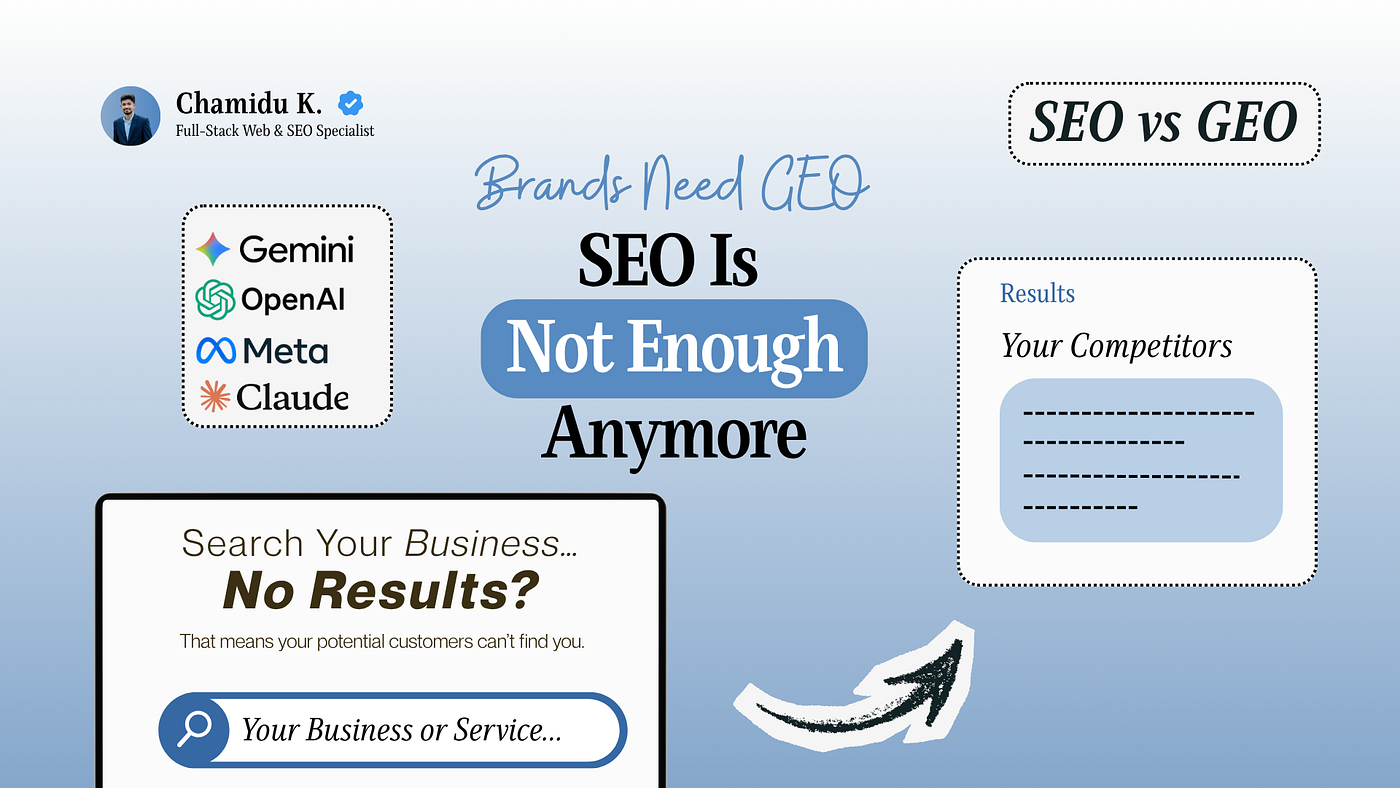
Your competitors are already appearing in AI answers. If you wait, you lose ground every day.
I can help you build a visibility strategy that works for both traditional search and AI search.
See my work and services: https://chamidu.web.lk/
Final Thought
SEO still matters because search traffic still matters. But the future of visibility is broader than rankings alone. As AI becomes a bigger part of how people discover information, GEO is becoming an essential layer of digital strategy.
The brands that win next will not just chase clicks. They will create content that deserves to be found, trusted, and cited. That is the real difference between being online and being visible.

Ready To Fix Your Visibility Problem (VisualVibe Studio-Contact Now)
References
- Conductor. “Generative Engine Optimization (GEO).”conductor
- Semrush. “SEO to GEO: Strategies for Marketers” (WSJ/Deloitte).deloitte.wsj
- Informa TechTarget. “GEO vs. SEO: A Marketer’s Guide to Dual Optimization.”informatechtarget
- Search Engine Land. “Generative engine optimization (GEO): How to win AI …”searchengineland
- Mayenmax. “SEO and GEO Integration: Analysis, Best Practices, and Strategic Recommendations 2025 Edition.”mayenmax
- High Growth Digital. “GEO vs SEO.”highgrowthdigital
- AdTaxi. “From SEO To GEO: What Marketers Need To Know and Why.”adtaxi
- inSegment. “Geotargeting for SEO: A Full Guide.”insegment
- Adsclique. “SEO vs GEO Marketing: Which One Drives Better Results?”asclique
- Advertising Week. “SEO to GEO: Best Practices Beyond Basic Optimization.”advertisingweek
메타데이터
- post_id
- 60fbd171f488
- slug
- seo-is-not-enough-anymore-why-smart-brands-need-geo-too-60fbd171f488
- url
- https://medium.com/@ChamiduDK/seo-is-not-enough-anymore-why-smart-brands-need-geo-too-60fbd171f488
- canonical_url
- https://medium.com/@ChamiduDK/seo-is-not-enough-anymore-why-smart-brands-need-geo-too-60fbd171f488
- author_url
- https://medium.com/@ChamiduDK
- status
- ok
- fetched_at
- 2026-07-13 06:23:13