MLCC Alternative for Automotive LiDAR: How YMIN Hybrid Capacitors Improve Power Stability and…
The Growing Reliability Challenge in Automotive LiDAR Power Systems
MLCC Alternative for Automotive LiDAR: How YMIN Hybrid Capacitors Improve Power Stability and Reliability
The Growing Reliability Challenge in Automotive LiDAR Power Systems
As autonomous driving technologies continue evolving toward Level 3 and Level 4 autonomy, automotive LiDAR systems have become one of the most critical sensing components inside modern vehicles.
From laser emission modules and signal receiving circuits to FPGA processors and AI computing units, every subsystem relies on stable power delivery to ensure accurate environmental perception and real-time decision-making.
For automotive Tier 1 suppliers and LiDAR manufacturers, power integrity is no longer simply a performance requirement — it has become a safety requirement.
One increasingly discussed issue among automotive hardware engineers is the long-term reliability limitation of high-capacitance MLCCs (Multilayer Ceramic Capacitors) used in LiDAR power circuits.
This challenge is driving interest toward hybrid aluminum electrolytic capacitors as a more robust alternative.
Why MLCC-Based LiDAR Designs Face Reliability Risks
MLCCs are widely used because of their compact size and excellent high-frequency characteristics. However, when deployed in automotive LiDAR applications, several inherent material limitations begin to emerge.
Mechanical Stress Caused by Piezoelectric Effects
Ceramic dielectric materials exhibit inverse piezoelectric behavior.
Under continuous electrical excitation, MLCCs generate microscopic mechanical vibrations. Combined with vehicle vibration, thermal cycling, and road shock conditions, this can create internal stress accumulation over time.
Potential consequences include:
- Capacitance degradation
- Increased leakage current
- Internal microcracks
- Reduced power stability
- Premature component failure
For LiDAR systems that require continuous precision sensing, even small electrical deviations can affect ranging accuracy, response consistency, and system reliability.
Thermal Cycling Challenges
Automotive environments regularly experience temperature variations ranging from sub-zero winter conditions to high-temperature engine compartment environments.
Repeated thermal expansion and contraction can accelerate mechanical fatigue inside ceramic capacitors, particularly in high-capacitance MLCC arrays.
Supply Chain Volatility
Many automotive manufacturers have experienced MLCC shortages and price fluctuations over the past several years.
As ADAS deployment scales globally, engineers increasingly evaluate alternative capacitor technologies that provide both technical advantages and supply chain stability.
Why Hybrid Aluminum Capacitors Are Gaining Attention in Automotive Electronics
Hybrid aluminum electrolytic capacitors combine conductive polymer technology with liquid electrolyte technology.
This architecture offers a unique balance of:
- Low ESR performance
- High ripple current capability
- Long operational life
- Excellent vibration resistance
- Stable capacitance characteristics
Most importantly, hybrid capacitors eliminate the piezoelectric effect associated with ceramic capacitors.
For automotive LiDAR power systems, this removes one of the primary root causes of long-term reliability concerns.
YMIN Hybrid Capacitor Solution for Automotive LiDAR
YMIN has developed automotive-grade hybrid aluminum capacitor solutions specifically designed for demanding power applications including:
- Automotive LiDAR
- ADAS control units
- AI computing modules
- FPGA power systems
- DC-DC converter outputs
- Automotive power distribution networks
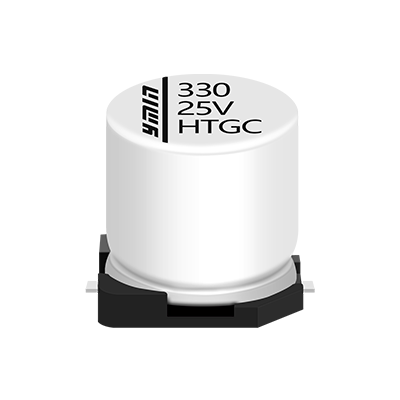
YMIN VHT Series Capacitor
Unlike traditional MLCC-based high-capacitance solutions, YMIN hybrid capacitors provide stable energy storage and ripple suppression while maintaining strong mechanical reliability under harsh vehicle operating conditions.
Key Technical Advantages
No Piezoelectric Effect
Because hybrid aluminum capacitors utilize aluminum electrolytic technology rather than ceramic dielectric materials, they do not generate piezoelectric-induced vibration.
This helps maintain stable electrical performance throughout the vehicle lifecycle.
Ultra-Low ESR Performance
Low ESR characteristics allow efficient ripple current filtering and voltage stabilization.
This is particularly valuable in:
- DC-DC converter output stages
- FPGA power rails
- AI processor power supplies
- LiDAR signal processing circuits
Enhanced Vibration Resistance
Automotive electronics must withstand continuous vibration exposure.
The hybrid capacitor structure provides superior resistance to mechanical stress compared with many high-capacitance ceramic alternatives.
Stable Performance Across Wide Temperature Ranges
Automotive applications require reliable operation across extreme environmental conditions.
YMIN hybrid capacitors maintain stable electrical characteristics throughout wide automotive temperature ranges, supporting long-term system reliability.
Recommended YMIN Capacitors for Automotive LiDAR Designs
YMIN VHT Series 50V 220μF
Typical applications:
- LiDAR transmitter power input
- High-power pulse circuits
- AI computing power entry stages
Key benefits:
- Stable voltage support
- High ripple current handling
- Reduced voltage fluctuation during peak power demand
YMIN VHT Series 35V 100μF
Typical applications:
- DC-DC converter outputs
- FPGA supply rails
- Signal processing modules
Key benefits:
- Excellent ripple suppression
- Cleaner power delivery
- Improved system stability
Engineering Benefits Beyond Component Replacement
For hardware engineers, capacitor selection is no longer solely about capacitance values and voltage ratings.
System-level performance increasingly depends on factors such as:
- Reliability under vibration
- Thermal stability
- Long-term maintenance costs
- Functional safety requirements
- Supply chain resilience
By replacing high-capacitance MLCC arrays with hybrid aluminum capacitor solutions, many designs can achieve:
- Reduced component count
- Simplified PCB layout
- Lower EMI optimization effort
- Improved power integrity
- Better long-term reliability
Lower Total Cost of Ownership for Automotive Programs
Component cost alone does not represent the true economic impact of a power design.
Automotive manufacturers must also consider:
- Warranty expenses
- Field failures
- Product recalls
- Engineering redesign costs
- Production delays
- Brand reputation risks
From a Total Cost of Ownership (TCO) perspective, improving reliability at the component level often delivers significantly greater value than minimizing initial procurement costs.
This is one reason why hybrid capacitor adoption continues to increase across advanced automotive electronics.
Conclusion
As automotive LiDAR systems become more sophisticated and autonomous driving moves toward mass adoption, power system reliability has become a strategic design priority.
For engineers seeking alternatives to high-capacitance MLCC solutions, hybrid aluminum capacitors offer a compelling combination of low ESR, vibration resistance, thermal stability, and long-term reliability.
YMIN hybrid capacitor solutions are helping automotive electronics designers build more robust LiDAR platforms while reducing lifecycle risks and improving overall system performance.
For automotive LiDAR, ADAS, FPGA, AI computing, and DC-DC power applications, hybrid aluminum capacitors are increasingly becoming a preferred choice for next-generation vehicle electronics.
메타데이터
- post_id
- 61058dce31f3
- slug
- mlcc-alternative-for-automotive-lidar-how-ymin-hybrid-capacitors-improve-power-stability-and-61058dce31f3
- url
- https://medium.com/@yjw_17414/mlcc-alternative-for-automotive-lidar-how-ymin-hybrid-capacitors-improve-power-stability-and-61058dce31f3
- canonical_url
- https://medium.com/@yjw_17414/mlcc-alternative-for-automotive-lidar-how-ymin-hybrid-capacitors-improve-power-stability-and-61058dce31f3
- author_url
- https://medium.com/@yjw_17414
- status
- ok
- fetched_at
- 2026-06-22 17:31:34

