The Friday Download: ChatGPT Dreams, Maryland Means It, and Congress Drops a 269-Page Mic (June 5…
OpenAI’s AI just started rewriting its own memory without asking. Maryland officially became the latest state to put AI guardrails in law —…
The Friday Download: ChatGPT Dreams, Maryland Means It, and Congress Drops a 269-Page Mic (June 5, 2026)
OpenAI’s AI just started rewriting its own memory without asking. Maryland officially became the latest state to put AI guardrails in law — the same week Utah handed Google Gemini the keys to 680,000 classrooms. Oh, and Congress dropped a 269-page federal AI bill that teachers unions called a “hard no” before the ink was dry. Your weekly download starts now.
[embed]
There are weeks in AI where you could close the browser, touch some grass, and come back to the same three story threads you’ve been tracking for months. This is not one of those weeks. The last seven days delivered a memory system that rewrites itself, two state-level education laws that actually have teeth, and a congressional AI bill so large it could double as a doorstop. Let’s get into it.
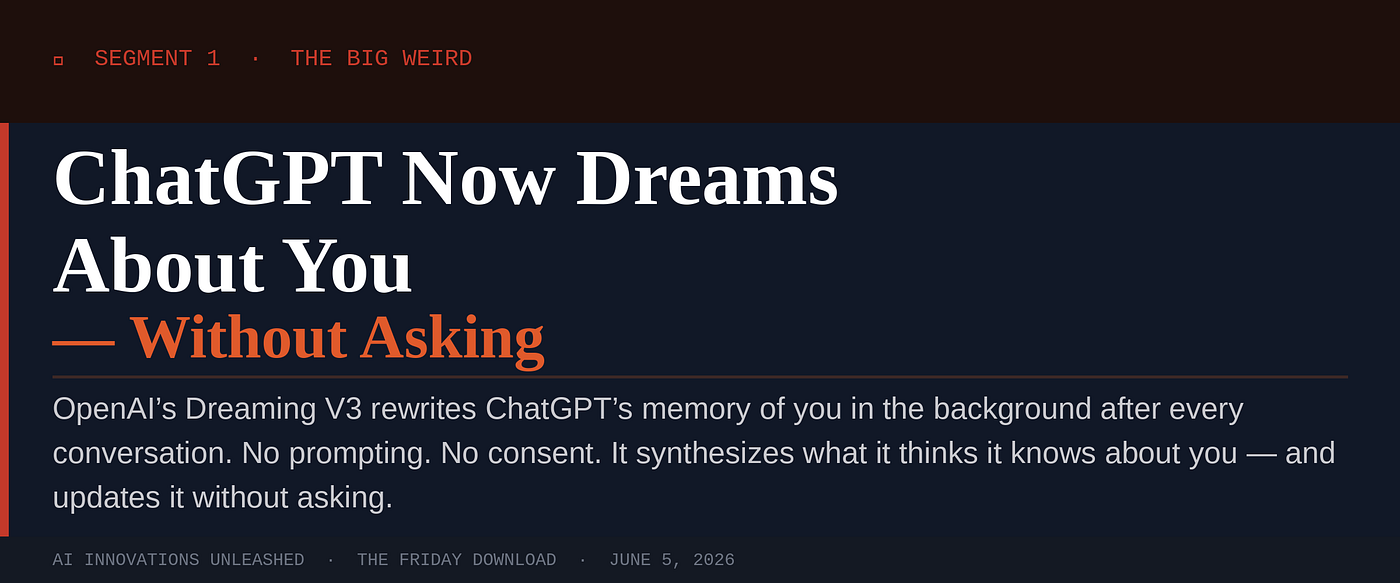
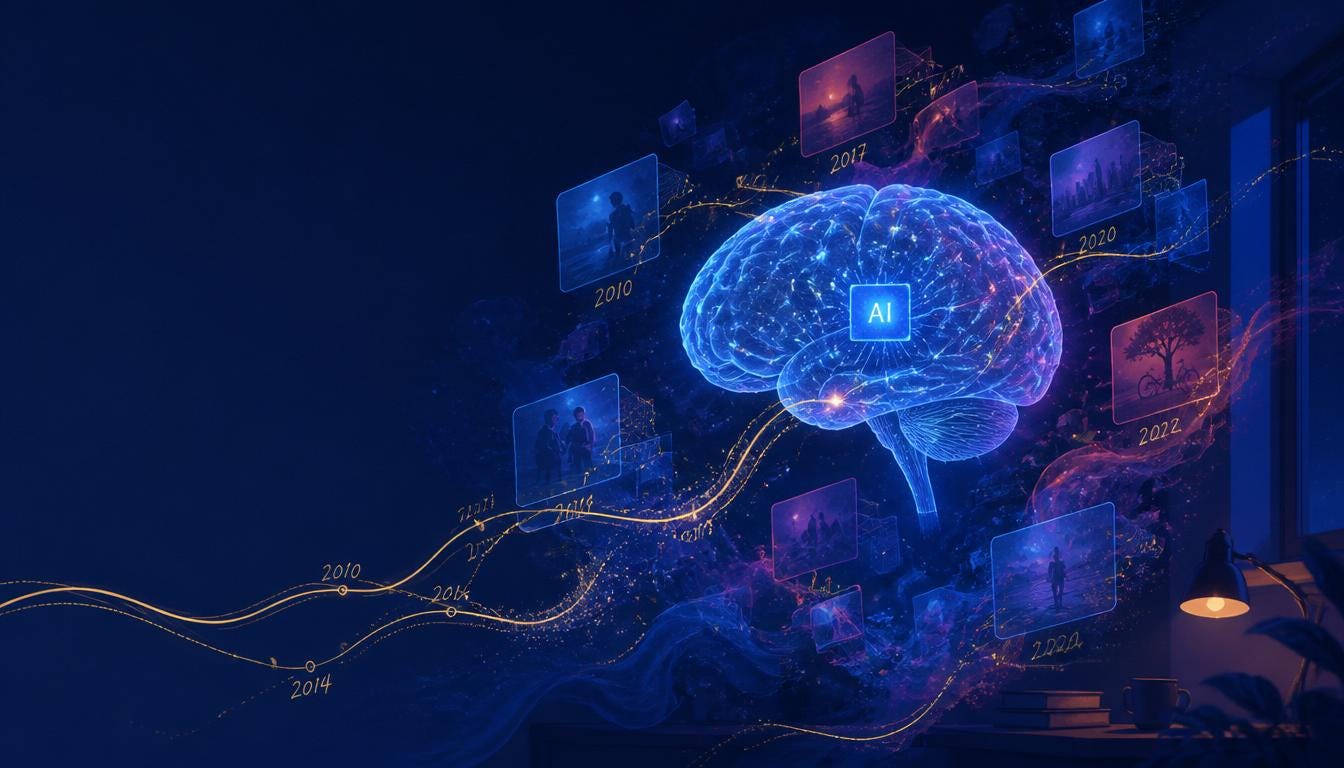
On June 4, 2026, OpenAI quietly rolled out what they’re calling Dreaming V3 — a new memory architecture for ChatGPT that runs silently in the background after every conversation, synthesizing what it thinks it knows about you and updating that knowledge on its own. No prompting required. No “hey, remember this.” It just… dreams.
Here’s what’s actually different: the old system required you to explicitly tell ChatGPT to save a memory. If you said “I’m going to Singapore in July,” it stored that fact permanently. Forever. Whether you went, cancelled, moved to Antarctica, whatever. Dreaming V3 fixes that by running a background synthesis process that tracks context across time, so the AI now understands you went to Singapore in July 2026, not that you’re still planning to go. It understands temporal reality. That’s new.
The rollout is starting with Plus and Pro subscribers in the US. Free-tier users are next — made possible by a roughly 5x reduction in the compute cost of running the dreaming process. Which means this is coming for everyone. Soon.
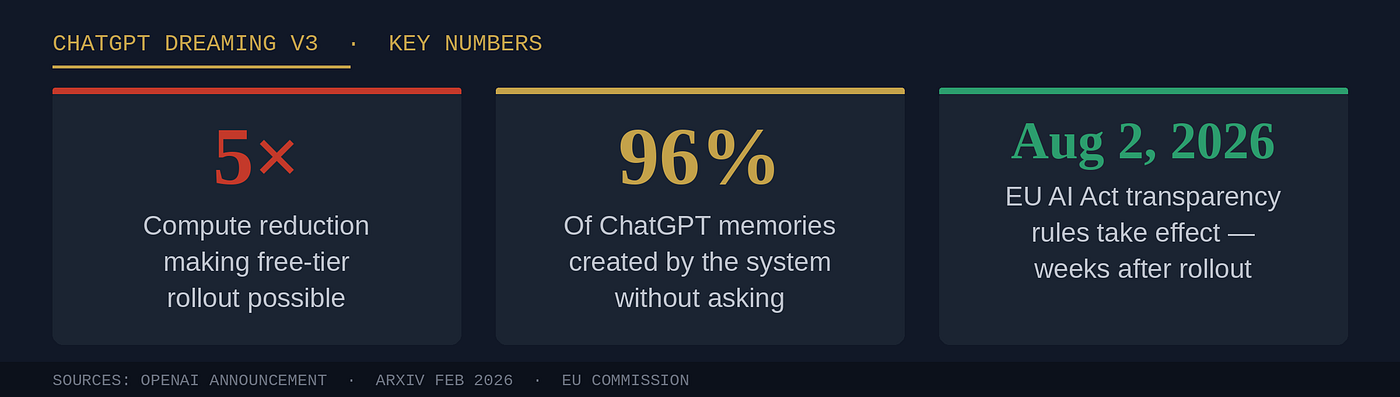
So what’s the catch? Privacy researchers aren’t thrilled. A February 2026 arXiv study found that 96% of ChatGPT memories in a sample group were created by the system, not the user. You didn’t ask for them. They were inferred. A new Memory Summary page lets you review and edit what ChatGPT believes about you — but that means the burden of auditing your AI’s knowledge base now lives with you.
“The thing you now have to audit is not just what you told it, but what it inferred and then decided to keep.” — Digital Applied, June 2026
The timing is also worth noting. OpenAI’s EU rollout is coming in the months right before the EU AI Act’s transparency obligations take effect in August 2026. A system that builds behavioral profiles about users — automatically, in the background — is exactly the kind of thing those rules were designed to govern.
What this means for educators and learners: If you or your students are using ChatGPT, Dreaming V3 means the AI is getting smarter about you specifically over time — without you doing anything. That’s genuinely useful for personalized learning. It also means it’s time to have the “what does your AI know about you?” conversation in every classroom that uses it.
We talk a lot on this show about states considering AI education policy. This week, two states stopped considering and started doing — in very different ways, both worth celebrating.
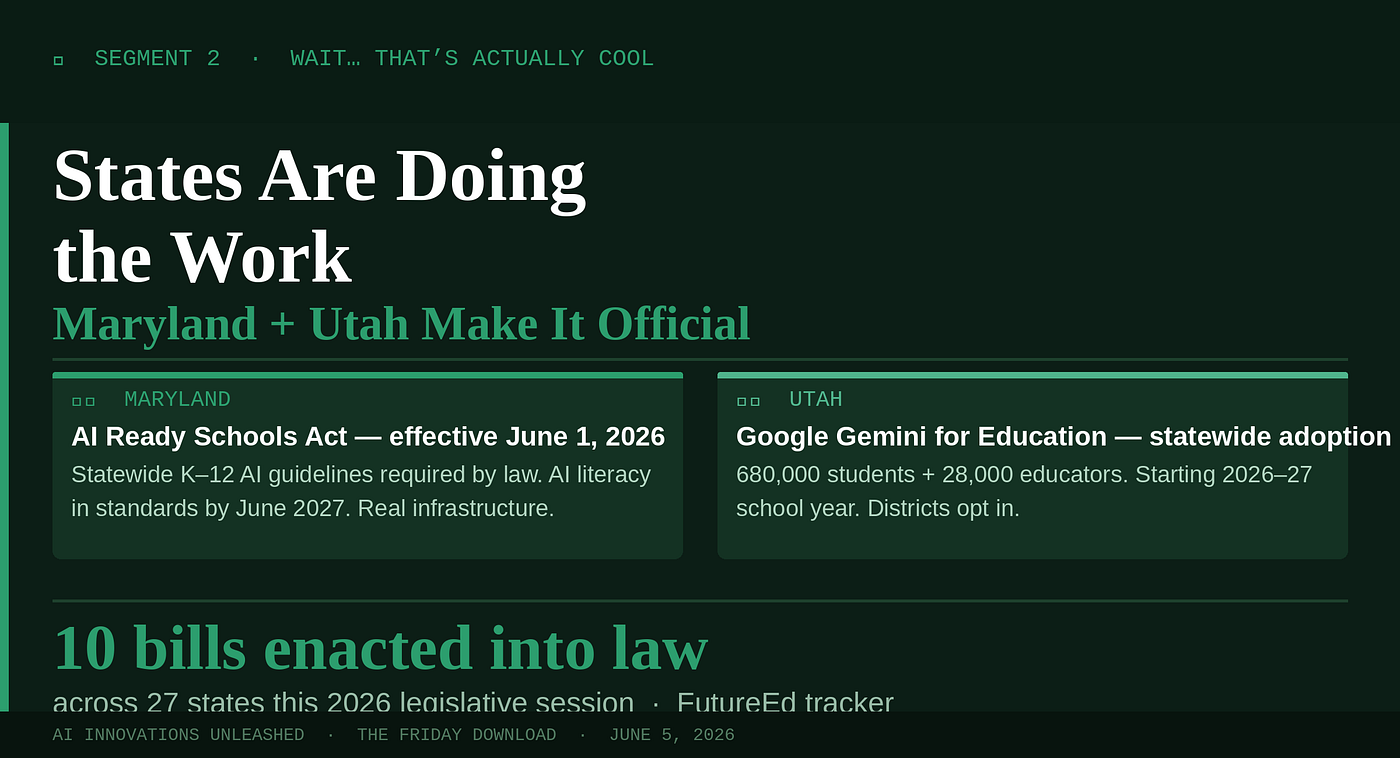
Maryland: The AI Ready Schools Act officially took effect on June 1, 2026. This isn’t a task force. It isn’t a committee recommendation. It’s law. The Maryland State Department of Education is now required to:
- Publish statewide guidelines for AI use in K–12 classrooms
- Incorporate AI literacy into workforce readiness and computer science standards (by June 2027)
- Provide professional development for teachers and school leaders
- Staff and support the new Maryland AI Education Collaborative
This is actual infrastructure. The collaborative is charged with issuing ongoing reports and recommendations — meaning the work doesn’t end when the law passes.
Utah: The Utah State Board of Education voted to adopt Google Gemini for Education statewide, with deployment starting with the 2026–27 academic year. That’s approximately 680,000 K–12 students and 28,000 educators gaining access to AI tools designed for classroom use. Individual districts retain full discretion over whether to implement — but the framework, the vetting, and the procurement are done. Utah didn’t wait for a federal mandate. They made a decision.
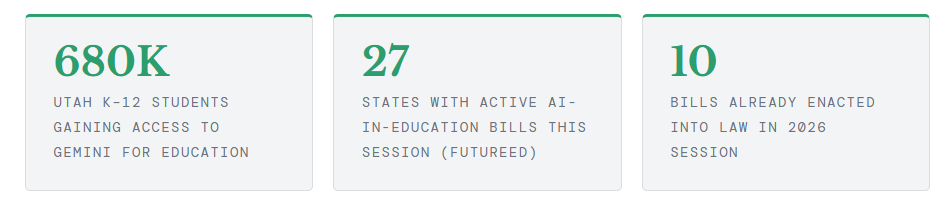
Here’s why this two-state snapshot matters: for a long time, the narrative around AI in schools was either “ban everything” or “let the market sort it out.” Maryland and Utah are showing a third path — state-level frameworks with real deadlines, real professional development requirements, and real consequences for inaction.
Neither is perfect. Maryland still has to write the guidelines. Utah is leaving adoption optional at the district level, which creates real equity risk between high-capacity and low-capacity districts. But the direction is right.
“We can’t just be preparing our kids for the economy of five years ago or the economy today; we have to be ready for what’s next.” — Rob Summers, City Springs Elementary, Baltimore
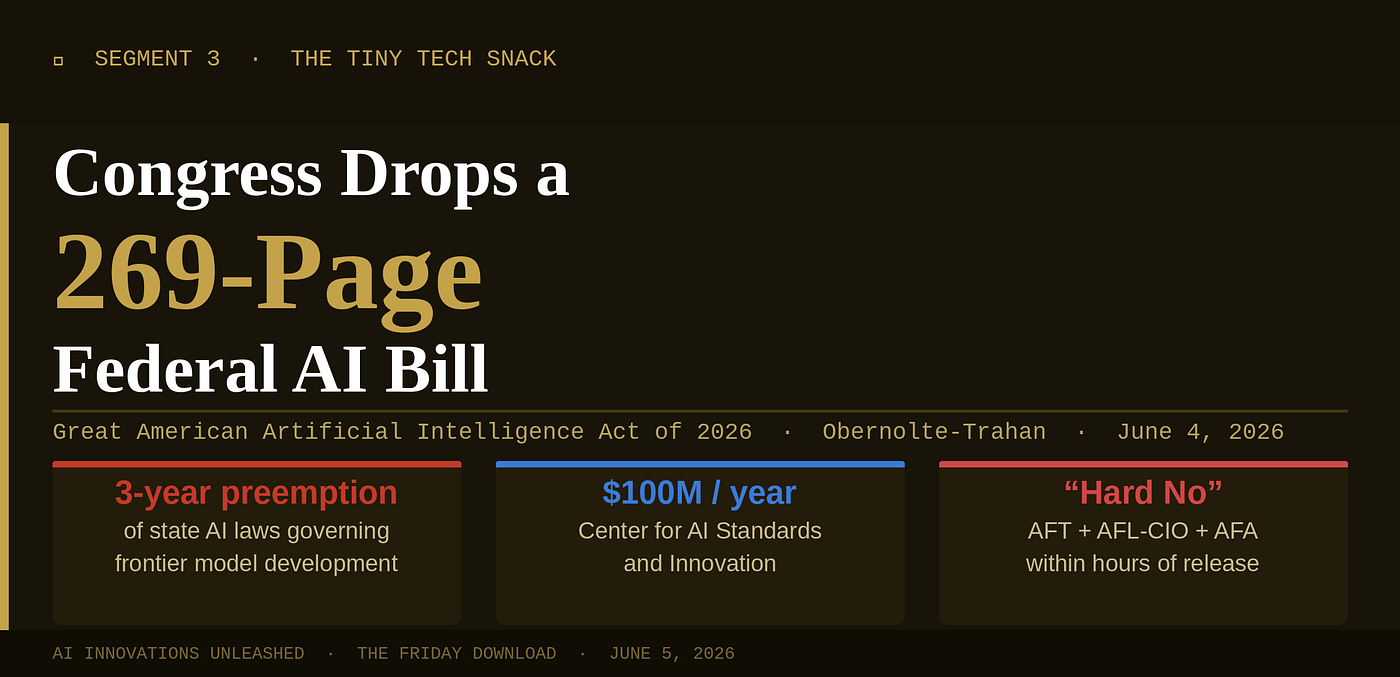
On June 4, Representatives Jay Obernolte (R-CA) and Lori Trahan (D-MA) unveiled a 269-page bipartisan discussion draft called the Great American Artificial Intelligence Act of 2026. It’s the most comprehensive federal AI framework ever put forward by Congress — and it landed with a thud in some very important rooms.
The headline provision: a three-year preemption of state AI laws related to how frontier AI models are built. That would freeze California’s AI bills, Colorado’s AI Act (scheduled to take effect June 30), and dozens of other state-level protections — including the very AI-in-education frameworks we just celebrated Maryland and Utah for building.
What the bill would actually do:
- Preempt state laws governing frontier AI development for 3 years
- Require companies with >$500M in annual AI revenue to publish governance frameworks
- Mandate safety incident reporting to the federal government
- Fund $100M/year for a federal Center for AI Standards and Innovation
- Include K–12 AI literacy programs and university scholarships
- Create criminal penalties for using AI to impersonate government officials
The American Federation of Teachers, AFL-CIO, and Association of Flight Attendants issued a joint statement within hours: “Hard no. This bill is a giveaway to the AI industry and a handful of trillion-dollar companies, at the expense of American workers.” Tech industry groups praised it. That’s the shape of the debate.
The snack-sized takeaway: This bill is a discussion draft, not a law. It’s asking for public feedback. But the preemption provision alone makes it one of the most consequential AI documents of 2026 — because if it passes anywhere close to its current form, the state-by-state AI education patchwork we’ve been tracking all year could get frozen in place for three years while federal rulemaking catches up. Or doesn’t.
Watch the AFT and NEA responses over the next few weeks. When 1.8 million teachers say “hard no” to a bipartisan bill the same day it drops, that’s a signal worth paying attention to.
That’s Your Friday Download for June 5, 2026
Three segments. Three stories. One theme: the AI landscape in education is moving faster than the policy can keep up with — and this week was the week that gap became impossible to ignore.
Subscribe, share, and if this show helps you make sense of what’s happening, consider supporting the work:
AI Innovations Unleashed · JR DeLaney, The AI Learning Guide The Friday Download publishes every Friday
🎙️ Full episode: AI Innovations Unleashed on Buzzsprout
메타데이터
- post_id
- 611ff3fe4d24
- slug
- the-friday-download-chatgpt-dreams-maryland-means-it-and-congress-drops-a-269-page-mic-june-5-611ff3fe4d24
- url
- https://medium.com/@larrydelaneyjr/the-friday-download-chatgpt-dreams-maryland-means-it-and-congress-drops-a-269-page-mic-june-5-611ff3fe4d24
- canonical_url
- https://medium.com/@larrydelaneyjr/the-friday-download-chatgpt-dreams-maryland-means-it-and-congress-drops-a-269-page-mic-june-5-611ff3fe4d24
- author_url
- https://medium.com/@larrydelaneyjr
- status
- ok
- fetched_at
- 2026-06-09 15:37:30