Why You Should Completely Avoid Ollama in 2026
And the way better open source options
Why You Should Completely Avoid Ollama in 2026
And the way better open source options
I was an Ollama user. For a long time.
When I first started playing with local AI, Ollama was my go-to. It was simple. It was user-friendly. You typed ollama run llama3 and boom — you had a running LLM. No compiling, no configuration, no headaches. It was the "Docker of local LLMs," and that comparison wasn't a coincidence.
But starting in 2026, things changed. And not for the better.
Here’s what’s happening: whenever new people want to start using local AI, Ollama becomes the default recommendation. YouTube tutorials point to it. Blog posts assume it. Documentation treats it as the standard. And that’s a problem — because you have way better options, and continuing to use Ollama in 2026 is costing you performance, flexibility, and trust in the open-source ecosystem.
I wrote this article to save you the time I spent figuring this out the hard way. Read it. Consider switching. Your future self — and the open-source community — will thank you.
Reason 1: Ollama Is Significantly Slower Than llama.cpp
Let’s start with the most immediate problem: performance.
Multiple community benchmarks and developer reports have shown that running the same model through Ollama produces 30–70% fewer tokens per second compared to running it through llama.cpp directly. This isn’t a marginal difference — it’s a gap you can feel when you’re waiting on output.
On an RTX 5090 running Qwen3 Coder 32B, one user documented 52 tokens/second with llama.cpp vs. 30 tokens/second with Ollama — a 70% performance gap. And this isn’t an isolated case. The nullmirror team documented their switch from Ollama to llama.cpp and found consistent throughput improvements across every model they tested, with no quality tradeoff.
Why Is Ollama Slower?
The answer comes from the source. Georgi Gerganov, the creator of llama.cpp, publicly confirmed the performance issues in a now-famous tweet:
“LMStudio are using the upstream ggml implementation which is significantly better and well optimized. Looking at ollama’s modifications in ggml, they have too much branching in their MXFP4 kernels and the attention sinks implementation is really inefficient. Along with other inefficiencies, I expect the performance is going to be quite bad in ollama.”
This isn’t speculation. This is the author of the underlying technology saying Ollama’s implementation is inefficient. And the benchmarks back him up.
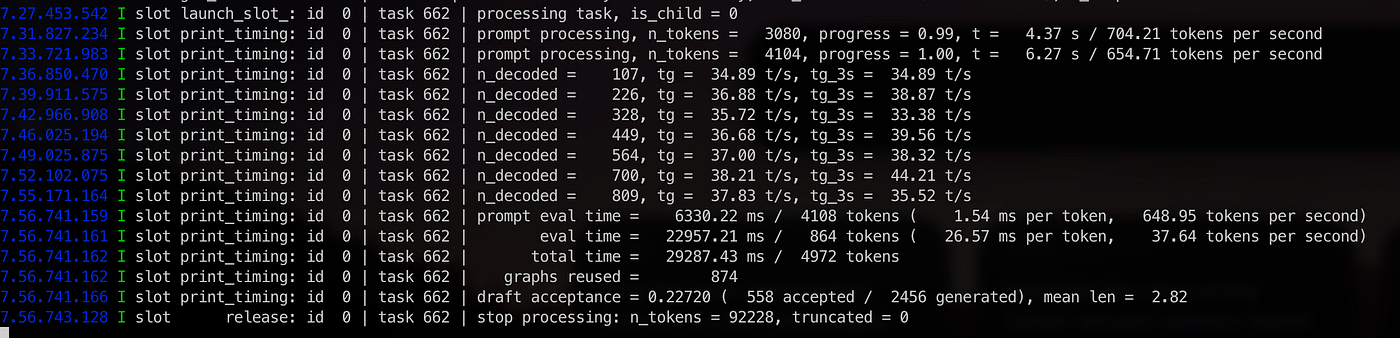
I also test it by myself, llama.cpp is usually, 20% — 30% faster than ollama.
Reason 2: They Forked llama.cpp, Went Proprietary, and Locked You In
Here’s where things get ugly.
For a period in 2024–2025, Ollama forked ggml (the low-level tensor library that llama.cpp is built on) and built their own custom inference engine. They stopped using llama.cpp entirely. And with that fork came a proprietary model storage format.
What does this mean for you?
Your downloaded models were stored in hashed filenames in Ollama’s own registry format. You couldn’t just point llama.cpp, LM Studio, or any other inference framework at those files. The models you “owned” were trapped in Ollama’s ecosystem.
This is vendor lock-in disguised as open-source convenience. You’re not allowed to export the “open-sourced” LLM model weights anymore. The irony is staggering.
And to make matters worse, during this period, Ollama’s inference performance was consistently worse than llama.cpp — so you were getting locked in and getting slower performance. Double loss.
Read more about the format lock-in here
Reason 3: They Stopped Giving Credit — Then Switched Back. Why?
Ollama started positioning themselves as an independent platform, not just a wrapper around llama.cpp. With that came a troubling pattern: they stopped giving proper credit to their upstream dependencies.
For years, Ollama’s README made no mention of llama.cpp. The attribution was buried, unclear, or absent. If your project trades on being open-source, you do not get to be vague about what is and isn’t open at launch.
So Why Did They Switch Back to llama.cpp in v0.30.0-rc15?
In May 2026, Ollama announced v0.30.0-rc15, which switches back to using llama.cpp directly. GGUF models are now first-class again. Three reasons drove this reversal:
1. They fell too far behind. New model architectures (MTP, hybrid attention, structured output) were all slower or broken in their custom backend. The performance gap became too embarrassing to ignore.
2. OpenAI’s GPT-OSS release. They needed day-1 support for new models and couldn’t afford to reimplement everything from scratch. The community was already on llama.cpp; Ollama had no path to forking the entire ecosystem.
3. Community pressure. The complaints became too loud, too public, and too well-documented. Benchmarks showing 70% performance gaps don’t age well in marketing materials.
Read the community reaction here
But here’s the thing: switching back doesn’t erase the damage. The trust is broken. And there are bigger problems.
Reason 4: Ollama Betrayed the Local-First Promise
Ollama started as a tool for local AI inference. That was the promise. Run models on your own hardware. Keep your data private. No cloud, no tracking, no middleman.
Then Ollama started bringing in venture capital funding and repositioning themselves as a platform — not a tool, but a platform. And with that came Ollama Cloud.
Ollama Cloud: A Disaster
If you thought running models locally was the point, Ollama Cloud proves otherwise:
- 29.7% failure rate on Qwen3.5 models, documented and ongoing
- 95% failure rate reported on Ollama Cloud Pro across all models
- 60+ second timeouts on inference, breaking agent workflows
- Tool calling broken (500 errors when tools enabled on cloud models)
- Hostile rate limiting: $100/month users hit 4-day throttles after just 5 days
- Support MIA: Tickets ignored for 2+ weeks, no incident communication
GitHub issue #14673 · GitHub issue #15453 · Reddit thread
Users who paid for cloud are switching to local models, vLLM, and alternatives. The service is unreliable, the support is nonexistent, and the pricing is hostile.
The Privacy Question
When Ollama pushes cloud inference, what are the privacy implications? Your prompts, your conversations, your data — where does it go? The company that once championed local-first AI is now building a cloud business. The incentives have shifted, and they haven’t shifted in your favor.
Reason 5: Trust and Transparency Issues
Beyond performance and cloud reliability, Ollama has a pattern of trust issues:
Misleading Model Naming
When DeepSeek released its R1 model family, Ollama listed the smaller distilled versions — models like DeepSeek-R1-Distill-Qwen-32B — simply as "DeepSeek-R1" in their library. This created massive confusion. Social media was flooded with people claiming they were running "the" DeepSeek-R1 on consumer hardware, when in reality they were running much smaller distilled variants that behave nothing like the full 671-billion-parameter model.
Ollama knew the difference. They chose to obscure it anyway, presumably because “DeepSeek-R1” drives more downloads than “DeepSeek-R1-Distill-Qwen-32B.”
License Attribution Complaints
Ollama has been accused of not properly crediting llama.cpp authors whose work the project was built on. Their binary distributions were vague about dependencies. Their GUI application launched without source code and with an unclear license. The app code is in the repository now, but that only makes the earlier rollout look worse, not better.
The Desktop App Launch
Ollama’s desktop app launched without being part of the main GitHub repository. The license was unclear. The source code wasn’t made available. If your project trades on being open-source, you do not get to be vague about what is and isn’t open at launch.
Reason 6: Ollama Is Falling Behind — Fast
While Ollama was busy building a platform and a cloud service, llama.cpp kept moving. And the gap keeps widening.
- MTP (Multi-Token Prediction): llama.cpp merged it. Ollama’s custom backend couldn’t support it properly.
- Structured output: Broken in Ollama’s custom backend, working in llama.cpp.
- New model architectures: llama.cpp adds support within days. Ollama’s fork lagged for months.
- SEED OSS 36B: Ollama lagged for months on supporting this model because they refused to update their llama.cpp fork.
- Router mode: llama.cpp now has native model switching and a web UI. Ollama’s advantage in convenience has evaporated.
llama.cpp is simply moving faster, inferring better, and delivering more features. Ollama’s custom backend reintroduced bugs that llama.cpp solved years ago. The community is voting with their feet.
So What Should You Use Instead?
You don’t need Ollama anymore. The tools it was built on are directly accessible, and in most cases, they’re not much harder to set up:
- Raw performance → llama.cpp — Faster, more control, no overhead. Now has router mode and web UI.
- GUI + simplicity → LM Studio — Polished interface, proper GGUF support, model switching, regularly updated llama.cpp backend
- Multi-user / production → vLLM or SGLang — Proper concurrency, production-ready, industry standard
- Mac / Apple Silicon → oMLX or MLX — Native Apple Silicon optimization, continuous batching, MTP support
The convenience gap has closed. llama.cpp now has router mode for model switching and a built-in web chat interface. You don’t need Ollama’s abstraction layer anymore.
Ollama was great when it started. It lowered the barrier to entry for local AI. It made running LLMs accessible to people who didn’t want to compile C++ from source. For that, it deserves credit.
But in 2026, Ollama is no longer that tool. It’s a VC-backed platform company that:
- Runs 30–70% slower than the technology it’s built on
- Locked your models in a proprietary format for over a year
- Stopped crediting the open-source project it was built on
- Betrayed its local-first promise with an unreliable cloud service
- Misled users with confusing model naming
- Falls behind on features while llama.cpp keeps advancing
You don’t have to use Ollama anymore. The alternatives are better, faster, more transparent, and more respectful of the open-source community that made all of this possible.
Switch today. Your performance, your flexibility, and your trust in open-source will all be better for it.
메타데이터
- post_id
- 6135d9e8591e
- slug
- why-you-should-completely-avoid-ollama-in-2026-6135d9e8591e
- url
- https://blog.gopenai.com/why-you-should-completely-avoid-ollama-in-2026-6135d9e8591e
- canonical_url
- https://blog.gopenai.com/why-you-should-completely-avoid-ollama-in-2026-6135d9e8591e
- author_url
- https://medium.com/@xhinker
- status
- ok
- fetched_at
- 2026-06-09 15:37:30