The Spreadsheet That Made Me Distrust an Unemployment Number
A friend told me the job market was getting better because unemployment was down. I said maybe, and then didn’t think about it again until…
The Spreadsheet That Made Me Distrust an Unemployment Number
A friend told me the job market was getting better because unemployment was down. I said maybe, and then didn’t think about it again until three weeks later, when I was building a spreadsheet for something unrelated and needed a clean unemployment series to sanity-check another dataset against.
India’s unemployment rate, Periodic Labour Force Survey: 6.0% in 2017–18, down to 3.2% by 2023–24. I dropped it in a column, moved on, came back an hour later to add real wage growth next to it as a second check.
The second column didn’t move. Not “grew slowly.” Flat, close enough to zero that I checked the source twice, assuming I’d pulled the wrong series.
I hadn’t. Real wages across most segments of the workforce had barely shifted over six years in which unemployment supposedly improved by nearly half. The only group with a visible gain was administrative and managerial roles — a small slice of the total.
That’s the moment this stopped being a spreadsheet exercise and became something I wanted to actually understand.
What “employed” was quietly absorbing
The standard story is simple: unemployment falls, workers have more leverage, wages rise. It’s the mechanism behind most Phillips Curve intuition, and it’s not wrong in general — it’s well-documented in the US and Europe. It just wasn’t showing up here, and I wanted to know what was different.
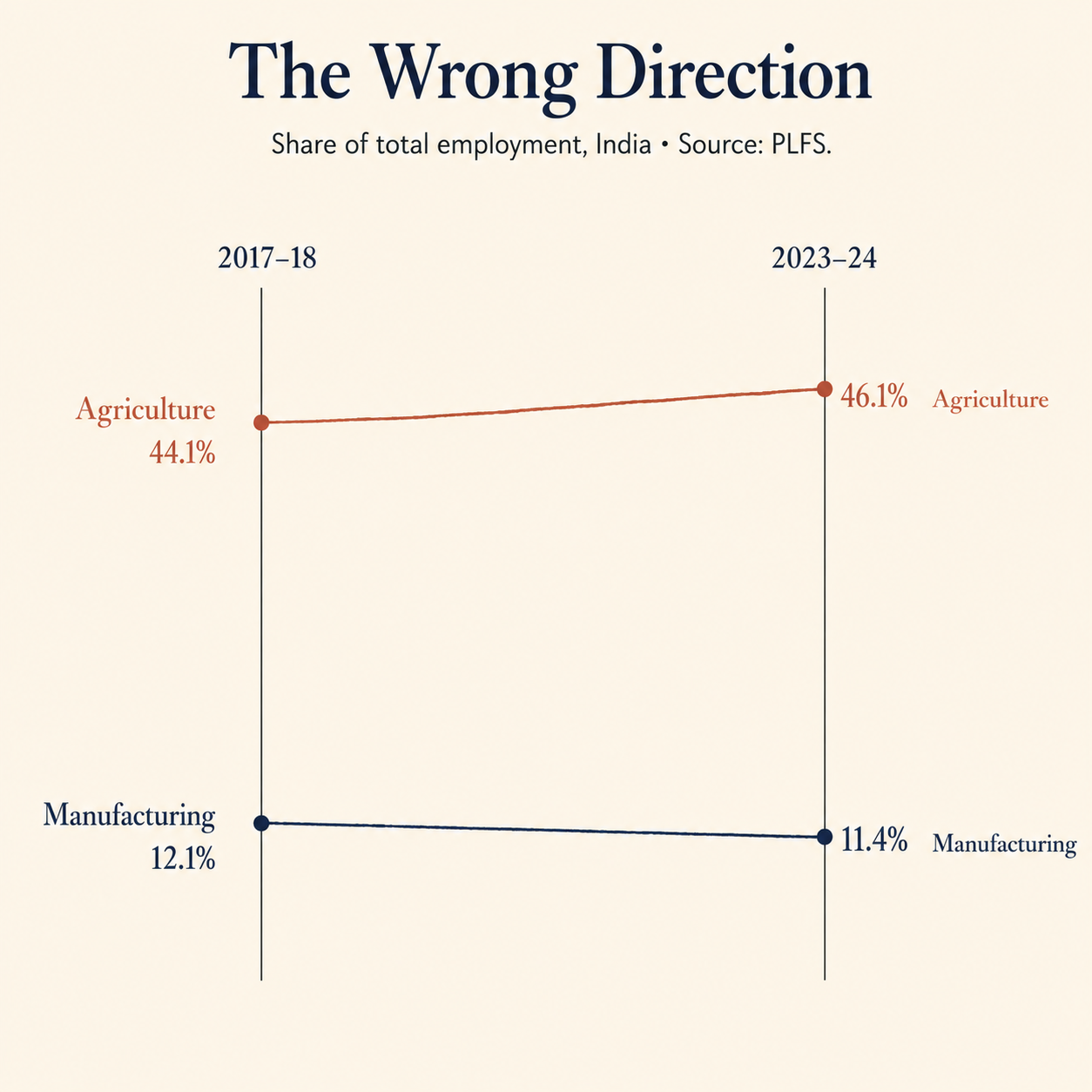
Two numbers explained most of the gap once I found them. Agriculture’s share of total employment rose from 44.1% to 46.1% over the same period — the opposite direction you’d expect from an economy that’s supposedly industrializing and creating better jobs. Manufacturing’s share fell, from 12.1% to 11.4%.
And roughly 80% of India’s workforce operates with no formal contract, no social security, no path to collective bargaining. A worker in that position doesn’t get more leverage just because the labor market tightened on paper. There’s no formal structure through which leverage would even travel.
So the unemployment rate improved largely because more people got absorbed into categories that count as “employed” in the survey — agriculture, self-employment, a meaningful amount of unpaid family labor — without those categories carrying the wage-bargaining power the headline number implies.
The one that actually stuck with me
Buried further into the same research: only about 8.25% of Indian graduates work in a role matching their qualification, according to the Economic Survey 2024–25.
That number doesn’t show up in an unemployment rate at all. Those graduates are employed, by definition. It’s a different kind of failure — not “can’t find work,” but “found work that has nothing to do with what you spent years training for.” I keep thinking about how invisible that specific frustration would be to anyone reading only the top-line jobs number.
I have a cousin who studied mechanical engineering and now runs a small logistics coordination job he found through a relative. He’s employed. He’s not unemployed. He’s also, by any reasonable definition, not doing what four years of engineering study prepared him for. He’d never come up in the 3.2% figure as anything other than a win.
What I’m doing differently now
I don’t read a national unemployment number the same way anymore, and I don’t think this is a uniquely Indian problem — it’s a problem with any single aggregate number asked to represent something this textured. “Employed” in this dataset covers a disguised agricultural laborer and a salaried software engineer with the same word, and the aggregate can genuinely improve while the median experience underneath it doesn’t move.
I’m still building out that spreadsheet, mostly because I haven’t found anyone publishing a clean, ongoing measure of “share of employment that actually carries bargaining leverage” — which feels like the more useful number, if it existed. I don’t know exactly what it would look like yet. I’m still figuring that part out.
Related reading: the full sourced breakdown of the numbers above lives at goutamprusty.com/writing/the-jobs-that-arent-jobs, and the shorter version of this argument is up as a LinkedIn article (https://www.linkedin.com/in/goutam-prusty/recent-activity/articles).
메타데이터
- post_id
- 613a4e348688
- slug
- the-spreadsheet-that-made-me-distrust-an-unemployment-number-613a4e348688
- url
- https://medium.com/@goutamprusty/the-spreadsheet-that-made-me-distrust-an-unemployment-number-613a4e348688
- canonical_url
- https://medium.com/@goutamprusty/the-spreadsheet-that-made-me-distrust-an-unemployment-number-613a4e348688
- author_url
- https://medium.com/@goutamprusty
- status
- ok
- fetched_at
- 2026-08-11 19:16:36