Why Cities from Jakarta to New York are Slowly Disappearing Beneath Our Feet
The sinking crises: groundwater extraction and land subsidence
Why Cities from Jakarta to New York are Slowly Disappearing Beneath Our Feet
The sinking crises: groundwater extraction and land subsidence
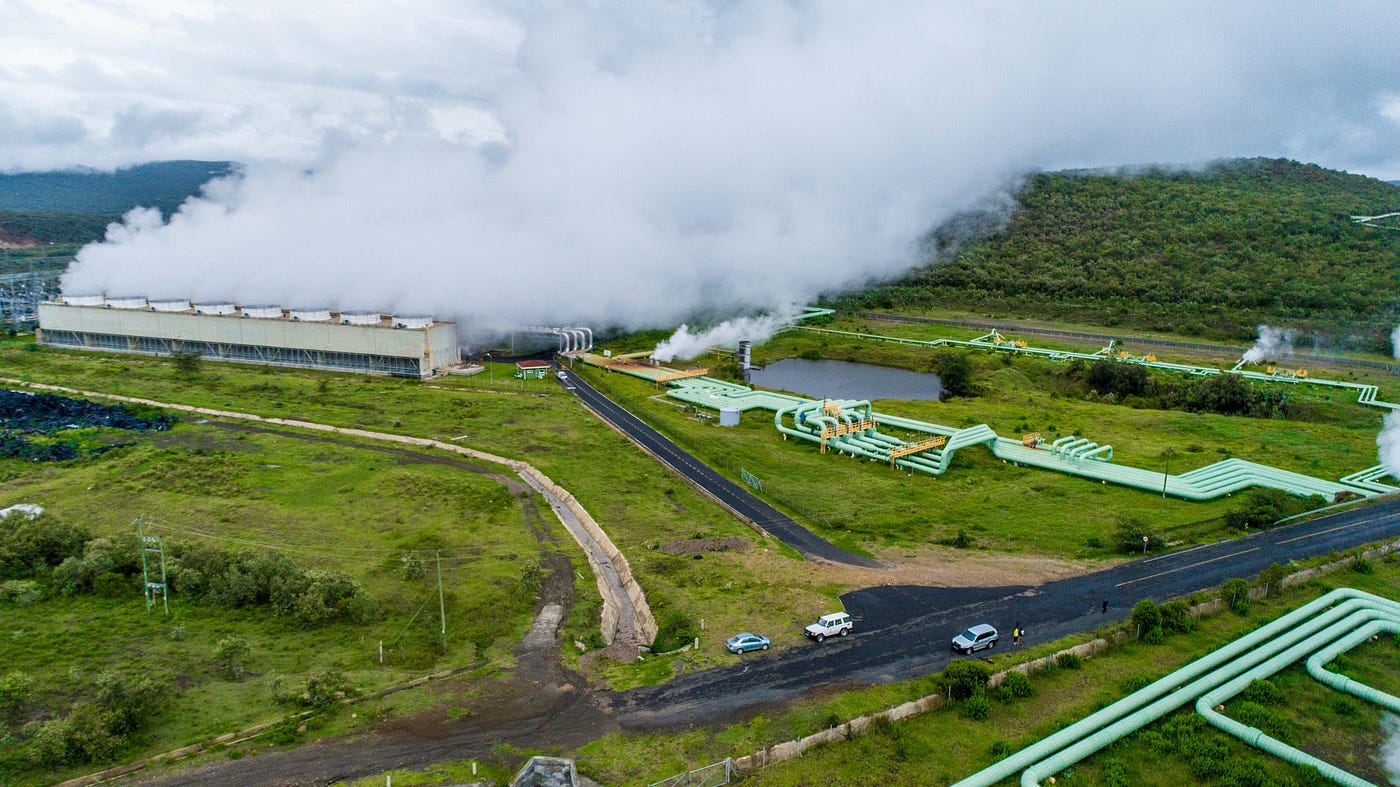
Photo by Kevin Rajaram on Unsplash
With the fast-paced development, the resources are depleting at an unprecedented rate. The reservoirs are being exploited beyond what nature can replenish, and that should alarm the human race.
A recent study by Nitheshnirmal Sadhasivam, Mohammad Khorrami, Susanna Werth & Manoochehr Shirzaei in Nature Sustainability has exposed the major risk that the human race and major metropolises are facing due to land subsidence.
According to the analysis, they observed 878 km² of land subsidence, exposing ~1.9 million people to a subsidence rate of more than 4 mm yr−1. With this subsidence rate, major cities like Chennai, Delhi, Mumbai and Bengaluru have been exposed to major structural damage.
While groundwater extraction is not the only reason behind it, it is among the major reasons behind the crises. The excessive urbanisation and expansion have taken a toll on nature.
Recently, in our neighbourhood, I got to see a borewell drilling for groundwater. Our area has been a great reservoir of water for many years due to the aquifer being close to the surface, but now that our neighbours have drilled it, they have been unable to access the aquifer due to groundwater depletion over many years.
Reflecting the grimness of the threat, which is slowly and eventually surfacing.
Eventually, the permanent reduction in the aquifer’s storage and changes in the gradients of streams and drains lead to land subsidence, a gradual process that poses risks on multiple fronts, including socio-economic, environmental, and security challenges.
It is not a nationwide crisis but a global one, affecting countries like the USA, China, Iran, Indonesia, Taiwan, Japan and others.
A recent study by researchers using NISAR (NASA-ISRO Synthetic Aperture Radar) satellite images confirms the happening. Major cities like Mexico and New York are slowly but gradually sinking, alarming the human race to take adaptive measures.
What is Land Subsidence?
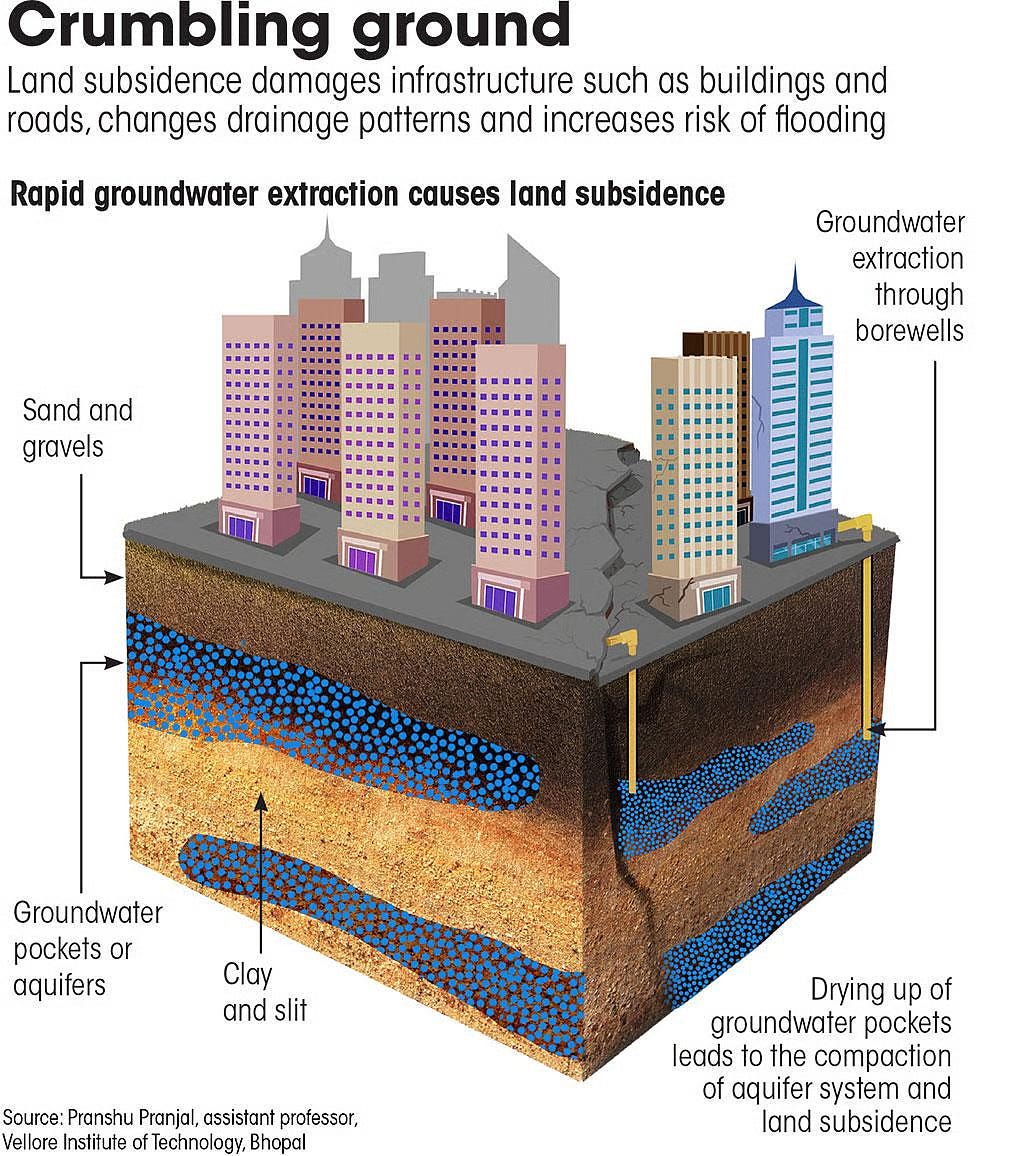
Image Credit — Down to Earth
It is a geotechnical phenomenon which occurs when the ground loses its ability to support due to compaction of underground layers of soil, rock and other geomaterials.
It is mainly aggravated by geological movements such as seismic activity, collapse of subsurface cavities, and anthropogenic activities such as mining, subsurface energy extraction, and excessive groundwater extraction.
The vital unforeseen impacts of it can be —
- Risk to Infrastructure and high cost of maintenance for railways, pipelines, buildings, etc.
- It leads to increased risk of flooding and gradual submergence of land, which eventually leads to saltwater intrusion.
- Wider level risk to humans in case of sustainability and survival.
Land subsidence is historically believed to be a phenomenon occurring in low deltaic areas, coastal regions and hilly regions with loose soil, but now it is being increasingly observed in large, densely populated urban areas due to high underground water extraction for public and industrial use.
Global Hotspots and subsidence rate
The major hotspot cities also happen to be one of the most populous cities in the world.
- Jakarta, Indonesia — A major epicentre with ground level reduction by up to 100–200 mm/year mainly in coastal areas, making it the world’s fastest sinking city.
- Tehran, Ramin and Karaj, Iran — According to Manoo Shirzaei, the urban rate of land subsidence is reaching ~20–25 cm/yr.
- **Delhi, India** — With a maximum subsidence rate of 51.0 mm yr−1.
- **El Nido area in the San Joaquin Valley** — Shows subsidence of 27 cm/yr (2008–2010) due to increased irrigation.
- Tianjin, China — With a maximum subsidence rate recorded near 9mm/year.
The other sinking cities, which are at high risk due to several factors, among which population growth matters the most, are —
Kolkata, Mumbai, Ho Chi Minh City, Bangkok, Miami, Shanghai, Yangon, etc.
Joshimath Land subsidence, 2023, India
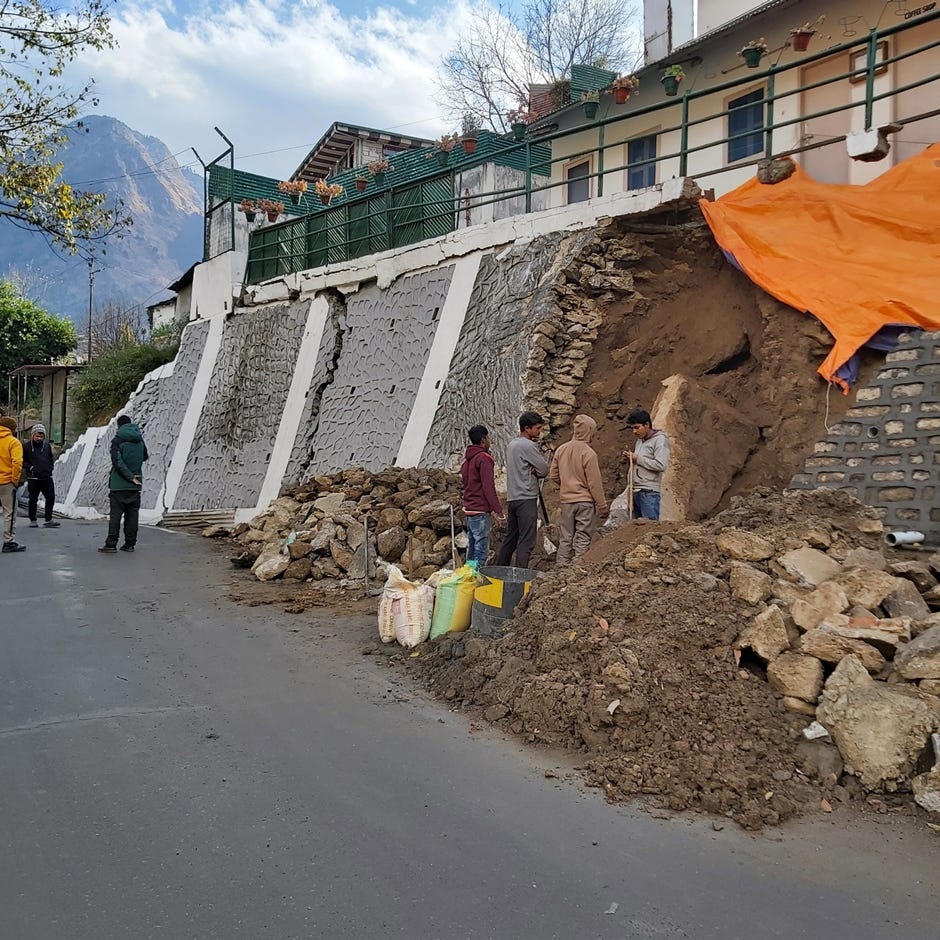
Image Credit — The India Forum
Joshimath, a hilly town in the Himalayan state of Uttarakhand, experienced a major land subsidence incident in 2023. The town falls in a high-risk seismic zone-V, and the major Himalayan river Alaknanda flows through it.
Joshimath, being an important tourist and religious location in the state, serves as an overnight rest stop for further pilgrims and also a major town supporting the local population.
The first report of cracks was reported in 2021, and further in 2022, Uttarakhand’s government’s expert panel report found that Joshimath is sinking due to man-made and natural factors; however, anthropogenic infra load and other projects have been happening.
Due to undercutting by major river currents, and loose deposits of sand & stone instead of a main solid rock, the town is exposed to a highly risky topography. Already being an ecologically fragile region, situated on a low cohesive and highly weathered rock like gneissic rock.
And further, the increased constructions, hydroelectric projects, widening of National Highways and high influx of tourists every year paved the way for the calamity to occur.
The land subsidence had affected 65 % of houses, prompting a relocation of 355 families and evacuation of more than 600 families.
Though in 1976 itself, the then commissioner of Garhwal, M.C Mishra, reported about the situation in Joshimath, recommending the restriction of heavy construction and other activities, however, the study went in vain.
Several infrastructure projects were undertaken, including the Tapovan- Vishnugad hydropower project, Helang- Marwari bypass road and others, eventually leading to the 2023 disaster.
The Garhwal Himalayas are home to over 51 million people, and the mismanagement of the region is putting this entire population at risk.
From the Joshimath incident, the analysis suggests that the disasters are avoidable if combined with planning and development measures.
Similar to the Himalayan regions, there are other small vulnerable island countries in the world which also sinking due to the rise in sea level, which is another repercussion of climate change.
Whether the island sinks due to sea level rise or cities due to land subsidence, all lead us to a way forward, which is sustainable growth in the epoch of climate change.
The main concern isn’t only sinking but also the chain of events linked to it, like groundwater depletion.
DownToEarth has reported the vulnerable stretch of India, with groundwater table drop and land subsidence incidents.
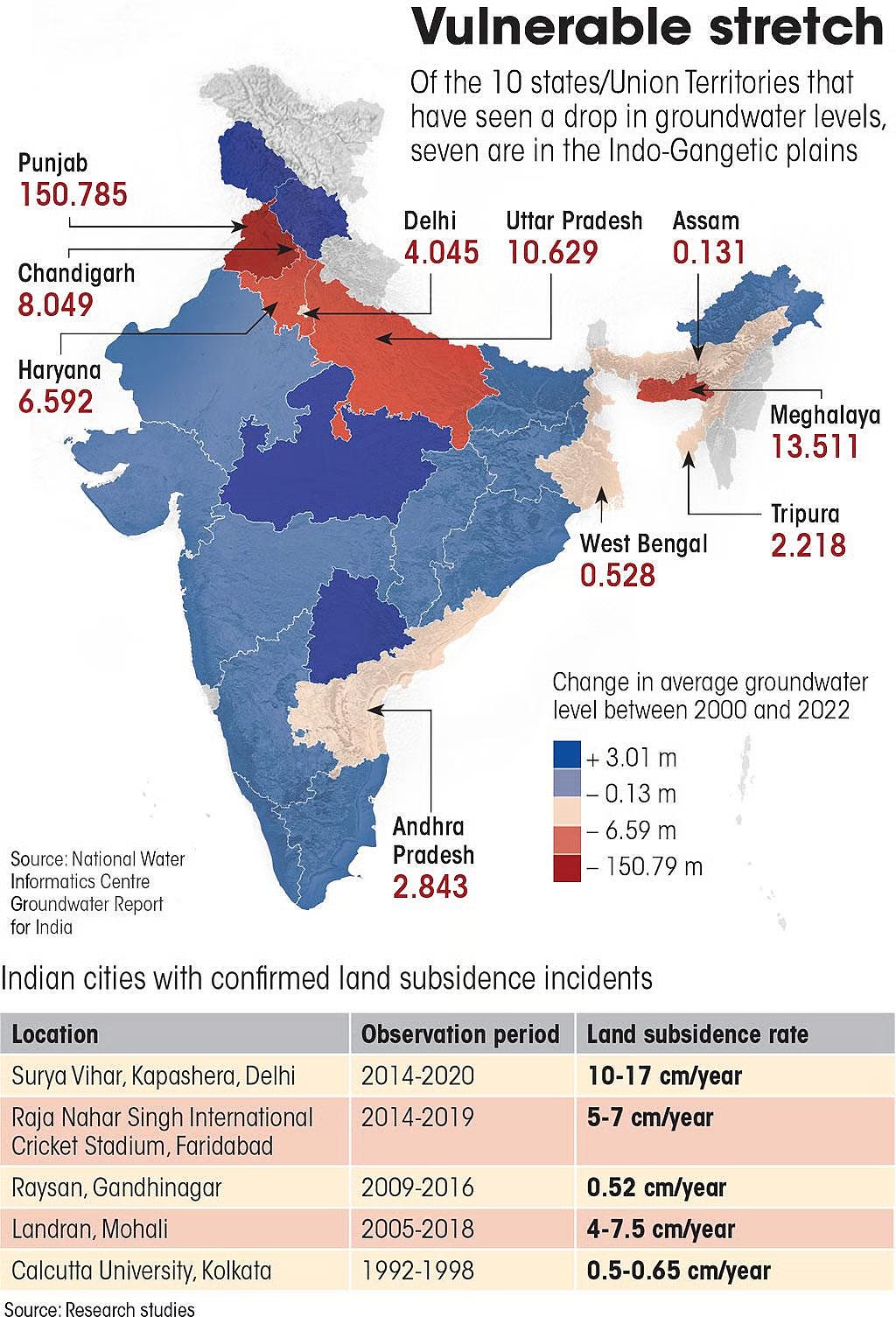
Image Credit — DownToEarth
China’s sponge city concept and way forward
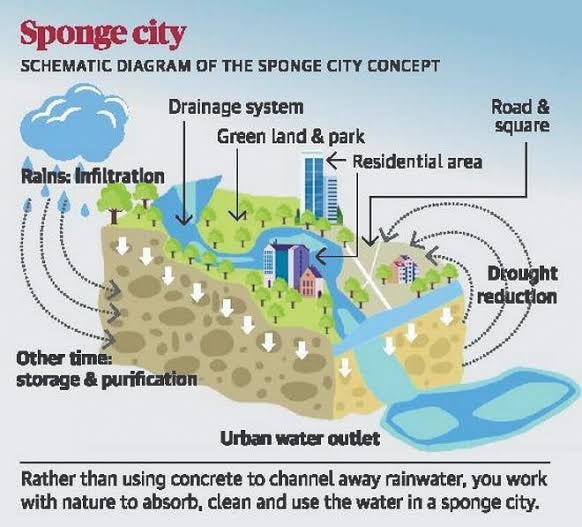
Image credit — Clean India Journal
Sponge City concept is a nature-based urban planning model launched in 2015, a central component in China’s comprehensive approach to mitigate and address land subsidence, groundwater management and artificial recharge.
A concept rooted in the traditional Chinese water management system is paving the way for holistic planning rather than individually addressing the interlinked crises.
This multi-prolonged strategy has enabled the establishment of more than 200 pilot cities across the nation, making a comprehensive shift.
The sponge concept simply put forth the idea of absorb, store, filter and reuse atleast 70% of rainwater. Design features like permeable paving, Rain gardens and Bios Wales are supposed to be the new design in modern urban planning of China, making cities sustainable.
The aquifer recharge through bio swales and other designs stabilises the subterranean water table, balancing the primary cause of land subsidence.
The natural infiltration through permeable pavements will allow the earth to naturally filter and absorb the water back, highlighting the concept of a sponge.
China’s national objective is to ensure that 80% of urban built-up areas in China successfully implement the concept by 2030.
Such policy implementation and efficient planning are the basis for ensuring safe cities and building urban resilience.
Just like China and India, other cities in the world are experiencing the twin crises of water shortages and flooding at the same time, and it’s a vicious cycle, eventually leading to life-threatening consequences like land subsidence and sinking cities.
Thus, rather than an individualistic approach for particular issues, one needs a holistic cycle of solutions addressing this multifaceted crisis.
“The Earth is in a death spiral. It will take radical action to save us.”
— George Monbiot, Environmental Journalist
메타데이터
- post_id
- 61715d54162e
- slug
- the-sinking-crises-groundwater-extraction-and-land-subsidence-61715d54162e
- url
- https://medium.com/the-environment/the-sinking-crises-groundwater-extraction-and-land-subsidence-61715d54162e
- canonical_url
- https://medium.com/the-environment/the-sinking-crises-groundwater-extraction-and-land-subsidence-61715d54162e
- author_url
- https://medium.com/@nehatimande
- status
- ok
- fetched_at
- 2026-06-20 20:29:01