Day 10 of 30: [Softmax and Logits — Classification Output Layer] (Deep Learning Challenge) — First…
.
Day 10 of 30: [Softmax and Logits — Classification Output Layer] (Deep Learning Challenge) — First code, then understand
.
First code, then understand — Day 10 of 30: [Softmax and Logits — Classification Output Layer] (Deep Learning Challenge).
Includes: NO source code on GitHub — sorry ;) some math formulas
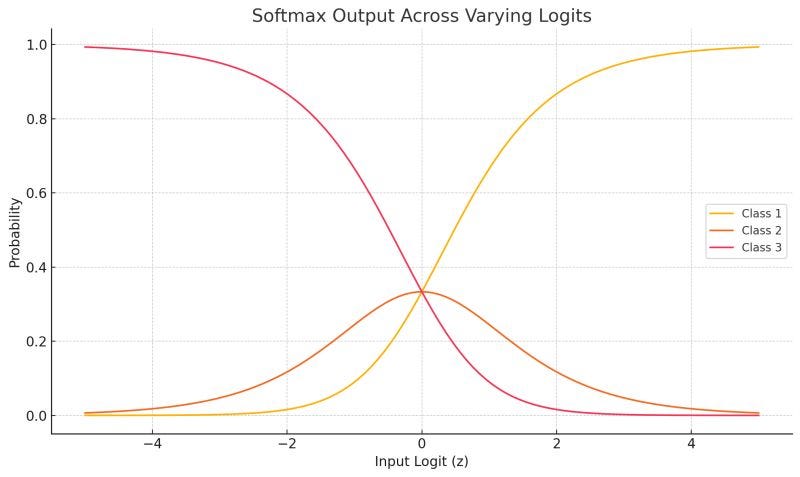
Softmax output across varying logits
Table of Contents
- What are logits? a) Code example
- Why softmax?
- What is softmax? a) Manual softmax in Python b) Why softmax -> logits -> probabilities? c) Why do we need probabilities? d) Without probabilities, loss wouldn’t work! e) But the one-hot encoded isn’t a probability. f) Is One-Hot a probability distribution? g) Cross-Entropy Formula with One-Hot Label
1. What are logits?
| Logits — raw, unnormalized output of neural network before applying softmax. | E.g.: logits = [2.0, 1.0, 0.1] <- not probabilities!
- Logits are used during training for numerical stability,
- Loss functions like ‘CrossEntropyLoss’ in PyTorch expect logits, not probabilities.
1. a) Code example
> PyTorch
import torch
import torch.nn.functional as F

# Raw model output (logits)
logits = torch.tensor([[2.0, 1.0, 0.1]])

# Apply softmax to convert logits into probabilities
probs = F.softmax(logits, dim=1)
> TensorFlow/Keras
import numpy as np
from tensorflow.keras.models import Sequential
from tensorflow.keras.layers import Dense, Softmax

# Example: 3-class classification output
model = Sequential([
    Dense(3, input_shape=(4,)),  # Last layer with 3 neurons
    Softmax()
])

# Fake input: 1 sample with 4 features
x = np.array([[0.5, 0.2, 0.1, 0.7]])
output = model.predict(x)
2. Why softmax?
- Converts logits into probability distribution,
- Each y_hat[i] in (1, 0), and the sum is 1,
- Squashes large positive values and higlights the most probable class,
Softmax formula: y_hat_i = exp(z_i) / sum_j(exp(z_j))
| If logits = [9.0, 1.0, 0.1], softmax will be skewed toward the first class. | Numerical stability trick: y_hat_i = exp(z_i — max(z)) / sum_j(exp(z_j — max(z))). | This version subtracts max(z) from all logits to improve numerical stability (avoids large exponentials).
3. What is softmax?
- Converts logits into a probability distribution
- Takes raw outputs (logits) from the final layer,
- Transforms them into values in the range [0, 1],
- Interpretable as class probabilities.
- Ensures outputs sum to 1
- Output vector: y_hat = [p1, p2, …, pn], where sum_i(p_i) = 1
- Makes it suitable for multi-class classification
- Used in multi-class classification
- Output layer for: Image classification, Text classification, ** Any task with mutually exclusive classes.
- Activation function
- Like ReLU or sigmoid, but for the output layer only,
- It’s differentiable -> supports gradient-based learning.
3. a) Manual softmax in Python
import numpy as np
def softmax(logits): shifted = logits — np.max(logits) # For numerical stability exps = np.exp(shifted) return exps / np.sum(exps)
logits = np.array([2.0, 1.0, 0.1]) softmax(logits)
3. b) Why softmax -> logits -> probabilities?
- Because in classification tasks, we want the model’s output to express:
- “How likely is this input to belong to class k?”,
- “This image is 90% cat, 10% dog”.
- This is naturally expressed using probabilities — values between 0 and 1, summing to 1.
3. c) Why do we need probabilities?
Because in classification: We want… -> “This is a cat with 85% confidence” So we use… -> Probabilities (e.g.: softmax)
We want… -> “Most likely class is Dog” So we use… -> argmax(probabilities)
We want… -> Measure “how wrong” we were So we use… -> CrossEntropyLoss(prob, true)
3. d) Without probabilities, loss wouldn’t work!
- Cross-Entropy Loss measures the distance between two probability distributions:
- Model’s prediction (via softmax),
- True label (one-hot encoded).
That’s why softmax is critical — it turns unbounded logits into a probabilistic interpretation, so we can measure how wrong the model was.
- Side note:
- During training, PyTorch/Keras apply CrossEntropyLoss directly to logits — it combines log_softmax + NLLLoss internally for numerical stability.
- But during prediction, we apply softmax manually to interpret the results.
Concept — Logits Description — Raw scores (not interpretable)
Concept — Softmax Description — Converts logits into probabilities summing to 1
Concept — Probabilities Description — Let us say “how likely” an input belongs to each class
Concept — Needed for Description — Loss functions, interpretability, decision-making
3. e) But the one-hot encoded isn’t a probability.
- How one-hot encoder works?
- Let’s say we have 3 classes: cat, dog, rabbit.
- If the true label is dog, then the one-hot encoded vector is: [0, 1, 0] # cat=0, dog=1, rabbit=0
- Key properties of one-hot encoding:
- It’s a vector with exactly one 1, and all others are 0,
- Length = number of classes.
- It represents certainty: “100% sure this is class 1”.
3. f) Is One-Hot a probability distribution?
| Yes, technically — it’s a special case.
- A one-hot vector is a degenerate (discrete) probability distribution:
- All probability mass is on one class (1),
- Others are zero (0).
- So it acts like a probability distribution:
- All values in [0, 1],
- Sum = 1.
- That’s why we can compute cross-entropy between:
- model_prob = [0.7, 0.2, 0.1]
- true_label = [0, 1, 0] ← one-hot
3. g) Cross-Entropy Formula with One-Hot Label
- Let:
- y = one-hot true label (e.g., [0, 1, 0])
- y_hat = predicted softmax output (e.g., [0.7, 0.2, 0.1])
- Then:
- CrossEntropy = -sum(y_i * log(y_hat_i)) = -log(y_hat_true_class),
- Because y_i is zero for all but the true class.
So in effect: - Cross-entropy compares:
- A true distribution = one-hot encoded
- A predicted distribution = softmax output
- The lower the predicted probability for the correct class → the higher the loss.
Real-World Analogy - True label: “It’s definitely a dog.” -> [0, 1, 0],
- Model says: ‘Maybe cat: 70%, dog: 20%, rabbit: 10%” -> [0.7, 0.2, 0.1],
- Cross-entropy punishes it for being wrong about dog.
SOURCE CODE on my GitHub — machinelearning-maverick https://github.com/machinelearning-maverick/deep-learning-challenge/
Let me know in the comments what do you think about this challenge! More content in the comments (LinkedIn post characters limit)…
30DaysChallengeWithDeepLearning #Softmax #Logits #DeepLearning #NeuralNetworks #Classification #CrossEntropy #ActivationFunction #PyTorch #Keras #MLChallenge
메타데이터
- post_id
- 618dc2f6c0c7
- slug
- day-10-of-30-softmax-and-logits-classification-output-layer-deep-learning-challenge-first-618dc2f6c0c7
- url
- https://medium.com/@machine-learning-maverick/day-10-of-30-softmax-and-logits-classification-output-layer-deep-learning-challenge-first-618dc2f6c0c7
- canonical_url
- https://medium.com/@machine-learning-maverick/day-10-of-30-softmax-and-logits-classification-output-layer-deep-learning-challenge-first-618dc2f6c0c7
- author_url
- https://medium.com/@machine-learning-maverick
- status
- ok
- fetched_at
- 2026-06-25 07:00:49




