Solar System Planets — The Complete Guide to Every World Orbiting Our Sun
Canonical URL: https://envisionstudio.xyz/stargaze/solar-system-planets/
Solar System Planets — The Complete Guide to Every World Orbiting Our Sun
Canonical URL: https://envisionstudio.xyz/stargaze/solar-system-planets/
Topics:
SpaceScienceAugmented RealityEducationTechnology
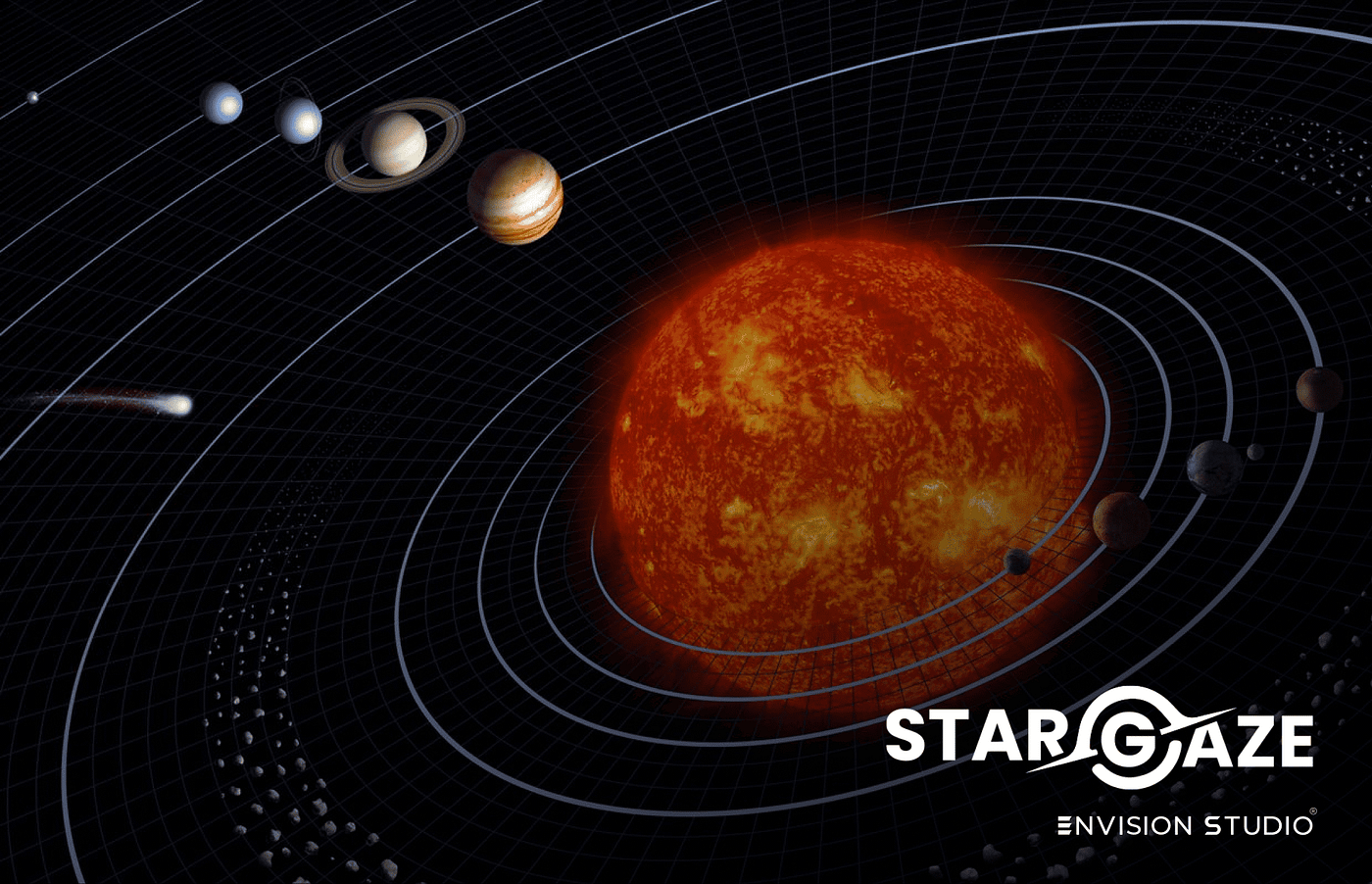
The solar system planets span distances and sizes so vast they are almost impossible to comprehend from a textbook. Here is what actually makes each one extraordinary.
Mercury — the planet where a day is longer than a year
Mercury orbits the Sun in just 88 Earth days but rotates so slowly that a single Mercurian day lasts 59 Earth days. Its temperature swings from -180°C at night to 430°C during the day — the most extreme range of all solar system planets. Its heavily cratered surface has barely changed in 4 billion years.
Venus — hotter than Mercury despite being further from the Sun
Venus’s thick carbon dioxide atmosphere creates a runaway greenhouse effect that pushes surface temperatures to 465°C — hot enough to melt lead. It also rotates backwards. The Sun rises in the west on Venus and sets in the east.
Mars — the most explored planet after Earth
More spacecraft have visited Mars than any other solar system planet beyond Earth. Olympus Mons — 21 km high — is the tallest volcano in the solar system. NASA’s Perseverance rover is currently searching the Jezero Crater for signs of ancient microbial life.
Jupiter — all other planets fit inside it
Jupiter’s diameter of 139,820 km means every other solar system planet could fit inside it simultaneously. Its Great Red Spot storm has been raging for over 350 years. Its moon Europa has a liquid water ocean beneath its ice that scientists consider one of the most promising locations for extraterrestrial life in the solar system.
Saturn — less dense than water
Saturn would float on water if you could find an ocean large enough. Its rings stretch 282,000 kilometres from the planet but are less than 1 kilometre thick. Its moon Titan has lakes and seas of liquid methane — the only world other than Earth with stable surface liquid.
Uranus — the planet that rolls
Uranus rotates on its side with a 97.8° axial tilt. Its poles experience 42 years of continuous sunlight followed by 42 years of darkness. At -224°C it is the coldest of all solar system planets.
Neptune — first predicted mathematically
Neptune was calculated to exist before anyone saw it — astronomers noticed Uranus was being pulled off course and worked out that another planet must be pulling it. Neptune was found exactly where the mathematics predicted in 1846. Its winds reach 2,100 km/h — faster than sound.
Explore all 8 solar system planets plus Pluto and the Moon in augmented reality with Stargaze XR — free on Android available on iOS and Meta Quest.
🤖 Free on Android: https://play.google.com/store/apps/details?id=com.EnvisionStudio.Stargaze 🥽 Meta Quest: https://www.meta.com/en-gb/experiences/stargaze-xr-ar-space-explorer/9333736950013837/
Read the full guide at envisionstudio.xyz
메타데이터
- post_id
- 61a8d09a7cfd
- slug
- solar-system-planets-the-complete-guide-to-every-world-orbiting-our-sun-61a8d09a7cfd
- url
- https://medium.com/@envision.studio/solar-system-planets-the-complete-guide-to-every-world-orbiting-our-sun-61a8d09a7cfd
- canonical_url
- https://medium.com/@envision.studio/solar-system-planets-the-complete-guide-to-every-world-orbiting-our-sun-61a8d09a7cfd
- author_url
- https://medium.com/@envision.studio
- status
- ok
- fetched_at
- 2026-08-09 07:44:01