Do LLMs Have Functional Brain Regions? Mapping the Neural “Geography” of Logic and Language
When a Large Language Model (LLM) solves a complex calculus problem or debugs a Python script, is it using the same pool of “gray matter,”…
Do LLMs Have Functional Brain Regions? Mapping the Neural “Geography” of Logic and Language
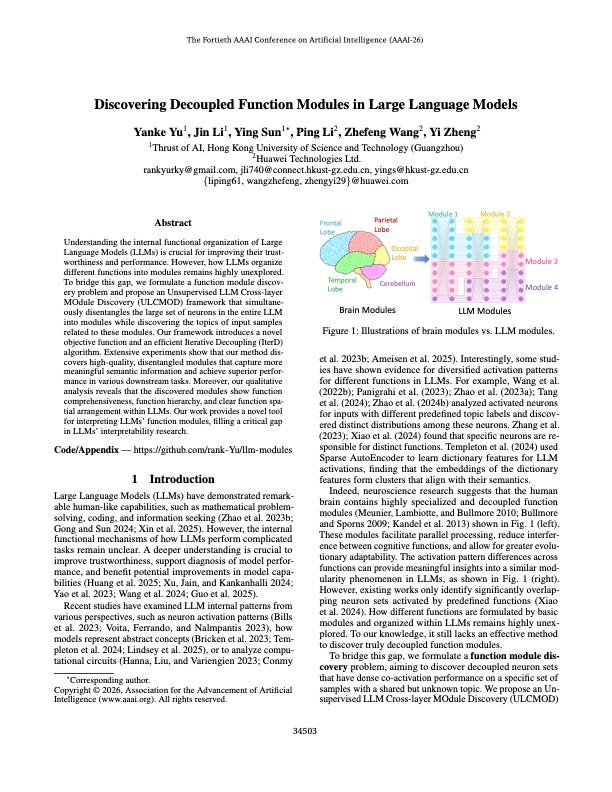
When a Large Language Model (LLM) solves a complex calculus problem or debugs a Python script, is it using the same pool of “gray matter,” or does it exhibit functional specialization similar to the human brain?
While we’ve long known that LLMs contain specific neurons for language or factual knowledge, a persistent hurdle in interpretability research has been overlap. Previous studies found that “coding neurons” often light up just as brightly during math tasks. This lack of decoupling made it nearly impossible to claim that models have distinct, dedicated functional zones.
A recent paper from the Hong Kong University of Science and Technology (HKUST) and Huawei marks a significant shift. It is the first work to formalize this question and provide a systematic answer by effectively “mapping” the LLM’s internal architecture.
The Methodology: Beyond Simple Overlap
The researchers redefined the problem as a neuron-sample dual partition. Instead of just looking for active neurons, they divided all neurons in a model into K groups and simultaneously divided input samples into K corresponding groups.
The goal was to maximize the activation intensity between a group of neurons and its corresponding sample set while minimizing cross-activation between different modules. To prevent the system from collapsing into one “giant module” and several empty ones, they introduced a balancing coefficient. Using an iterative algorithm, they optimized these assignments until the model’s internal “functional blocks” emerged.
Tested across the Qwen2.5 series (1.5B, 3B, and 7B), this method consistently outperformed baselines like K-Means in identifying specialized neural clusters.
Three Captivating Insights
The qualitative analysis offers a fascinating look into how these models organize their “thoughts”:
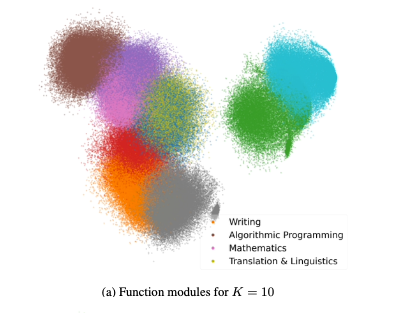

1. Functional Hierarchy
The model’s structure is nested. When the researchers set K=10, a broad “programming” module appeared. However, when they increased K to 20, that single block naturally split into granular sub-modules, such as “code debugging” and “systems programming.”
2. Spatial Locality and “Neural Hubs”
Neurons aren’t just randomly scattered. Modules for math, coding, and science tend to cluster together, forming a “technical zone.” Intriguingly, linguistics and translation modules sit at the intersection of multiple regions. Acting as cross-domain hubs, these language centers mirror how the human brain processes communication as a bridge between different cognitive functions.
3. Layer Depth and Task Complexity
Not all tasks require the same “brain power.” Information retrieval tasks are handled in the shallower, earlier layers of the model. In contrast, complex reasoning tasks — like math and coding — rely on neurons located much deeper. As models scale up in size, this division of labor becomes increasingly distinct.

A New Path for Interpretability
In the current landscape of AI safety and interpretability, Sparse Autoencoders (SAEs) have been the “hot” method for parsing features at a granular level. However, this paper takes a different, structural route. By partitioning the model at the neuron level, it provides a macro-map of the LLM’s “anatomy,” proving that as these models grow, they don’t just get smarter — they get more organized.
| Find papers faster on arXivSub with AI summary (CVPR/ICCV/ICML/ICLR/NeurIPS/AAAI/MICCAI)

메타데이터
- post_id
- 61d4b8f2f0e5
- slug
- do-llms-have-functional-brain-regions-mapping-the-neural-geography-of-logic-and-language-61d4b8f2f0e5
- url
- https://medium.com/@zljdanceholic/do-llms-have-functional-brain-regions-mapping-the-neural-geography-of-logic-and-language-61d4b8f2f0e5
- canonical_url
- https://medium.com/@zljdanceholic/do-llms-have-functional-brain-regions-mapping-the-neural-geography-of-logic-and-language-61d4b8f2f0e5
- author_url
- https://medium.com/@zljdanceholic
- status
- ok
- fetched_at
- 2026-06-14 11:28:49