When your autistic culture clashes with your family culture
“What time did he get home?”
When your autistic culture clashes with your family culture
“What time did he get home?”
I had no idea what time my husband got home. This is a common occurrence. My husband, who is a pilot, often flies late. I go to bed early and often sleep through whenever he comes home.
I’m actually grateful for that. I’m typically a light sleeper, and when we first moved in together, I woke up anytime there was movement in our room. It was exhausting. I’m glad my body has normalized my husband’s movement and determined it’s not worth waking me up.
Other people would worry more.
Other people like my father-in-law.
He moved in with us two months ago. He always wants to know where his son is. He’s constantly asking me questions like:
When did he leave?
Where did he go?
When will he be coming home?
How long will he be gone?
I seldom have the answers. Nor do I try to get them. I trust my husband is doing what he needs to do and will return when he is done. If something is wrong, like a flight is running exceptionally late, I know he’ll notify me.
I don’t worry. I go about my life as normal.

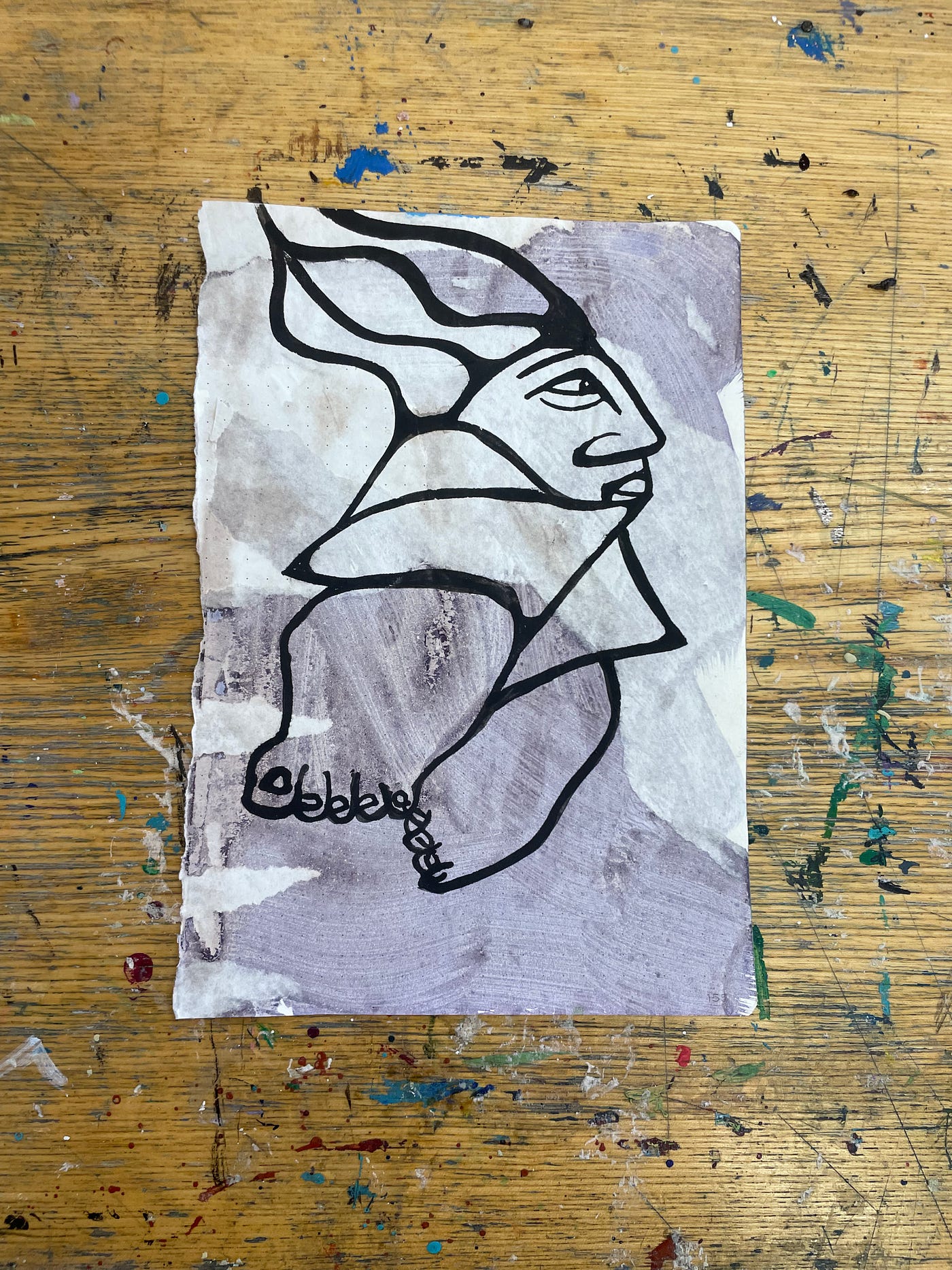
Me, doing my own thing. I made this with ink
My father-in-law, in contrast, worries. He exhibits an exceptional level of care and concern for his son. He’ll wait up until he comes home. The minute he hears any movement, he’ll come out of his room and ask, “Is that him?” He’s usually disappointed to learn it was just our dog barking at a deer he saw.
Many times he waits to eat dinner until my husband comes back.
Meanwhile, I’ll be in my home studio, happily eating, watching a show, and painting.
But my father-in-law’s level of concern is not unique to him. Their entire family is that way. Before he lived with us, my husband would call morning and night to check in on him. The same with his sister. It’s part of their family culture.
Some of their family culture is rooted in the inter-dependence that is common in Indian families that grow up living together. Some of their culture is due to their lives now being dispersed across the globe.
My husband left home at a young age to study in some of the best schools in India. He then left India to study in some of the best universities in America. His sister did the same. From an early age, they’ve had to keep track of each other from afar.
What strikes me about their constant monitoring of each other is how much it is rooted in love. They genuinely care about each other — dote on each other. When my husband comes home from work, his father happily sits with him and listens to his day. They talk for hours.
Meanwhile, I excuse myself to go work on a painting.
I know my father-in-law finds my behavior bizarre — though he’s certainly too kind and reserved to tell me. It’s obvious though from his questions.
When are you leaving today?
How long will you be gone?
When will you get back?
My answers are usually the same: I don’t know. I’m not trying to be obtuse, I just genuinely have no idea. I don’t have a set time I leave for work. Even today, I have no idea what time I’ll leave. It’s 7:50am. Maybe I’ll sit and read after I write this essay. Maybe I’ll feel like visiting my friends at the coffee shop. Maybe I’ll write for a while instead. I have no idea.
The same goes for my plans for the day. Yes, I’ll see my therapy clients, but I don’t know what I’ll do after that. I have no idea what my energy levels will be, which basically dictate my life. If I have no energy, I come home and take a nap. If I have energy, I might go check out a thrift store or go to the gym for a swim.
After I respond to my father-in-law’s questions with insufficient answers, he moves on to questions about his son:
Is he asleep?
What time did he get home?
Will he fly today?
Many times I don’t even know if he’ll fly. I often forget and have to be reminded.
But I’m ok with my way of being. My friend recently pointed out, “You have your own culture.”
I do, and it’s a very strong culture. A culture of 1 — though I’m pretty sure my fellow AuDHDers would happily join in my culture.
Long, quiet, undisturbed mornings with journaling, reading, and yummy coffea drinks. Enough time spacioussness to leave when you want. Some meaningful work. More time spaciousness to decide what you do after. Some exciting activities, like hunting for treasures at a thrift store or finding a new coffee shop. Eating simply and predictably. Quiet evenings full of painting or reading. Options for connection with people, if there is energy for it.
It’s a good culture.
Just not one lived by my in-laws.
Thanks for reading!
Here are 3 ways to connect with me more:
- ***Sign up for my free FUNletter. *I share a weekly list of all the things I find fun as an autistic artist, author, and art therapist.
- ***Become an art therapy client*. I work with autistic clients from all over the world.
- Read my book Life as a Late-Identified Autistic

메타데이터
- post_id
- 61d95a2e223d
- slug
- when-your-autistic-culture-clashes-with-your-family-culture-61d95a2e223d
- url
- https://medium.com/@jackieschuld/when-your-autistic-culture-clashes-with-your-family-culture-61d95a2e223d
- canonical_url
- https://medium.com/@jackieschuld/when-your-autistic-culture-clashes-with-your-family-culture-61d95a2e223d
- author_url
- https://medium.com/@jackieschuld
- status
- ok
- fetched_at
- 2026-07-13 06:23:13