Realpolitik in Judea and Samaria
Synopsis: Israel’s control over Judea and Samaria is a widely debated topic around the world. Most right-wing Israelis approach this debate…
Realpolitik in Judea and Samaria
Synopsis: Israel’s control over Judea and Samaria is a widely debated topic around the world. Most right-wing Israelis approach this debate using theological arguments; yet, in a world ruled by Realpolitik, such arguments do not hold weight. Therefore, in this article, I will explain the strategic and military reasons that mandate Israel’s presence in these areas and prevent any peace deal in the foreseeable future.
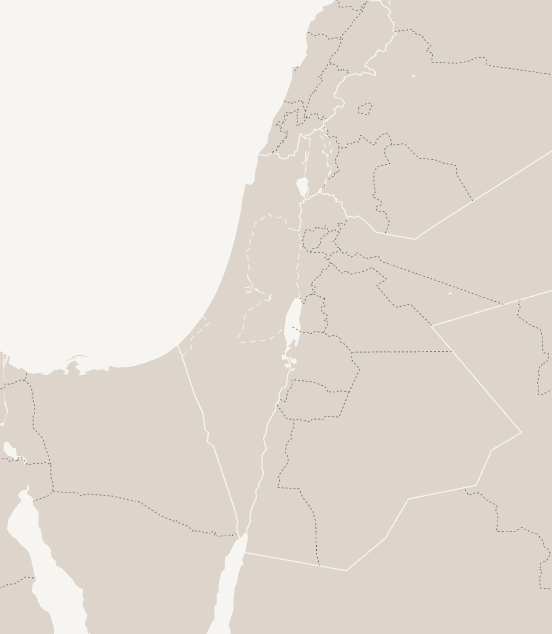
Israel and its surronding
Background — the where: Judea and Samaria are two regions in the middle east, De facto ruled partly by Israel and partly by the Palestinian Authority (PA). Legally it is a disputed land, where the two entities claim to have legal right to rule the land. Those are Mountainous regions sloping westward toward the coastal plain of the Mediterranean sea. In the north it is bordering the Jezreel Valley and the Gillboa Mountain range while in the south it is bordering the Negev Desert and the Beer Sheva Basin.
The Jewish theological claim: The Jewish claim of those region goes back to the biblical era, when god promised the land of Israel to the Abraham for him and for his heirs, then to Abraham son, Isaac, for him and his heirs, then to Issac son, Jacob, for him and for his heirs. Every repetition focused the lens of the promise and excluded the other sons of the previous recipient.
Than, the land was promised once again to the Jews, now as People, the People of Israel, right before Joshua bin Non lead them to conquer the land. The main events in the bible take place in those regions. Those areas where the political center of the Jewish kingdoms, while the modern centers of Israel, apart from Jerusalem, where only partially inhabitable, due to floods risk.
After the Roman Conquered the land, and banished the Jews from living there, the time of the Jewish Diaspora started. During this era, for thousands of years, Jews never forgot their homeland. Jews kept praying facing Jerusalem. the entire corpus of Jewish religious literature — from the Mishnah and Talmud to medieval rabbinic codes — remained intrinsically bound to the land. Jewish law (Halakha) continuously engaged with the agricultural cycles, geography, and specific commandments bound to the soil of Israel.
Realpolitik: Realpolitik in this context is the idea that most diplomatic and political policies of most countries are conducted base on the principles of Realpolitik. in other words — that most countries and people act rationally when thinking about global politics, rather then strictly following ideological, moral, or ethical premises. In Realpolitik the state’s primary and ultimate goal is survival, it is the only measure of the state’s action, acting otherwise would wipe out the state and will erase its ideal.
why Realpolitik: The theological claim is a widely used weapon in the Israeli arsenal, this is an effect of the notion of many religious Jew (who tend to be right wing), that since most of the world population believe in the Abrahamic god then this claim will effect them, this is a mistake. Most people, even religious look at the facts of the world, then they choose their opinion, and only after this process they seek a justification in their belief system, therefore, the fact that most people are religious don’t make them automatically pro-Israel after hearing the story of the Jews.
Therefore we must come with an alternative claim, factual claim, for our justification to settle the lands of Judea and Samaria, and such a claim do exist.
The borders of Israel: In order to understand the challenge of Judea and Samaria we need to first take a look at the other borders of Israel, and also to understand the meaning of a defensible border. A border should be considered defensible if and only if it possesses at least one of two qualities: I) Topographical Advantage (The High Ground): This means the border runs along natural obstacles like mountain ranges or rivers. In warfare, holding the ‘high ground’ gives a massive advantage — it allows a military to easily spot oncoming threats and defend the territory with fewer forces against a larger army.
II) Strategic Depth (Space and Time): This is the physical distance between the border and the country’s core population centers or vital infrastructure. Strategic depth acts as a buffer zone. It ensures that if a country is attacked by surprise, it has enough space to fight back and organize its defense before the enemy can reach its strategic center.
Every border, even in peace time, should be evaluated by those parameters, living with a border that is indefensible is a risk that must be noted and managed — since an attack from such border is practically a death sentence for the state.
Israel has 5 Border: North border (Lebanon and Syria), Jordan Border, Egypt Border, Gaza Border and Judea-Samaria Border.
The North border, which is in fact two borders, the Lebanon Border and Syria Border, but they share common features, is a defensible border. This border possesses the quality of Strategic Depth, moving from the north border to the center of Israel will take a lot of time in combat condition, and will allow the IDF to mobilize against an invasion. Also, the Lebanon part of the border utilize major natural defensive obstacles: steep ridges, deep ravines, and rocky cliffs, those features will prevent armored invasion.
The Jordan border is the most defensible border of Israel, since it possesses both qualities. The Jordan valley is surrounded by mountains on both sided of the border, and any invader would be forced to traverse up the mountains on the other side of the border. Also the distance between the center of Israel and the Jordan border is around 80km.
In the Israel-Egypt peace agreements, Egypt promised to not deploy troops in the Sinai Peninsula beyond strictly limited and agreed-upon monitoring forces. This agreement meant to prevent a swift invasion in case the peace agreement fail, Egypt has violated the strict demilitarization terms, but in fact it does not matter. The Egypt border, even without the Sinai Peninsula possesses a Strategic Depth, that during the 1948 war has proven itself.
The Gaza Border is very similar to the Egypt border, and in the same way I mentioned the to borders in the north as one I could have mention the Egypt border and Gaza border with one common term, the south border. Yet the Gaza border is a perfect case study for the Judea-Samaria border since those are two areas that are ruled by the Palestinians and in light of the 7th of October attack. In the 7th of October 2023 a highly organized terror-army invaded Israel, when a defensible border fail, such as in this attack, the result is tragic, yet truth must be told: since there was only one active front, Israel was not in strategic danger.
Peace: Now we had arrived at the core of it all, the Judea-Samaria border. Critics often argue that Israeli military control and civilian presence in Judea and Samaria are the primary obstacles to peace. They claim that withdrawing from these territories and establishing a Palestinian state is the only path to long-term stability, but the facts are more complicated.
Strategically, the Judea-Samaria border is totally indefensible, a border is indefensible when it lack both qualities, but it is totally indefensible when it possesses such qualities, but it favor you enemy. Judea-Samaria border is the definition of high ground, the mountains of Judea-Samaria have clear sight of the strategic center of Israel, Tel-Aviv and the Dan Metropolitan area, if any army would conduct war from such a border, Israel is lost.
It might be argued that the Palestinian will give up military action against Israel after a peace agreement will be sign. History tell us otherwise, yet this is not even important, even if the Palestinian want peace non of their action prove us such thing, and even if they will not attack immediately, who can assure us that the moderates will stay in power? No! Israel can not give up Judea-Samaria unless we will be sure beyond reasonable doubt that no one will try to invade our country via this border.
Only one question left, the question of civilian settlement in Judea-Samaria, critic claim that this is planned by Israel in order to consolidate its control over those regions, yet this is simply not true. History teach us that an army can not stay in a region successfully without supportive civilian population, armies are less battle-keen than one might suspect, they usually support withdrawal from as much area as possible in order to better defense the state’s core. And this is the reason why the settlements exist in Judea-Samaria
메타데이터
- post_id
- 61d9d54e2988
- slug
- realpolitik-in-judea-and-samaria-61d9d54e2988
- url
- https://medium.com/@navon.roee/realpolitik-in-judea-and-samaria-61d9d54e2988
- canonical_url
- https://medium.com/@navon.roee/realpolitik-in-judea-and-samaria-61d9d54e2988
- author_url
- https://medium.com/@navon.roee
- status
- ok
- fetched_at
- 2026-06-17 12:55:42