Drip Irrigation: Application in Modern Agriculture
Water is one of the most critical inputs in agricultural production. Globally, agriculture accounts for approximately 70% of freshwater…
Drip Irrigation: Application in Modern Agriculture
Water is one of the most critical inputs in agricultural production. Globally, agriculture accounts for approximately 70% of freshwater withdrawals, making efficient water management essential for sustainable food production. Traditional irrigation methods such as flood and furrow irrigation often result in substantial water losses through evaporation, runoff, and inefficient distribution.
Drip irrigation was developed as a solution to these challenges by delivering water directly to the root zone of crops in controlled quantities and at precise intervals. This technology enables farmers to maximize crop production while conserving water, reducing labor requirements, and improving nutrient management. Today, drip irrigation is widely used in horticulture, field crops, orchards, greenhouses, nurseries, and high-value agricultural production systems.
What Is Drip Irrigation?
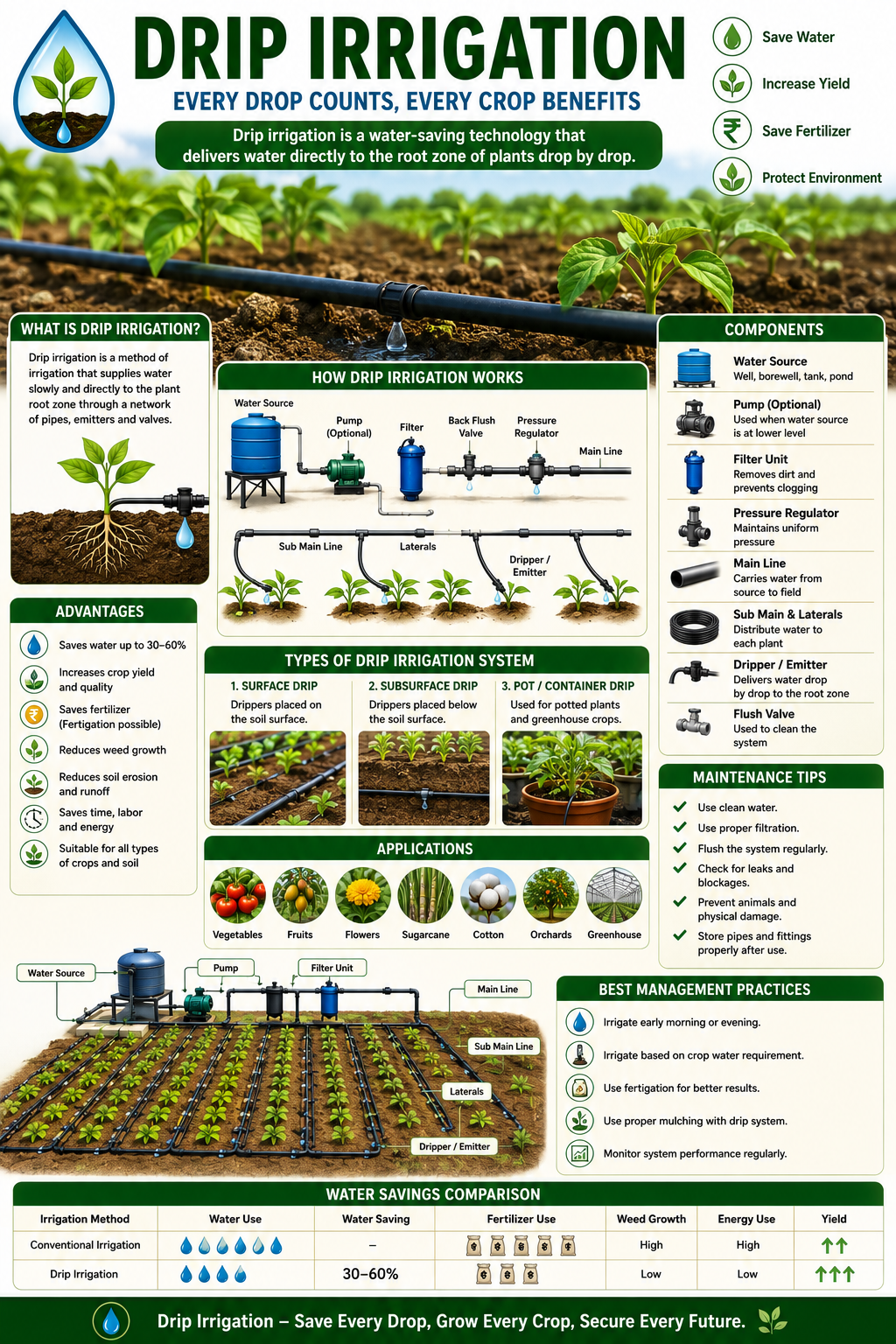
Drip irrigation (also known as trickle irrigation or micro-irrigation) is a localized irrigation method that supplies water slowly and directly to the plant root zone through a system of emitters.
The system applies water in small amounts at frequent intervals, maintaining optimum soil moisture conditions while minimizing losses. Unlike conventional irrigation methods that wet the entire soil surface, drip irrigation targets only the area where roots actively absorb water and nutrients.
Historical Development of Drip Irrigation
The concept of localized irrigation has existed for centuries, but modern drip irrigation emerged during the mid-20th century with plastic piping technologies.
Major Milestones
Ancient clay pot irrigation systems → Development of perforated pipes → Introduction of plastic emitters → Automated irrigation systems → Integration with fertigation and precision agriculture technologies
Today, drip irrigation represents one of the most advanced irrigation technologies available.
Principles of Drip Irrigation
Drip irrigation operates on the principle of frequent, low-volume water application directly to the root zone.
Localized Water Application: Water is applied only where needed.
Frequent Irrigation: Small quantities are applied regularly.
Low Operating Pressure: Most systems operate under relatively low pressure.
Controlled Distribution: Uniform water delivery achieved through emitters.
Efficient Resource Utilization: Water and nutrients delivered with minimal waste.
Primary Objectives
Water Conservation: Reducing irrigation water consumption.
Enhanced Crop Productivity: Providing optimal moisture conditions for plant growth.
Improved Nutrient Efficiency: Supporting precise fertilizer application through fertigation.
Reduced Labor Requirements: Automation minimizes manual irrigation operations.
Environmental Sustainability: Reducing water wastage and nutrient losses.
Components of a Drip Irrigation System
A drip irrigation system consists of several interconnected components:
Water Source: Sources such as wells, boreholes, rivers, reservoirs, municipal water supplies. Reliable water availability is essential.
Pumping Unit: Pumps provide pressure required to distribute water. Types include centrifugal pumps, submersible pumps and solar-powered pumps.
Filtration System: Filtration prevents clogging of emitters (one of the most important components).
- Screen Filters: Remove large particles
- Disc Filters: Provide finer filtration
- Sand Filters: Remove organic matter and suspended solids
Mainline Pipes: Transport water from source to field. Materials: PVC, HDPE, polyethylene.
Submains: Distribute water from mainline to laterals.
Laterals: Small-diameter pipes carrying water directly to plants.
Emitters: Regulate water flow to individual plants.
- Inline Emitters: Integrated within lateral tubing
- Online Emitters: Attached externally to lateral pipes
- Pressure-Compensating Emitters: Maintain consistent flow despite pressure variations
Control Valves: Regulate water movement. Examples such as gate valves, ball valves, solenoid valves.
Fertigation Unit: Allows fertilizers to be injected into irrigation water. Devices include Venturi injectors, fertilizer tanks and injection pumps.
Types of Drip Irrigation Systems
Surface Drip: Emitters on soil surface. Easy inspection, lower cost but greater exposure to damage
Subsurface Drip: Lines buried beneath soil. Reduced evaporation, improved efficiency but more complex maintenance
Point Source: Individual emitters. Common in orchards/vineyards.
Line Source: Continuous emitters along laterals. Common in vegetable production.
Design Considerations for Drip Irrigation
Effective system design requires consideration of multiple factors:
Crop Characteristics: Root depth, plant spacing and water requirements.
Soil Properties: Texture influences water movement, wetting patterns and irrigation frequency.
Climate: Temperature, humidity, wind, rainfall
Water Quality: Filtration requirements, emitter performance.
Topography: Field slope influences pressure distribution and layout.
Soil-Water Dynamics Under Drip Irrigation
Water spreads through:
Vertical Movement: Driven by gravity.
Horizontal Movement: Driven by capillary forces.
Sandy Soils: Greater vertical movement, limited horizontal spread.
Clay Soils: Greater horizontal movement, slower infiltration.
Fertigation in Drip Irrigation
Fertigation is the application of fertilizers through irrigation systems. Benefits include improved nutrient-use efficiency, uniform nutrient distribution, reduced fertilizer losses and increased crop productivity. Common Nutrients applied are nitrogen, potassium, calcium and micronutrients.
Advantages of Drip Irrigation
High Water Use Efficiency: Efficiencies often exceed 90%.
Reduced Evaporation Losses: Only portion of soil surface wetted.
Improved Crop Yields: Optimal moisture promotes growth.
Enhanced Crop Quality: Consistent water improves quality.
Reduced Weed Growth: Dry inter-row spaces suppress weeds.
Improved Fertilizer Efficiency: Nutrients delivered directly to roots.
Reduced Disease Incidence: Dry foliage reduces disease pressure.
Labor Savings: Automation reduces manual labor.
Energy Savings: Lower pressures reduce energy consumption.
Limitations of Drip Irrigation
High Initial Investment: Installation costs substantial.
Emitter Clogging: From sediments, biological growth, chemical precipitation.
Maintenance Requirements: Regular monitoring and cleaning essential.
Technical Expertise: Specialized knowledge required for design/operation.
Salt Accumulation: Salts may accumulate near wetted zone edges.
Crops Suitable for Drip Irrigation
Orchard Crops: Mango, citrus, apple, pomegranate
Vegetable Crops: Tomato, pepper, cucumber, onion
Plantation Crops: Coffee, tea, banana
Field Crops: Cotton, sugarcane, maize
Greenhouse Crops: Highly compatible with protected cultivation
Economic Benefits
Increased Productivity: Higher yields improve profitability.
Water Savings: Reduced requirements lower costs.
Reduced Fertilizer Consumption: Improved efficiency reduces expenses.
Lower Labor Costs: Automation reduces labor needs.
Improved Marketable Yield: Enhanced quality commands premium prices.
Drip Irrigation and Sustainability
Water Conservation: Critical in water-scarce regions.
Reduced Nutrient Losses: Minimizes leaching and runoff.
Lower Environmental Impact: Reduces pollution and wastage.
Climate Adaptation: Improves drought resilience.
Automation and Smart Drip Irrigation
Soil Moisture Sensors: Monitor soil water status.
Weather-Based Controllers: Auto-adjust irrigation schedules.
IoT: Real-time monitoring and control.
AI: Predictive irrigation management.
Mobile Apps: Remote system operation.
Challenges for Adoption
Government support and extension services play important roles in promoting adoption.
High capital costs
Limited technical knowledge
Water quality issues
Infrastructure constraints
Maintenance requirements
Future Trends
Precision Irrigation: Highly targeted water management
AI-Driven Scheduling: Automated decision-making
Solar-Powered Systems: Reduced fossil fuel dependence
Advanced Sensors: Improved monitoring capabilities
Integrated Water-Nutrient Management: Optimized fertigation
Climate-Smart Irrigation: Adaptation to environmental changes
Best Practices for Success
Proper system design
Adequate filtration
Regular maintenance
Water quality monitoring
Scheduled pipeline flushing
Appropriate fertigation practices
Continuous crop water requirement monitoring
Conclusion
Drip irrigation represents one of the most efficient and sustainable irrigation technologies in modern agriculture. By delivering water directly to the root zone in controlled amounts, it significantly improves water-use efficiency, crop productivity, nutrient management, and environmental sustainability.
Although challenges such as initial investment costs and maintenance requirements exist, long-term agronomic and economic benefits often outweigh these limitations. As agriculture faces increasing pressure from water scarcity, climate change, and growing food demand, drip irrigation will continue playing a vital role in improving resource-use efficiency and supporting sustainable agricultural development.
Advances in automation, sensors, AI, and precision agriculture technologies are expected to further enhance the effectiveness and adoption of drip irrigation systems worldwide.
Disclaimer: Parts of this content may be AI-generated or AI-assisted. All interpretations, opinions, and conclusions presented are the responsibility of the author. Kindly do not consider this information as any form of advisory. Do your own research before implementing the knowledge shared above.
메타데이터
- post_id
- 61fd4ee8138e
- slug
- drip-irrigation-application-in-modern-agriculture-61fd4ee8138e
- url
- https://medium.com/@rohanchhabra2025/drip-irrigation-application-in-modern-agriculture-61fd4ee8138e
- canonical_url
- https://medium.com/@rohanchhabra2025/drip-irrigation-application-in-modern-agriculture-61fd4ee8138e
- author_url
- https://medium.com/@rohanchhabra2025
- status
- ok
- fetched_at
- 2026-07-07 06:24:42