TOWARDS THE REAL MOUNTAINS
Log 2 : An Unplanned Journey
TOWARDS THE REAL MOUNTAINS
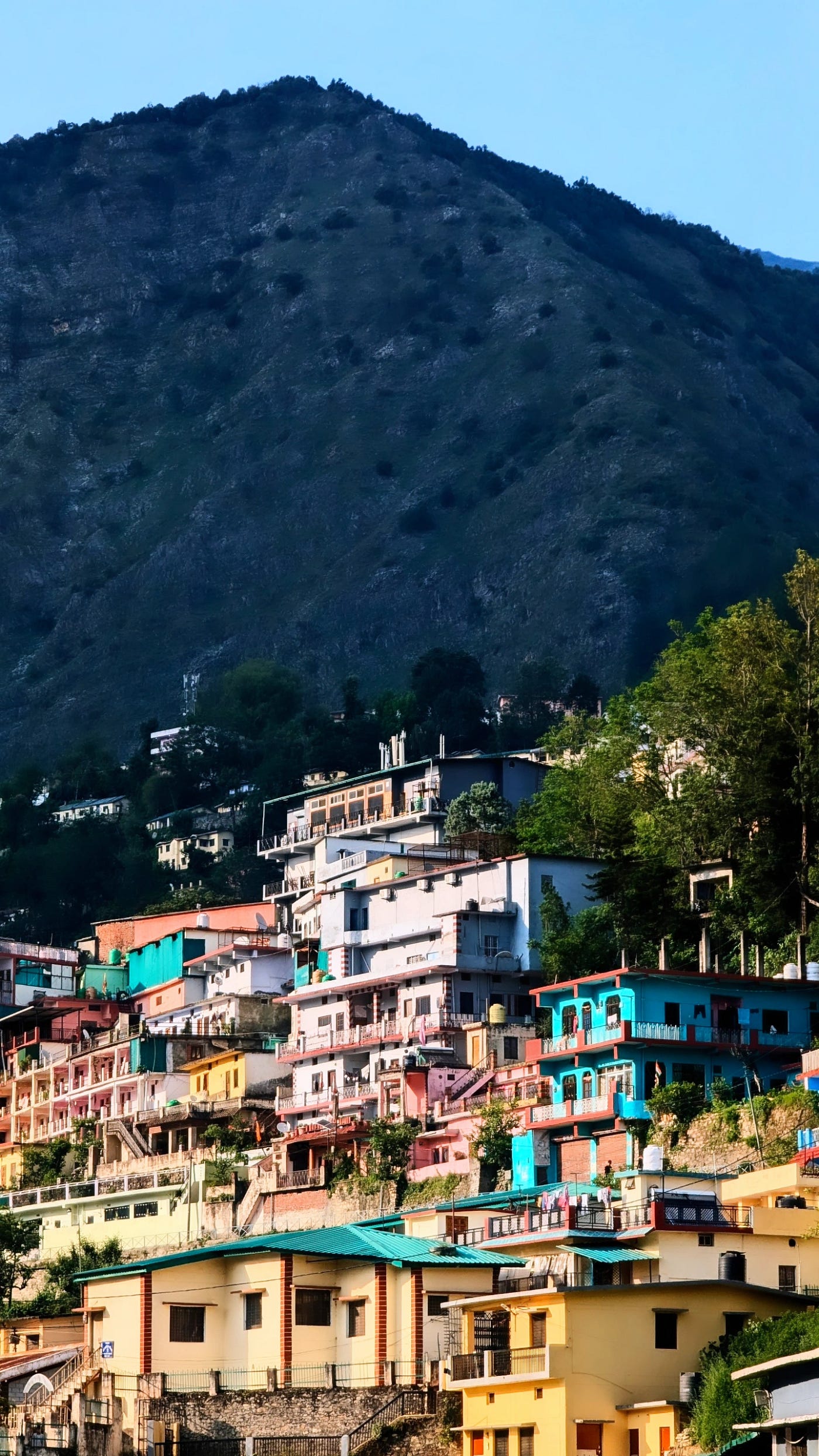
It was around 0500 hrs. The cab driver had already called me. I answered him, although I wasn’t completely awake. My alarm actually woke me up, and this time I got out of bed and called back the taxi driver, who was a relative of Suraj. So I checked my stuff in the bag and headed towards Laxman Jhula in order to cross it. The morning air was fresh and less crowded. I couldn’t see the sun, but there was still some light. While crossing Laxman Jhula, I could see the unopened glass bridge and thought about the uncle. The security guards were still there. I could also see the Trayambakeshwar Temple clearly from the other end. We were headed towards Chamoli. I had pictured Uttarakhand in my own way in my mind. Suraj called and said, "You’re gonna love the journey. Welcome to the mountains." I told him I had been to mountains before, but he replied, "Bro, I’m talking about real mountains." I just smiled and continued my journey. My eyes were burning, so I took a nap using my eye mask for about half an hour, I guess, in the front seat. All I could hear were Bhole Nath, Harshu Mama, and the typical Pahadi songs. I didn’t want to disturb the driver by playing my music, so I stuck to my headphones. I had heard a little Pahadi music before but had never listened to it out of my own interest. Usually, almost every song has similar music. Pick any one song and you’ll notice the repetition. It isn’t fast-paced, doesn’t have much variation in pitch, isn’t sad either. Most of them have a happy tone, just like the people you find there, from what I noticed. I asked Suraj about this later when we met in person, and he told me it was true. We stopped for breakfast. There was a boy named Kanha whom I met in the car. He was sharing a few stories. The car kept moving along the bank of the river. I could finally see in person what I had dreamt about—the mountains, the rock structures. I kept wondering what kind of rocks were present there and what caused such cruel landslides. I could also see warning boards about landslides. The higher we climbed, the clearer the water of the Ganga became. I saw a temple-like structure, similar to the Gurdwaras in Punjab, standing in the middle of the river. It was the Dhari Devi Temple. I could only see it from a distance because of time. Later, I changed vehicles at Nandaprayag to go to Gopeshwar. I was excited to see Suraj and Gopeshwar. The cab driver stopped near a Dhara (Himalayan spring) to fill his bottle, and all of a sudden I wanted to drink that water—not because I was thirsty, but because I wanted to taste it. It was cold and undoubtedly one of the best water I had ever drunk from a pipe. Of course, the only other one that comes close is the sip of water from a pipe after playing. Finally, I reached in front of Suraj’s place. He was there on the road to welcome me. Our usual conversations continued as we walked to his home. The house was compact, but I could sense an immense feeling of peace and happiness. It was exactly what I wanted. The view from the back of his house was fabulous. He used to tease me by sending pictures from there. The mountains and the Ganga were clearly visible. I wondered how beautiful it would look if it snowed there.
So he started cooking for us. We went to a shop to buy juice, and while returning, there was a small boy wearing a white vest. Suraj kept talking to him, while my mind was thinking about something. Suraj said something to him, which I didn't hear. Immediately, he touched my feet. I stepped back as I was shocked. I didn't know how to react and started scolding both of them. They were laughing. He told me that this was the kind of culture there.
We moved back home, and we were discussing which trek we should go on. He had suggested Rudranath the most over the phone because of its difficulty and elevation. People on the way suggested that I visit Kedarnath and Badrinath, which were the most visited pilgrimage sites for Hindus. Valley of Flowers had also been at the back of my mind. It was on the way to Badrinath, and the difficulty level was moderately easy. So obviously, I had to eliminate it. Kedarnath was a bit far, but the trek was moderate. If I wanted to go for treks like Nanda Devi, Kuari Pass, or Adi Kailash, I was out of time.
So I finally decided on Rudranath. I asked him if we could leave for the trek at that very moment and camp there. Initially, he hesitated because he had some work. But when I spoke about camping and my own experience, his face slowly started showing some excitement. He told me he had to ask his parents over a phone call since he and his siblings stayed away from them and their village. His siblings had gone to the village for vacation. I said okay, and it was fine for me to do the trek all alone. He didn't tell his parents the complete camping plan. They said it was up to him.
He was curious too, and I told him, "I'll take a bath. Till then, you decide whether you want to come with me or not."
My mind was fixed on Rudranath. He told me it was undoubtedly the toughest among the Panch Kedars, and the views were amazing from the pictures his friend had shown him. He also said it wasn't easy, but he had a feeling that we would somehow complete the trek.
I took a bath and came back. He was discussing the trek with his friends over a call, and when I returned, we had lunch. The dal was amazing. Usually, I don't like dal on a regular basis, but his cooking style made it taste much better. I appreciated his effort.
Then I explained the camping plan that we could execute. The power bank borrowed from the neighbour was already charging. I started arranging my bag for the trek by separating the unwanted and necessary items. I was searching for a torch, while Suraj was speaking to his friend about the trek and the permissions.
Aman was curious to trek and camp with us. He was a small boy studying in Class 7. A part of us didn't want him to come because we knew the difficulty of the trek, and if something went wrong, it would be hard.
After packing, I noticed Suraj's expression changing again. The permit wasn't allowed after 2 p.m., and personal camping wasn't permitted there. If caught, the guards would confiscate the tents. Only a few stay options were available because the area came under the Kedarnath Wildlife Division. We had missed the 2 p.m. deadline by just a few minutes. Even if we had reached Sagar Base Village by then, getting permission would have been difficult.
So we were forced to postpone the plan until the next morning. I had to leave after the trek on Sunday morning itself so that I could report for my shift. Honestly, I couldn't extend my leave.
Now came the biggest task. Completing the Rudranath Trek in a single day was considered impossible by many locals, Google, and even Suraj. But Suraj said that we would do it in a day no matter what because of my circumstances. I was up for the challenge, as always. For that, we had to leave at 0330 hrs. So he suggested that I take a nap, and I slept for around an hour.
As soon as I woke up, we went out to explore the town wearing our shoes, as we had planned for a short run. We walked through the streets of Gopeshwar, and he took me to the local stadium. People were playing, running, boxing, and practising their respective sports. It was nice to watch.
We went for a 2 km jog around the circle. The feeling was peaceful as I could see mountains all around me, with houses built on top of them. The view brought me even closer to the mountains. The sun was up there.
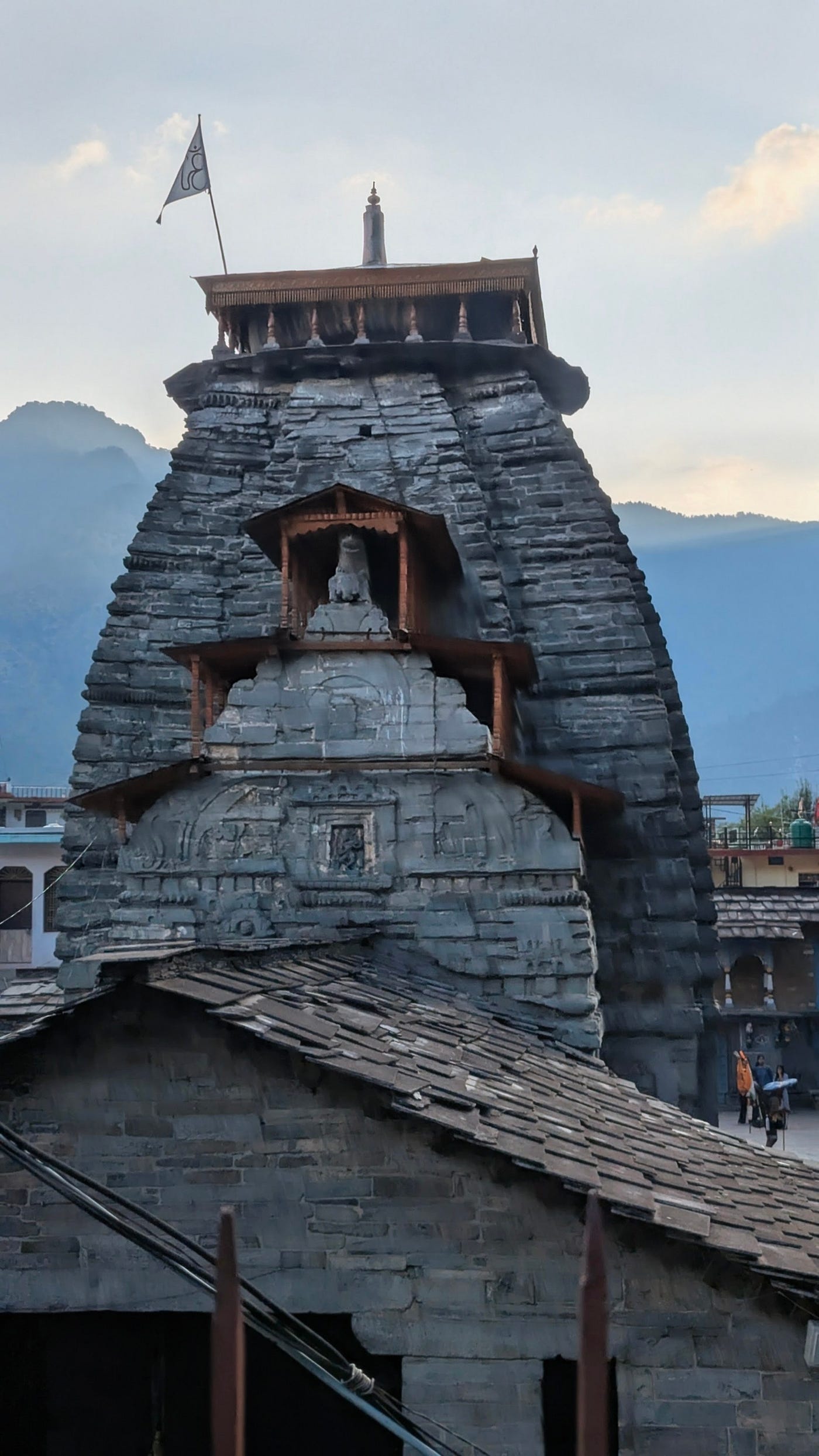
After the run, we visited the old Gopinath Temple in Gopeshwar. It was built in the typical Nagara style of architecture. We removed our shoes. I stood there looking at the temple for several minutes and touched the stones. I noticed cement placed between them. When I asked, I came to know that it had been applied during renovation.
The trident was there too. It had its own old legends, like the Nepalis bringing it from the Rudranath Temple and placing it there. Next to the temple stood an old model of a traditional Uttarakhand house. I kept observing all these things. We sat inside the temple for less than a minute.
Then we moved to the park to see the town from above. On the way, there were dogs, and we played with them. Usually, they have thicker fur to survive the harsh cold, which makes them look even cuter.
From the park, we could see the entire town and its roads. There was a statue of someone neither of us knew. The town looked picture-perfect. I couldn't find a single flaw. Box-shaped houses everywhere. The colours weren't dark but light and attractive. No skyscraper could match those houses or the people living there.
Honestly, I felt people were happy there. At the same time, I wondered how devastating a landslide or flood could be if it occurred. Nature is unpredictable. It gives, and it takes away, just like we humans do.
After some time, we had sugarcane juice and momos. We booked a cab to drop us at Sagar Base Village the next morning so that we could begin the trek. The driver was also from his village. They started communicating in Garhwali. Uttarakhand can broadly be divided into Garhwal and Kumaon, each having its own language, while the rest communicate in Hindi.
We decided to leave early at 0400 hrs, as the driver would only be available then.
I noticed a group of school and college girls moving around happily, talking among themselves. Honestly, I felt happy as well as a little surprised because, from my own life experience, I hadn't seen this happen in most small towns in India. I'm not saying it doesn't happen in India. But from what I've seen, it mostly happens in cities. Even if it happens in a town, people often keep judging with their eyes.
Generally, boys hanging out isn't considered a big deal, but when it comes to girls, people's opinions change, and they quickly start passing comments, which isn't right. I asked Suraj about it, and he said it was completely normal there. So yes, seeing those girls hanging out made me happy. They were on their own, just as they should be.
We reached home. Both Aman and Suraj asked me to join them for a wedding. I hesitated a little at first, but somehow agreed. Suraj took a photo of the invitation, and I asked why.
He replied, "In case someone asks."
I said, "Why would someone ask if they've already invited you?"
Both of them looked at each other and burst into laughter. Then they told me that the invitation was actually from Aman's house.
I questioned them again and said, "Phir mujhe kyu bulaya?" (Then why did you call me?)
They replied, "Nothing. Just come. No one will say anything."
So we got dressed and went to the wedding.
Children came and took blessings from Suraj because he was their teacher. I looked at him and smiled. It was their way of showing respect. It reminded me of something too. Usually, one keeps such feelings inside, I think.
By then, what I had noticed everywhere wasn't just the happiness on people's faces at the wedding but throughout the town. People didn't look sad. Neither were they in a hurry to build an empire, nor were they worried about tomorrow. That's not easy. Maybe they have a deeper understanding of life. Still, it's too early for me to make such a conclusion.
What I could genuinely feel was that people there were non-judgmental.
Within a minute, two little school-going girls, whom I didn't know, brought noodles for Suraj and me.
"Bhaiya, le lo." (Brother, please take it.)
It was a nice gesture. They were actually Aman's sisters. Aman's mother was also there. She had helped me earlier by filling water in the bathroom.
Children were happily eating instead of creating chaos. There was a huge queue for food, but Suraj took a shortcut by using his little student's influence and skipped the line.
Behind me stood another small boy named Aman. He asked me where I was from.
I replied that I was from Himachal.
He then asked what language we spoke there.
I answered, "Pahadi."
He excitedly said, "Ohh, say something in Pahadi."
Instantly, I said,
"Ki Kheyecho?" (What did you eat?)
He looked confused and replied,
"Samajh nahi paya." (I couldn't understand.)
Suraj and I smiled at each other—not because he couldn't understand, but because I'm not actually from Himachal, and what I had spoken was Bengali. The phrase had come out subconsciously. Ironically, I knew neither Bengali nor Pahadi except for a few words and phrases.
It was fun.
Then we had dinner. It was amazing, especially the hot Gulab Jamun that Aman gave me before we entered the queue. I ate only a small portion.
Later, Aman took me downstairs to show me the hall. Kids were dancing happily. I could see the stage. Aman kept saying a few things.
That night, I felt overwhelmed seeing people being genuinely happy without showing any worries on their faces. I could sense something there that I still can't explain.
메타데이터
- post_id
- 620752f13543
- slug
- towards-the-real-mountains-620752f13543
- url
- https://medium.com/@dharunlogs/towards-the-real-mountains-620752f13543
- canonical_url
- https://medium.com/@dharunlogs/towards-the-real-mountains-620752f13543
- author_url
- https://medium.com/@dharunlogs
- status
- ok
- fetched_at
- 2026-07-08 18:29:56