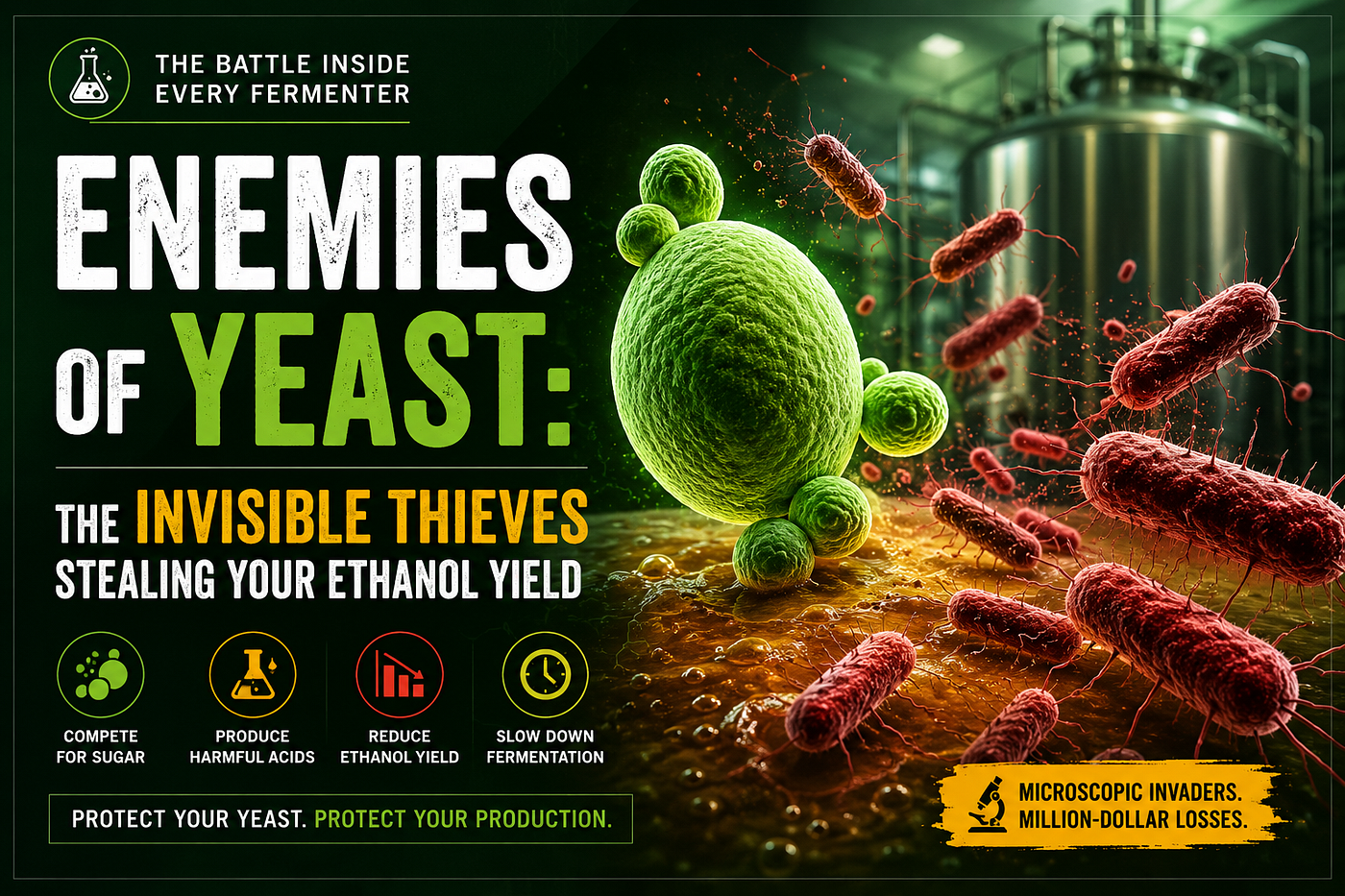
Enemies of Yeast: The Invisible Thieves Stealing Your Ethanol Yield
You Won’t See Them… But You’ll Definitely Feel Their Impact
Enemies of Yeast: The Invisible Thieves Stealing Your Ethanol Yield
You Won’t See Them… But You’ll Definitely Feel Their Impact
Imagine this.
You arrive at the ethanol plant for your morning shift.
The fermenters are running.
The temperature is exactly where it should be.
The pH looks normal.
The pumps are humming, and nothing seems out of place.
Everything appears perfect.
But when yesterday’s fermentation report lands on your desk, something doesn’t add up.
The ethanol yield is lower than expected.
Residual sugar has increased.
Fermentation has taken longer than usual.
No alarms were triggered.
No equipment failed.
So, what went wrong?
The answer might be hiding in a single drop of fermentation broth.
Not a broken machine.
Not an operator’s mistake.
But millions of microscopic bacteria quietly multiplying inside the fermenter, stealing nutrients from yeast and slowing down the process without making a sound.
In an ethanol plant, the most dangerous enemies are often the ones you can’t see.
Meet the Unwanted Guests
If yeast is the star employee of an ethanol plant, bacteria are the coworkers nobody invited.
They don’t help produce ethanol.
Instead, they consume the same sugars that yeast needs and leave behind unwanted by-products that make fermentation less efficient.
Think of it like preparing a buffet for one guest, only to discover that several gate-crashers arrived first and finished half the meal.
That’s exactly what happens inside a contaminated fermenter.
Every gram of sugar consumed by bacteria is sugar that never becomes ethanol.
And in an industry where every percentage point of yield matters, even a small contamination can translate into significant financial losses.
Why Do Bacteria Love Fermenters So Much?
A fermenter is designed to provide yeast with everything it needs to grow.
Warm temperatures.
Abundant nutrients.
Plenty of sugar.
Moisture.
Essential minerals.
Unfortunately, bacteria enjoy the very same environment.
To them, an ethanol fermenter is not a factory.
It’s a five-star hotel with an unlimited food buffet.
Once they find a way inside, they begin multiplying rapidly.
Sometimes contamination starts with raw materials.
Sometimes it enters through inadequately cleaned pipelines, valves, heat exchangers, or sampling ports.
In other cases, it may come from recycled process streams or survive because cleaning and sanitation were not completely effective.
Whatever the source, bacteria don’t need much time.
Given favorable conditions, their population can explode within hours.
The Biggest Troublemakers in Ethanol Plants
Not all bacteria are harmful.
Many play important roles in nature and industry.
But inside an ethanol fermenter, a few groups become particularly troublesome.
Species belonging to the genus Lactobacillus are among the most common contaminants found in industrial ethanol production.
Other bacteria, such as Pediococcus, Leuconostoc, and Acetobacter (under certain conditions), may also interfere with fermentation.
These microorganisms compete directly with yeast for nutrients.
Even worse, many of them produce organic acids such as lactic acid and acetic acid.
As these acids accumulate, yeast experiences increasing stress.
Instead of focusing on ethanol production, yeast must spend energy simply trying to survive.
The result?
Lower productivity.
Longer fermentation time.
Reduced ethanol yield.
How Bacteria Steal Your Ethanol Yield
Bacteria don’t steal ethanol directly.
They steal the opportunity to produce it.
Here’s how.
1. They Eat the Sugar First
Yeast isn’t the only microorganism that enjoys glucose.
Contaminating bacteria consume fermentable sugars for their own growth.
Every gram of sugar they use is one less gram available for ethanol production.
2. They Produce Organic Acids
Many contaminating bacteria convert sugars into lactic acid or acetic acid instead of ethanol.
These acids lower the fermentation pH and place additional stress on yeast cells.
3. They Slow Down Yeast
A stressed yeast cell ferments more slowly.
Its growth decreases.
Its vitality declines.
Eventually, fermentation becomes sluggish.
4. They Reduce Overall Yield
The combined effect of sugar loss, acid production, and stressed yeast means one thing —
less ethanol in the storage tank.
Warning Signs You Should Never Ignore
Bacterial contamination rarely announces itself with flashing lights.
Instead, it leaves subtle clues.
Experienced operators and microbiologists learn to recognize them early.
Some common warning signs include:
- Slower-than-normal fermentation.
- Lower ethanol yield.
- Increased residual sugar.
- Rising lactic acid concentration.
- Higher volatile acidity.
- Excessive foaming.
- Reduced yeast viability.
- Unusual fermentation odors.
The earlier these signs are detected, the easier contamination becomes to control.
Catching the Culprits Before They Win
This is where microbiology becomes one of the most valuable tools in an ethanol plant.
Routine microbial monitoring helps detect contamination before it grows into a major problem.
Depending on the plant, microbiologists may monitor:
- Bacterial count.
- Yeast count.
- Yeast viability.
- Yeast vitality.
- Gram staining.
- Culture-based identification.
- Microscopic examination.
- Organic acid levels.
These tests provide an early warning system, allowing corrective action before production losses become significant.
Can We Stop These Invisible Thieves?
Fortunately, yes.
Good ethanol plants don’t wait for contamination to become visible.
They focus on prevention.
Some of the most effective practices include:
- Maintaining strict cleaning and sanitation (CIP).
- Using healthy, active yeast.
- Monitoring contamination regularly.
- Maintaining proper fermentation conditions.
- Following hygienic sampling procedures.
- Identifying contamination trends before they become serious.
In fermentation, prevention is always less expensive than recovery.
Final Thoughts
The first article in this series introduced yeast as the hardest-working employee in an ethanol plant.
This time, we’ve met its biggest enemies.
Bacteria may be invisible, but their impact is impossible to ignore.
They quietly consume valuable sugars, weaken yeast, slow fermentation, and reduce ethanol yield — all without making a sound.
That’s why successful ethanol production isn’t just about feeding yeast.
It’s about protecting it.
Because in the battle between yeast and bacteria, every healthy yeast cell counts.
Coming Next
Healthy Yeast, Higher Yield: Why Cell Viability and Vitality Matter More Than You Think
We’ll explore why two yeast cultures with the same cell count can produce completely different fermentation results — and how simple microscopic observations can predict plant performance before yield begins to fall.
Hi, I’m Khushboo, a biotechnology professional passionate about ethanol production, industrial fermentation, and sustainable biofuels. Through my articles, I simplify complex scientific concepts into practical, engaging, and easy-to-understand knowledge for students and industry professionals.
메타데이터
- post_id
- 620cea2bd29b
- slug
- enemies-of-yeast-the-invisible-thieves-stealing-your-ethanol-yield-620cea2bd29b
- url
- https://medium.com/@khushbookumawat999/enemies-of-yeast-the-invisible-thieves-stealing-your-ethanol-yield-620cea2bd29b
- canonical_url
- https://medium.com/@khushbookumawat999/enemies-of-yeast-the-invisible-thieves-stealing-your-ethanol-yield-620cea2bd29b
- author_url
- https://medium.com/@khushbookumawat999
- status
- ok
- fetched_at
- 2026-08-18 17:53:11