The Dancing Plague of 1518: A Town’s Unstoppable Dance
In the summer of 1518, something extraordinary happened in Strasbourg, now part of France. People started dancing uncontrollably…
The Dancing Plague of 1518: A Town’s Unstoppable Dance
In the summer of 1518, something extraordinary happened in Strasbourg, now part of France. People started dancing uncontrollably, captivating the town. This event became known as the “Dancing Plague of 1518.”
This bizarre incident has puzzled historians and researchers for centuries. They are still searching for answers to this day.
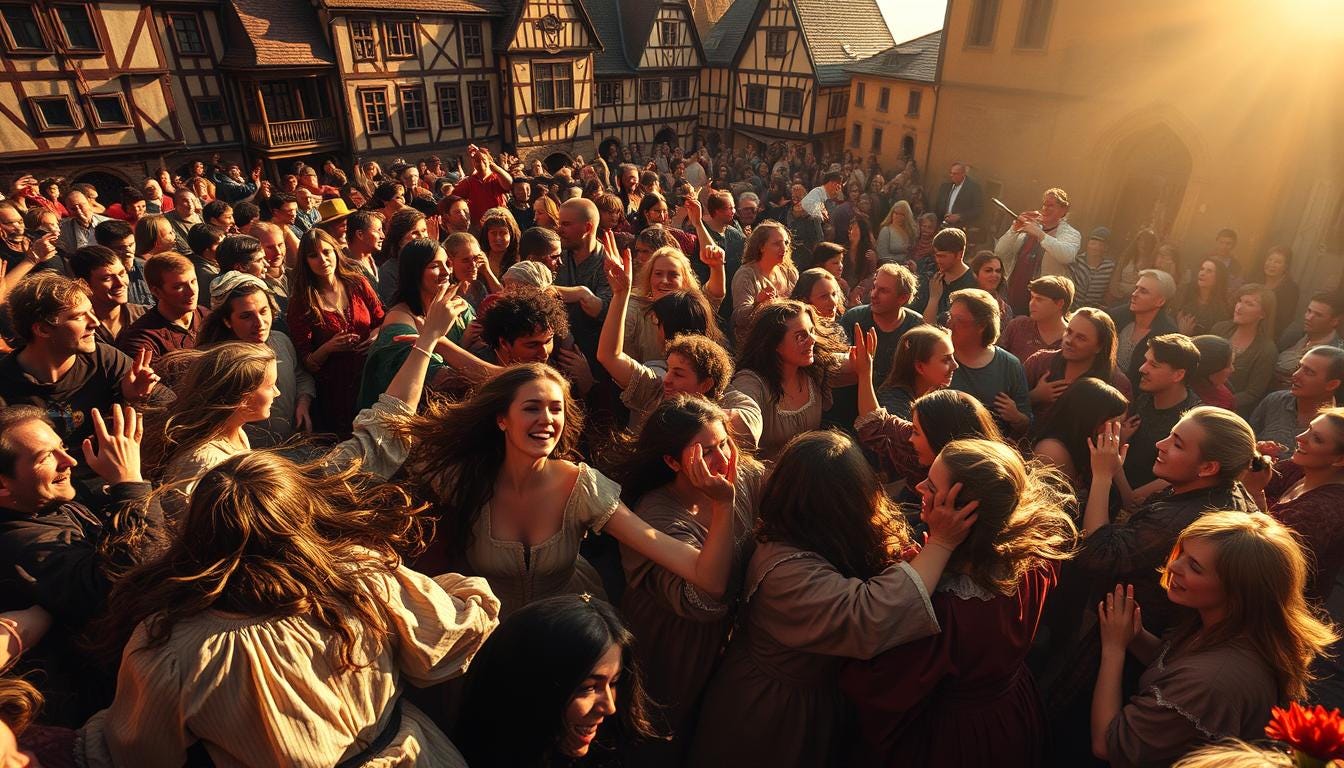
A chaotic 16th-century scene depicting a lively crowd of villagers in Strasbourg, France, caught in the fervor of an uncontrollable dance. Their faces express a mix of joy and despair, as their traditional clothing swirls around them. The town square is filled with medieval architecture, flanked by curious onlookers and musicians playing feverish tunes, while the atmosphere is infused with a sense of urgency and surrealism. Shadows elongate under the golden afternoon sun, creating a hauntingly beautiful tableau of movement and emotion.
Click here for a full Article by HISTORY.COM
Key Takeaways
- The Dancing Plague of 1518 was a mysterious mass dancing incident that occurred in the city of Strasbourg, now part of modern-day France.
- A group of people suddenly began dancing uncontrollably, unable to stop for weeks on end, capturing the attention of the entire town.
- Historians and researchers have struggled to find a definitive explanation for this bizarre phenomenon, leaving the “Dancing Plague” as a puzzling historical event.
- The Dancing Plague of 1518 has become a topic of fascination, with its cultural and historical significance still being explored today.
- The incident serves as a reminder of the mysterious and unexplained events that can occur in human history, challenging our understanding of the world around us.
The Dancing Plague of 1518: When a Town Couldn’t Stop Dancing
The dancing plague of 1518, also known as the Strasbourg dancing outbreak, is a mystery. It happened in Strasbourg, France, and left everyone confused. The town’s leaders were stumped, trying to figure out why people couldn’t stop dancing.
The Strange Phenomenon
In the summer of 1518, a woman named Frau Troffea started dancing in the streets of Strasbourg. Soon, more people joined her. They danced for days, some even collapsing from exhaustion.
Historians and researchers are still trying to understand this unexplained mass dancing incident. The dancing plague of 1518 details show that people were not dancing in a coordinated way. Instead, they were caught in a frenzy, moving their bodies involuntarily.
Theories and Explanations
Many theories have been proposed to explain the Strasbourg dancing outbreak. Some think it was a form of mass hysteria, caused by social, psychological, or religious factors. Others believe it might have been due to ergot poisoning, which can cause hallucinations and uncontrollable movements.
Even though the exact cause of the dancing plague of 1518 is still unknown, it was a very disturbing event for Strasbourg. The town’s leaders tried to stop the dancing but only made things worse.
“The dancing plague of 1518 remains one of the most perplexing and intriguing events in history, a testament to the enduring mysteries of the human experience.”
Click here for a full Article by HISTORY.COM
The Historical Context of 16th Century Europe
To understand the Dancing Plague of 1518, we must look at 16th century Europe. This includes the Renaissance in Strasbourg. This time saw big changes in politics, religion, and art.
The 16th century was full of change. The Protestant Reformation, led by Martin Luther, was changing things. This movement challenged the Catholic Church’s power.
Strasbourg, in Alsace, was a center of Renaissance culture. It was close to the Holy Roman Empire and was a key trade center. This mix of influences might have led to the Dancing Plague of 1518.

By looking at 16th century Europe, especially Strasbourg during the Renaissance, we learn more about the Dancing Plague of 1518.
[embed]
“The 16th century was a time of great upheaval and change in Europe, with the Protestant Reformation and the Renaissance shaping the social and cultural landscape of cities like Strasbourg.”
Click here for a full Article by HISTORY.COM
The Town of Strasbourg and Its Residents
Strasbourg, by the Rhine River, was a lively place in the 16th century. It was the heart of the Holy Roman Empire’s Alsace region. Here, people from all walks of life lived together, making the town rich and diverse.
Life in Strasbourg During the Renaissance
Life in Strasbourg was a mix of old traditions and new ideas. The market buzzed with activity, offering everything from clothes to spices. Artisans worked hard, passing on their skills to the next generation.
Universities and monasteries were hubs for learning and debate. Scholars and theologians came to discuss and grow intellectually.
The Victims of the Dancing Plague
The Dancing Plague of 1518 hit Strasbourg hard. It affected people affected by the dancing plague from all backgrounds. They danced uncontrollably, showing no signs of stopping.
From common workers to high-ranking clergy, no one was spared. The people affected by the dancing plague left a lasting impact on Strasbourg’s life in strasbourg during renaissance.
“The victims of the Dancing Plague were said to have danced with such vigor that many of them collapsed from sheer exhaustion and were forced to be carried away.”
The Onset of the Bizarre Outbreak
The dancing plague in Strasbourg started with a strange event in the summer of 1518. A woman named Frau Troffea began dancing in the street. Her actions drew a crowd, and soon, many others joined her.
The First Reported Cases
Days passed, and more people got caught up in the dancing. The initial reports of the strange dancing incidents showed a growing crowd. The first cases of the dancing outbreak worried the authorities and locals in Strasbourg.
The beginning of the dancing plague left officials puzzled. The dancers didn’t get tired, even after hours of dancing.
“They danced without rest, some of them until they collapsed from sheer exhaustion and had to be carried away.”
The townspeople were shocked by the dancing plague. They struggled to understand this strange event.
Click here for a full Article by HISTORY.COM

The Spread of the Uncontrollable Dancing
In Strasbourg, a strange dancing plague started and quickly grew. It caught everyone’s eye, from locals to officials. The expansion of the dancing outbreak was a sight to behold.
The timeline of the dancing mania shows how fast it spread. At first, a few people danced uncontrollably. But soon, hundreds of townspeople were dancing in the streets.
People of all ages danced for hours in public places. No one knew who started it. It seemed to spread like a virus.
The town’s leaders were overwhelmed. They didn’t know how to stop the expansion of the dancing outbreak. The spread of the dancing plague kept going, leaving everyone in Strasbourg amazed and helpless.
Timeline of the Dancing Plague Number of Affected Individuals July 1518 Dozens, August 1518 Hundreds, September 1518 Over 400
Futile Attempts to Stop the Plague
The Dancing Plague of 1518 hit Strasbourg hard. The town’s leaders worked hard to stop it, but they couldn’t. They tried everything to end the strange dancing.
Measures Taken by Authorities
The officials in Strasbourg tried many things to stop the dancing. They used medicine like purging and bloodletting. They also tried prayers and religious events to ask for help.
They even tried to stop the dancers by building stages. But the dancers kept going. They even moved dancers to other towns, but the plague followed.
Measure Taken Outcome Medical treatments (purging, bloodletting) Ineffective in stopping the dancing Religious interventions (processions, masses) Failed to curb the outbreak Physical restraints (stages, platforms) Dancing continued uninterrupted Transporting dancers to other towns Spread the plague to neighboring areas
Despite their hard work, the leaders couldn’t stop the dancing. The dancing kept going, leaving Strasbourg’s people confused and helpless.

Click here for a full Article by HISTORY.COM
Theories and Explanations for the Dancing Mania
The Dancing Plague of 1518 has long been a mystery to historians and scientists. Many have tried to find out why this strange event happened. They’ve looked at everything from psychological and social reasons to possible medical and environmental causes.
One idea is that the dancing was a form of mass psychogenic illness. This means that the power of suggestion and group hysteria caused people to dance uncontrollably. It’s thought that the stress and anxiety of life in 16th-century Europe, along with social tensions, made this kind of collective behavior possible.
Another theory suggests ergot poisoning might have played a role. Ergot is a fungus that grows on rye grain and can make people hallucinate. It’s believed that eating contaminated rye could have led to the dancing, as people experienced vivid delusions and lost control of their movements.
- Possible causes of the dancing plague, including psychological and social factors
- Explanations for the dancing mania, such as mass psychogenic illness and ergot poisoning
- Historical theories about the dancing outbreak, exploring various hypotheses
Even though we still don’t know for sure what caused the Dancing Plague of 1518, the search for answers is still exciting. These theories help us understand the complex and intriguing nature of this event.
“The dancing plague remains one of the most perplexing and unexplained phenomena in human history.”
Click here for a full Article by HISTORY.COM
The Lasting Impact and Legacy
The Dancing Plague of 1518 in Strasbourg has fascinated people for centuries. This strange event has left a lasting mark on culture and history. It shows how strong and adaptable the human spirit can be.
Cultural and Historical Significance
The Strasbourg Dancing Plague has inspired many artistic and literary works. These works explore the mix of physical, psychological, and social forces involved. Paintings, sculptures, and writings capture the essence of the dancers and the outbreak’s psychological depths.
This event also holds deep historical value. It reminds us of the fragility of life and the unpredictability of human nature. Scholars have studied it to understand the medical, social, and environmental factors behind this unusual event.
FAQ
What was the Dancing Plague of 1518?
The Dancing Plague of 1518 was a strange event in Strasbourg, now in France. For weeks, people danced uncontrollably. This amazed the town and the world.
What caused the Dancing Plague?
Many theories try to explain the Dancing Plague. These include psychological, social, medical, and environmental factors. But, the real cause is still a mystery.
How did the authorities try to stop the Dancing Plague?
The authorities in Strasbourg tried many things to stop the dancing. They used medical treatments and religious interventions. But, nothing worked to stop the dancing.
What was the cultural and historical significance of the Dancing Plague?
The Dancing Plague of 1518 has always fascinated people. It’s seen as a key event in history and culture. It has led to many studies and changed how we think about human behavior.
Where can I find more information about the Dancing Plague of 1518?
There are many resources for learning about the Dancing Plague of 1518. You can find historical accounts, studies, and articles. Looking into these can help you understand this strange event better.
메타데이터
- post_id
- 624a2bfd0eb9
- slug
- the-dancing-plague-of-1518-a-towns-unstoppable-dance-624a2bfd0eb9
- url
- https://medium.com/@zakaria2012tachalte/the-dancing-plague-of-1518-a-towns-unstoppable-dance-624a2bfd0eb9
- canonical_url
- https://medium.com/@zakaria2012tachalte/the-dancing-plague-of-1518-a-towns-unstoppable-dance-624a2bfd0eb9
- author_url
- https://medium.com/@zakaria2012tachalte
- status
- ok
- fetched_at
- 2026-06-14 11:28:49