Who Powers Brazil in 2026?
And why is the G20’s cleanest electricity system the one where solar growth is slowing — held back by transmission lines that can’t keep…
Who Powers Brazil in 2026?
And why is the G20’s cleanest electricity system the one where solar growth is slowing — held back by transmission lines that can’t keep pace with the sun?

Who Powers Brazil in 2026?
And why is the G20’s cleanest electricity system also the one where solar growth is slowing — held back by transmission lines that cannot keep pace with the sun?
Brazil already achieved what most countries are still building toward. With 84.63% of installed electricity capacity from renewable sources in 2026, Brazil has already surpassed its own 2030 clean energy target — five years early. Wind and solar together generated more than a third of the country’s electricity in August 2025, a new monthly record, doing it during a drought that would have triggered a fossil fuel crisis just four years earlier. The G20’s lowest per-capita power sector emissions. The third-largest renewable energy generation capacity on Earth. And yet solar additions are slowing — a 24% decline in 2025, with another 7% drop projected for 2026. Not because Brazil doesn’t have sunlight. Because the transmission lines that carry that sunlight to consumers don’t exist yet.
Brazil’s energy story in 2026 is the story of a country that built the cleanest major grid on Earth and is now discovering that the next challenge is not generation — it is infrastructure. The procurement opportunity is not in adding more renewable capacity. It is in connecting the capacity that already exists and is being curtailed, and in building the storage and transmission that will determine whether Brazil’s clean energy lead grows or stalls. For developers, investors, data center operators, and industrial buyers entering Brazil, understanding this distinction is the difference between a project that delivers returns and one that generates power nobody can use.
87% — Of Brazil’s electricity from renewable sources — G20’s cleanest grid by far. Global average: 30%.
34% — Wind + solar share in August 2025 — first month ever above one-third. A new structural baseline.
$629B — Renewable + storage projects tracked in Brazil pipeline — 1,900+ active projects, per Industrial Info.
Brazil Electricity Generation Mix — 2024/2025 Actuals (Ember / ANEEL / IEA)
Hydro 56%
Wind 15%
Solar 10%
Thermal 10%
Bio 7%
·
Hydropower56%Dominant but drought-vulnerable. Installed share declining as wind/solar grow faster.
Wind15%Up from 8.8% in 2019. Northeast Brazil dominant. Growing steadily.
Solar PV10%Up from 1.1% in 2019. Growth slowing due to transmission congestion and regulatory issues.
Thermal10%Gas, coal, oil. Drought backup historically. Down from 26% in 2021 as wind/solar scale.
Biomass7%Sugarcane bagasse dominant. Dispatchable clean energy. Unique Brazilian advantage.
Nuclear2%Angra 1 & 2. Third reactor (Angra 3) expected operational 2026–2027.
Source by source — what makes Brazil’s mix unique
Hydropower — The Foundation
56%
The backbone that makes Brazil’s grid clean — and the single point of failure that wind and solar are finally fixing
Hydropower has powered Brazil’s economy for a century. With 172 GW of theoretical hydroelectric potential and 102+ operating plants, Brazil holds one of the world’s largest hydro fleets. At 56% of electricity generation, hydro is still the foundation of the Brazilian grid — and the reason Brazil achieved 87% renewables before most countries reached 30%.
But hydro is also Brazil’s structural vulnerability. Droughts in 2001, 2013, 2014, and 2021 revealed how dependent the system was on rainfall. In August 2021, fossil fuel generation spiked to 26% as hydro collapsed. In August 2025, when hydro hit another four-year low, fossil fuels covered only 14% — because wind and solar had grown enough to fill the gap. This is the most important structural shift in Brazil’s energy history: the system is no longer held hostage by drought. The wind and solar portfolio has crossed the threshold of drought resilience. The hydro backbone is still essential, but it no longer determines whether Brazil has a fossil fuel crisis during dry seasons.
Future hydro expansion is constrained by environmental concerns — approximately 70% of Brazil’s untapped potential lies in the Amazon and other protected areas. The growth vector is now wind, solar, and storage, not hydro. The installed base remains, but the capacity factor is weather-dependent and the growth ceiling has been reached.
Wind
15%
From 8.8% to 15% in five years — the Northeast trade winds that transformed Brazil’s grid
Brazil’s Northeast region — particularly the states of Bahia, Ceará, Rio Grande do Norte, and Piauí — has some of the most consistent onshore wind resources in the world. Northeast trade winds blow with exceptional reliability, making capacity factors of 45–55% common, compared to the global onshore average of 25–30%. This geographic advantage has made Brazil one of the most cost-competitive wind markets on Earth, with some projects achieving levelized costs below R$100/MWh — competitive with any generation source in the country.
Wind grew from 8.8% of Brazil’s electricity in 2019 to 15% in 2024, adding approximately 43 wind farms and 1,825 MW of new capacity in 2025 alone. In August 2025, wind was the primary driver behind wind and solar together reaching a record 34% of monthly generation — covering the drought-driven hydro shortfall without a fossil fuel spike. The next frontier is offshore wind: Brazil has 4,600 miles of windy coastline, and the government is developing the regulatory framework for offshore auctions. The installed offshore capacity is currently zero, but the pipeline is substantial.
GridEnergyX
Brazil’s Northeast wind corridor is the highest-capacity-factor onshore wind resource accessible through a functioning auction market in the Americas. For developers, the challenge is not the wind — it is navigating ANEEL auction timelines, inter-state transmission connection, and PPA counterparty selection across state utilities with highly variable payment histories. GridEnergyX’s Brazil wind procurement framework pre-qualifies counterparties, maps transmission evacuation capacity by corridor, and structures contracts compatible with international project finance requirements.
Solar PV — The Growth Story Hitting Friction
10%
From 1.1% in 2019 to 10% in 2025 — but the acceleration is stalling for the first time
Solar’s growth in Brazil over the past decade is extraordinary. From essentially zero in 2014 to 10% of national generation in 2025, solar PV has become the defining investment story of Brazil’s energy sector. The country added 15 GW in 2024 — a historic record. By early 2026, total installed solar capacity reached approximately 75.9 GW, split between 51.8 GW in distributed generation (rooftops, small properties) and 24.1 GW in large centralized plants.
But the acceleration has stopped. Solar additions slowed to 11.4 GW in 2025 — a 24% decline from 2024 — and are projected to slow further to 10.6 GW in 2026, a 7% additional decline. Investment in solar is projected to fall from R$40 billion in 2025 to R$31.8 billion in 2026. Job creation is declining. Tax revenues from the solar supply chain are falling. This is not a demand problem or a technology problem. It is three structural issues arriving simultaneously: transmission congestion, regulatory uncertainty over the net metering framework, and interest rates approaching 15% that make project finance more expensive than at any point in the decade.
GridEnergyX
Brazil’s solar slowdown is a procurement infrastructure problem, not a solar problem. Plants are ready, sun is available, but transmission bottlenecks force curtailment — energy generated but never delivered. GridEnergyX’s Brazil solar procurement framework screens every project against ONS transmission congestion maps before RFQ issuance, ensuring new capacity is sited where evacuation capacity exists today, not where it might exist after the 2026 transmission auctions complete. Projects that connect to uncongested corridors generate and deliver. Projects that don’t generate curtailment without compensation.
Biomass — Brazil’s Unique Asset
7%
Sugarcane bagasse — the world’s most abundant dispatchable bioenergy source
Brazil’s biomass generation — primarily from sugarcane bagasse, the fibrous material left after juice extraction — is 7% of national electricity and represents one of the most underappreciated features of the Brazilian grid. Unlike solar and wind, biomass is dispatchable: it can be scheduled to generate when the grid needs it, not when the resource is available. Biomass plants co-located with sugar mills in São Paulo state provide flexible, carbon-neutral generation that complements the intermittency of wind and solar.
This dispatchability is a structural advantage that most renewable-heavy grids lack. While Germany, California, and Texas are spending billions on battery storage to manage solar intermittency, Brazil already has a dispatchable clean energy source that accounts for 7% of generation and can flex with demand. As battery storage scales in Brazil, biomass and batteries together will provide the flexibility layer that allows hydropower to serve as the long-duration seasonal backstop while wind and solar handle the variable generation.
Thermal (Gas/Coal/Oil)
10%
The drought backup that wind and solar are making obsolete — slowly
Thermal generation — natural gas, coal, and oil — accounts for 10% of Brazil’s electricity in 2025, down dramatically from the drought-driven spike of 26% in August 2021. The trajectory is structural: every gigawatt of wind and solar added reduces the call on expensive thermal backup during droughts. In 2025, thermal plants operated primarily as seasonal backup, not baseload — a role they will continue to play until battery storage and demand flexibility can fully replace their grid stabilization function.
The regulatory framework is being redesigned to formalize this backup role. The April 2026 Capacity Reserve Auction (LRCAP) — Brazil’s first-ever dedicated battery storage auction — is designed to contract BESS specifically to absorb excess solar and wind generation during peak production hours and dispatch it during demand peaks. If successful, this auction creates the market mechanism that allows thermal generation to retire from its backup role permanently, rather than being retained as insurance against renewable intermittency.
The transmission bottleneck — Brazil’s most urgent procurement problem
The single most consequential infrastructure gap in Brazil’s energy sector in 2026 is not generation capacity. It is transmission. Power plants are ready. The sun shines and the wind blows. But the lines that carry that electricity to consumers are saturated — forcing the National System Operator (ONS) to curtail renewable generation that could displace thermal and fossil fuel imports.
The federal government has responded with two major transmission auctions planned for 2026: the first in March, covering 888 km of new lines across 12 states at approximately R$5.7 billion investment; the second in the second half of the year, covering more than 3,500 km of new lines at over R$20 billion. These auctions, if executed on schedule, will be the most significant transmission infrastructure investment in Brazil in a decade — and will directly determine how much of the renewable capacity already built can actually deliver energy to consumers.
The paradox Brazil must solve
Brazil has achieved 87% renewables in its electricity matrix and is the only G20 country currently on track to meet the COP28 renewable energy tripling goal. And yet solar additions are declining for the second consecutive year, investment is falling, and new jobs in the sector are shrinking. The cause is entirely structural: transmission congestion is forcing curtailment of renewable generation that has already been built and paid for. The solution is transmission — not policy, not economics, not technology. And the companies that understand this distinction will invest in the right assets at the right moment.
The trajectory — Brazil by 2030
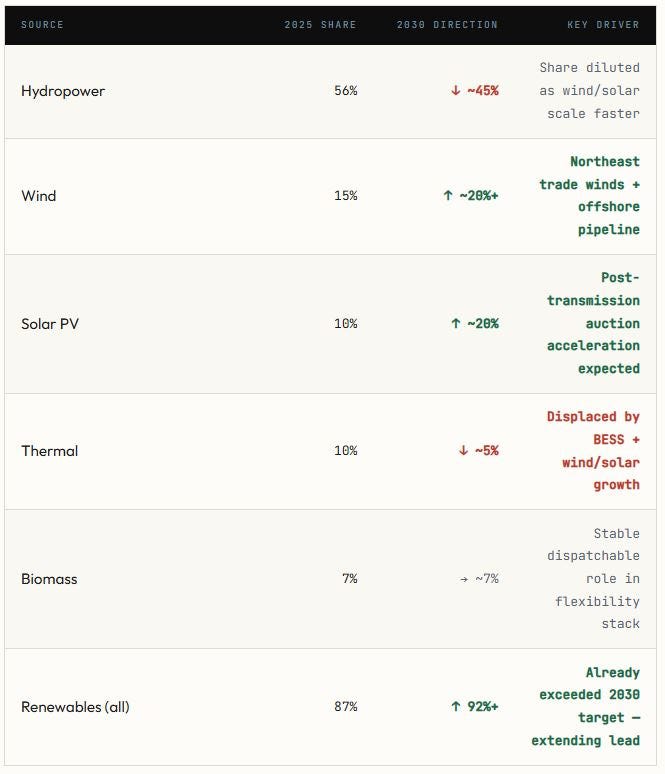
87%
Brazil’s renewable electricity share — already surpassing its own 2030 target
The G20’s cleanest electricity system. Power sector emissions 31% below 2014 peak despite 22% demand growth. The only G20 country currently on track to meet the COP28 renewable tripling goal. The challenge now is not adding more renewables — it is building the transmission and storage infrastructure that allows the renewables already built to actually deliver their electrons.
Before and after GridEnergyX
Without structured procurement
Data center developer, 100 MW load, São Paulo — targeting 100% renewable
- Solar project identified in Bahia — ONS congestion zone, curtailment risk unknown
- PPA signed — plant generates but 35% curtailed in first year, no compensation
- Backup thermal contract: R$480/MWh during curtailment periods
- ANEEL audit: net metering framework changes retroactively affect economics
- Distributed solar: regulatory uncertainty delays rooftop program 14 months
- Carbon certificates: no Brazilian standard compatible with international RE100
- Effective renewable coverage: 65% (curtailment + backup gas gaps)
- Energy cost: R$340/MWh blended — above modeled assumption
Annual procurement failure cost: R$48M vs structured alternative
With GridEnergyX
Same developer — procurement structured through marketplace
- ONS congestion map screened at project initiation — non-congested corridor selected
- PPA counterparty validated: ANEEL-licensed developer, transmission connection confirmed
- Curtailment risk: contractually allocated with compensation mechanism
- Regulatory monitoring: ANEEL net metering changes tracked, contract protected
- Wind supplement sourced from Northeast corridor: fills curtailment and night gaps
- Carbon certificates: I-REC standard registered, RE100 compatible from Day 1
- Effective renewable coverage: 98%+ continuously verified
- Energy cost: R$242/MWh locked PPA — 29% below alternative
Annual cost advantage: R$48M | Platform fee: R$3.8M | ROI: 13×
“Brazil built the world’s cleanest major grid. Now it must build the infrastructure that lets that grid work at scale — and the procurement decisions being made in 2026 will determine whether the lead grows or stalls.”
13×
Platform ROI — 100 MW data center, Brazil, annual energy cost horizon
R$48M annual cost advantage through transmission-aware procurement vs R$3.8M in GridEnergyX fees. Brazil’s renewable credentials are real and globally recognized — data centers, corporate buyers, and industrial operators are all moving here for clean energy. The procurement infrastructure that navigates transmission congestion, regulatory complexity, and carbon certification is what separates the companies that capture Brazil’s clean energy advantage from those that pay a premium for it anyway.
The bottom line
Brazil’s energy story in 2026 is not about whether the country has enough renewable energy. It already does. It is about whether the infrastructure, regulation, and procurement practices can keep pace with the generation capacity that has been built — and whether the companies entering Brazil can navigate a market where the sun shines, the wind blows, and the transmission line between them and the consumer is the binding constraint.
For data center developers and hyperscalers, Brazil is the most attractive clean energy market in Latin America — 87% renewable electricity, the G20’s lowest power sector emissions per capita, and a growing digital economy that needs stable, verifiable clean power. The procurement challenge is identifying the generation assets that deliver electrons reliably against the transmission congestion that curtails others. For infrastructure investors and private equity funds, the 2026 transmission auctions represent the most significant unlocking event in the Brazilian energy market since the wind energy boom — $25 billion in new transmission investment that will determine which renewable assets appreciate in value and which remain stranded. For industrial energy buyers, Brazil’s energy cost advantage relative to fossil-dependent economies is structural and growing — but capturing it requires procurement expertise in navigating ANEEL regulations, ONS curtailment rules, and Brazilian PPA law that most international buyers don’t have in-house.
GridEnergyX makes energy procurement fast, standardized, and reliable. In Brazil, where the renewable credentials are genuine, the transmission bottleneck is real, and the regulatory complexity is substantial, that means ensuring the clean energy you procure actually reaches your meter — and generates the carbon credentials your customers, investors, and auditors are expecting.
Until next time,
메타데이터
- post_id
- 624ca242e3c4
- slug
- who-powers-brazil-in-2026-624ca242e3c4
- url
- https://medium.com/@b2b.supplychain.media/who-powers-brazil-in-2026-624ca242e3c4
- canonical_url
- https://medium.com/@b2b.supplychain.media/who-powers-brazil-in-2026-624ca242e3c4
- author_url
- https://medium.com/@b2b.supplychain.media
- status
- ok
- fetched_at
- 2026-06-09 15:37:30