From Kronstadt to Constanta: How Russia’s War Swallowed Europe’s Borders
Half a million Russian soldiers dead, drones detonating in NATO ports, and a Kremlin forum selling the illusion of normalcy
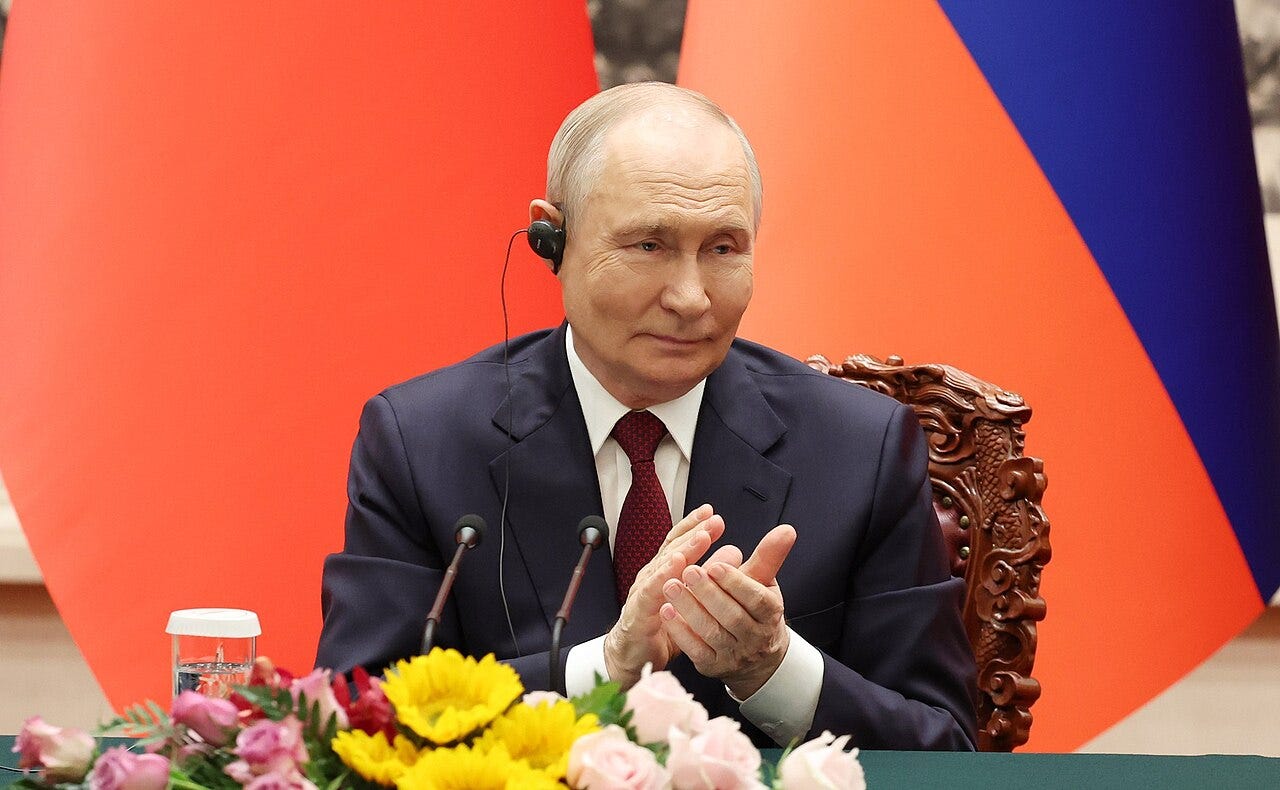
Vladimir Putin at press conference in Beijing (May 2026)
From Kronstadt to Constanta: How Russia’s War Swallowed Europe’s Borders
Half a million Russian soldiers dead, drones detonating in NATO ports, and a Kremlin forum selling the illusion of normalcy
The war in Ukraine entered its fifth year against a backdrop of intensifying military operations, fractured diplomacy, and a widening geopolitical chasm between Russia and the West.
What unfolded across the first days of June 2026 offered a snapshot of a conflict that has reshaped the European security order, strained alliances, and drawn in actors from across the globe — some seeking peace, others exploiting the chaos.
At the center of this period stood the St. Petersburg International Economic Forum, an annual gathering that once styled itself as Russia’s answer to Davos, a venue for international investment and diplomatic exchange.
In the years before February 2022, Western executives and heads of state would mingle with Kremlin officials over deal signings and champagne.
Now, four years into the full-scale invasion of Ukraine, the forum had become something else entirely: a stage for Vladimir Putin’s vision of a post-Western world order, populated by a cast of delegations from China, India, the Gulf states, and Iran, alongside a peculiar assortment of Western fringe figures whose presence served as living propaganda for Moscow’s narrative.
Saudi Arabia arrived as the forum’s guest of honor, with a sprawling delegation of ministers and top executives.
The stated theme — “Pragmatic Dialogue: The Path to a Stable Future” — belied what the gathering had really become. Russia’s “pivot to the East” had been a years-long strategic repositioning, accelerated by Western sanctions.
At the forum’s plenary session, Putin made his geopolitical ambitions explicit, boasting that the BRICS grouping — comprising Brazil, Russia, India, China, South Africa, and several newer members — had already surpassed the G7 in economic size as measured by purchasing power parity.
He claimed that over the previous five years, nearly half of all annual global GDP growth had come from BRICS nations, compared to just eighteen percent from the G7. He projected BRICS growth at over four percent annually, against a G7 rate of barely above one percent.
“The centre of global trade, as well as the financial system, is going to shift. It is already shifting,” Putin declared, in remarks that seemed aimed as much at Donald Trump — who had threatened the bloc with steep tariffs — as at the assembled delegates.
The forum’s moderation by India Today underscored a central diplomatic reality of this phase of the war: India, holding the BRICS presidency in 2026, had maintained its posture of strategic ambiguity, continuing to purchase discounted Russian oil while deepening ties with Western partners.
Putin praised India as a “key partner” and a global leader in information technology, a rhetorical gesture toward one of the few major democracies that had declined to join Western sanctions against Moscow. The broader message was clear: Russia was not isolated. It had alternatives. And it intended to demonstrate as much on the world stage, even as its military forces ground forward at catastrophic human cost.
Putin also made a striking admission at the forum that drew significant attention.
In a meeting with representatives of leading global news agencies — including EFE — held at the Constantine Palace on the outskirts of St. Petersburg, he confirmed that Russian and American officials had held discussions about a possible military operation in Cuba, framed along the lines of the intervention carried out in Venezuela in December of the previous year.
“Were there contacts with the American administration on Cuba? Yes, there were,” Putin said.
The admission came as Russian Foreign Minister Sergei Lavrov extended formal congratulations to former Cuban president Raúl Castro on his ninety-fifth birthday, pledging Moscow’s solidarity with Havana amid what he described as unprecedented external pressure from Washington.
Russia had already sent a tanker carrying one hundred thousand tons of crude oil to Cuba in March, signaling its continued commitment to propping up the island’s economy. The acknowledgment of US-Russia talks on Cuba — however oblique — illustrated the extent to which the two powers continued to engage bilaterally on issues beyond Ukraine, even as their relationship had descended to historic lows.
The most consequential moment of the forum came when Putin formally rejected Zelenskyy’s proposal for direct, face-to-face negotiations.
The Ukrainian president had published an open letter to Putin — sent to the Russian leader and shared with governments around the world — calling for a meeting in a neutral country, such as Switzerland, Turkey, or an Arab state, to negotiate an end to the war.
The letter was striking in its directness and its tone, addressing Putin as a man whose time was running out, whose resources were shrinking, and whose inner circle had grown weary of a conflict it had not chosen. Zelenskyy cited battlefield losses — over thirty thousand Russian soldiers killed or seriously wounded in May alone, he said, with sixty-three percent of those being fatalities rather than wounded — and argued that the rate of attrition was unsustainable.
He proposed a full ceasefire for the duration of negotiations, a comprehensive prisoner exchange, and the return of civilians and children taken during the war. “You can stop your war,” the letter concluded. “Eternal memory to all those whose lives were taken by this war.”
Putin’s response from the forum podium was blunt and dismissive. He said he saw no reason for a meeting.
He called the letter’s tone “rude” and suggested its purpose was not to create the conditions for dialogue but to prevent them. He argued that a temporary ceasefire would only allow Ukraine to regroup and that any agreement must be durable and final, not a pause in fighting. He also took the opportunity to rebuke Zelenskyy’s territorial claims, asserting that Russia had fully consolidated control of the Luhansk region and that Ukrainian-controlled territory in Donetsk had shrunk to less than fifteen percent. He addressed his soldiers directly: “You are the ones to address, not the author of that letter. The whole country is watching you, is proud of you, trusts you. Keep working, brothers.” The applause in the hall was vigorous.
Zelenskyy’s response was swift.
“Unfortunately, the Russian side once again chooses war,” he wrote. “Everyone hears the answer. I think this answer will have disappointed many people around the world.”
German Chancellor Friedrich Merz, attending an EU-Western Balkans summit in Montenegro, welcomed Zelenskyy’s offer and emphasized that European nations expected to be part of any eventual peace process.
“I welcome very much that President Zelenskyy has again made an offer to talk. Again — this is not the first time he has offered to hold direct talks with the Russian president,” Merz said.
French President Emmanuel Macron, meanwhile, declared Russia’s longstanding demand that Ukraine withdraw from the Donbas region to be obsolete. German Foreign Minister Johann Wadephul, speaking from Mexico City, said Germany’s support for Ukraine was “unshakeable” and that the sooner Putin came to the negotiating table, the sooner the dying would stop — on all sides.
Adding a layer of complexity to the diplomatic landscape was the meeting between Putin and former German Chancellor Gerhard Schröder in Moscow. Kremlin adviser Yuri Ushakov confirmed the encounter, describing it as “good and friendly,” though he declined to reveal any details of what was discussed, citing the private nature of the conversation. The meeting was significant because Putin had publicly named Schröder the previous month as his preferred European intermediary for potential dialogue with the EU.
Schröder’s history as chancellor included forging close energy ties with Moscow, overseeing the early stages of the Nord Stream pipeline, and later serving as chairman of the supervisory board of the Nord Stream AG and as a director at Rosneft. That background made him deeply controversial in Brussels and Berlin.
EU foreign policy chief Kaja Kallas said it was “clear” why Putin wanted Schröder as a mediator. Merz was more categorical: “We Europeans decide ourselves who speaks for us. Nobody else.” The Schröder meeting went ahead nonetheless, a reminder that back channels — however politically fraught — remain active even in a conflict of this magnitude.
On Sunday evening, Merz joined Macron and British Prime Minister Keir Starmer in London for talks with Zelenskyy.
The gathering of the so-called E3 group was focused on coordinating support for Ukraine and reviewing the work of the “Coalition of the Willing,” a grouping of approximately thirty-five predominantly European nations committed to sustaining military and financial assistance to Kyiv. The coalition had taken on added importance as US engagement fluctuated, with Trump’s administration increasingly focused on negotiations with Iran and showing limited appetite for an active diplomatic role in the Ukraine conflict. The Nato summit in Turkey in early July loomed as a further pressure point.
Even as diplomats talked, the war raged with undiminished ferocity. On the last day of the St. Petersburg forum, Ukrainian forces launched what Russian officials described as an unprecedented mass drone attack on the city. Over 140 drones were intercepted over the Leningrad region alone, with the governor urging residents to remain indoors — the first such warning since the war began. The Ukrainian navy confirmed strikes on a fuel depot and an oil terminal in the Leningrad region, and the Security Service of Ukraine reported a fire and secondary detonations at the Russian Navy’s 15th Arsenal near Kronstadt, the main base of Russia’s Baltic Fleet. Zelenskyy confirmed that his forces had struck naval arsenals and the Kronstadt base itself, with drones traveling over a thousand kilometers from Ukrainian territory. A separate strike hit an oil depot in the Krasnodar region. The commander of a Ukrainian drone unit gave the BBC a chilling account of the operation: “We fly in Russia as if it were our own territory. Almost no resistance. It’s not difficult to hit a target.”
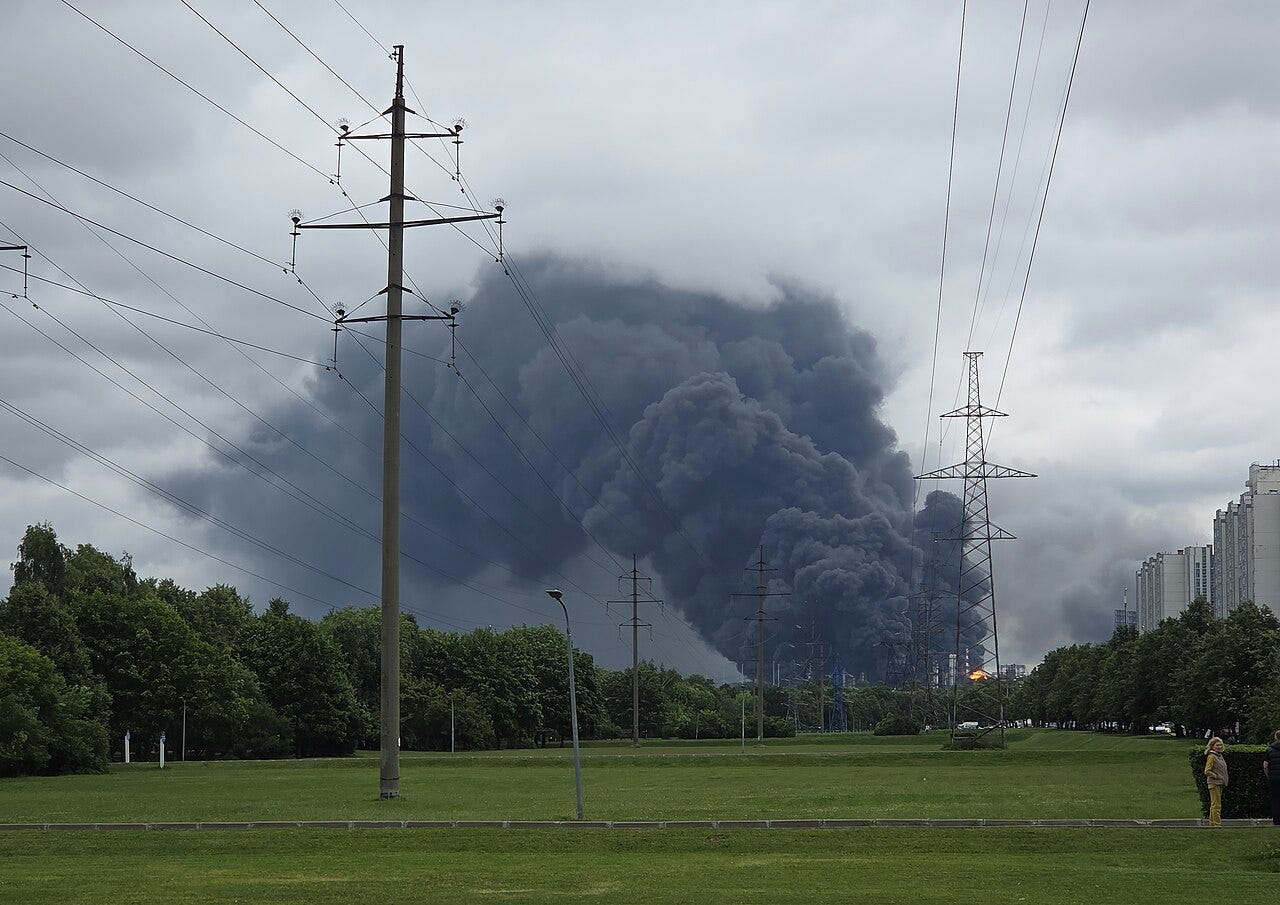
It was not the first time Ukrainian drones had struck St. Petersburg during the forum. A Ukrainian drone attack on a refinery at the start of the event had sent black smoke billowing over the city’s UNESCO-protected historic center. The attacks carried unmistakable symbolic weight: Ukraine was demonstrating that it could project force deep into Russian territory, striking the very city where Putin was hosting his showcase of Russian normality and global influence.
Elsewhere on the front, five civilians were killed in Russian strikes on the Kherson region. Russian artillery and drone attacks hit residential areas and a petrol station north of the city, and a man was killed in a village by a drone strike. In the Belgorod region on the Russian side of the border, a Ukrainian drone struck a vehicle near the frontier, killing the driver. In the Zaporizhzhia nuclear power plant zone, the International Atomic Energy Agency reported a serious incident during mine clearance operations carried out as part of a locally negotiated ceasefire. Russian soldiers were wounded, and Russia accused Ukraine of violating the truce. Ukraine denied the claim. IAEA chief Rafael Grossi called for maximum military restraint and full compliance with the ceasefire agreement around the plant.
The war’s geographic spread had also extended into European NATO territory in new and disturbing ways. In Romania’s Black Sea port of Constanta — the country’s largest port and a crucial alternative export route for Ukrainian grain and fuel — a Ukrainian sea drone detonated near an oil terminal after drifting off course. Ukraine’s navy said the drone had lost control as a result of Russian electronic warfare jamming. Ukraine warned Romanian authorities in advance, allowing for the evacuation of the port and surrounding beaches. No casualties were reported. Romanian President Nicusor Dan blamed Russia directly: “The entry of this drone into Romanian sovereign space is a direct consequence of the war waged by Russia against Ukraine.” The incident came just one week after a Russian drone struck an apartment building in the Romanian city of Galati, injuring two people — the first time in the war that a drone had struck a densely populated area inside a NATO member state. Romania has faced repeated breaches of its airspace, stray mines drifting onto its shores, and now the threat of misdirected Ukrainian naval drones, all products of a conflict whose physical boundaries increasingly refuse to respect national borders.
The spillover into NATO territory took on another dimension with new research published in early June. Scientists at the University of Texas and Spanish technology firm GMV, drawing on data shared with the New York Times, concluded that Russian satellites had caused seconds-long GPS outages across Europe on multiple occasions. In at least three of seventy-five incidents studied since 2019, the interference was traced to the EKS satellite constellation, Russia’s early-warning network for detecting missile launches. The disruptions had been recorded from Iceland to Italy, affecting devices connected to GPS networks operated by the United States, China, and the European Union — though not Russia’s own system. Whether the interference was intentional or a byproduct of the satellites’ primary functions remained unclear, but the implications were sobering. “Someone could, if they wanted to, selectively jam an entire continent every day,” said Ramsey Faragher of the Royal Institute of Navigation. Senior US Air Force officials were briefed on the incidents. The EU confirmed it had conducted a classified investigation. The Russian embassy offered no comment.
Ukraine’s apology to Greece for a separate drone incident added yet another layer to the picture of a war whose ripple effects were now lapping at the shores of multiple European nations. In May, Greek fishermen near the Ionian island of Lefkada had discovered an unmanned sea vessel approximately six meters long, running its engine, carrying around a hundred kilograms of explosives. Identified by authorities as Ukrainian, the drone was neutralized in a controlled explosion by the coastguard. Greece filed a formal protest, citing risks to maritime safety and to civilians. Ukraine’s foreign ministry spokesperson Heorhiy Tychyi expressed regret, noting that the incident was caused by “circumstances resulting from Russia’s ongoing aggression against Ukraine,” and took the opportunity to argue that Russia’s war was a threat not only to Ukraine but to neighboring European states as well.
Ukraine’s domestic situation reflected the paradox of a nation at war finding unexpected sources of resilience and even economic vitality. Finance Minister Serhiy Marchenko, speaking at the European Bank for Reconstruction and Development’s annual meeting in Riga, described Ukraine’s defense industry as a booming sector that had become a permanent feature of the country’s economic future. The pressure of war had generated intense innovation and demand, he said, creating an industrial base with genuine export potential. He noted that technologies developed for military purposes could, after the war, be adapted for civilian use. The country that had been written off by many as a potential Russian conquest in seventy-two hours in 2022 was now developing one of the most combat-tested defense industries in the world. Sweden’s defense minister had recently noted that testing arms systems in Ukraine yielded innovations in weeks or months that would take years or decades to achieve through conventional peacetime testing.
Ukraine’s continued ability to hold the line — and increasingly to take the fight deep into Russian territory — owed much to European support, which had grown substantially to compensate for the reduction in American military aid under the Trump administration. The European Union had just agreed to open accession talks with Ukraine, beginning with the first negotiating cluster on democracy and the rule of law. Some in Kyiv hoped full membership could come as early as 2027, though EU insiders considered that timeline optimistic. The Economist’s editors had recently argued that Ukraine was no longer a charity case for Europe but rather a critical security partner, whose battle-hardened army and innovative defense sector represented assets that European defense desperately needed. Germany’s Merz had floated the concept of “associate membership” as an intermediate step, though Zelenskyy had been quick to dismiss the idea.
At NATO’s northeastern flank, the alliance moved ahead with new deployments in Sweden and Finland. On June sixth, newly established Forward Land Forces began operations: a battle group was stood up on Swedish soil, and a multinational headquarters was established in Rovaniemi, in Finland’s Lapland, just over fifty kilometers from the Russian border. General Alexus Grynkewich, Supreme Allied Commander Europe, described the region as “one of the most strategically significant, with an environment that ranks among the most challenging in the world.” Finland, which shares a border of over thirteen hundred kilometers with Russia and joined NATO in April 2023, had for decades maintained a studied neutrality. Sweden, which formally ended its traditional neutrality by joining NATO in 2024, was now hosting allied combat forces for the first time in its modern history. Both transformations had been driven directly by Russia’s invasion of Ukraine.
British Prime Minister Keir Starmer sharpened the sense of urgency. In a visit to a drone manufacturer in southwest England, he told reporters that British intelligence assessments — shared by other NATO allies — suggested Russia could be in a position to attack a NATO state as early as 2030. NATO Secretary General Mark Rutte had issued a similar warning the previous December, speaking of a five-year window. Germany’s own military planners placed the date of a potential large-scale Russian offensive capability against NATO territory at 2029. These assessments were not merely rhetorical. They were driving defense budget decisions, force posture adjustments, and treaty commitments across the alliance.
Within Russia itself, the picture that emerged — from intelligence assessments, from the observations of Russian opposition figures in exile, and from the forum’s own subtext — was one of a state under significant strain. British intelligence assessed that Russian battlefield losses had now reached close to half a million soldiers killed since the war’s start, a figure that dwarfed earlier estimates and confirmed the catastrophic human cost Moscow was bearing. In a given month, Russian forces were losing upward of thirty thousand men to death or serious injury, with an unusual kill-to-wound ratio heavily skewed toward fatalities — a sign of inadequate medical evacuation, poor battlefield tactics, or both.
The exiled oligarch and Putin critic Mikhail Khodorkovsky, whose research organization had published a report on “Cracks in the Kremlin Walls,” argued in an interview with Le Figaro that no one in Putin’s inner circle genuinely supported the war — only Putin himself remained its engine.
He described a paranoid, aging autocrat who had used war repeatedly to stabilize his political position, and predicted that the conflict would enter its final phase in 2026 or 2027, most likely ending with a ceasefire along the current line of contact. But he warned that any expectation of normal behavior from Russia while Putin remained alive was “a dramatically dangerous mistake.”
History showed, he said, that Putin had started four wars to manage domestic political pressure. When this one ended, he would face another crisis of legitimacy — and would need a new external enemy. Only if Europe armed itself sufficiently and pushed Russia toward genuine federalization of its regions — redistributing power away from the center — could the cycle be broken.
The forum itself had attracted a revealing assortment of Western figures whose presence provided the Kremlin with exactly the imagery it sought.
Andrew and Tristan Tate, the British-American brothers notorious for misogynistic social media content and facing serious criminal charges in Romania, were received with ceremony — bread and salt, traditional music, costumed dancers. The Russian state framed them as symbols of authentic freedom in a censorious West. Candace Owens, the American conservative commentator, appeared on a panel about family values.
Steven Seagal, the aging action star and Russian passport holder who has called Putin his “brother,” attended panels on culture, presumably to revisit his well-worn themes of Hollywood’s moral decline. The German journalist Hubert Seipel, whose career in his home country had collapsed after revelations that he had received at least six hundred thousand euros from a Kremlin-linked oligarch while writing a flattering biography of Putin, was presented by Russian propagandists as “the true, independent thinker” of Germany.
A four-person AfD delegation, led by the party’s foreign policy spokesperson Markus Frohnmaier, met with Gazprom chief Alexei Miller and was celebrated in Russian state media as “the voices of reason” from Germany. Russian television, with theatrical gratitude, allowed them to pose as defenders of German economic interests — interests that, in their telling, required the immediate resumption of cheap Russian gas via pipelines that the German government had firmly closed.
In the United States, a rare act of congressional defiance offered a counterpoint to the Trump administration’s posture. The House of Representatives passed the Ukraine Support Act by a vote of 226 to 195, with eighteen Republicans joining Democrats to push the bill through after months of obstruction.
The legislation included over a billion dollars in direct assistance for Kyiv, up to eight billion dollars in loan support, and sweeping new sanctions on Russian financial institutions, the oil and mining sectors, and Russian officials. Ukraine’s ambassador to Washington called it “an important step forward.” But the bill’s path to law remained uncertain: Senate Republican leadership had refused to bring comparable legislation to the floor, deferring to Trump’s preference to keep sanctions decisions at the White House. Even if the Senate acted, a presidential veto seemed probable. The passage nonetheless signaled a crack in Republican unity on Ukraine — a development that, alongside EU accession talks and new NATO deployments, suggested that the war’s western support architecture, while strained, had not collapsed.
Far from the diplomatic salons and parliamentary chambers, the war continued in the most elemental and brutal terms.
A Ukrainian writer based in Kharkiv, Sergei Gerasimov, published an account of what a single Russian Shahed drone actually does when it explodes in a residential street.
Each drone, he explained, is packed with thousands of small tungsten cubes, each roughly the size of a fingertip and denser than lead. At initial velocities exceeding a thousand meters per second, they can penetrate armored doors, puncture steel pipes, fell trees, and kill a human being at distances of up to five hundred meters.
He found dozens of square holes punched through a steel-armored door by these cubes. He photographed the craters they left in asphalt — hundreds of them, like a pockmarked lunar surface filling with rainwater in the morning light. He described the rattling sound of a Shahed approaching through the night air, the open windows residents kept so they could hear it in time to move to the corridor. In Kharkiv, he wrote, air raid warnings sound every half hour. People no longer run. There is nowhere to go, and no time anyway. They just listen.
Meanwhile, investigations by the documentary filmmaker Danylo Mokryk, published under the title “Torture Culture,” documented systematic torture of Ukrainian civilians by Russian occupying forces. Survivors — teachers, priests, local administrators — described arbitrary detention, beatings, electric shocks, sleep deprivation, starvation, and sexual abuse.
Historians in the film traced these methods back through the KGB to the NKVD of the Stalinist era, noting their continuity across decades of Russian state practice. The documentary argued that torture was not an aberration in the Russian security system but a deeply embedded cultural and institutional practice — one deployed to subjugate occupied populations, punish perceived disloyalty, and terrorize communities into submission.
Somewhere in a frozen fjord on the Kola Peninsula, meanwhile, a different kind of danger festered largely unseen. At Andreyeva Bay, a former Soviet submarine base, roughly half of the legacy spent nuclear fuel from decommissioned submarines remained in storage — rusted, brittle containers holding the most dangerous materials, the ones left for last because they were the hardest to move. International funding for the cleanup had dried up the moment Russia invaded Ukraine. Norway, only sixty kilometers away, had been the project’s primary external funder and was now watching from a distance, unable to monitor progress or intervene.
Russian state nuclear agency Rosatom, its mandate and budget stretched by wartime demands, had provided almost no public updates. The project’s completion date had slipped from 2028 to sometime in the 2030s. “Without international support,” said one investigative researcher, “ecological issues are no longer the priority for Russia” — especially during wartime.
What the first week of June 2026 revealed, then, was a conflict that had long since escaped its original geography and was now reshaping the security, political, and physical landscape of the entire continent. Russian drones landed in Romanian ports. Tungsten cubes fell on Kharkiv streets.
Nuclear waste sites went unmonitored in the Arctic. GPS signals flickered across European skies. Ukrainian sea drones washed up on Greek islands. A former German chancellor met privately with the Russian president. NATO deployed combat forces inside the Arctic Circle.
The US House passed Ukraine aid that the White House might veto. And at a glittering forum in St. Petersburg, Putin told the world that history was moving in his direction — even as his armies bled, his economy contracted, and the countries his soldiers had not yet invaded quietly joined the alliance that had been built to stop him.
Sources and Further Readings
https://www.nytimes.com/2026/06/05/world/europe/russia-satellites-gps-interference-europe.html
https://www.nytimes.com/2026/05/29/world/europe/romania-drone-russia-ukraine.html
메타데이터
- post_id
- 624eb2bd1a73
- slug
- from-kronstadt-to-constanta-how-russias-war-swallowed-europe-s-borders-624eb2bd1a73
- url
- https://medium.com/the-geopolitics-report/from-kronstadt-to-constanta-how-russias-war-swallowed-europe-s-borders-624eb2bd1a73
- canonical_url
- https://medium.com/the-geopolitics-report/from-kronstadt-to-constanta-how-russias-war-swallowed-europe-s-borders-624eb2bd1a73
- author_url
- https://medium.com/@jens_sorensen_geopol.
- status
- ok
- fetched_at
- 2026-06-15 20:49:13