AI Fluency Development Plan
AI Fluency Development Plan for cybersecurity architect, executive advisor, strategist, and AI‑era leader
AI Fluency Development Plan
AI Fluency Development Plan for cybersecurity architect, executive advisor, strategist, and AI‑era leader
🎯 Your Strategic Goal
Operate at executive‑level AI fluency, enabling you to:
- Architect AI‑driven security and governance systems
- Lead AI‑augmented teams
- Produce litigation‑grade, executive‑grade outputs with AI
- Integrate AI into enterprise workflows responsibly and efficiently
📌 Competency‑by‑Competency Development Plan
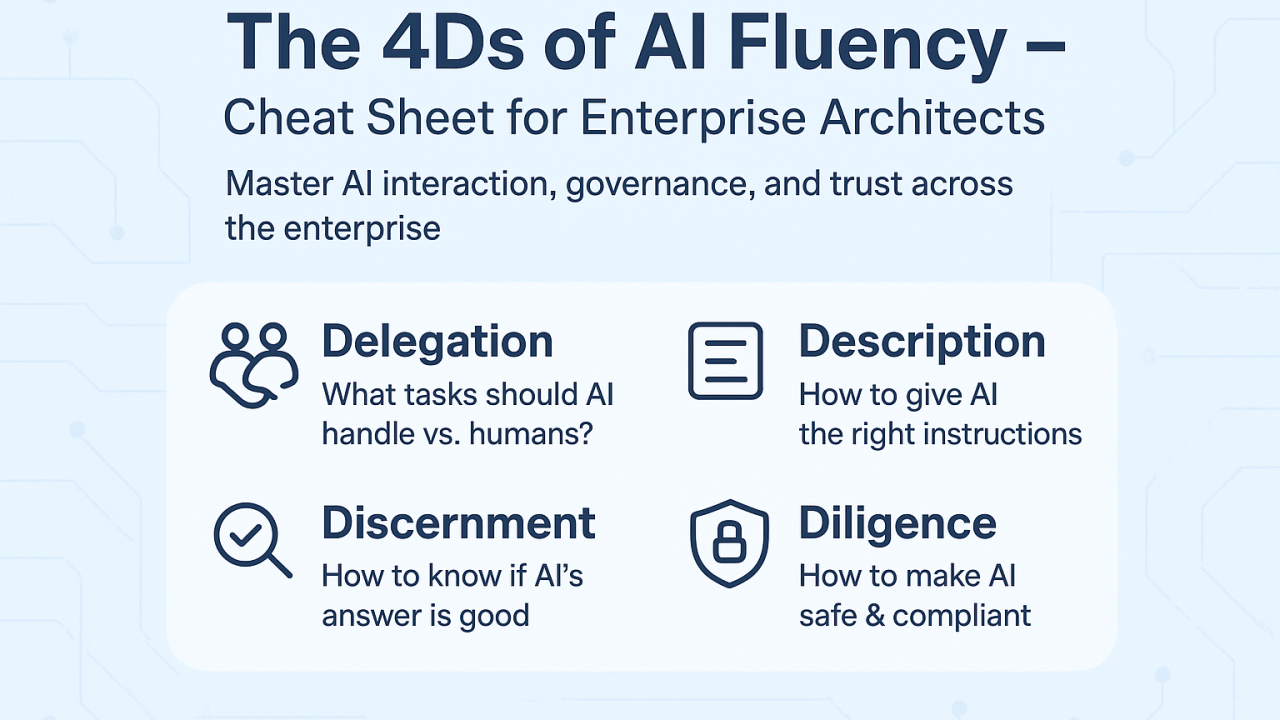
1. Discernment (Primary Focus Area)
Why it matters for you: You operate in high‑risk domains (security, compliance, governance). Discernment is your leverage point.
Actions:
- Build a library of AI risk patterns (bias, hallucination, reasoning gaps)
- Practice process tracing: ask AI to show its reasoning and evaluate it
- Develop tool selection heuristics for enterprise AI systems
Milestone: You can audit AI reasoning as rigorously as a security architecture.
Practice Questions
- Evaluate AI reasoning: An AI gives you a correct answer but with flawed logic. What should you do?
- You’re asked to use AI for a sensitive HR decision. What factors determine whether AI is appropriate?
- An AI tool is powerful but opaque. How do you assess its suitability?
2. Delegation
Why it matters: Your work spans analysis, strategy, architecture, and communication — ideal for hybrid human‑AI workflows.
Actions:
- Create reusable task breakdown templates for research, architecture, legal analysis
- Define AI‑ready modules in your workflows (summaries, comparisons, drafts, risk matrices)
- Build a delegation playbook for your team
Milestone: You can design end‑to‑end workflows where AI accelerates 40–60% of the work.
Practice Questions
- A project requires research, synthesis, and stakeholder messaging. Which parts should AI handle?
- You need a competitive analysis. What information must you define before delegating to AI?
- A task is ambiguous. How do you break it into AI‑ready components?
3. Description
Why it matters: Your outputs require precision, structure, and executive clarity.
Actions:
- Develop prompt frameworks for:
- security architecture
- legal counter‑analysis
- portfolio modeling
- executive briefings
- Standardize tone, structure, and formatting preferences
- Use process prompts to force structured reasoning
Milestone: Your AI outputs become indistinguishable from expert‑level human work.
Practice Questions
- You want a structured 1‑page brief. What elements must your Product Description include?
- You need AI to follow a specific reasoning method. How do you specify the process?
- You want a consistent tone across multiple outputs. What interaction preferences do you define?
4. Diligence
Why it matters: Your domains require compliance, safety, and auditability.
Actions:
- Build a responsible‑use checklist for all AI‑assisted work
- Implement transparency protocols for client‑facing deliverables
- Create a validation workflow for accuracy, safety, and compliance
Milestone: You can defend any AI‑assisted output in a legal, regulatory, or executive setting.
Practice Questions
- AI produces a confident but incorrect summary. What steps do you take?
- You used AI to draft a client proposal. Who needs to know, and what must you disclose?
- You’re handling sensitive data. What safety diligence steps are required?
메타데이터
- post_id
- 6257ccfe07b6
- slug
- ai-fluency-development-plan-6257ccfe07b6
- url
- https://medium.com/@ealtili/ai-fluency-development-plan-6257ccfe07b6
- canonical_url
- https://medium.com/@ealtili/ai-fluency-development-plan-6257ccfe07b6
- author_url
- https://medium.com/@ealtili
- status
- ok
- fetched_at
- 2026-06-20 20:29:01





