Now Playing — Metaphor : ReFantazio
Where I played — PlayStation 5
Now Playing — Metaphor : ReFantazio
Where I played — PlayStation 5
The eighth generation of consoles (PS4/XBO) was defined by many things, but none more positive than the iron curtain coming down between east/west in terms of which Japanese games are popular enough to warrant a western release. Time was that only the most popular Japanese games were going to come over, because localization is expensive, and distributing physical copies in the western market is going to probably be more trouble than it’s worth. Even games that did come over usually had limited runs, and indeed many of the most expensive retro-games are Japanese RPGs (a lot of them published by Atlus) that only had one printing here.
Once the PS4 hit and every game was guaranteed a place on digital storefronts, you started to see a lot more of these games come over, and indeed many of the most iconic releases of that generation are from franchises that previously would have skipped releasing in the west at all. Examples would include Dragon Quest XI, Yakuza 0, Nier Automata, but I don’t know if there’s any franchise that went from relative obscurity to being at the forefront of the RPG genre quite like Persona…particularly Persona 5.
Persona 5 was an EVENT. I don’t know exactly what forces came together to push this one over the edge, as Persona3/4 were still pretty niche games in their day, but when Persona 5 came out it was massive, even in 2017 which was a banner year in video game history.
Years on from that titanic event, Atlus has given us countless spinoffs of P5, including a special “Royal” edition, a remaster of Catherine, SMTV…the list goes on but we’ve never gotten even a sniff that Persona 6 is in development or even remotely close to releasing. Instead of Persona 6 for the time being, the core team at Atlus is content to give us Metaphor : ReFantazio.
The quickest way to sum up Metaphor is that it is the core systems and mechanics of Persona, but slightly remixed and applied to a medieval fantasy setting. Let’s go over what’s the same and what’s changed.
The Same
- S-tier character and art design. This is one of the most stylish, best looking games you can possibly play. Style and grace drips from every element of the UI, and the art is second to none.
- A long, generous, JRPG journey that feels like it encompasses three or four seasons of a television show in it’s breath and reach. Metaphor is slightly shorter than Persona 5 (80 hours instead of over 100), and is expertly paced. It is a long game but it doesn’t feel too long
- Extremely well-balanced difficulty pacing and gameplay. These are games that command your attention and will punish you for getting lazy, but not so difficult that you are bound to get stuck or frustrated. They are demanding of the player in exactly the right way.
The Different
- Atlus has usually set Persona games in modern settings like Tokyo. Metaphor is set in the world of Euchronia with lots of interesting fantasy races and rules to explore. The socio-political drama and intrigue of this foreign society is really the meat of this title, and it’s housed in a fantasy setting that is in some ways familiar, but is delightful in it’s departure from the typical “Tolkienien” fantasy of the last one-hundred years or so. There are no elves, dwarves, magic missiles, or monster manuals here.
- Mirroring the new setting, the immaculately clean, intricate, and catchy tunes of a Persona game have been replaced by typical fantasy scoring, but decorated with new aspects that again serve to seperate Metaphor from other fantasy slop. The monks chanting during the battle-theme is the primary and best example of this new musical direction.
The story is far too long and complicated to be surmised proficiently here, but essentially it boils down to this. A populist war hero named Louis Guiabern assassinates the sitting King of Euchronia, and puts himself front and center to be elected to the now vacant office. He is supported by huge swathes of the population that trust in his ability to rule from power, and save them from rampant monsters called “Humans”. You play as a kid who knows that secretly the Prince of this kingdom is still alive, (albeit suspended in a magic coma),and is trying to prevent Louis from taking the throne for himself before the rightful heir has a chance to wake up and claim the country that is rightfully his.
There are many twists and turns, and the pacing of events and story beats is excellent, but the real star of the show here is Louis. Louis is the strongest JRPG villain in the genre’s history, right up there with Kefka and Sephiroth. The hallmark of a great villain is their righteous and understandable intentions, and Louis does a great and charismatic job of making his case to the world. He is powerful, masculine, regal, cunning, and just a bastard you absolutely love to hate.
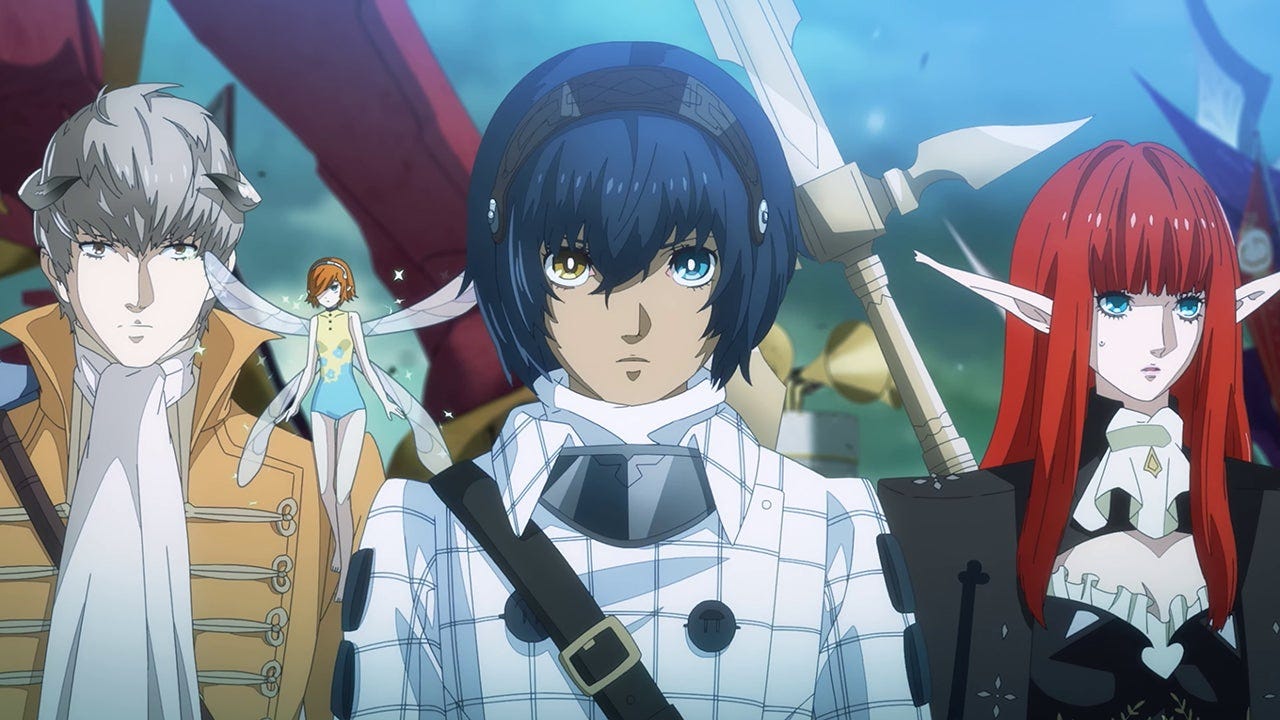
Outside of Louis the supporting cast of characters is the best that has been in an Atlus game. The game plays with your expectations of how these character archetypes are going to play out in interesting ways — the tank class is fulfilled by an elvish looking woman with red hair. The thief character is initially introduced as a brutish kidnapping murderer, before you come to realize he’s a 3-foot tall bat/mouse hybrid called a Eugief. Metaphor is constantly playing with what your expectations of JRPG tropes are, and the character design here is just stunningly good. Every JRPG has that ONE party member that you just hate, or you find useless in your party. No so with Metaphor…I loved these characters and have so much affection for them.
And then there’s the primary change which is to the underlying gameplay systems. Persona combat operates on weaknesses, which essentially allow you to add an extra turn to combat and keep your party attack as long as possible. You want to keep hitting weaknesses so you can put the entire enemy squad on their back foot, and once everyone is stunned, execute an all-out attack and wipe them out in stylish fashion.
Metaphor is a little different. Gone are the all-out attacks, and instead you are striking an always interesting balance between exploiting weaknesses to again gain more chances to attack, and spending those extra turns on more powerful “synthesis” abilities between teammates. You also have to account for the extra MP cost that synthesis requires, because it will charge the cost of the MP to every member implicated in these attacks.
Another radical change is that in Persona, only the primary character can change between multiple classes. In Metaphor, every character can be any class, although I think it’s fairly obvious that each are supposed to head down a fairly pre-disposed path. It’s ultimately up to you, but the game makes some strong suggestions.
For example — Early on you meet up with your thief archetype character. He can be sent down any skill-tree of class progression, turning him into a fighter, mage, gunner, merchant…etc…but ultimately there is a “super thief” class that only HE has access to, and the prerequisites for unlocking this class is heavily pushing him down the thief skill tree anyway. For as much freedom as this system initially seems to have in unlocking the very stringent class system of Persona, it ultimately doesn’t get away from it in the end.
This is really my primary complaint with Metaphor. This was Atlus’s opportunity to really shake things up, and I think they made a game that is essentially Persona 5 with a fresh aesthetic and world. That’s fine, because again Persona 5 is one of the greatest JRPGs ever made, so more of that is wonderful, but I think my disappointment comes from the failure of the new experiments with the gameplay structure here.
People complain that Persona 5 has too much of a predictable structure — three hours of dialogue, three hours of dungeon, three hours of dating simulator…rinse and repeat about ten times and the game is over. Metaphor attempts to shake this up by giving you lots of freedom in how you address the side content and your free-time, but ultimately because of the way these games are built, you end up still playing it much the same way as you would have played a Persona game.
People complain about how every non-hero in Persona is essentially railroaded into being a particular class…a heavy physical striker, or a mage. So Atlus tries to shake things up with Metaphor and the result is essentially exactly the same. Hulkenberg is going to end up as your tank, Strohl is going to be your heavy fighter, and Junah is going to be your black mage.
You can see them trying to shake things up, but ultimately they aren’t able to get away from the legacy of their past titles. I’m still surprised that we are more than twenty years out from Persona 3 and these games really haven’t changed all that much. At the end of the day it’s a great formula, but Metaphor was their chance to really experiment and get wild, and I didn’t see enough of that. If anything, I think Metaphor plays it a little too safe, and I would have liked to see them really branch out and go wild with the structure and gameplay here…even if it ultimately led to a weaker overall product. Do the experimentation NOW so that by the time Persona 6 is ready, you can deliver on a truly new game. I cannot imagine another typical Persona experience that is better than Persona 5…so change things up baby!
메타데이터
- post_id
- 6281fa89e383
- slug
- now-playing-metaphor-refantazio-6281fa89e383
- url
- https://medium.com/@sam.strajack/now-playing-metaphor-refantazio-6281fa89e383
- canonical_url
- https://medium.com/@sam.strajack/now-playing-metaphor-refantazio-6281fa89e383
- author_url
- https://medium.com/@sam.strajack
- status
- ok
- fetched_at
- 2026-06-26 03:39:16