The Silent Assassin in Our Mitochondria
The Silent Assassin in Our Mitochondria
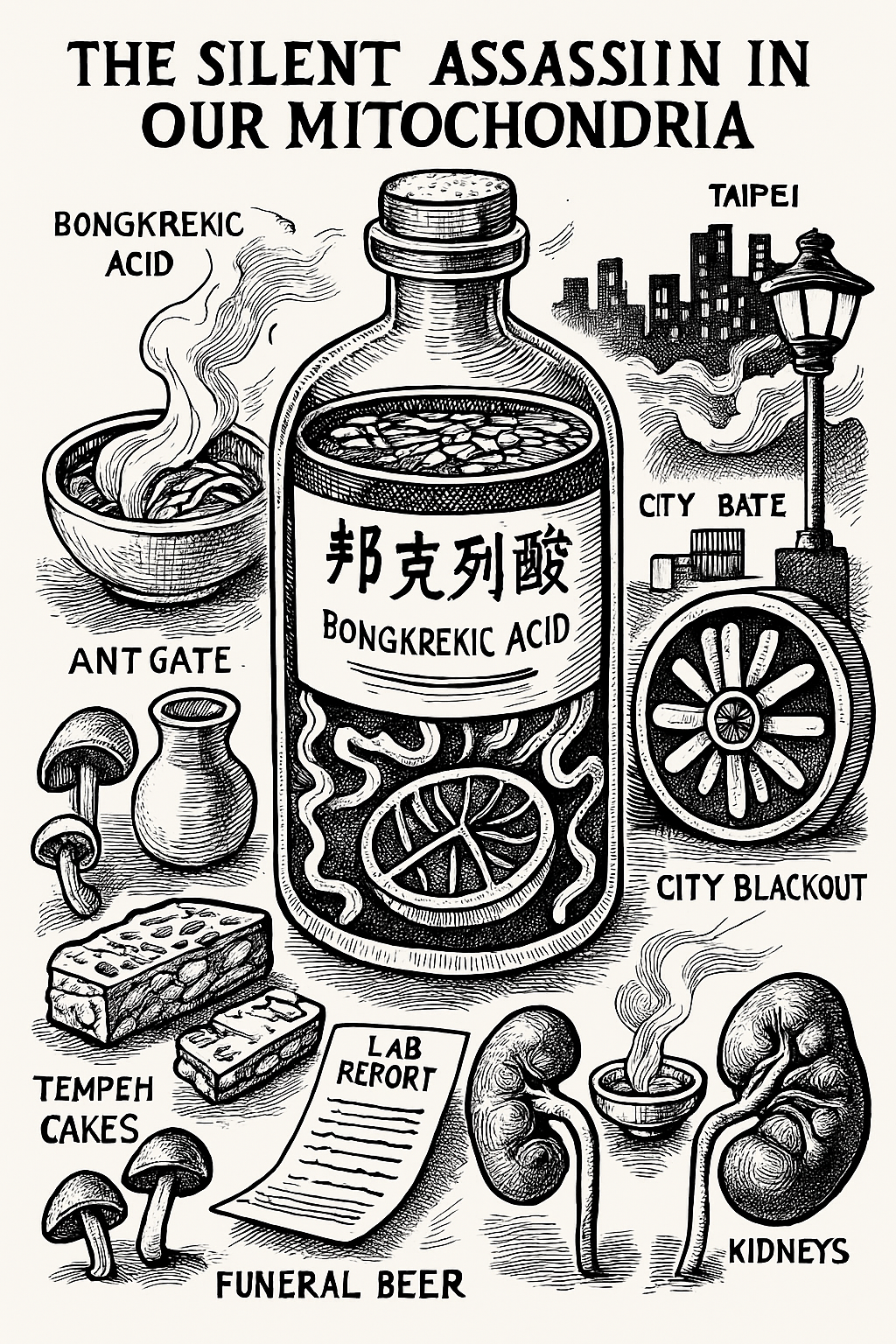
A plate of noodles
March 2024, a weekend afternoon in a bustling Taipei food court. Laughter and clatter in the air, steam rising from woks. Somewhere in the noise, a diner orders a vegetarian stir-fried rice noodle dish that looks innocuous, even comforting.
Hours later, the first patients arrive at the emergency department with what seems like routine stomach trouble. Nausea, vomiting, weakness, diarrhea. Standard protocols are followed, as always. Then the floor drops out. Liver enzymes soar, kidneys fail, consciousness dulls. One organ after another shuts down as if the body has been unplugged from the wall. Within days, the first deaths occur. More people are admitted to the ICU, teetering.
When the forensic lab reports return, a clumsy name enters Taiwan’s public vocabulary: bongkrekic acid. The initial Chinese rendering, tied to the word “rice,” sparks worry in a rice-loving society. To steady nerves and improve accuracy, experts recommend an official transliteration: 邦克列酸. Naming can be an act of public health, a way to navigate fear while keeping science intact.
Investigations later call the event the first recorded bongkrekic acid mass poisoning in Taiwan, centered on a chain restaurant known as Polam Tea House. Several people die. The toxin is detected on a substitute cook’s hand swab, yet investigators fail to culture the suspected culprit, Burkholderia gladioli pathovar cocovenenans, from the kitchen environment. The chain of contamination remains opaque, as if a murderer had wiped every print.
What is this silent toxin that is colorless, tasteless, and heat stable? Why does a molecule first described over a century ago in the Dutch East Indies appear in a modern Asian metropolis, hiding in a plate of noodles? To understand, we have to travel in both space and scale: from Javanese markets to the inner life of a cell, then back out to an ICU bed where time moves fast and energy runs out.
Java’s riddle: tempeh, poverty, and two persistent Dutch scientists
The archive record begins in 1895, in colonial Java, where officials note a mysterious, often fatal food poisoning linked to a cheap staple called tempe bongkrek. After pressing coconut residues left from making coconut milk, home producers inoculate the cakes for fermentation. It is filling, protein-rich, and affordable, a lifeline for families living on the margins. Every so often, the food turns on its eaters.
The Great Depression in the 1930s pushes many households into do-it-yourself production. Fermentation, exquisitely sensitive to temperature, moisture, and hygiene, becomes a hazard when done in cramped kitchens under tropical heat. Outbreaks multiply. The deaths mount.
At the Eijkman Institute in Batavia, two Dutch researchers, W. K. Mertens and A. G. van Veen, take on the case. Without genetics or high-performance chromatography, their work resembles sifting a beach for a single grain of black sand. They collect lethal coconut cakes, peer through microscopes, and try to grow something reproducible from the chaos.
By the early 1930s they isolate an unfamiliar bacterium. Under particular conditions it makes two toxins. One, toxoflavin, is yellow and relatively less lethal. The other is invisible, odorless, devastating. They name it bongkrekic acid, after the food that betrayed the poor. The bacterium is first labeled Pseudomonas cocovenenans, later reclassified as Burkholderia gladioli pathovar cocovenenans.
Science moves because people suffer. Without waves of home fermentation driven by poverty, this toxin might have stayed hidden longer. The Indonesian government eventually bans tempe bongkrek in 1988. The food exits history; the toxin’s name does not. It migrates into medical journals and case reports, a warning embedded with its place of origin.
When the power plants mutiny
To see why bongkrekic acid kills, shrink your imagination until a cell becomes a city. Every heartbeat, thought, and breath relies on the city’s power stations, the mitochondria. They manufacture ATP, the cell’s small packets of usable energy, the way a power grid converts fuel into light and motion.
Mitochondria are double-walled. ATP is minted on the inner membrane, then must cross that membrane to reach the cytoplasm, where most of life’s work happens. The gate for this traffic is a protein called adenine nucleotide translocase, or ANT. Think of ANT as a precision revolving door. Each time a fresh ATP exits, a depleted ADP enters for recharging. The exchange keeps the turbines humming and the city alive.
Bongkrekic acid does not blow up the turbines the way cyanide does. It does something more cunning. Its geometry lets it lodge in the ANT gate and jam it. The door freezes in a state that allows ADP to move inward, but traps ATP inside. It is the biochemical equivalent of locking electricity in a substation and starving the rest of the city. The binding is tenacious and hard to reverse. There is no specific antidote.
Inside the mitochondria, ATP begins to accumulate while ADP becomes scarce, which slows production. Outside, the cytoplasm runs dry. Enzyme pumps stall, membranes lose their gradients, and the cell drifts toward death. A milligram or so of this toxin can be enough to end a human life because it targets a universal bottleneck. It does not attack one organ; it attacks the logic of energy distribution itself.
Renal blackout
When cellular power flickers, energy-hungry organs fail first. The liver, the brain, and the kidneys are voracious. The kidneys filter around 180 liters of plasma daily and, with remarkable thriftiness, reclaim most of what we need. That reclamation is uphill work, powered by ATP-dependent ion pumps embedded in tubular cells. Cut the power and the pumps stop. Ion balance collapses. Water floods in. Cells swell and die. Sloughed cells plug the tubules like wet plaster peeling from a wall.
Pathologists call this acute tubular necrosis, a leading cause of acute kidney injury. Clinically, urine output falls, sometimes to nothing. Blood levels of creatinine and urea climb as toxins accumulate. Fluid retention worsens; patients become nauseated, confused, edematous. In Taiwan’s outbreak, this pattern was stark. Autopsies revealed severe necrosis and detachment along both proximal and distal tubules.
At that point, medicine can only buy time. Dialysis functions as a temporary kidney, clearing solutes and water until the patient’s own organs recover, if they can. Some reports discuss plasma exchange to remove circulating toxin, though benefits remain uncertain. The message is blunt. In bongkrekic acid poisoning, renal failure is not a side note. It is one of the first dominoes, a visible sign that the body’s power economy has collapsed.
From a Mozambican funeral to a Chinese kitchen
For decades the poison felt like an Indonesian tragedy. That illusion ended in 2015 in Chitima, Mozambique. At a funeral, villagers drank a home-brewed corn beer called pombe. Dozens fell ill. Seventy-five died. Rumors blamed crocodile bile. Advanced testing later found high concentrations of bongkrekic acid in the beer and grew Burkholderia gladioli from the cornmeal. The toxin had crossed oceans, or rather, similar practices had recreated similar conditions.
China’s reports added variety. In 2020, a family in Heilongjiang shared homemade fermented corn noodles called suantangzi that had sat frozen for a year. Nine ate; nine died. Other outbreaks involved wood ear and white tremella mushrooms soaked at room temperature, as well as moist rice-based products like fresh rice noodles and he fen that had been left out too long. The pattern is consistent. The bacterium is not a master invader. It is an opportunist in soil and plants, ordinary until people offer precisely what it needs: neutral pH, low salt, warmth in the mid-20s Celsius, time, and substrates rich in fatty acids or starch. Give it these, and it may deliver a molecule that the stove cannot destroy.
Indonesia’s coconut cakes, Mozambique’s sorghum or corn beer, China’s fermented staples, Taiwan’s stir-fried rice noodles. Different foods, same code. This is not a single outbreak spreading outward. It is parallel lines of risk drawn by culture, climate, and storage habits. The danger lives in kitchens everywhere because it is born from process, not place.
What we do with the lesson
For clinicians, the challenge of bongkrekic acid can be summarized in three short words. Fast. Fierce. No-antidote. Incubation is brief, often between one and ten hours. Deterioration can be swift and deep: mild gastrointestinal upset to liver and kidney failure, shock, coma, death. Treatment is supportive only. Ventilators for respiratory failure, vasopressors for shock, dialysis for renal collapse. We build scaffolding around a breaking body and hope the toxin clears before the scaffolding fails.
Which is why prevention is everything, and prevention lives in unglamorous routines.
- Rehydrate dried mushrooms in the refrigerator, not on the counter. Taiwan’s warm, humid climate is welcoming to bacteria. Cold slows growth.
- For moist starch products like fresh rice noodles, rice cakes, and he fen, cook soon after purchase. Do not leave at room temperature. If the texture turns slimy or a sour odor appears, discard without hesitation.
- Be cautious with home-fermented grains and coconut products. Safe fermentation requires strict hygiene and control. Most home kitchens cannot guarantee this.
- Wash hands before and after handling ingredients. Use separate cutting boards and knives for raw and cooked foods to avoid cross contamination.
The Polam Tea House tragedy hurts, but it also validates the resilience of Taiwan’s medical and public health systems. Knowledge gathered across a century, from Java to Mozambique to China, allowed teams to identify an obscure toxin rapidly and prevent wider panic. History’s value is not fear; it is humility and wisdom. Bongkrekic acid reminds us that convenience and cuisine exist inside a larger, microbial world. Respect the invisible. Handle food with care. Keep learning so the race stays winnable, even if it has no finish line.
Reference
- Anwar M, Kasper A, Steck A, Schier J. Bongkrekic acid — a review of a lesser-known mitochondrial toxin. J Med Toxicol. 2017;13(2):173–9.
- Gudo ES, Cook K, Kasper AM, et al. Description of a mass poisoning in a rural district in Mozambique: the first documented bongkrekic acid poisoning in Africa. Clin Infect Dis. 2018;66(9):1400–6.
- Yuan Y, Chen S, Zhang M, et al. A foodborne bongkrekic acid poisoning incident — Heilongjiang Province, China, 2020. China CDC Wkly. 2020;2(52):1039–42.
- Li J, Xie J, Tang J, et al. Bongkrekic acid poisoning: Severe liver function damage combined with multiple organ failure caused by eating spoiled food. Leg Med (Tokyo). 2019;41:101620.
- Niu C, Niu B, Chen H. Epidemiology of foodborne bongkrekic acid poisoning outbreaks in China, 2010 to 2020. PLoS One. 2023;18(1):e0279957.
- van Veen AG, Mertens WK. De bongkrek-vergiftigingen in Banjumas. Geneeskd Tijdschr Ned Indie. 1933;73:1309–33.
- Henderson PJ, Lardy HA. Bongkrekic acid. An inhibitor of the adenine nucleotide translocase of mitochondria. J Biol Chem. 1970;245(6):1319–26.
- Lauquin GJ, Duplaa AM, Klein G, Rousseau A, Vignais PV. Isobongkrekic acid, a new inhibitor of mitochondrial ADP-ATP transport: radioactive labeling and chemical and biological properties. Biochemistry. 1976;15(11):2323–7.
- Food and Drug Administration, Ministry of Health and Welfare, Taiwan. 防治邦克列酸(Bongkrekic Acid)食品中毒專區問答集. 2024. Available from: https://www.fda.gov.tw/tc/includes/GetFile.ashx?id=f638482844429862048&type=3&iid=12941
- Shurtleff W, Aoyagi A. History of tempeh and tempeh products (1815–2022): extensively annotated bibliography and sourcebook. Lafayette, CA: Soyinfo Center; 2022.
- Torrelles JB, Azad AK. A deadly plate of noodles: The recent bongkrekic acid poisoning outbreak in Taiwan. Travel Med Infect Dis. 2024;60:102839.
- Zhou Q, Wang Y, Wu J, et al. Pan-genome analysis of the lethal foodborne pathogen Burkholderia gladioli pv. cocovenenans reveals great genomic diversity and a possible recent origin of the bongkrekic acid biosynthesis gene cluster. Front Microbiol. 2021;12:656845.
- Wikipedia contributors. Bongkrek acid [Internet]. Wikipedia, The Free Encyclopedia; 2024 Nov 26. Available from: https://en.wikipedia.org/wiki/Bongkrek_acid.
- Johnson-Arbor K. Bongkrekic acid poisoning. National Capital Poison Center. 2024. Available from: https://www.poison.org/articles/bongkrekic-acid-poisoning-fermented-food-204
- Moebius N, Ross C, Scherlach K, Rohm B, Hertweck C, Gressler M. Biosynthesis of the respiratory toxin bongkrekic acid in the pathogenic bacterium Burkholderia gladioli. Chem Biol. 2012;19(9):1164–74.
메타데이터
- post_id
- 62820d621eae
- slug
- the-silent-assassin-in-our-mitochondria-62820d621eae
- url
- https://medium.com/medical-stories/the-silent-assassin-in-our-mitochondria-62820d621eae
- canonical_url
- https://medium.com/medical-stories/the-silent-assassin-in-our-mitochondria-62820d621eae
- author_url
- https://medium.com/@critnephro
- status
- ok
- fetched_at
- 2026-06-13 00:08:42