Fichte’s dialectics of the Miracle
Here I’ll dwell only on some respective differences between Fichte’s and Hegel’s methods and some interesting comparisons, per example…
Fichte’s dialectics of the Miracle
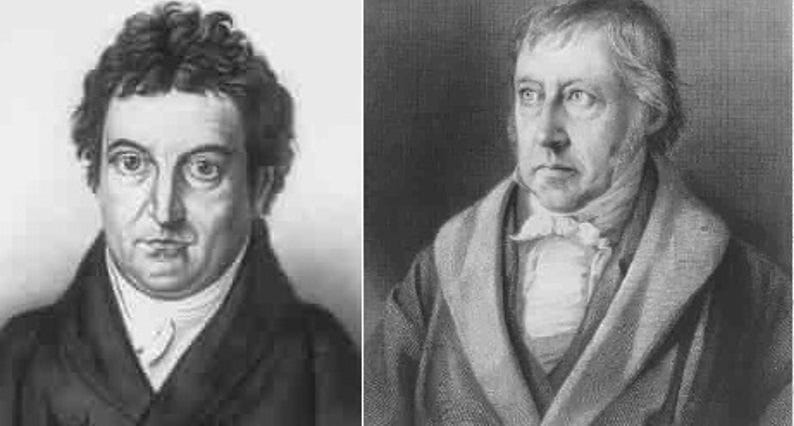
Here I’ll dwell only on some respective differences between Fichte’s and Hegel’s methods and some interesting comparisons, per example between Hegel’s “absolute negativity” and Fichte’s “absolute miracle” and how this relates to the Fichtean understanding of a revolution.
As shown previously, both Fichte and Hegel share the joint task of immanent thinking; we see this, per example, in Hegel’s introduction to the Logic and Fichte’s insistence that transcendental thinking (the thinking of conditions of possibility) itself is not enough, because as it was shown in Kant this ultimately results into the root of being and thinking that is not capable of positing itself. Instead it is simply posited by finite reflection as a root of the two. For Fichte according to the immanence of this position the root contradicts itself; as the root from which being and thinking originate, it itself cannot simply be posited a synthesis as a consequence of the arising of the two terms (synthesis post factum). If this root is not constructed in consciousness as producing the two terms (being and thinking) prior to their arising, it cannot be claimed to be the root from which being and thinking originate. In Fichte’s language, this means that it is simply posited by a finite reflexion and thereby obtains the character of a ‘fact’ — a fact, moreover, that is not properly genetic or alive because it has not posited itself but was instead by posited a reflexion that remains external to it, as is demonstrated by Kant’s admission that this root is wholly unknown. This is why the Absolute should be an absolute prius and a result for Fichte, or immanently construct itself and this be demonstrated — this is where Kant went astray.
This is also where Fichte and Hegel join hands, but also simultaneously go astray. Both of them want to have a presuppositionless starting point, but the way they go around it is different. They agree that this entails practically the negation of being and our thinking as thinking of being, and the reversal of this negation as arrival unto pure thinking. This does not mean that this is a thinking of pure consciousness- on the contrary. Consciousness is a term alongside being that is to be eliminated. This is thinking thinking itself and being in relation with itself and to itself independent of objectivity (objective world) and thinking as thinking of objectivity (finite subjectivity). For Hegel this entails elimination of all determinacy as such; pure thinking/pure knowing consists in purely reflecting unto itself, as itself and through itself. This means that there is no matter of thinking other than thinking thinking itself and this is pure Being or pure immediacy. Being in this sense is not only the elimination of all determinacy and all that exists; it is also that which contains all of it in itself. As it is pure, however, we know that Hegel does not rest simply on this notion but demonstrate that it is self-contradictory in its vanishing into nothing and that it is this movement itself that is its truth.
How? On the one hand, pure thinking thinks itself in abstraction from the act of abstracting of being (objectivity) and consciousness (thinking of being), so it thinks itself purely. In its own self-genesis through abstraction from the act of abstracting from both consciousness and objectivity, pure knowing for Fichte genetically conceives itself literally as that which is utterly independent from any division into being and thinking. It conceives itself without dependence on any duality. Is it then the oneness of being and thinking? No strictly speaking — it is simply the very act of genesis itself, i.e. genesis as genesis independent of any disjunction or unity. That being said, in reflecting unto itself thinking always introduces a duality and so it sees itself for itself as oneness of duality or as that in which there must necessarily arise the disjunction of being and thinking in which oneness passes over into. This itself is the disjunction in which pure knowing stands for Fichte: pure knowing as absolute oneness independent of disjunction into being and thinking (pure arising, in and for itself), and pure knowing as oneness from which the disjunction into being and thinking arises and the first movement of the Wissenschaftslehre. Both terms are equally valid, but as we know for Fichte they also annul themselves.
Here it is important to clarify that with this distinction Fichte utilizes a theme that he worked on in the Jena years: transcendental seeing or insight. It is that which, according to Fichte, is more originary and upon which thinking as judgement-syllogism is based on. This is why while conceptual mediatedness and intuitive understanding are the domain of the latter kind of thinking which culminates in Reason as oneness of understanding, absolute Reason qua absolute oneness is the domain of absolute insight which whilst being in unity with the former, it is nonetheless not reducible to it. It is absolute oneness that encompasses Reason of the understanding, i.e. oneness of duality but is not reducible to it.
This is why I want to focus on this particularly: Fichte’s notion of genesis and Hegel’s sublation. To my mind, they’re utterly identical but with one important difference — while the Hegelian Concept retroactively posits itself through the self-annulling of content previously in contradiction with itself (thereby this dialectic annulling itself in speculative unity), the Fichtean Light (Absolute) adds a further step to this. As demonstrated in the previous article, the Fichtean Concept follows the path of Hegelian sublation insofar as it demonstrates the move from the implicit to the explicit. The disjunction between the supposedly absolute oneness and the Concept negates itself — the contradiction contradicts itself — and what is revealed is what had always been implicit to these two terms, but is only revealed as having posited itself through the self-annulling ideality of the terms since they presupposed it all along. In other words, the Concept undergoes its dissolution as the foundation it relied upon turns out not to have been consistent at all; it loses its ground, i.e. itself and in this self-annulling of the grounding it posits itself as the presupposition. This is the Concept which is circularly self-positing without premises as Fichte loved to say. But because the movement immanently follows the beginning for Fichte, this also includes the revelation of the Light-Absolute which posits itself independently of the self-annulling content of previous cases that are needed for Concept to construct itself by sublating them. As Fichte used to say in the 1804 Wissenschaftslehre, the essence of the Light is to be circularly self-positing without dependence on any disjunctive term. This is the territory of the Fichtean ‘insight’.
More precisely, if the Concept constructs itself with relation to the self-annulling content of previous cases it sublates, the Fichtean Light is only successively revealed to have always already posited itself without any ‘dependence’ on the self-annulling and self-sublating of previous cases. But this indeed is its independent movement of self-construction that the WL promises alongside the Concept! Of course, this also means that our perspective on the Light always already retroactively changes itself as successive revelations change our perspective of Light. Strictly speaking, this is an impossibility in Hegelian thought. Here, to emphasize this again, this is not the sublation of the Concept which is revealed to have always already been the self-positing presupposition of the content which, being dialectically opposed to itself sublated itself in speculative Concept. This is the only movement in Hegel, beyond which there is none in his edifice. The Fichtean movement adds to this one more element; with the revealing of itself from being implicit to explicit, the Fichtean Light also moves from implicitness to explicitness: as that which had independently posited itself without dependence on the Concept or its movement of self-sublation. But this is still thinking; Fichtean Light does not posit itself outside of thought. This is the territory of Fichte’s insight.
In this sense, is not Fichte’s method prescient as it demonstrates the necessity of a certain movement which was on display in much of modern history when it comes to revolutions and receptions thereof; one thinks one sees in a certain revolution the authentic, undialectical and unsublatable Event but which goes on to disappoint the expectant viewer or participant as it proceeds to fall into its dialectical opposite. Per example this is what Hegel identifies nicely with the French Revolution and its fall into its opposite (Terror). Of course, the Hegelian answer to this dilemma is the rational state and rational system of goods — the Fichtean is to insist upon the French Revolution as the singular Event which, through its fall to its opposite reveals that it has always already objectified and killed the genuine Event/Revolution and whose sublation in the rational state (Concept) can only then precipitate the revelation of the genuine Event/Revolution and reveals that the objectification had already taken place. In the previous article, we saw that it is the subversion of freedom itself; the reduction of freedom qua freedom to the presupposition of the society.
At this stage, we also saw in the Fichtean dialectic that the Absolute negates the Concept; it is before the inversion of revolution that there is a different type of disjunction, which is the negation of the Concept by Absolute where the Absolute shows itself as the Lacanian ‘Real’ of the Concept (the Absolute cannot be symbolized, mediated, it is what breaks and kills the Concept in its self-mediating as an irreducible “product” that emerges within Concept’s circularity-remainder in the movement of Concept’s positing of presupposition… — recall that Fichte says that the whole of reality is the graveyard of the Concept which strives to be in the Light). In other words, the objectification of the Concept and its devouring of the Light coincides with the Light’s negation of the Concept. It is only in and through the destruction of the revolution not only through its self-annulling (sublation of the dialectical inversion) that the revolution actually takes place, since it is in this self-annihilation of the annihilation that the objectification of the Absolute, coinciding with the negation of the Concept by the Absolute-Real, also ceases. This is Fichte’s triple negativity, if we understand the Absolute proper is the Nothing (not only “no-thing”, but something which entirely precedes “what-is”). It is necessary to pass through this movement — it is only through failure that the Light actually reveals itself because the objectification of the Concept, i.e. the Concept yields itself. To put it a bit daringly, the final movement is revelation of what had always been (but to which we could arrive only through the necessity of failure): the inversion of the Real into pure Life. This is another paradox of the Fichtean movement; as long as there was objectification, the Absolute could’ve been nothing but the abyssal Real; in the self-yielding of the Concept, the Absolute in turn yields to us which reveals not that the Absolute has forfeited its abyssalness — it hasn’t — but that it is pure Life itself out of which the Concept arises from and from which it is inseparable, as the I.
…(This philosophy) raises itself to the ‘more than all infinity’ that is unchangeable, and in this alone it finds true Being. It perceives time and eternity and infinity in their rise from the appearing and becoming visible of that One which is in itself invisible and which is only comprehended, rightly comprehended, in this invisibility. Even infinity is, according to this philosophy, nothing in itself and there is in it no true Being whatsoever.
Originally published at https://adein.substack.com.
메타데이터
- post_id
- 6288a0d65a2c
- slug
- fichtes-dialectics-of-the-miracle-6288a0d65a2c
- url
- https://medium.com/@jmiticp/fichtes-dialectics-of-the-miracle-6288a0d65a2c
- canonical_url
- https://medium.com/@jmiticp/fichtes-dialectics-of-the-miracle-6288a0d65a2c
- author_url
- https://medium.com/@jmiticp
- status
- ok
- fetched_at
- 2026-07-21 02:19:38