Most Workers Compensation Liens Do Not Fail in Court; They Fail in Follow-Up
Ask any biller who has spent years chasing workers’ compensation liens, and they’ll tell you the same thing: It is not in the courtroom…
Most Workers Compensation Liens Do Not Fail in Court; They Fail in Follow-Up
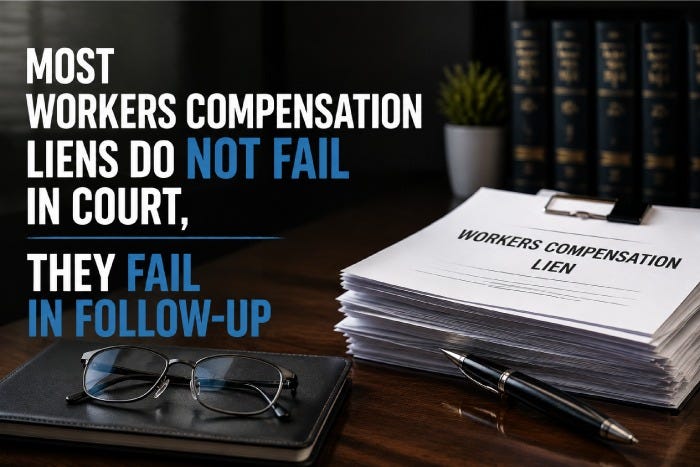
Ask any biller who has spent years chasing workers’ compensation liens, and they’ll tell you the same thing: It is not in the courtroom where you lose money. Very few liens ever reach a contested hearing if they are not paid. They die quietly somewhere, left in a pile of unanswered calls, in a missed deadline, or in an unfollowed status update.
That’s the uncomfortable truth about lien recovery. Typically, the legal arguments are sound. Usually has supporting documentation for payment. The time after the lien is filed is the time that collapses.
The Myth of the “Difficult Lien”
In practice, it is often believed that the case was weak if it is deemed to have a denied or delayed lien. In fact, the California Labor Code provides lien claimants a valid avenue to payment, and the WCAB procedure is intended to be on the merits. When done properly, a Labor Code Section 4903 lien is fully entitled to be paid.
But why do so many people fail to get paid for months or years?
No one took action after this. The adjuster failed to reply to the first letter. There was no monitoring of the EOR (Explanation of Review) deadline. The lien was placed on a queue as the practice worked on the new claims. When someone discovers it, the file is cold, the contact has moved on to another job, and the carrier doesn’t have a record of the contact before.
Where Lien Collection Actually Breaks Down
The breakdown points are predictable, and once you’ve seen enough lien files, you start recognizing the pattern immediately:
No tracking system
Liens are placed but then are never updated in a spreadsheet. If there’s no live status for each claim, there’s no way to follow up but at best a guess.
Missed response deadlines
Carriers and TPAs may have internal review periods. If someone doesn’t respond or escalate the lien quietly slips to the bottom of the pile.
Inconsistent communication
A single phone call to an adjuster is not a plan. Liens paid are those that have a documented cadence of contact, and NOT just a one-off attempt followed by silence.
No escalation path
When a claim stalls, there has to be a next step: a lien conference request, a DOR (Declaration of Readiness), or a formal demand. Practices without an escalation protocol just let the file sit.
Staff turnover and lost institutional knowledge
History is frequently a part of the person who oversees a lien’s departure. The next person begins with zero.
None of these is a legal failure. They’re operational ones. And they’re entirely preventable.
Why This Matters More Than It Seems?
Just one lien may not be a pressing matter. Multiply that by hundreds of claims, however, and the money in limbo takes its toll. After 18 months, the leverage goes away, memory fades, adjusters change, and statutes of limitations begin to matter.
The money loss is not all down to the unpaid balance. It’s the staff hours that are wasted going back to old claims, the opportunity cost of spending time on old cases rather than new, and the cash flow that quietly drains away over a busy practice.
What Effective Workers Compensation Lien Collection Actually Requires
Collection of lien revenue is not a matter of being more aggressive in court. It’s about creating a system that doesn’t let claims go quiet in the first place. That means:
- A single tracking system to mark all liens by status, due date and last contact date
- Scheduled, documented follow-up, not occasional check-ins triggered by memory
- An escalation protocol that clearly defines the next steps for stalled claims to be automatically transferred to.
- Time of staff members (or outsourced support) dedicated to dealing with lien aging in addition to general billing tasks
- Clear and precise documentation, and no need to re-create from scratch later on
Practices that treat **workers compensation lien collection** as an ongoing operational discipline rather than a one-time filing event consistently recover more and recover faster.
The Real Fix Isn’t Legal. It’s Procedural.
This is the thing that is overlooked. Practices spend a lot of money on ensuring that the first lien filing is correct, the codes are correct, the documentation is correct, and the legal basis is correct, and then they believe the hard part is over. However, it is the easy 20% to file the lien. The other 80% is the follow-up grind: tracking, escalating, documenting, and not letting a single claim go cold.
That’s exactly the gap Doctor Management Services was built to close. Rather than treating lien recovery as a side task squeezed between other billing duties, our team manages the full lifecycle, filing, tracking, follow-up, and escalation so liens don’t sit forgotten while deadlines quietly expire.
Bottom Line
In most cases, workers’ compensation liens are not given up due to the law. Nobody watched them closely enough to collect the money, and that’s why they’re gone. It is not a better legal argument; that’s the fix. It is a better follow-up procedure.
When aging liens have fallen quiet in the practice, ask yourself, “Is this a legal problem or a follow-up problem? When it comes down to it, most of the time, it is the latter, and it is a problem that can be solved.
메타데이터
- post_id
- 629fa1f38dff
- slug
- most-workers-compensation-liens-do-not-fail-in-court-they-fail-in-follow-up-629fa1f38dff
- url
- https://medium.com/@doctormanagementservice/most-workers-compensation-liens-do-not-fail-in-court-they-fail-in-follow-up-629fa1f38dff
- canonical_url
- https://medium.com/@doctormanagementservice/most-workers-compensation-liens-do-not-fail-in-court-they-fail-in-follow-up-629fa1f38dff
- author_url
- https://medium.com/@doctormanagementservice
- status
- ok
- fetched_at
- 2026-06-20 20:29:01