The “Reusable Component” Trap That Slowly Destroys Frontend Architecture
A component reused everywhere often becomes maintainable nowhere.
The “Reusable Component” Trap That Slowly Destroys Frontend Architecture
A component reused everywhere often becomes maintainable nowhere.
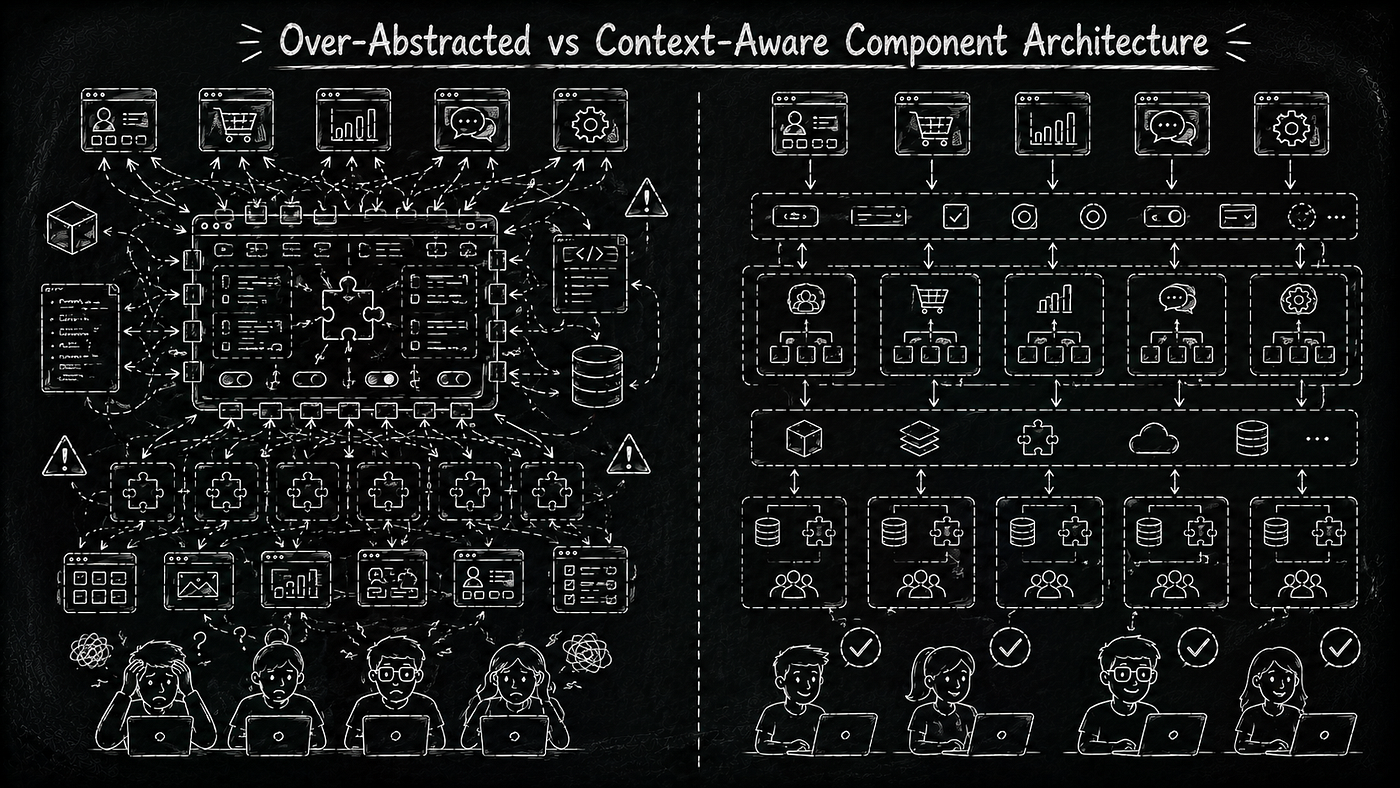
One of the biggest frontend mistakes developers make is treating reusability as the ultimate goal.
At first, it sounds correct.
“Let’s create one reusable component for everything.”
But after a few months, that “smart reusable component” becomes:
- impossible to understand
- filled with conditions
- overloaded with inputs
- difficult to debug
- risky to change
And suddenly: every feature depends on one massive component.
This is how frontend architecture slowly becomes fragile.
The Problem Starts Innocently
A team creates a shared component:
<app-table></app-table>Initially it handles:
- sorting
- pagination
- filters
Everything looks clean.
Then new requirements arrive.
Another team wants:
- custom actions
- expandable rows
- inline editing
- dynamic rendering
- role-based UI
Instead of creating specialized components, developers keep extending the same component.
Soon the API looks like this:
<app-table
  [enableExport]="true"
  [allowEdit]="false"
  [showFooter]="true"
  [customTemplate]="template"
  [isAdmin]="true"
  [dynamicColumns]="cols"
  [lazyLoad]="true"
>
</app-table>
Now the component is no longer reusable.
It is unpredictable.
Why This Architecture Fails
1. Every New Feature Increases Complexity
The component starts accumulating:
- feature flags
- conditional rendering
- branching logic
- edge-case handling
Eventually developers become afraid to touch it.
One small change breaks multiple screens.
2. Different Domains Have Different Needs
A finance dashboard, an admin panel, and a reporting system should not behave exactly the same.
Trying to force them into one generic component creates architectural confusion.
3. Reusability Starts Fighting Readability
This is the hidden problem.
Highly abstract components optimize for:
- flexibility
But real systems need:
- clarity
- ownership
- predictability
Over-abstraction reduces all three.
Bad Architecture vs Better Architecture
❌ Bad Approach
One giant shared component:
SharedTableComponent
 ├── Finance
 ├── Reports
 ├── Users
 ├── Audit
 ├── Analytics
 └── Admin
Result:
- tightly coupled features
- massive configuration objects
- hard debugging
- impossible testing
✅ Better Approach
Use:
- small focused components
- domain-specific behavior
- shared primitives only where necessary
Example:
BaseTable
 ├── FinanceTable
 ├── AuditTable
 ├── UserTable
 └── ReportTable
Now:
- each feature owns its behavior
- debugging becomes easier
- changes stay isolated
- architecture scales better
Real Engineering Lesson
Senior engineers optimize for:
- maintainability
- clarity
- isolation
- scalability
— not maximum reuse.
Good architecture is not about creating fewer files.
It is about creating systems that remain understandable after 2 years.
Think Of It Like This
A Swiss Army knife is flexible.
But surgeons do not perform heart surgery with one.
Specialized tools scale better for specialized problems.
Frontend architecture works the same way.
Senior-Level Insight
The best engineering teams reuse:
- patterns
- primitives
- design systems
- architectural principles
— not giant business components.
That distinction changes system scalability completely.
Final Takeaway
Over-reusing components often creates:
- tighter coupling
- harder debugging
- slower development
- architectural instability
The goal is not:
“How many places can reuse this?”
The better question is:
“Will this still be understandable after years of growth?”
That is real scalability.
Connect with Me
If you enjoyed this post and would like to stay updated with more content like this, feel free to connect with me on social media:
- Twitter : Follow me on Twitter for quick tips and updates.
- LinkedIn : Connect with me on LinkedIn
- YouTube : Subscribe to my YouTube Channel for video tutorials and live coding sessions.
- Dev.to : Follow me on Dev.to where I share more technical articles and insights.
- WhatsApp : Join my WhatsApp group to get instant notifications and chat about the latest in tech
Email: Email me on dipaksahirav@gmail.com for any questions, collaborations, or just to say hi!
I appreciate your support and look forward to connecting with you!
메타데이터
- post_id
- 62a0d2f9d230
- slug
- the-reusable-component-trap-that-slowly-destroys-frontend-architecture-62a0d2f9d230
- url
- https://medium.com/angular-engineering/the-reusable-component-trap-that-slowly-destroys-frontend-architecture-62a0d2f9d230
- canonical_url
- https://medium.com/angular-engineering/the-reusable-component-trap-that-slowly-destroys-frontend-architecture-62a0d2f9d230
- author_url
- https://medium.com/@dipaksahirav
- status
- ok
- fetched_at
- 2026-06-09 15:37:30