Takeda Sōkaku’s Eimeiroku
Written and translated by Motobu Naoki
Takeda Sōkaku’s Eimeiroku
Written and translated by Motobu Naoki
A few days ago, I introduced an anecdote about Takeda Sōkaku’s victory over Yagyū Shingan-ryū master Tanozaki Kō’emon (田野崎幸右衛門), which was the result of his martial arts training in Okinawa in his youth. However, I also mentioned that this anecdote should be treated with caution unless proven by contemporaneous historical documents, since the honor of Yagyū Shingan-ryū is also at stake.
Later, I received a comment that this anecdote is related to a description in Matsuda Ryūchi’s “Hiden Nihon Bujutsu (Secret Japanese Martial Arts)” (1978). According to the book, Tanozaki Kō’emon (a native of Miyagi Prefecture and a master of Yagyū Shingan-ryū) was initiated into Takeda in 1900 (p. 194).
[embed]秘伝日本柔術 秘伝日本柔術 on Amazon.com. FREE shipping on qualifying offers. 秘伝日本柔術a.co
If true, this is interesting, but unfortunately, the source was not written. There is also no mention of victory or defeat, but it is written that at that time, Takeda “competed with prominent martial artists in Sendai and other parts of Miyagi Prefecture, and added them to his own students” (p. 192).
The fact of his initiation may be mentioned in the Eimeiroku (英名録, a register of students) that Takeda kept with him at all times, but it is not possible to confirm this because the Eimeiroku is not open to the public.
However, it seems that there were cases in which a person was not necessarily a student, even if he or she was listed in the Eimeiroku. Amatsu Yutaka, “Memories of ‘Hisa-san’ of Asahi [Newspaper]” (2001), writes as follows:
Also, the Eimeiroku is not the same as the Monjin-chō (門人帖, a register of students). I told Hisa-san that I was not the first member of the editorial department [to become a student of Daitō-ryū], since the Eimeiroku contains the name of the head of the Asahi Newspaper’s social department. Then Hisa-san told me that Takeda Sensei asked him to meet with the head of the social department, and when he did, the head gave him (Takeda) his business card, and Takeda Sensei was so pleased that he asked Hisa-san to write his (the head’s) name on the Eimeiroku. So, the names of the students who actually studied with Takeda Sensei and the names of the famous people who met with him must have been mixed up in the Eimeiroku.
Amatsu is a student of Hisa Takuma, who was awarded menkyo kaiden (full license) by Takeda. An editorial department member of the Asahi Newspaper means a reporter. In 1936, Takeda began teaching Daitō-ryū at the dōjō of the Osaka Asahi Newspaper, but Hisa and his colleagues belonged to the general affairs department, and there were no editorial department members (reporters) among Takeda’s students.
Takeda Sensei respected soldiers and policemen very much, so there are many names of soldiers and policemen in the Eimeiroku. So some of them may have learned Daito-ryu, but some of them did not.
By the way, Eimeiroku does not originally mean a register of students. Eimei (英名) means excellent reputation. Therefore, Eimeiroku (literally, record of fame) means “gentleman’s register” or “biographical dictionary.”
Therefore, it must be said that the understanding of Eimeiroku = register of students is a “misuse” in light of the original meaning of the word. In fact, this meaning is only accepted among Daitō-ryū and its branches. Why did Takeda Sōkaku make such a misuse of the word?
Perhaps he originally named the register Eimeiroku in the original sense, with the intention of having the names of influential people and martial artists he met on his travels written on it. However, when the names of students began to be written on the register, the meaning gradually changed to Monjin-chō (register of students).
Therefore, it is necessary to judge more carefully whether a person was actually a student, even if his name was written in the Eimeiroku. In addition to the Eimeiroku, Takeda also kept a ledger of tuition fees called “Shareiroku” (謝礼録), which showed how much students had paid. Therefore, by comparing the information with this ledger, it may be possible to determine more precisely whether or not the person was a student.
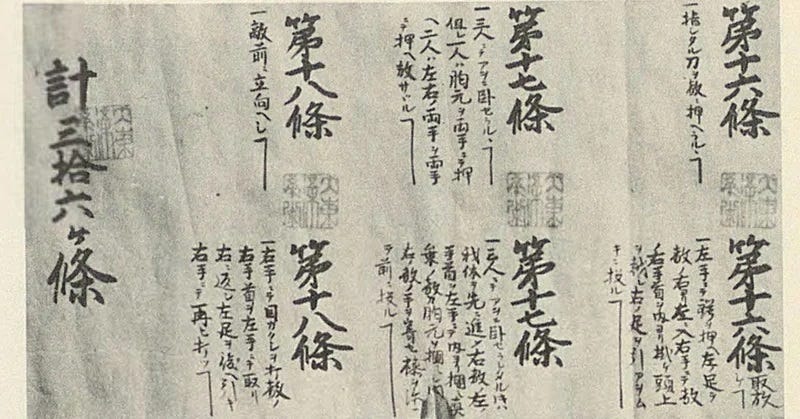
By the way, there is a book titled “Imperial Martial Arts Eimeiroku” (1888) edited by Arai Tomosada. It is like an “encyclopedia of martial arts masters”, introducing famous martial artists with illustrations.

“Imperial Martial Arts Eimeiroku”
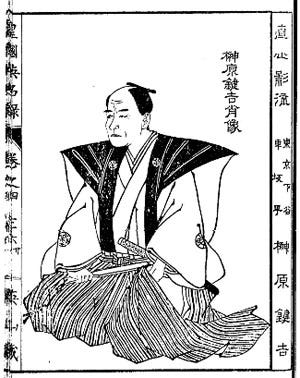
Sakakibara Kenkichi of Jikishin Kage-ryū Swordsmanship
Takeda Sōkaku’s Eimeiroku, which began to be written in 1899, may have been named after this “Martial Arts Eimeiroku.”
It is generally said that Takeda was illiterate, but there is a testimony that he read newspapers etc., so he may have had no problem reading. If so, he may have read the “Martial Arts Eimeiroku” and liked the term Eimeiroku so much that he adopted it.
References: Quarterly “Aiki News” № 129 (Summer 2001 issue), Dō Shuppan, 2001.
Thank you for reading my story. If you would like, please follow me.
메타데이터
- post_id
- 62bd4bc73ec9
- slug
- takeda-sōkakus-eimeiroku-62bd4bc73ec9
- url
- https://medium.com/motobu-ryu-blog/takeda-s%C5%8Dkakus-eimeiroku-62bd4bc73ec9
- canonical_url
- https://medium.com/motobu-ryu-blog/takeda-s%C5%8Dkakus-eimeiroku-62bd4bc73ec9
- author_url
- https://medium.com/@motobu715
- status
- ok
- fetched_at
- 2026-06-23 06:34:20