Hidden Fees in International Transfers:
The Complete Breakdown for Indian Families and MSMEs
Hidden Fees in International Transfers:
The Complete Breakdown for Indian Families and MSMEs
Imagine this: Priya is 22, from Hyderabad, and has just received an offer from a university in the United States. Her parents are thrilled. After months of planning, her father walks into their bank and hands over ₹10,00,000 to cover the first semester’s tuition and accommodation deposit. The teller quotes a transfer fee of ₹500. He signs, feeling relieved that international transfers are “not so expensive after all.”
Three days later, Priya emails from the US. The university’s finance office says the payment arrived short by the equivalent of roughly ₹30,000. The accommodation deposit has also fallen short of the required amount. Her father is confused and frustrated. He paid the fee. What went wrong?
The answer is almost never the transfer fee itself. The real cost — the one banks rarely explain clearly — is buried inside the exchange rate they apply. Layered on top of that are SWIFT intermediary charges and receiving bank deductions that silently reduce what arrives. This invisible cost affects thousands of Indian families, students, freelancers, and small business owners every single day.
This guide breaks down every layer of cost in an international money transfer, explains what the “hidden fee” really is, and shows you how to avoid overpaying — without needing a finance degree to figure it out.
Why International Transfers Cost More Than You Think
Most people focus on one number when sending money abroad: the transfer fee. It is the figure printed on the receipt and the one advertised on bank posters. But it is rarely the largest cost of the transaction.
A typical international transfer has four distinct layers of charges:
• Transfer fee — The flat fee or percentage charged by your bank to initiate the transfer. This is the cost that is visible and widely advertised, yet usually the smallest component.
• FX markup — The difference between the real mid-market exchange rate (the one Google shows you) and the rate your bank actually applies. This spread is where banks quietly earn significant revenue.
• SWIFT / correspondent bank charges — Most international transfers pass through one or more intermediary banks before reaching the destination. Each bank in this chain can deduct a fee — typically between USD 15 and USD 50 — before passing the funds along. These charges are rarely disclosed upfront.
• Receiving bank deductions — The bank at the destination may also charge a fee to accept the incoming transfer, further reducing what the recipient actually receives.
The result is that what you send and what arrives are rarely the same number. And the gap can be surprisingly wide, especially for larger transactions like tuition payments.
The Biggest Hidden Cost: FX Markups
The mid-market rate — also called the interbank rate — is the real, live exchange rate between two currencies at any given moment. It is the rate banks use when trading with each other. You can look it up on Google, XE.com, or Reuters at any time.
When you send money internationally, your bank does not give you this rate. They give you a slightly worse rate — one adjusted in their favour. The gap between the real rate and the rate you receive is called the FX spread or FX markup.
Traditional Indian banks commonly apply FX markups of 1.5% to 3% above the mid-market rate. Customers are almost never told the markup percentage directly. The number is simply embedded in the rate offered at the counter.
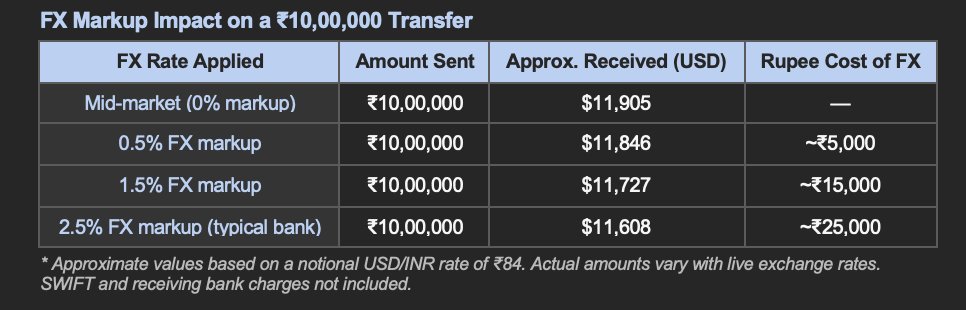
Real-World Example: Priya’s Semester Payment from Hyderabad
Let’s trace what actually happens when Priya’s father sends ₹10,00,000 through a traditional Indian bank to cover tuition and accommodation at a US university.

Hidden Fees Students and Families Frequently Encounter
For the hundreds of thousands of Indian students studying abroad each year, cross-border payments are a recurring necessity. Each transfer carries its own exposure to hidden charges:
• Tuition fee payments are typically the largest and most frequent transfers. Even a modest FX markup on a payment of ₹10 lakh or more translates to tens of thousands of rupees in avoidable cost.
• Accommodation deposits for university housing or private rentals are often due before the academic term begins, leaving families little time to compare providers.
• Visa-related transfers for application fees and consular payments are time-sensitive, which often means higher effective costs due to urgency.
• Emergency family transfers for medical expenses or flight changes are sent under stress and at short notice — among the costliest transfers on a per-rupee basis.
In each scenario, the problem is not a lack of options. It is a lack of visibility into the total cost before confirming the transfer.
Hidden Fees MSMEs Face Every Day
For Indian MSMEs engaged in import and export, international transfers are operational necessities. The cumulative cost of FX leakage at scale is a genuine business problem:
• Supplier payments: Even a 1.5–2.5% FX markup across multiple transactions per month represents a meaningful reduction in margin — costs rarely factored into pricing models.
• Import transactions: The combination of transfer fees, FX spread, and correspondent bank charges can collectively amount to 2–3.5% of total transaction value.
• Export settlements: When an overseas buyer pays an Indian MSME, the rupee equivalent received depends entirely on the exchange rate applied by the receiving bank. A poor rate directly compresses the payment received.
• Cross-border invoicing: MSMEs invoicing in USD, EUR, or GBP face an additional layer of uncertainty — the final rupee value varies not just with market movements, but with the bank’s internal rate on settlement day.
An MSME making 10–15 international payments per month can lose several lakh rupees annually to these charges — costs that never appear as a line item in the P&L but quietly erode working capital.
A Simple Checklist to Spot Hidden Charges Before Sending Money
These steps take only a few minutes and can save meaningful amounts:
• Check the mid-market rate first. Before initiating any transfer, look up the real USD/INR or EUR/INR rate on Google or XE.com. This gives you a benchmark.
• Ask for the exchange rate in writing. Ask your bank: “What exchange rate will you apply to this transfer?” Compare it to the mid-market rate.
• Calculate the FX spread. Subtract the rate offered from the mid-market rate, divide by the mid-market rate, and multiply by 100. Anything above 0.5–1% is worth questioning.
• Ask about SWIFT and correspondent bank fees. Request information on whether intermediate banks will deduct charges. Some providers absorb these; others pass them to the recipient.
• Compare total cost, not the headline fee. The only number that matters is: how much does the recipient receive, net of all charges? Providers who show this upfront operate transparently.
• Verify what the recipient actually received. The difference between what you sent and what arrived is your true total cost.
What Transparent International Payments Should Look Like
The international payments industry has historically been designed around opacity. Modern payment infrastructure is beginning to change this. A genuinely transparent cross-border payment experience includes:
• Clear, upfront pricing: The total cost — including transfer fee and FX spread — is shown before you confirm, not after.
• Real exchange rate visibility: The platform shows you the mid-market rate and explains exactly what markup is being applied. No surprises at checkout.
• Faster settlement: Slow transfers expose both parties to FX rate fluctuations over multiple days. Faster settlement reduces this risk, particularly for time-sensitive business payments.
• Mobile-first access: International payments should not require a branch visit or hours of paperwork.
• End-to-end tracking: The sender should be able to follow the payment from initiation to final credit with real-time status updates.
Platforms like NIVIXPE are built around this principle. Rather than hiding costs inside exchange rate spreads, NIVIXPE’s infrastructure is designed to give users FX visibility from the outset — so students, parents, freelancers, and MSMEs can make informed decisions about every transfer.
Key Takeaways
The advertised transfer fee is almost never the biggest cost in an international payment. The FX markup — embedded in the exchange rate — typically costs significantly more.
• A 2.5% FX markup on a ₹10,00,000 transfer quietly removes approximately ₹25,000 from the transaction, before SWIFT fees are even added.
• SWIFT intermediary charges and receiving bank deductions add a further ₹3,000–₹7,000 in costs that are often invisible until after the transfer is complete.
• For a Hyderabad family sending ₹10 lakh for a daughter’s US university fees, total deductions can easily reach ₹28,000–₹32,000 — a meaningful shortfall against tuition and accommodation requirements.
• Indian students, parents, MSMEs, and freelancers are among the most exposed to these hidden charges, due to the frequency and scale of their cross-border payments.
• Before sending any international payment, compare the rate offered against the mid-market rate, ask about all fees, and calculate the total cost — not just the headline transfer fee.
• Transparent payment platforms provide upfront FX visibility, faster settlement, and mobile-first access — removing the guesswork from every remittance.
Final Thoughts
The hidden fee problem in international transfers is not a minor inconvenience. For a family paying university tuition twice a year, or an MSME settling supplier invoices every week, these costs accumulate into a meaningful financial drain — one that is entirely avoidable with better information.
The first step is awareness. Now that you know to look beyond the transfer fee and examine the full cost of the exchange rate, you are already ahead of most people sending money internationally.
The next step is comparison. Before your next transfer, check the mid-market rate, ask your provider for the rate they will apply, and calculate the real cost. You may be surprised by what you find — and what you can save.
Before your next transfer — compare the full cost, not just the fee.
Use the mid-market rate as your benchmark and ask every provider what markup they apply. Platforms like NIVIXPE are building toward a future where that question is answered clearly, upfront, and without needing to ask — because transparent pricing should be the standard, not the exception.
If this article helped you understand the true cost of sending money internationally, share it with someone who sends or receives cross-border payments. The more people ask the right questions, the faster the industry will move toward genuine transparency.
About NIVIXPE
NIVIXPE is a modern cross-border payments platform focused on transparent pricing, real-time FX visibility, and faster settlement for Indian students, families, freelancers, and MSMEs. Built on blockchain-powered infrastructure, NIVIXPE is designed to make international payments simpler, faster, and more predictable.
Note: NivixPe is in BETA Phase.

메타데이터
- post_id
- 62c04cbd46bb
- slug
- hidden-fees-in-international-transfers-62c04cbd46bb
- url
- https://medium.com/@sahi0046/hidden-fees-in-international-transfers-62c04cbd46bb
- canonical_url
- https://medium.com/@sahi0046/hidden-fees-in-international-transfers-62c04cbd46bb
- author_url
- https://medium.com/@sahi0046
- status
- ok
- fetched_at
- 2026-06-15 20:49:13




