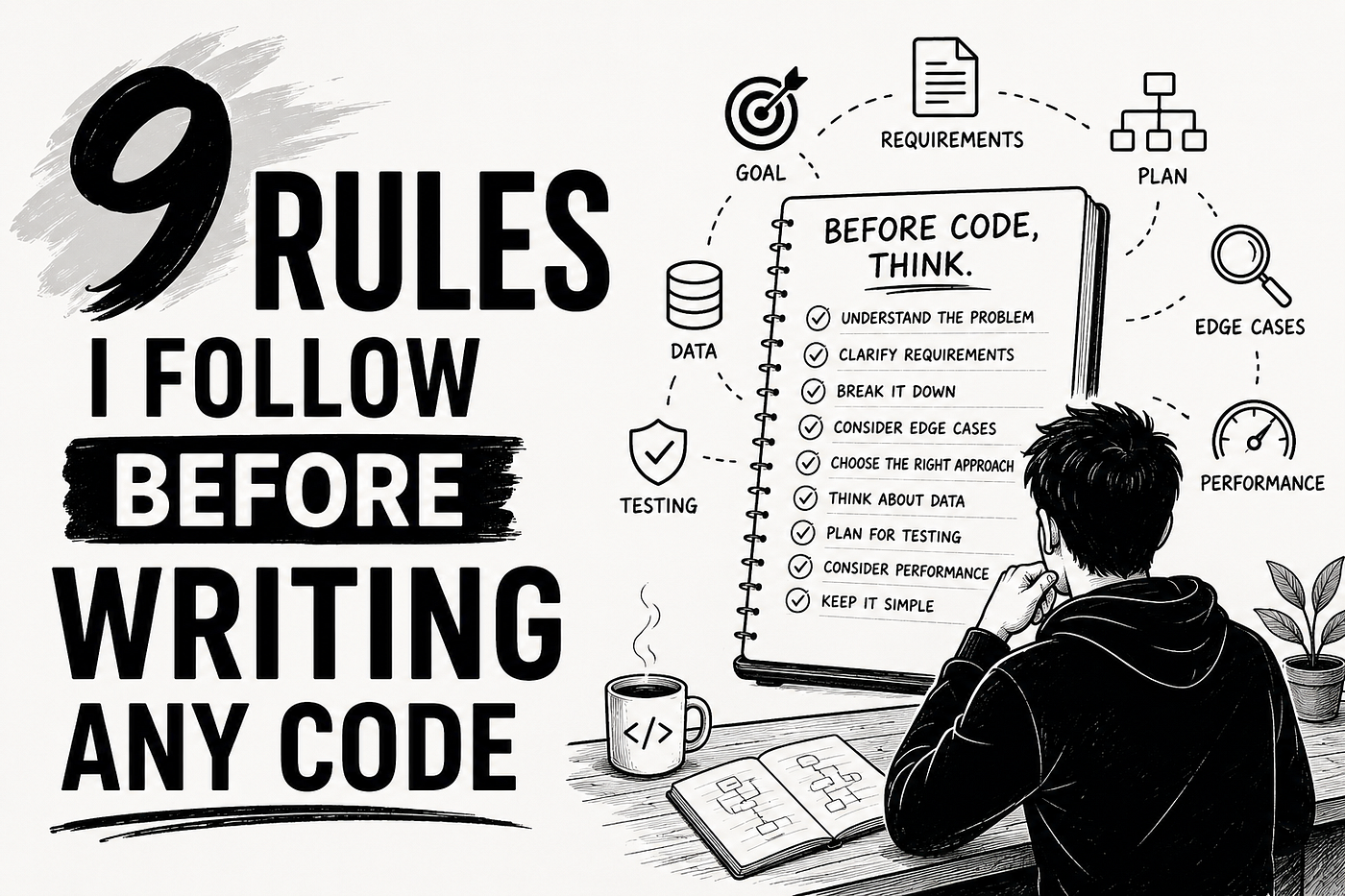
My Biggest Productivity Mistake as a Developer
I thought productivity meant starting faster and writing more code. It actually meant reducing rework, unclear decisions, and unnecessary…
My Biggest Productivity Mistake as a Developer
I thought productivity meant starting faster and writing more code. It actually meant reducing rework, unclear decisions, and unnecessary complexity.

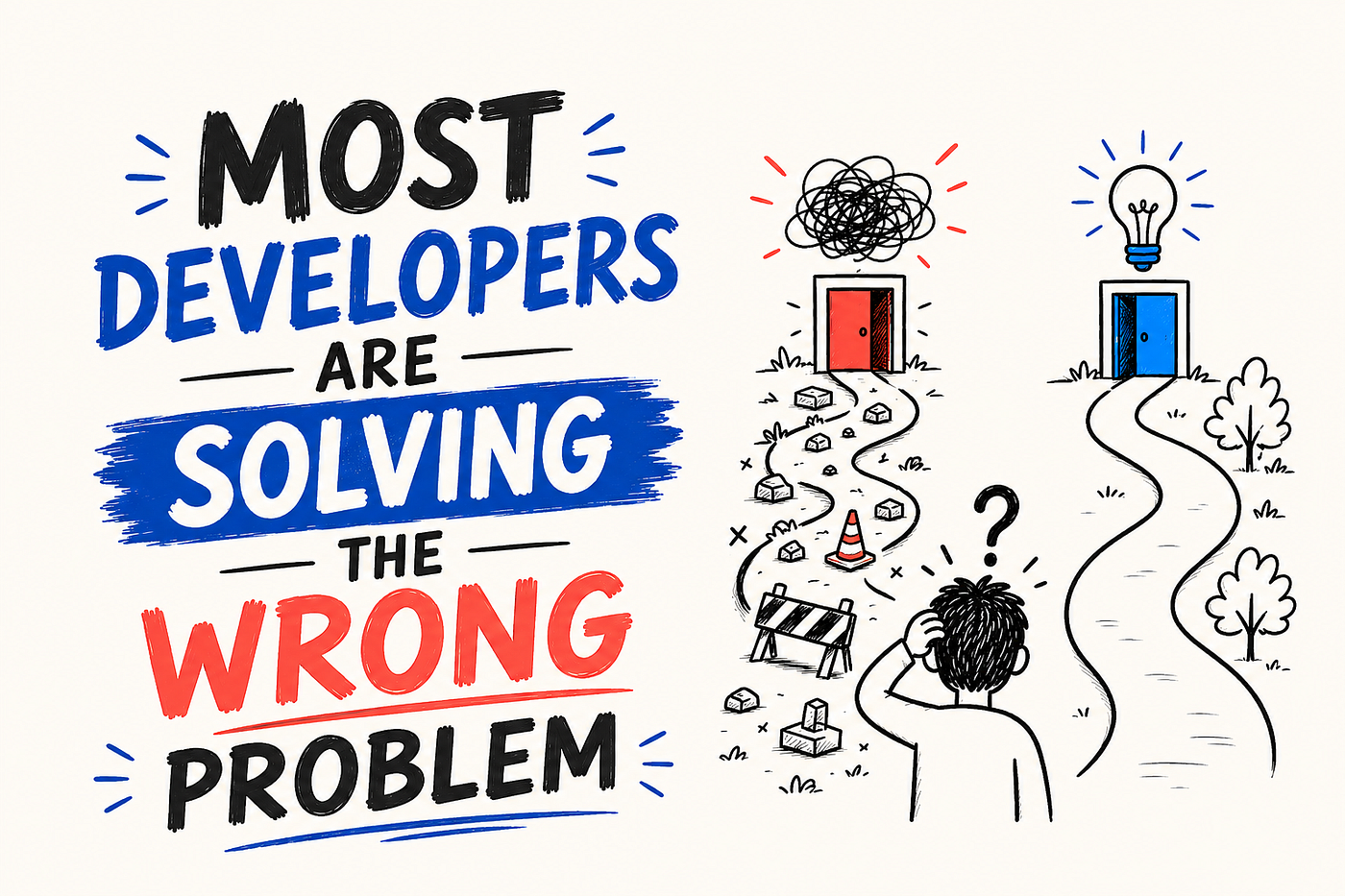
My biggest productivity mistake was starting too quickly.
I thought opening the editor immediately meant I was making progress.
Most of the time, I was only creating code I would have to rewrite once I understood the problem properly.
The pattern was easy to miss because it looked productive from the outside. A task arrived, files changed, commits appeared, and the pull request grew. There was visible movement.
Then the requirement became clearer.
The abstraction did not fit. An important edge case changed the data model. Another team interpreted the expected behavior differently. A supposedly small feature touched permissions, reporting, and an older workflow nobody had mentioned.
The first implementation was not completely wrong. It was built around an incomplete version of the problem.
That distinction matters because many developers do not lose time by working too slowly. They lose time by moving quickly in a direction that was never properly examined.
A fast start can create a very slow finish.
The most productive engineers are not always the first people to begin typing. They are often the ones who reduce uncertainty before it becomes code, dependencies, tests, review comments, and future maintenance.
Starting Immediately Felt Like Progress
Software development rewards visible activity.
A new branch feels like momentum. A growing diff feels like evidence. An early pull request creates the reassuring sense that the task is already under control.
Clarifying questions do not produce the same feeling.
Reading existing code, tracing a workflow, checking production data, or asking why a requirement exists can feel like delay. Nothing has been built yet. There is no screenshot to share and no commit to point at.
That makes implementation emotionally attractive, even when the problem is still unclear.
The failure usually begins with a task that sounds specific enough:
“Add an approval status.”
“Create a reusable table.”
“Fix the user session issue.”
“Support multiple addresses.”
Each sentence appears to describe a coding task. In reality, each one contains unanswered product and system questions.
Who can approve the record? Can approval be reversed? Does the new status replace an existing state or sit beside it? Which screens depend on the current behavior? What happens to historical records? Is the session issue caused by expiration, cookie configuration, stale cache, or inconsistent authentication state?
Starting before answering these questions does not remove uncertainty. It converts uncertainty into implementation decisions.
Those decisions become harder to challenge once code exists. The team starts discussing how to modify the chosen design instead of asking whether the design should exist at all.
This is why visible activity can create false confidence.
The developer appears productive because the task is moving. In reality, the cost is only being deferred. It will reappear during review, testing, integration, or production, when changing direction is more expensive.
I became more effective when I stopped treating hesitation as failure.
Sometimes the most productive first move is not creating a file. It is finding the assumption most likely to invalidate the entire approach.
I Was Solving My Assumptions, Not the Requirement
Unclear tasks do not remain empty.
Developers fill the gaps.
When a requirement says, “Show inactive employees,” one developer may interpret inactive as terminated. Another may include employees on leave. The database may contain a status field, an end date, a soft-delete column, and a separate job assignment state, all representing different versions of inactivity.
The code can be clean and still answer the wrong question.
This is one of the most expensive forms of rework because the implementation often looks reasonable. It compiles. The tests pass because they were written around the same assumption. The interface behaves consistently.
Only later does someone say, “That is not what inactive means here.”
The problem was never syntax or technical ability. The wrong meaning became embedded in the system.
This happens frequently at boundaries between teams. Product uses one term, operations uses another, and the database reflects several years of historical decisions. A developer picks the most obvious field and begins implementing without discovering that each group is talking about a different concept.
The resulting pull request grows as those differences appear.
A simple filter needs exceptions. The API response changes. Existing reports no longer match. Another endpoint uses a different definition. Tests become filled with special cases because the underlying meaning was never agreed upon.
The productive move would have been to make the ambiguity visible before choosing a solution.
What exact records should appear? Which field is authoritative? Are historical records included? Does the same definition already exist elsewhere? What should happen when the relevant data is missing or contradictory?
These questions are not administrative overhead. They define the work.
I used to think good developers were able to infer what a task meant and keep moving. Experience taught me that inference is dangerous when a decision affects business behavior, data ownership, security, or system boundaries.
Strong engineers do not avoid assumptions entirely. That would be impossible.
They identify which assumptions are expensive to get wrong, then verify those first.
More Code Created More Decisions
A misunderstood requirement rarely creates only one wrong function.
It creates structure.
Once implementation begins, the developer chooses names, interfaces, database fields, abstractions, dependencies, validation rules, and test boundaries. Each choice creates another decision that must remain internally consistent.
This is why unnecessary code becomes expensive so quickly.
Suppose a team receives a request to support a second notification channel. Before confirming whether both channels need identical behavior, a developer creates a generic notification framework with providers, factories, configuration objects, retry policies, and a shared message model.
The architecture looks flexible.
Then the actual requirement becomes clear. The second channel is only needed for one operational alert, it uses different content, and failures should not be retried because duplicate delivery is worse than missed delivery.
The abstraction is now fighting the requirement.
At this point, deleting it feels wasteful because the team has already invested time. Instead, more options are added. The provider accepts flags. The shared model gains nullable fields. Retry behavior becomes configurable per caller.
The codebase becomes more sophisticated while the original problem remains small.
Every additional layer creates questions:
Where should this rule live?
Which option is correct for this caller?
Can this provider be used synchronously?
Who owns retry behavior?
What happens when two configurations conflict?
Code does not only solve decisions. It creates them.
That is why writing more code can reduce productivity even when the code is technically sound. A larger solution increases the surface that must be reviewed, understood, tested, deployed, monitored, and changed.
The better question is not, “How can I design the most reusable solution?”
It is, “What is the smallest structure justified by the behavior we actually understand?”
Sometimes that means accepting temporary duplication. Sometimes it means adding one explicit branch rather than a generalized strategy system. Sometimes it means delaying a shared abstraction until the second and third use cases reveal the real pattern.
Productive engineering is not the avoidance of design.
It is refusing to create more design decisions than the problem requires.
I Confused Debugging With Random Movement
Rushing did not only affect implementation. It also affected how I debugged.
When something failed, activity became a substitute for evidence.
I added logs to several layers. I changed a condition that looked suspicious. I restarted the service, cleared the cache, modified the query, and tried again. Each action felt useful because the system was changing.
But changing the system before narrowing the cause destroys information.
Consider an API that sometimes returns an empty result for valid users. The problem could exist in the database query, permission filtering, cached authorization data, request parsing, environment configuration, or client-side state.
Changing several of those areas at once may make the symptom disappear. It does not prove which assumption was wrong.
This creates fragile fixes.
A developer adjusts the query and adds a frontend retry. The issue appears resolved, but the retry now hides intermittent authorization failures. Weeks later, another screen exposes the same defect because the actual cause was never identified.
The team completed work without gaining understanding.
Good debugging is less dramatic. It is a process of elimination.
Can the failure be reproduced with one user and one request? Is the correct record present in the database? Does the query return it directly? At which boundary does the expected value disappear? Is the behavior different across environments? What is the smallest observation that can rule out an entire layer?
Each answer reduces the search space.
The productive debugger does not ask, “What can I change?”
They ask, “What can I prove?”
That change in mindset matters because debugging time grows with uncertainty. Random edits increase the number of possible explanations. Controlled experiments reduce them.
A useful fix should leave the team with a clear causal statement:
The request failed because the authorization cache was not invalidated after a role update.
The pagination skipped records because the ordering column was not deterministic.
The session disappeared because the cookie configuration differed between environments.
That explanation is part of the solution.
Without it, the team has only changed the behavior and hoped the problem is gone.
Large Tasks Made Avoidance Easier
Not every productivity problem looked like rushing.
Sometimes it looked like procrastination.
A task would remain untouched because it felt large, vague, and difficult to enter. The requirement might be only a few paragraphs, but it implied several systems, unclear ownership, and unknown edge cases.
I would delay starting because “implement the new reporting workflow” was not an actionable step.
Then, once the delay became uncomfortable, I would compensate by starting too aggressively. Files were created before the work had been broken down. Architecture became a way to feel control over a task that was still poorly understood.
This created a cycle:
The task felt vague.
Vagueness created avoidance.
Avoidance created time pressure.
Time pressure encouraged premature implementation.
Premature implementation created rework.
The productivity issue was not a lack of discipline. The next useful action was unclear.
Large tasks become manageable when converted into questions and observable outcomes.
Instead of “build the reporting workflow,” the first step might be to identify the source of truth for report data. Then verify whether historical records must be reproducible. Then map which roles can generate, view, and export reports. Then confirm the expected behavior when data changes after generation.
None of these steps requires a complete architecture.
They reduce uncertainty one boundary at a time.
This is also useful when a task genuinely needs substantial implementation. A migration, authentication redesign, or major workflow change cannot always be reduced to a tiny patch. But it can still be divided into independently understandable decisions.
What must remain backward compatible?
Which data transition is irreversible?
What can be released behind a feature flag?
Which failure can be detected automatically?
What is the smallest end-to-end path that proves the design?
Clear next actions reduce both avoidance and reckless starts.
Productivity improves when the task stops being one large emotional object and becomes a sequence of decisions that can be tested.
Better Questions Removed More Work Than Better Tools
Developers are surrounded by productivity tools.
Faster editors, AI assistants, code generators, command-line utilities, snippets, templates, and automation can remove friction. They are useful.
But they accelerate whatever direction has already been chosen.
A code generator can create the wrong structure faster. An AI assistant can produce a polished implementation for an unclear requirement. A new framework can reduce boilerplate while introducing a boundary the team does not need.
Tools improve execution speed.
Questions improve decision quality.
The questions that saved me the most time were usually simple:
What problem is the user actually experiencing?
What behavior must not change?
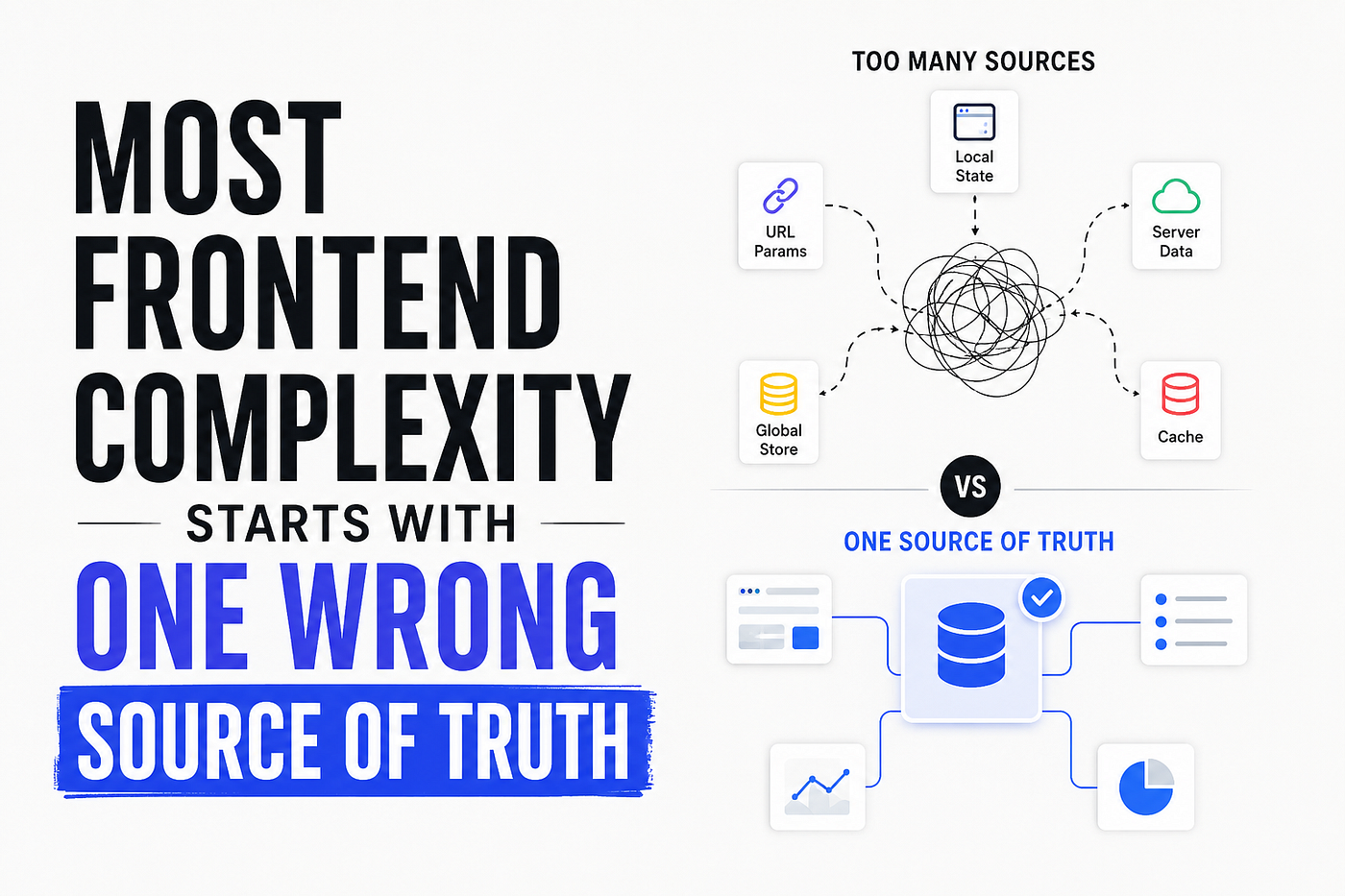
Where does the source of truth live?
Who owns this decision?
What evidence would prove the issue is fixed?
What is the smallest safe change?
What happens if we do nothing?
That last question is especially valuable.
Some tasks exist because a temporary inconvenience has been described as a permanent software requirement. A manual process may occur twice a year and take ten minutes. Automating it could require weeks of implementation and create long-term ownership.
The correct engineering decision may be to leave it manual.
Similarly, a requested configuration option may only compensate for inconsistent business rules. A new API endpoint may duplicate data already available elsewhere. A frontend workaround may hide a backend contract that should be corrected instead.
Better questions expose these possibilities.
They also improve collaboration. When a developer explains the unresolved decisions before implementation, product and engineering can disagree cheaply. Once those decisions are embedded in a large pull request, the same disagreement becomes personal, technical, and expensive.
The most productive conversations happen before the team becomes attached to a solution.
This does not mean every task needs a meeting or a long design document. Small changes should remain small. The amount of clarification should match the cost of being wrong.
The principle is simple:
Do not optimize the implementation before confirming that the implementation is necessary.
Real Productivity Became Producing Less Waste
I used to measure productivity through output.
How quickly did I begin?
How much code did I write?
How many tickets moved?
How many hours did I remain busy?
Those measurements were visible, but they ignored the work created by my decisions.
A rushed feature that required two rewrites still looked like a completed ticket. A broad abstraction that slowed future changes still looked like clean architecture. A bug fixed without understanding the cause still looked resolved.
The waste appeared later, often in someone else’s task.
Real productivity became easier to recognize when I started looking at the entire path from request to reliable outcome.
How much uncertainty was removed before implementation?
How many assumptions were verified?
How small was the debugging surface?
How easy was the change to review?
How much future behavior did the solution accidentally create?
Could the next developer understand where to modify it?
This does not mean productive developers spend all day analyzing and never building. Overthinking can waste as much time as rushing. Some uncertainty only becomes visible through implementation, and small experiments are often the fastest way to learn.
The difference is intention.
A quick prototype used to test an assumption is productive. A large implementation built while pretending the assumption is already true is not.
A small explicit solution may be productive even when it contains some duplication. A flexible abstraction may be productive when several stable use cases genuinely share ownership and behavior.
The goal is not writing the least code possible.
The goal is creating the least unnecessary work while reaching the correct result.
That shift changed how I understood developer productivity. It was no longer about appearing active or moving fastest in the editor. It was about reducing rework, narrowing uncertainty, and leaving the system easier to change than I found it.
The mistake was not that I worked too slowly.
It was that I kept creating work that a few better questions could have removed.
What part of your development process creates the most unnecessary rework?
메타데이터
- post_id
- 62fade0009aa
- slug
- my-biggest-productivity-mistake-as-a-developer-62fade0009aa
- url
- https://medium.com/skillstuff/my-biggest-productivity-mistake-as-a-developer-62fade0009aa
- canonical_url
- https://medium.com/skillstuff/my-biggest-productivity-mistake-as-a-developer-62fade0009aa
- author_url
- https://medium.com/@masaood
- status
- ok
- fetched_at
- 2026-07-17 22:01:38