How Do Concrete Vaults Actually Work?
You deposit into a vault. You receive shares. Your value grows.
How Do Concrete Vaults Actually Work?
You deposit into a vault. You receive shares. Your value grows.
It feels simple because it is designed that way. But behind that simplicity, Concrete vaults are running a structured system that manages capital continuously.
Let’s break it down in the clearest way possible.
A Familiar Starting Point
You open a vault, deposit your asset, and instantly receive vault shares.
Now your dashboard shows:
- your shares
- eRate
- NAV
At this point, many users wonder:
Where is my yield? Why did I get shares instead of rewards?
The answer is simple:
Your growth is built into the system, not paid out separately.
Think of the Vault as a Fund
A helpful way to understand DeFi vaults is to compare them to a fund.
- The vault = the fund
- Users = investors
- Vault shares = fund units
When you deposit, you are buying into the system.
You are not earning yield manually. You are owning a portion of a system that generates yield for you.
Vault Shares: Your Position
Your vault shares represent your position in the vault.
If the vault holds 1,000 units of value and you own 10 percent of shares, you effectively own 10 percent of everything inside.
That percentage stays constant unless you deposit or withdraw.
What changes is the value of the vault itself.
eRate: How Growth Is Measured
eRate is the easiest way to track growth.
It shows how much one share is worth.
At the start:
- 1 share = 1 unit
After yield is generated:
- 1 share = more than 1 unit
You still hold the same number of shares. But each one becomes more valuable.
That is how automated compounding works in practice.
NAV: The Big Picture Number
NAV (Net Asset Value) represents the total value of the vault.
Think of it as the size of the system.
- NAV increases when strategies generate yield
- NAV decreases if losses occur
Your share value is directly tied to NAV.
When NAV grows:
- eRate increases
- your position grows
NAV is the single number that reflects everything happening inside the vault.
Why Time Is Essential
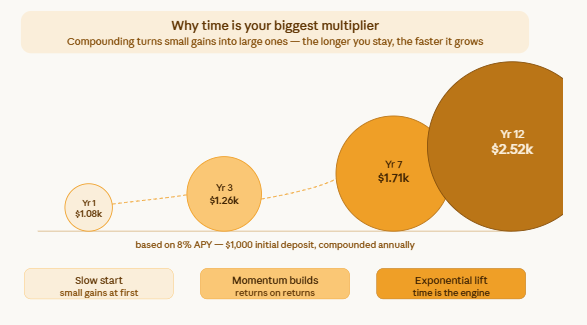
One of the most important things to understand is that vaults reward time, not timing.
Short-term actions do not capture the full value of the system.
Here is why:
- strategies need time to perform
- capital allocation evolves gradually
- compounding builds momentum
- costs like gas are spread over time
A simple analogy is a flywheel.
At first, it moves slowly. With time, it builds speed and becomes powerful.
The same is true for vaults.
The longer you stay, the more the system works in your favor.
Active Management Behind the Scenes
Concrete vaults are not static.
They are actively managed systems.
Your capital is continuously:
- allocated across strategies
- rebalanced as markets shift
- optimized for efficiency
Think of it like a control system.
You set the input by depositing. The system continuously adjusts to produce the best output.
This is what makes onchain capital deployment scalable.
Where the Yield Comes From
Yield is generated through multiple coordinated activities, such as:
- lending assets
- providing liquidity
- accessing restaking opportunities
- capturing incentives when efficient
But the real advantage is not just access.
It is how these are combined and managed.
Concrete vaults aim to:
- reduce idle capital
- maintain continuous exposure
- compound returns automatically
- adapt to changing conditions
This leads to more efficient outcomes than manual strategies.
Connecting Everything Together
Here is the full flow in simple terms:
- you deposit into the vault
- you receive vault shares
- the vault deploys your capital
- strategies generate yield
- NAV increases
- eRate increases
- your balance grows
No manual claiming. No constant repositioning.
Just a system working continuously.
The Simplest Mental Model
If you want to remember it easily:
- Vault = a capital system
- Vault shares = your ownership
- NAV = total system value
- eRate = value of ownership
- Time = growth multiplier
- Management = optimization layer
That is all you need to understand how Concrete vaults work.
The Bigger Shift in DeFi
DeFi is moving away from manual strategy management.
Instead of constantly making decisions, users can rely on systems that manage capital efficiently.
That is the role of vault infrastructure.
From manual actions → to automated systems From fragmented positions → to unified capital From effort → to efficiency
That is what managed DeFi looks like.
Explore Concrete at **app.concrete.xyz**
메타데이터
- post_id
- 6324e67cee7c
- slug
- how-do-concrete-vaults-actually-work-6324e67cee7c
- url
- https://medium.com/@alamin81549/how-do-concrete-vaults-actually-work-6324e67cee7c
- canonical_url
- https://medium.com/@alamin81549/how-do-concrete-vaults-actually-work-6324e67cee7c
- author_url
- https://medium.com/@alamin81549
- status
- ok
- fetched_at
- 2026-06-17 08:20:12